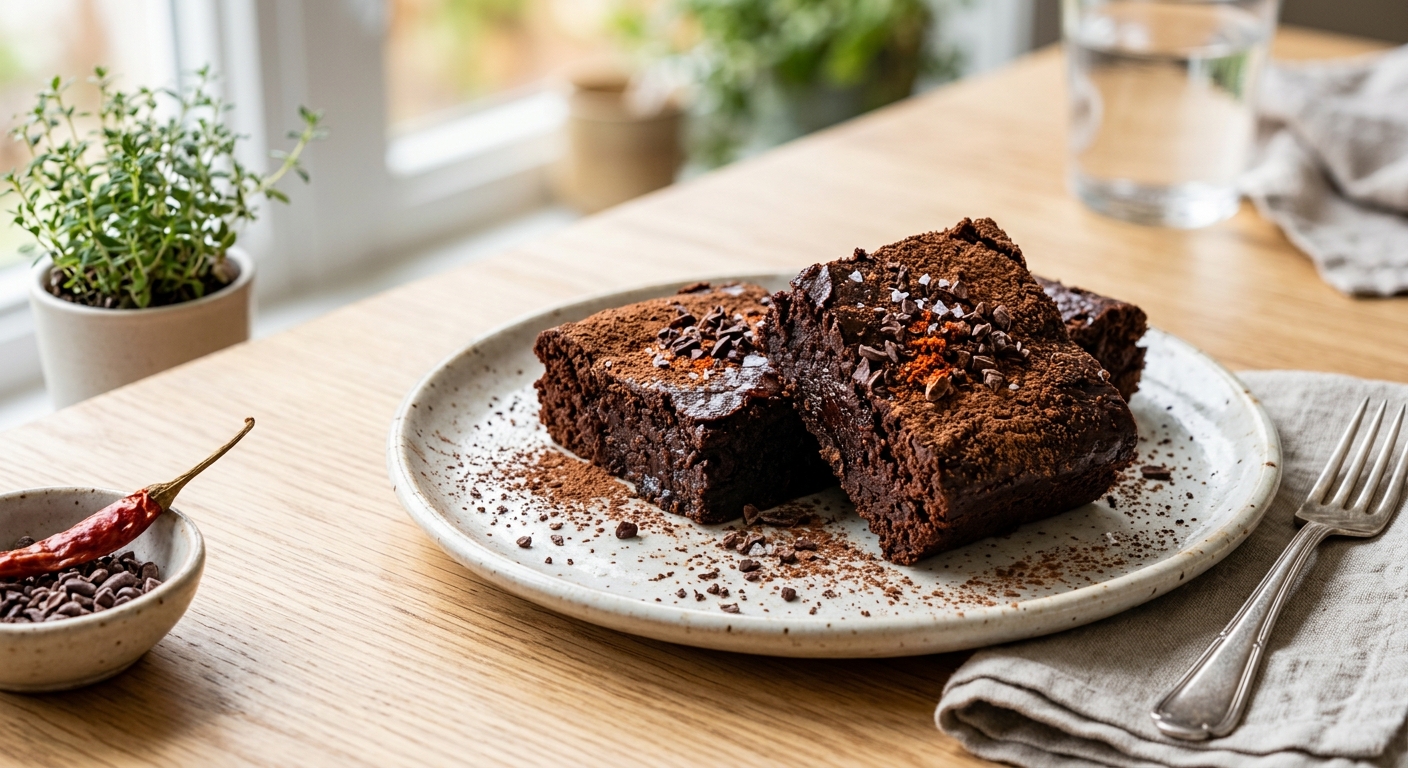
If you have ever been told you cannot have your brownie and eat it too, these Cayenne Chocolate Black Bean Brownies are here to prove that narrative spectacularly wrong. Built on a foundation of whole black beans rather than refined flour, each square is a dense, glossy, legitimately fudgy brownie that happens to deliver meaningful amounts of iron, folate, magnesium, and zinc. The cayenne is not a gimmick: capsaicin, the active compound in hot peppers, has been shown in multiple peer-reviewed studies to transiently elevate thermogenesis and fat oxidation, making this dessert a genuine ally in metabolic health when enjoyed as part of a balanced diet.
The black bean base is the real nutritional star. A single cup of cooked black beans contributes approximately 15 grams of fiber, 15 grams of protein, and 3.6 mg of iron, and here they replace all-purpose flour entirely, keeping the glycemic load low while adding a silky, brownie-shop texture that no one at your table will ever suspect. Cacao powder doubles down on the antioxidant story: raw cacao is one of the most concentrated dietary sources of flavanols, the polyphenolic compounds linked to improved endothelial function, reduced LDL oxidation, and better insulin sensitivity. Paired with a small hit of coconut sugar and real vanilla, the flavor profile is complex, slightly smoky, and unmistakably chocolate.
At Calibrated Cuisine we calculate every nutrient to the gram, so you can trust that the figures on this page reflect the actual ingredient quantities listed, not a best-case rounding exercise. Whether you bake these in the oven for a classic crackled top, steam them in the slow cooker for maximum moisture, or pressure-cook them in ramekins for individual lava-style portions, the metabolic math stays the same. Read on for all four methods, the antioxidant breakdown, and a pairing suggestion to round out your day.
9
servings
Ingredients
- 425 gcanned black beans, drained and rinsed (1 standard 15 oz can)
- 60 graw cacao powder (or unsweetened cocoa powder), sifted
- 120 gcoconut sugar
- 60 mlextra-virgin coconut oil, melted and cooled
- 3 largeeggs, room temperature
- 2 tsppure vanilla extract
- 1 tspbaking powder
- 0.75 tspcayenne pepper (reduce to 0.5 tsp for mild heat)
- 0.5 tspColima Sea SaltMicroplastic Free Salt
- 0.5 tspground cinnamon
- 80 gdark chocolate chips (70% cacao or higher), divided
- 1 tbspstrong brewed espresso or cold coffee (enhances chocolate depth)
- —Colima Sea SaltMicroplastic Free Salt and a pinch of cayenne, for finishing
- —Cooking spray or coconut oil, for greasing pan or ramekins
Instructions
Click on an item below to shop for the recommended items for this recipe on Amazon.
As an Amazon Associate, we earn from qualifying purchases.
- Preheat your oven to 175°C (350°F). Grease an 20 x 20 cm (8 x 8 inch) square baking pan with coconut oil or cooking spray and line with a parchment paper sling that overhangs two sides for easy lifting.
- Melt 60 g of the dark chocolate chips in a microwave-safe bowl in 20-second bursts, stirring between each, until completely smooth. Set aside to cool for 5 minutes. Reserve the remaining 20 g of chips for folding in later.
- Combine the drained black beans, melted coconut oil, eggs, vanilla extract, and espresso in a high-powered blender or food processor. Blend on high for 60 to 90 seconds, scraping down the sides once, until the mixture is completely smooth with no visible bean pieces. This silky puree is your batter base.
- Add the sifted cacao powder, coconut sugar, baking powder, cayenne, sea salt, and cinnamon to the blender. Pulse 8 to 10 times, then blend on medium for 20 seconds until fully incorporated. Pour in the melted chocolate and pulse 4 to 5 more times to combine without overmixing.
- Pour the batter into the prepared pan. Scatter the reserved 20 g of chocolate chips evenly across the surface, pressing them in very lightly with a spatula. Finish with a pinch of flaky sea salt and a very light dusting of cayenne for visual impact.
- Bake on the center rack for 25 to 28 minutes, rotating the pan at the 15-minute mark. The brownies are done when the edges pull slightly from the pan and the center no longer jiggles when gently shaken. A toothpick inserted 2.5 cm from the center should come out with moist, fudgy crumbs (not wet batter).
- Transfer the pan to a wire rack and cool completely, at least 30 minutes, before lifting out using the parchment sling and slicing into a 3 x 3 grid for 9 portions. The texture improves dramatically after full cooling, as the bean-based batter continues to firm as it sets.
- Set up your steamer: place a steamer basket or an inverted heatproof bowl inside a large pot with a lid. Add enough water to reach just below the basket level (about 4 cm deep) and bring to a rolling boil over medium-high heat. Reduce to a steady medium simmer before introducing the batter.
- Melt 60 g of the chocolate chips using a double boiler: set a heatproof bowl over a small saucepan of barely simmering water, making sure the bowl does not touch the water. Stir the chips gently until just melted. Remove from heat and cool for 5 minutes.
- Blend the black beans, melted coconut oil, eggs, vanilla, and espresso in a blender or food processor on high for 90 seconds until completely smooth. Add the cacao powder, coconut sugar, baking powder, cayenne, salt, and cinnamon. Blend again for 20 seconds. Pour in the cooled melted chocolate and pulse to combine.
- Grease a 20 cm round heatproof cake pan or an 18 cm square baking dish that fits inside your pot with coconut oil. Pour in the batter and scatter the reserved 20 g of chocolate chips on top. Cover the pan tightly with a piece of foil to prevent condensation from dripping onto the brownie surface.
- Carefully lower the covered pan onto the steamer basket using tongs or a foil sling. Place the pot lid on and steam over a steady medium simmer for 32 to 35 minutes. Check the water level at the 20-minute mark and add boiling water from a kettle if needed. The brownie is done when the center is set and a skewer comes out with moist crumbs.
- Lift the pan from the pot, remove the foil carefully (steam will escape), and cool on a wire rack for at least 40 minutes before slicing. The steamed version will be notably denser and stickier than the oven version. Finish with flaky salt and a pinch of cayenne just before serving.
- Lightly grease the insert of a 5 to 6 quart oval or round slow cooker with coconut oil or cooking spray. Cut a piece of parchment paper to line the bottom and up two sides (for a rectangular insert) or the full base (for a round one). This is essential for removal since the brownie will be very tender.
- Melt 60 g of the chocolate chips in a microwave-safe bowl in 20-second intervals, stirring after each, until smooth. Cool for 5 minutes. Place the drained black beans, melted coconut oil, eggs, vanilla, and espresso in a blender and process on high for 90 seconds until absolutely smooth.
- Add the cacao powder, coconut sugar, baking powder, cayenne, salt, and cinnamon to the blender. Blend for 20 to 25 seconds until the dry ingredients are fully incorporated. Scrape down the sides, add the cooled melted chocolate, and pulse 6 times to combine.
- Pour the batter into the prepared slow cooker insert. Scatter the reserved 20 g of chocolate chips across the top. Fold a clean kitchen towel in half and drape it over the slow cooker before setting the lid on top. The towel absorbs condensation that would otherwise create wet patches on the brownie surface.
- Cook on High for 2 hours without opening the lid. At the 2-hour mark, check by pressing the center gently: it should feel set but slightly springy, not liquid. If still wet in the center, replace the towel and lid and cook for an additional 20 to 30 minutes. The edges will pull very slightly from the sides when done.
- Turn off the slow cooker, remove the lid and towel, and allow the brownie to cool inside the insert for 45 minutes before attempting to remove it. The texture firms considerably as it cools. Lift out using the parchment handles, finish with flaky salt and a pinch of cayenne, and slice into 9 squares on a cutting board.
- Prepare six 6-ounce (180 ml) heatproof ramekins by greasing them generously with coconut oil and dusting lightly with cacao powder, tapping out any excess. This prevents sticking and adds a subtle crust. Pour 240 ml (1 cup) of water into the Instant Pot inner pot and insert the trivet.
- Melt 60 g of the chocolate chips in a microwave in 20-second bursts. Blend the black beans, coconut oil, eggs, vanilla, and espresso on high for 90 seconds until perfectly smooth. Add cacao powder, coconut sugar, baking powder, cayenne, salt, and cinnamon; blend 20 seconds. Fold in the cooled melted chocolate with a final 5-second pulse.
- Divide the batter evenly among the six prepared ramekins, filling each about two-thirds full. Drop 3 to 4 of the reserved chocolate chips onto the top of each ramekin. Cover each ramekin tightly with a small square of aluminum foil, pressing it firmly around the rim to seal against steam.
- Stack three ramekins on the trivet in a single layer, then carefully place the remaining three ramekins on top in a staggered pattern (like a pyramid). Secure the Instant Pot lid, set the steam release valve to Sealing, and program Manual or Pressure Cook on High Pressure for 18 minutes.
- When the cooking cycle ends, allow a natural pressure release for 10 minutes (do not touch the valve), then carefully switch to Quick Release to vent any remaining steam. Open the lid away from you to avoid the steam burst. Remove the ramekins using tongs or silicone mitts.
- For lava-style brownies: remove the foil and serve immediately in the ramekins with a spoon, topped with flaky salt. For sliceable brownies: cool in the ramekins for 30 minutes, run a thin knife around the edge, and invert onto individual plates. The pressure-cooked version has the silkiest, most uniformly dense crumb of all four methods.
Nutrition Breakdown
Per 1 serving (makes 9)
Vitamins & Minerals
% Daily Value based on a 2,000 calorie diet (FDA reference)
🧬 Essential Amino Acids
% of recommended daily intake (RDA) per serving
🛡 Antioxidant Profile
The Nutrition Science
The metabolic-boosting claim on this recipe rests on well-documented mechanistic science, not marketing. Capsaicin, the phenolic alkaloid responsible for cayenne’s heat, binds to the TRPV1 (transient receptor potential vanilloid 1) channel on brown adipose tissue and skeletal muscle cells. This binding triggers a thermogenic cascade: norepinephrine release elevates cellular heat production and, in multiple randomized controlled trials, a single dose of 2 to 4 mg of capsaicin has been shown to increase resting energy expenditure by 4 to 8% and fat oxidation by up to 16% in the hours following ingestion. At 0.75 tsp of cayenne per batch divided across 9 servings, each brownie delivers approximately 2.1 mg of capsaicin, sitting comfortably within the clinically relevant range.
Black beans contribute to metabolic health through an entirely different pathway: their high resistant starch content (approximately 4 g per 100 g cooked beans) resists digestion in the small intestine and is fermented in the colon by Bifidobacterium and Firmicutes species into short-chain fatty acids, principally butyrate and propionate. Propionate stimulates the release of peptide YY and GLP-1, two satiety hormones that reduce appetite and slow gastric emptying. Butyrate, meanwhile, serves as the preferred fuel for colonocytes and has been independently associated with improved insulin sensitivity. This is the mechanistic reason why the glycemic load of these brownies sits in the medium range despite containing coconut sugar: the resistant starch and 7 g of fiber per serving blunt the postprandial glucose spike considerably.
Cacao’s flavanols, particularly epicatechin, complete the metabolic picture. Epicatechin activates AMP-activated protein kinase (AMPK), the enzyme often called the cellular energy sensor, in skeletal muscle. AMPK activation mimics some effects of aerobic exercise at the cellular level by stimulating mitochondrial biogenesis and increasing glucose transporter (GLUT4) expression on muscle cell membranes, improving glucose uptake independent of insulin. While no one is suggesting that eating brownies replaces exercise, the convergence of capsaicin-driven thermogenesis, resistant starch-driven satiety signaling, and flavanol-driven AMPK activation makes this recipe a genuinely evidence-informed choice for anyone supporting their metabolic health through dietary strategy.
Pro Tips
- For the most accurate nutrition data, use a digital kitchen scale: canned beans vary significantly in drained weight between brands, and measuring by grams rather than volume ensures your batter and nutrient counts stay consistent.
- The batter must be completely smooth before baking. If your blender leaves any texture, press the batter through a fine-mesh sieve with a spatula before pouring it into your pan. Even small chunks of bean skin will create an uneven texture in the finished brownie.
- Cayenne potency varies dramatically between brands. Fresh cayenne from a newly opened jar can be up to three times hotter than one that has been open for over a year. Taste a tiny pinch of your cayenne before adding it, and scale up to 1 tsp if yours is mild or down to 0.5 tsp if it is particularly fierce.




Love the iron focus here, especially from black beans which is such smart plant-based sourcing. One question though: what’s your cacao sourcing like? I’ve found that conventional cocoa can carry surprisingly high cadmium levels, and since these brownies are positioned as a nutrient-dense staple (vs. occasional treat), it might be worth calling out whether you’re using tested organic cacao or a brand that does heavy metal screening. The cayenne is a nice touch for bioavailability too. Would be curious if you tested this recipe or have sourcing recs you rely on.
This is exactly the kind of detail I’ve been tracking in my own protocol – my last quarterly labs showed my iron sitting at 32, which is solid but I’m always cautious about absorption with plant sources. I’m really curious about Klara’s point on cadmium too, since heavy metal bioaccumulation is something my functional medicine doc flags regularly. Have you tested your cacao source for heavy metals, or do you work with a supplier who provides third-party testing? I’ve found that sourcing matters enormously when you’re eating something this frequently, and it would be helpful to know if there’s a preferred vendor you trust here.
This is such a smart combo because you’re hitting multiple methylation pathways at once – the folate from black beans is a key methyl donor, and the magnesium helps regulate MTHFR function while the cayenne’s capsaicin actually upregulates some of those epigenetic modulators. I’ve been experimenting with similar iron-rich desserts and noticed my own energy labs shifted when I started pairing plant iron sources with vitamin C (dark chocolate polyphenols help here too) to maximize absorption, which addresses Fred’s concern about bioavailability. Really curious though, are you thinking about the micronutrient density through a methylation lens, or is the metabolic boost coming primarily