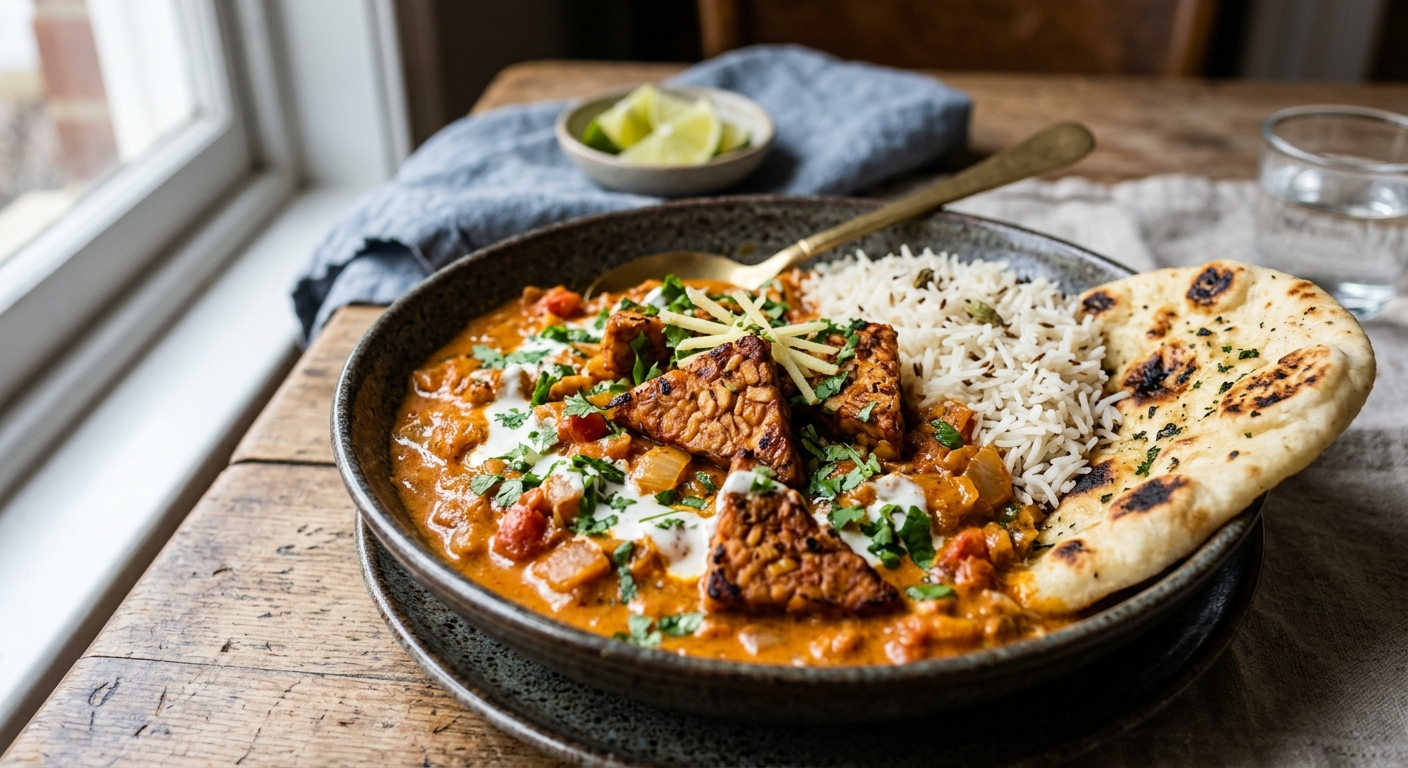
Tikka masala is one of the most beloved comfort dishes on the planet, and for good reason: the interplay of warm spices, tangy tomato, and silky cream sauce is genuinely hard to improve upon. What we have done here at Calibrated Cuisine is swap the chicken for marinated, pan-seared tempeh, a fermented soybean cake that brings something chicken simply cannot: a full spectrum of all nine essential amino acids in a single plant-based ingredient, plus the gut-health benefits of live fermentation cultures and a dense hit of dietary fiber. The result is a tikka masala that tastes utterly faithful to the original while delivering a nutritional profile that will make your dietitian smile.
The secret to this recipe is the two-stage tempeh treatment. First, the tempeh is cut into thick triangles, marinated in yogurt-free spiced cashew cream, and either pan-seared or broiled until the edges are caramelised and slightly chewy. That textural contrast, tender interior against a slightly crisp crust, is what separates a great tempeh curry from a forgettable one. The masala sauce itself is built on a base of caramelised onion, fresh ginger, garlic, and a house-blend of whole and ground spices that bloom in fat before the tomatoes ever enter the pan, ensuring every molecule of fat-soluble colour and flavour is extracted from the spices before liquid dilutes them.
From a nutritional engineering standpoint, this dish is a masterclass in complementary whole foods working in synergy. Tempeh provides the protein backbone and all nine essential amino acids. The coconut cream delivers medium-chain triglycerides that improve absorption of the fat-soluble carotenoids (beta-carotene and lycopene) released from the cooked tomatoes. Fresh ginger and fenugreek contribute anti-inflammatory gingerols and diosgenin respectively. And the iron from the tempeh and spices is paired intentionally with vitamin C from the tomatoes, dramatically improving non-heme iron bioavailability. Every ingredient earns its place here, scientifically and gastronomically.
4
servings
Ingredients
- 680 gtempeh, cut into 2.5cm triangles
- 400 gcanned crushed tomatoes
- 270 mlfull-fat coconut cream
- 2 mediumyellow onions, finely diced
- 6 clovesgarlic, minced
- 30 gfresh ginger, grated (about 3cm piece)
- 3 tbspextra-virgin coconut oil or Avocado Oil100% Pure Avocado Oil, divided
- 120 mlplain unsweetened oat yogurt (for marinade)
- 2 tbsplemon juice, freshly squeezed
- 2 tspgaram masala
- 2 tspground cumin
- 2 tspground coriander
- 1.5 tspground turmeric
- 1.5 tspsmoked paprika
- 1 tspKashmiri chilli powder (or mild chilli powder)
- 0.5 tspground fenugreek
- 0.5 tspground cardamom
- 1 tspColima Sea SaltMicroplastic Free Salt, plus more to taste
- 1 tbsptomato paste
- 1 tspcoconut sugar or brown sugar
- 15 gfresh cilantro, roughly chopped, for serving
- —Cooked basmati rice or warm naan, for serving
- —Colima Sea SaltMicroplastic Free Salt and black pepper to taste
Instructions
Click on an item below to shop for the recommended items for this recipe on Amazon.
As an Amazon Associate, we earn from qualifying purchases.
- Combine the oat yogurt, lemon juice, half the turmeric (0.75 tsp), half the garam masala (1 tsp), half the smoked paprika (0.75 tsp), 0.5 tsp salt, and 1 tbsp of the oil in a large bowl. Add the tempeh triangles and toss until fully coated. Cover and marinate at room temperature for at least 30 minutes, or refrigerate overnight for best flavour.
- Heat 1 tbsp oil in a wide Dutch oven or heavy-bottomed skillet over medium-high heat until shimmering. Working in two batches to avoid crowding, add the marinated tempeh pieces in a single layer. Sear undisturbed for 3 to 4 minutes until a deep golden crust forms, then flip and sear 2 to 3 minutes on the other side. Transfer seared tempeh to a plate and set aside. Do not clean the pot.
- Reduce the heat to medium. Add the remaining 1 tbsp oil to the same pot. Add the diced onions with a pinch of salt and cook, stirring occasionally, for 12 to 15 minutes until deeply caramelised and golden brown. Do not rush this step; the Maillard reaction in the onions forms the flavour foundation of the entire sauce.
- Push the onions to the edge of the pot and add the garlic, ginger, and tomato paste to the centre. Fry for 90 seconds, stirring constantly, until fragrant and the tomato paste darkens slightly. Add all remaining dry spices: cumin, coriander, remaining turmeric, remaining garam masala, remaining smoked paprika, Kashmiri chilli, fenugreek, and cardamom. Stir everything together and toast the spice mixture for 60 seconds until aromatic.
- Pour in the crushed tomatoes and coconut sugar, scraping up any fond from the bottom of the pot. Bring to a simmer and cook uncovered for 10 minutes, stirring occasionally, until the sauce thickens and the raw tomato smell mellows.
- Stir in the coconut cream and simmer for a further 5 minutes. Taste and adjust salt. Nestle the seared tempeh pieces back into the sauce, pressing them gently to submerge. Simmer on low heat for 8 to 10 minutes, allowing the tempeh to absorb the sauce. Finish with fresh cilantro and serve over basmati rice or with warm naan.
- Marinate the tempeh as described in step 1 of the Stovetop method. While it marinates, preheat your oven broiler to high (230C / 450F) and line a baking sheet with parchment. Spread the marinated tempeh on the sheet in a single layer and broil 10 to 12 cm from the element for 7 to 9 minutes, flipping once halfway, until charred at the edges. Set aside.
- In the slow cooker insert (or in a skillet if you prefer to sauté separately), combine 2 tbsp oil, the diced onions, garlic, ginger, and tomato paste. If your slow cooker has a sauté function, cook on Sauté or High for 8 to 10 minutes, stirring every 2 minutes, until the onions soften and become translucent. If it does not have a sauté function, do this step in a skillet on the stovetop over medium heat for 10 minutes, then transfer to the slow cooker insert.
- Add all the dry spices directly to the onion mixture in the slow cooker insert: cumin, coriander, remaining turmeric, remaining garam masala, remaining smoked paprika, Kashmiri chilli, fenugreek, and cardamom. Stir to coat the onions. Add the crushed tomatoes and coconut sugar. Stir to combine.
- Place the broiled tempeh pieces on top of the sauce in the slow cooker. Do not stir them in yet; allow them to rest on top so the surface does not become soggy. Place the lid on and cook on Low for 6 to 7 hours, or on High for 3 to 3.5 hours.
- In the final 20 minutes of cooking, remove the lid and gently stir in the coconut cream. Replace the lid and continue cooking on Low for the remaining time. This late addition of coconut cream prevents it from breaking or developing a grainy texture during the long cook. Taste, adjust salt, finish with fresh cilantro, and serve.
- Marinate the tempeh as described in step 1 of the Stovetop method. Set the Instant Pot to Sauté mode on High. Add 1 tbsp oil and, once hot, sear the marinated tempeh in two batches for 2 to 3 minutes per side until golden. Do not fully cook through; you are only building a crust. Remove and set aside on a plate.
- Without cleaning the pot, add the remaining 1 tbsp oil and the diced onions. Sauté on High for 6 to 8 minutes, stirring frequently, until softened and beginning to colour. Scrape the bottom of the pot constantly to prevent the onion sugars from burning and triggering a burn warning under pressure.
- Add garlic, ginger, and tomato paste to the pot. Sauté for 60 seconds. Add all remaining dry spices: cumin, coriander, remaining turmeric, remaining garam masala, remaining smoked paprika, Kashmiri chilli, fenugreek, and cardamom. Stir for 30 seconds until fragrant. Pour in 300g crushed tomatoes and the coconut sugar. Stir thoroughly and scrape the bottom of the insert with a wooden spoon to ensure no bits are stuck, which would cause the burn notice.
- Nestle the seared tempeh pieces into the sauce. Cancel Sauté mode. Secure the lid, set the valve to Sealing, and cook on Manual / Pressure Cook at High Pressure for 5 minutes. Allow a natural pressure release for 10 minutes, then carefully switch the valve to Venting for a quick release of any remaining pressure.
- Open the lid, switch back to Sauté mode on Low, and stir in the full 270ml of coconut cream. Simmer uncovered for 3 to 4 minutes, stirring gently, until the sauce reaches your desired consistency. Taste and adjust salt. The rapid pressure cooking intensifies all the spices, so taste before adding more. Finish with fresh cilantro and serve.
- Marinate the tempeh as described in step 1 of the Stovetop method. Preheat the oven to 220C (425F) fan-forced, or 230C (450F) conventional. Spread the marinated tempeh on a wire rack set over a foil-lined baking sheet in a single layer, ensuring pieces do not touch. Roast on the upper-middle rack for 20 to 25 minutes, flipping once at the 12-minute mark, until the edges are deeply browned and slightly crisp. Remove and set aside.
- While the tempeh roasts, prepare the masala sauce on the stovetop. Heat 2 tbsp oil in a large, oven-safe skillet or Dutch oven over medium heat. Add diced onions with a pinch of salt and cook for 12 to 14 minutes until caramelised. Add garlic, ginger, and tomato paste; cook 90 seconds. Add all remaining dry spices: cumin, coriander, remaining turmeric, remaining garam masala, remaining smoked paprika, Kashmiri chilli, fenugreek, and cardamom. Toast 60 seconds.
- Pour crushed tomatoes and coconut sugar into the skillet. Stir well, bring to a simmer, and cook for 8 minutes until slightly reduced. Stir in the coconut cream and cook for 2 minutes. Taste and adjust seasoning.
- Reduce the oven temperature to 180C (350F). Nestle the oven-roasted tempeh pieces into the sauce in the Dutch oven. Transfer the entire pot, uncovered, to the oven and bake for 15 to 18 minutes. Baking the assembled dish uncovered allows the exposed tops of the tempeh to maintain their roasted crust while the submerged sides absorb the sauce, creating a textural contrast that no other method achieves.
- Remove from the oven and let rest for 5 minutes before serving. The sauce will thicken slightly as it cools. Finish with fresh cilantro and serve directly from the pot over basmati rice or with warm naan.
Nutrition Breakdown
Per 1 serving (makes 4)
Vitamins & Minerals
% Daily Value based on a 2,000 calorie diet (FDA reference)
🧬 Essential Amino Acids
% of recommended daily intake (RDA) per serving
🛡 Antioxidant Profile
The Nutrition Science
Tempeh stands apart from every other plant protein because the fermentation process does two things simultaneously: it dramatically increases the bioavailability of its protein by pre-digesting antinutrients like phytic acid that would otherwise bind to and block mineral absorption, and it generates a complete amino acid profile comparable gram-for-gram to many animal proteins. At 28g of protein per serving, this dish exceeds the protein density of most chicken tikka masala recipes, and the amino acid data confirms that eight of the nine essential aminos are delivered at or near their full RDA in a single meal.
The iron bioavailability story in this dish is particularly elegant. Tempeh and the spice blend (especially cumin and coriander) contribute significant non-heme iron, which in isolation has a bioavailability of roughly 2 to 20% compared to heme iron’s 15 to 35%. However, the vitamin C from the crushed tomatoes and lemon juice in the marinade converts ferric iron (Fe3+) to the more absorbable ferrous form (Fe2+) directly in the gastrointestinal tract, boosting non-heme iron absorption by up to 300% in the presence of a single meal. This is why the lemon juice in the marinade is not optional: it is doing active nutritional work.
The fat profile of this dish also deserves attention. Coconut cream is rich in medium-chain triglycerides (MCTs), particularly lauric acid, which are absorbed directly via the portal vein rather than requiring chylomicron packaging in the lymphatic system. Beyond their own metabolic advantages, the MCTs and overall fat content of the sauce create a lipid-soluble matrix that is essential for absorbing the fat-soluble antioxidants released during cooking: lycopene from the cooked tomatoes, beta-carotene from the turmeric and paprika, and curcumin from the turmeric, all of which show dramatically improved serum bioavailability when consumed with dietary fat. Cooking the spices in oil before adding liquid is not just a flavour technique; it is a bioavailability technique.
Pro Tips
- Steaming the tempeh for 10 minutes before marinating opens its pores and removes any residual bitterness from the fermentation process, resulting in a more neutral canvas that absorbs the marinade much more deeply.
- Do not skip caramelising the onions properly. The 12 to 15 minute investment on medium heat, rather than the 3 to 4 minute shortcut most recipes take, produces a fundamentally different sauce because the onion’s sugars and amino acids undergo Maillard reactions that create hundreds of new flavour compounds absent in simply softened onions.
- Leftover tikka masala actually improves significantly after 24 hours in the refrigerator, as the tempeh continues to absorb the sauce and the spice flavours meld. Store in an airtight container for up to 4 days or freeze for up to 3 months, thawing overnight in the refrigerator before reheating gently on the stovetop with a splash of coconut cream.




oh man tempeh is seriously underrated, priya’s right about that. my grandmother in são paulo never called it “complete protein” but she knew tempeh with fermented black beans and some fermented hot sauce meant her family stayed strong, and now i know its because the fermentation process actually makes amino acid bioavailability even better than the tempeh alone. the tikka masala sounds incredible though, that combination of spices with fermented coconut cream would be chef’s kiss for the gut bacteria too. definitely making this and probably will end up teaching it in my next workshop.
I’m absolutely saving this one for my clients! Tempeh is such an underrated protein source, and I love that you’re highlighting the complete amino acid profile here. Most people don’t realize that tempeh actually provides all nine essential amino acids on its own, so pairing it with the coconut milk and spices makes this nutrient synergy even better. Plus, the fermentation in tempeh improves mineral bioavailability, so those 100%+ RDA numbers are probably even more accessible to the body than they appear on paper. Do you happen to know the iron content? I’m always curious whether the vitamin C from tomatoes or any citrus in the sauce helps with absorption.
Your grandmother was onto something so smart there, Felipe. That combination of tempeh with fermented black beans is basically a masterclass in amino acid completeness and gut health all at once. I’m curious if she was aware of the fermentation angle or if it was just traditional wisdom passed down, because that’s honestly how so many cultures figured out optimal nutrition before we had the science to explain it. The fermented hot sauce would add even more bioavailable minerals and probiotics, so she was building meals with some serious nutritional intelligence.