
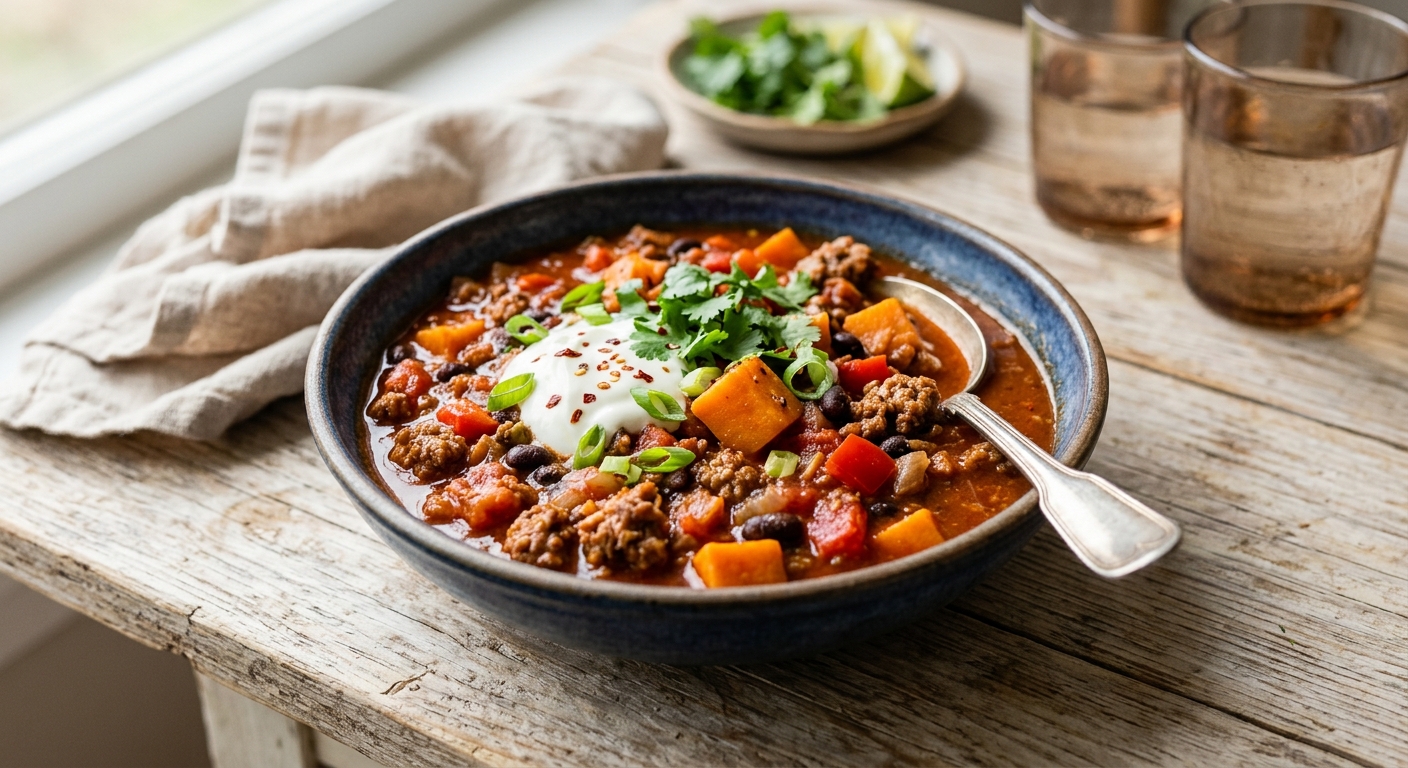
Bison is one of North America’s most nutritionally compelling proteins, yet it remains stubbornly underused in home kitchens. Compared to 80/20 ground beef, ground bison carries roughly 25% more protein per 100g while delivering significantly less saturated fat, thanks to the animal’s grass-fed, free-range lifestyle. When you pair it with sweet potato, which adds slow-digesting complex carbohydrates, a dense hit of beta-carotene, and a natural sweetness that tempers the heat of the spices, you get a chili that is both a nutritional precision instrument and an unashamed crowd-pleaser.
The architecture of this recipe is deliberate. Black beans extend the protein and nearly double the fiber, while a spice blend built on smoked paprika, ancho chili powder, cumin, and a small measure of cinnamon works synergistically with the bison’s natural earthiness. That touch of cinnamon is not an accident: cinnamon has been shown to support blood glucose regulation, which, combined with the medium glycemic load of sweet potato and beans, keeps post-meal energy levels remarkably stable. This is the kind of dish that fuels a long afternoon rather than ending it.
At Calibrated Cuisine, we designed this recipe around four servings that each hit meaningful thresholds: more than 100% of the daily recommended intake for vitamin B12, over 80% for iron, and a complete essential amino acid profile anchored by the leucine-rich bison. Whether you cook it on the stovetop in under an hour, walk away and let the slow cooker work overnight, or get it on the table in 35 minutes with a pressure cooker, the nutritional outcome is nearly identical. Choose your method based on your schedule, not on any compromise in quality.
4
servings
Ingredients
- 600 gground bison (90/10 lean)
- 450 gsweet potato (about 2 medium), peeled and cut into 1.5cm cubes
- 400 gcanned black beans, drained and rinsed
- 400 gcanned crushed tomatoes
- 250 mllow-sodium beef broth
- 1 mediumyellow onion, finely diced
- 1 mediumred bell pepper, finely diced
- 4 clovesgarlic, minced
- 1 mediumjalapeño, seeded and finely minced
- 2 tbspancho chili powder
- 2 tspground cumin
- 2 tspsmoked paprika
- 0.5 tspground cinnamon
- 0.5 tspdried oregano
- 0.25 tspcayenne pepper
- 2 tbsptomato paste
- 1 tbspextra-virgin olive oil
- 1 tbspapple cider vinegar
- —Colima Sea SaltMicroplastic Free Salt and black pepper to taste
- —Optional garnish: sliced scallions, plain Greek yogurt, fresh cilantro, lime wedges
Instructions
Click on an item below to shop for the recommended items for this recipe on Amazon.
As an Amazon Associate, we earn from qualifying purchases.
- Heat olive oil in a large Dutch oven or heavy-bottomed pot over medium-high heat until shimmering. Add the ground bison in a single layer without breaking it up immediately. Let it sear undisturbed for 2 to 3 minutes until a deep brown crust forms on the underside, then break into coarse chunks and continue cooking for another 3 minutes until no pink remains. Use a slotted spoon to transfer the browned bison to a bowl, leaving the rendered fat in the pot.
- Reduce heat to medium. Add the diced onion and red bell pepper to the pot. Cook, stirring occasionally and scraping up any browned bits from the bison, for 5 to 6 minutes until the onion is soft and translucent. Add the minced garlic and jalapeño and cook for another 90 seconds until fragrant.
- Push the vegetables to the edges of the pot to clear a hot spot in the center. Add the tomato paste directly to that center spot and cook it, stirring constantly, for 1 to 2 minutes until it darkens from red to a deep brick color. This step caramelizes the tomato paste and removes its raw, sharp edge. Now add all the dry spices (chili powder, cumin, smoked paprika, cinnamon, oregano, and cayenne) and stir them into the paste and vegetables for 60 seconds to bloom them in the residual fat.
- Return the browned bison to the pot. Add the sweet potato cubes, crushed tomatoes, and beef broth. Stir everything together thoroughly, scraping the bottom of the pot clean. Bring to a vigorous boil over high heat, then reduce to a gentle simmer. Cover partially (lid slightly ajar to allow steam to escape) and cook for 20 minutes, stirring every 5 minutes.
- After 20 minutes, the sweet potatoes should be just beginning to yield. Add the drained black beans, stir to incorporate, and continue simmering uncovered for another 15 to 20 minutes. The chili is ready when the sweet potato is completely tender when pierced with a fork and the liquid has reduced to a thick, glossy sauce that coats the back of a spoon. Stir in the apple cider vinegar, taste, and adjust seasoning with salt and black pepper. Serve immediately with your chosen garnishes.
- Before any slow cooker step, brown the bison: heat olive oil in a skillet over medium-high heat, add the ground bison in a single layer, and sear without disturbing for 3 minutes to build a dark brown crust. Break into chunks, cook through fully, and drain off excess fat. Transfer to the slow cooker insert.
- In the same skillet over medium heat, add the diced onion and red bell pepper and cook for 4 minutes until softened. Add the garlic and jalapeño and cook for 1 minute. Add the tomato paste and all the dry spices directly into the skillet and stir constantly for 90 seconds to bloom the spices in the hot fat. This concentrated flavor base is the key to a slow cooker chili that does not taste flat. Scrape the entire contents of the skillet into the slow cooker.
- Add the sweet potato cubes, crushed tomatoes, beef broth, and drained black beans directly to the slow cooker. Stir everything together until the spice base is evenly distributed throughout the liquid. The beans go in at the start here (unlike the stovetop method) because the gentle, prolonged heat of the slow cooker will not cause them to break down excessively.
- Place the lid firmly on the slow cooker. Cook on Low for 7 to 8 hours or on High for 3.5 to 4 hours. Resist the urge to lift the lid during cooking, as each peek adds 20 to 30 minutes of recovery time. The chili is ready when the sweet potato is completely tender and the bison has absorbed the surrounding spiced liquid, becoming deeply savory.
- When cooking is complete, remove the lid and stir in the apple cider vinegar. If the chili is thinner than you prefer, switch the slow cooker to High with the lid off and cook for an additional 20 to 30 minutes, stirring occasionally, to reduce the liquid. Taste and adjust salt and pepper. The flavor will be noticeably richer and more integrated than when it first went in, as the extended cooking time encourages a deeper fusion of all components. Serve with garnishes.
- Set your Instant Pot or electric pressure cooker to Saute mode on High. Add the olive oil and, once shimmering, add the ground bison. Press it into a flat layer and sear without moving for 3 minutes to develop browning on the base. Break into large chunks and continue cooking until cooked through, about 3 more minutes. Use the saute function’s high heat aggressively here, as this is your only window for Maillard browning in this method. Remove bison with a slotted spoon and set aside.
- Without switching off Saute mode, add the onion and bell pepper to the residual fat in the pot. Cook, stirring and scraping the browned fond from the bottom of the pot (this is critical to avoid a burn warning), for 3 to 4 minutes. Add garlic and jalapeño, cook 1 minute. Add tomato paste and all dry spices, stirring constantly for 60 seconds to bloom.
- Deglaze the pot by pouring in the beef broth immediately after the spice bloom. Use a wooden spoon or silicone spatula to scrape every browned bit from the bottom of the pot until the surface is completely clean. This step is essential: any stuck material will trigger the pressure cooker’s burn sensor and interrupt the cook cycle.
- Return the browned bison to the pot. Add the sweet potato cubes (cut to 2cm), crushed tomatoes, and drained black beans. Do not stir vigorously after this point; gently push the ingredients down to submerge them in the liquid but avoid disturbing the bottom. The liquid level should just cover the ingredients. Cancel Saute mode.
- Secure the lid, set the valve to Sealing, and program the cooker to Pressure Cook (Manual) on High Pressure for 15 minutes. Once the cycle completes, allow a natural pressure release for 10 minutes, then carefully switch the valve to Venting to release any remaining steam. Remove the lid, stir in the apple cider vinegar, and assess the consistency. If the chili needs thickening, switch back to Saute mode and cook uncovered for 5 to 8 minutes, stirring frequently. Season with salt and pepper and serve immediately.
- Preheat your oven to 160C (325F). Place a large Dutch oven on the stovetop over medium-high heat and add the olive oil. Sear the ground bison in a single undisturbed layer for 3 to 4 minutes to develop deep browning, then break apart and cook through fully. Remove with a slotted spoon and reserve. Add the onion and bell pepper to the pot and cook over medium heat for 5 minutes, scraping up the browned fond. Add garlic, jalapeño, tomato paste, and all dry spices, cooking and stirring for 90 seconds.
- Deglaze the pot with the beef broth, scraping the bottom completely clean. Return the bison and add the sweet potato cubes, crushed tomatoes, and black beans. Stir to combine. Bring the mixture to a gentle boil on the stovetop before transferring to the oven. This ensures the liquid is hot enough to begin tenderizing the sweet potato from the moment it enters the oven, shortening the total braise time.
- Cover the Dutch oven with its lid and transfer to the center rack of the preheated oven. Braise for 1 hour. After 1 hour, carefully remove the Dutch oven, lift the lid away from you (the escaping steam is very hot), and stir the chili from the bottom up. The sweet potatoes should be approaching tenderness but not yet fully soft.
- Return the Dutch oven to the oven with the lid set slightly ajar (resting a wooden spoon under one edge of the lid works well). Continue braising for another 30 to 45 minutes. The chili is done when the sweet potato is completely tender, the bison is meltingly soft, and the exposed top has developed a slightly darkened, concentrated layer that stirs back into the pot for tremendous flavor.
- Remove from the oven, stir the chili thoroughly to reintegrate the surface layer, and add the apple cider vinegar. Let the pot rest uncovered on the stovetop for 10 minutes before serving, during which the chili will thicken further as it cools slightly. The resting period is especially important with the oven method because the uniform heat of the braise leaves the starch in the sweet potato fully activated and the sauce will tighten noticeably. Adjust seasoning and serve with garnishes.
Nutrition Breakdown
Per 1 serving (makes 4)
Vitamins & Minerals
% Daily Value based on a 2,000 calorie diet (FDA reference)
🧬 Essential Amino Acids
% of recommended daily intake (RDA) per serving
🛡 Antioxidant Profile
The Nutrition Science
Bison’s nutritional advantage over conventional ground beef is rooted in its feeding environment. Pasture-raised bison accumulate a higher proportion of omega-3 fatty acids relative to omega-6 in their muscle tissue, yielding a more favorable n-3/n-6 ratio of approximately 1:3 compared to grain-fed beef at around 1:20. This matters because chronic dietary excess of omega-6 relative to omega-3 is consistently linked to elevated systemic inflammation. Beyond fatty acid profile, bison provides heme iron at a concentration of roughly 3.5mg per 100g of cooked meat, the most bioavailable form of dietary iron, absorbed at rates of 15 to 35% compared to 2 to 10% for the non-heme iron in plant foods.
The vitamin C from the bell peppers and tomatoes in this recipe is strategically significant. Ascorbic acid forms a soluble complex with non-heme iron in the gastrointestinal tract, reducing ferric iron (Fe3+) to the more absorbable ferrous form (Fe2+) and preventing it from binding with phytate inhibitors present in the black beans. Research published in the American Journal of Clinical Nutrition estimates that including 25 to 75mg of vitamin C alongside a meal can increase non-heme iron absorption by 2 to 3 times. This recipe delivers approximately 42mg of vitamin C per serving, placing it squarely in the therapeutic window for iron absorption enhancement.
The sweet potato and black bean combination is a model of complementary carbohydrate nutrition. Sweet potato provides resistant starch alongside its rapidly available glucose, and black beans are exceptionally rich in soluble fiber, particularly pectin and oligosaccharides that serve as prebiotics for Bifidobacterium and Lactobacillus species. Together they produce a net carbohydrate load that is moderated in glycemic impact far below what either food’s GI number alone would suggest, because the soluble fiber creates a viscous intestinal matrix that delays gastric emptying and slows glucose entry into the portal circulation. The result is a sustained, stable energy release that is clinically meaningful for both athletic performance and metabolic health.
Pro Tips
- For maximum browning on the bison, make sure your pan is fully preheated and the meat is patted dry with paper towels before it hits the oil. Moisture is the enemy of the Maillard reaction, and well-browned bison contributes a compound flavor that no amount of additional spice can replicate.
- Toast your ancho chili powder in a dry skillet over medium heat for 60 to 90 seconds before adding it to the recipe if you want to amplify its fruity, smoky complexity. Watch it carefully, as ground chili burns quickly and turns bitter.
- This chili improves dramatically overnight. The fat-soluble flavor compounds in the spices continue to infuse the liquid after cooking, and the sweet potato starch further thickens the sauce as it cools. If you have time, make it the day before and reheat gently over medium-low heat with a splash of broth to loosen.





omg yes bison is such a game changer for iron bioavailability, like the heme iron absorption rate is just *chef’s kiss* and i love that youre pairing it with sweet potato bc the vitamin c content actually helps with absorption too! my ferritin levels finally started climbing when i stopped just eating plain chicken and switched to fattier cuts of bison, so this recipe feels like it was made for people like us managing anemia through food instead of supplements alone. does the chili have any citrus or tomato in it bc that would amp up the iron uptake even more?
yes! the tomato base is definitely working overtime here for iron absorption, plus if you add a squeeze of lime or lemon juice at the end it becomes basically a performance meal for me, ive used similar chili recipes as a post-ultra recovery dish bc the combo of heme iron, carbs from the sweet potato, and protein actually helps with glycogen restoration and reducing inflammation. curious if youve played around with cooking times – ive read that longer simmering can actually increase bioavailability even more, so this slow-cooked approach is genius for someone managing ferritin levels like you mentioned.
ok this is literally calling my name because my oldest has been dragging on iron intake (picky eater energy) and ive been trying to sneak it into everything, plus bison hits different for bioavailability compared to regular ground beef. quick question though – are you soaking and sprouting any of the beans in this or going straight dried, because if theyre kidney beans or black beans i’d be so curious if you tested it with sprouted ones to see if it reduced the phytic acid and bumped up mineral absorption even more? my kids actually ate seconds of my sprouted black bean chili last week which literally never happens, and i’m wondering if the enzyme activation made it easier on their digestion.