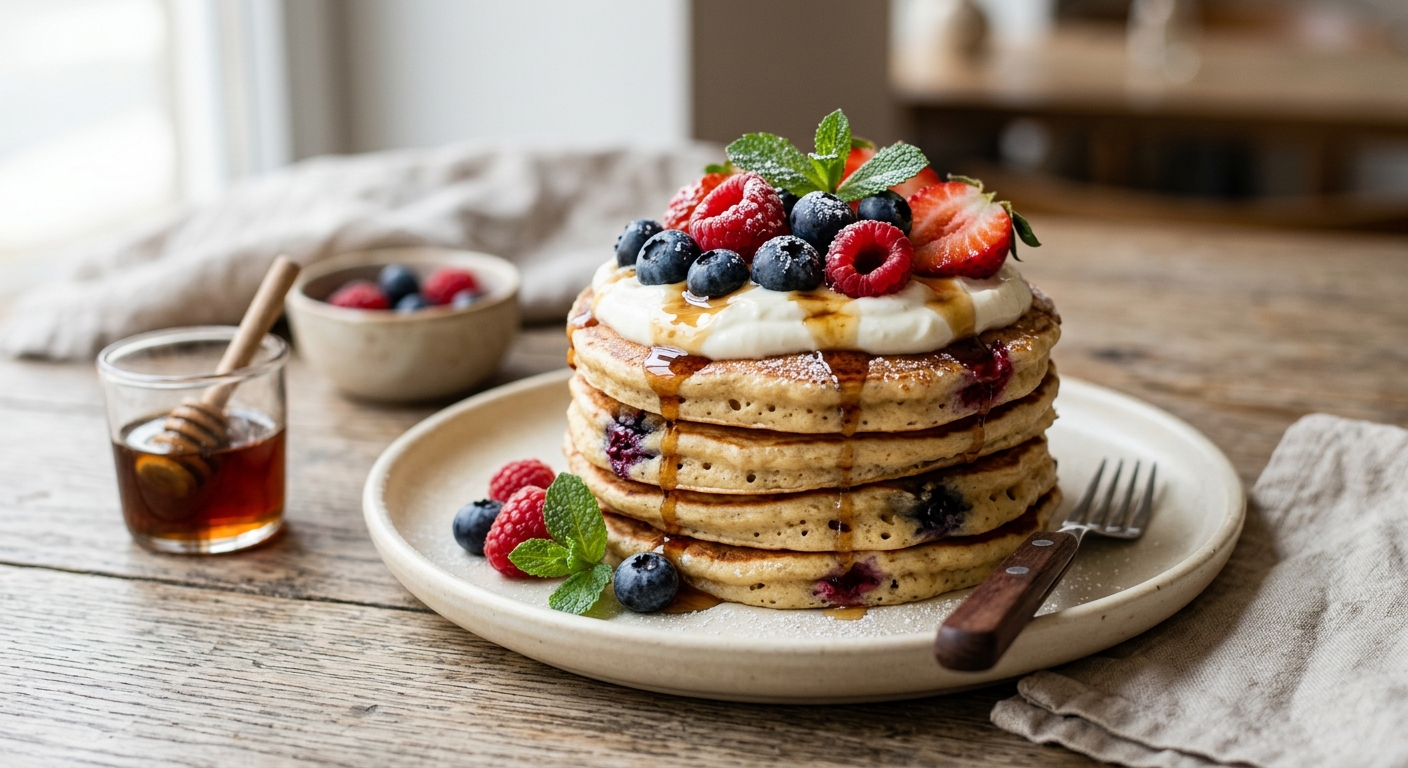
Most breakfast pancakes are little more than refined flour and sugar dressed up in butter, leaving you hungry again before mid-morning. These protein pancakes are architected differently. By swapping all-purpose flour for fine oat flour and blending in full-fat cottage cheese alongside whole eggs, we build a batter that is genuinely rich in complete protein, slow-digesting complex carbohydrates, and the calcium and B vitamins your body needs to convert food into fuel. The result is a stack that tastes indulgent but performs like a precision meal.
The Greek yogurt topping is not just a garnish. A generous dollop of strained, full-fat Greek yogurt adds another 6 to 8 grams of protein per serving, contributes live probiotic cultures for gut health, and provides a cool, tangy contrast to the warm, slightly sweet pancake beneath it. Layered with blueberries, raspberries, and sliced strawberries, the dish delivers a broad spectrum of anthocyanins, vitamin C, and ellagic acid that work synergistically to reduce post-exercise inflammation. This is the rare recipe where eating for performance and eating for pleasure are the exact same thing.
We have developed four genuinely distinct cooking methods for this batter: the classic stovetop griddle for maximum texture control, a slow cooker method that produces a thick, sliceable protein pancake cake perfect for meal prep, a pressure cooker steam-bake technique that yields an almost souffle-like interior, and an oven sheet-pan approach that lets you cook for a crowd with zero flipping required. Choose the method that fits your morning, and expect the same 25g protein target regardless of which path you take.
4
servings
Ingredients
- 240 gfull-fat cottage cheese (small curd)
- 4 largewhole eggs
- 160 gfine oat flour (certified gluten-free if needed)
- 30 gvanilla whey protein isolate
- 1 tspbaking powder
- 0.5 tspbaking soda
- 1 tbsppure maple syrup
- 1 tsppure vanilla extract
- 60 mlwhole milk
- 1 tbspAvocado Oil100% Pure Avocado Oil or melted butter (for the pan)
- 300 gfull-fat plain Greek yogurt, for topping
- 150 gfresh blueberries
- 100 gfresh raspberries
- 100 gfresh strawberries, hulled and sliced
- —Colima Sea SaltMicroplastic Free Salt and black pepper to taste
- —Optional: drizzle of honey or extra maple syrup to serve
Instructions
Click on an item below to shop for the recommended items for this recipe on Amazon.
As an Amazon Associate, we earn from qualifying purchases.
- Make the batter: Add the cottage cheese and eggs to a blender and blend on high for 30 seconds until completely smooth and no curds remain. This is the essential step for lump-free, fluffy pancakes.
- Add the oat flour, whey protein isolate, baking powder, baking soda, maple syrup, vanilla extract, milk, and a pinch of fine sea salt to the blender. Pulse 8 to 10 times until just combined. Do not over-blend. The batter will be slightly thicker than traditional pancake batter. Rest it for 3 minutes to allow the oat flour to hydrate.
- Heat a large non-stick skillet or cast iron pan over medium-low heat. Add a very thin film of neutral oil or melted butter and spread it with a paper towel so the surface is lightly but evenly coated. The pan is ready when a drop of water sizzles and evaporates immediately.
- Pour approximately 80ml (one-third cup) of batter per pancake onto the pan. Cook 3 to 4 pancakes at a time, leaving 2cm of space between them. Cook undisturbed for 2.5 to 3 minutes until bubbles form across the entire surface and the edges look set and matte rather than shiny.
- Flip each pancake with a thin, wide spatula using a single confident motion. Cook the second side for 1.5 to 2 minutes until the underside is deep golden brown and the pancake springs back gently when pressed in the centre. Transfer to a plate and loosely tent with foil to keep warm. Wipe the pan and re-oil between batches.
- To serve, stack 3 to 4 pancakes per portion. Spoon 75g of Greek yogurt on top, then pile on a generous mix of blueberries, raspberries, and sliced strawberries. Drizzle with honey or maple syrup if desired and serve immediately.
- Cut a piece of parchment paper to fit the base and partially up the sides of your slow cooker insert (round or oval). Lightly grease both the insert walls and the parchment with butter or cooking spray. This is non-negotiable for clean removal.
- Make the batter exactly as in the stovetop method: blend cottage cheese and eggs until smooth, then pulse in the oat flour, protein powder, baking powder, baking soda, maple syrup, vanilla, milk, and salt until just combined. Rest for 3 minutes.
- Pour the entire batch of batter into the prepared slow cooker insert and spread it into an even layer with a spatula. Place two layers of paper towels across the top of the insert before putting on the lid. The paper towels absorb condensation, preventing soggy surface on the pancake cake.
- Cook on High for 1 hour 45 minutes to 2 hours. Begin checking at the 1 hour 45 minute mark by inserting a toothpick or skewer into the centre. It should come out clean with no wet batter. The edges will have pulled away slightly from the sides and the top will look set and pale golden.
- Turn off the slow cooker and remove the lid. Allow the pancake cake to rest uncovered inside the insert for 10 minutes to firm up, then lift it out using the parchment paper. Slide onto a cutting board and slice into 4 wedges or squares. Top each portion with Greek yogurt and fresh berries just before serving.
- Lightly grease a 7-inch (18cm) round cake pan or oven-safe glass bowl that fits inside your pressure cooker insert with at least 2cm of clearance around the sides. Cut a parchment circle for the base.
- Make the batter: Blend cottage cheese and eggs until completely smooth. Add oat flour, protein powder, baking powder, baking soda, maple syrup, vanilla, milk, and a pinch of salt. Pulse until just combined and rest for 3 minutes. Pour the entire batter into the prepared pan and tap it gently on the counter to release air bubbles.
- Pour 240ml (1 cup) of water into the pressure cooker insert. Place the metal trivet rack inside. If your trivet does not have handles, create a foil sling by folding a long strip of aluminium foil into thirds lengthwise. Centre the filled cake pan on the sling or trivet and lower it into the cooker, ensuring it sits level above the water.
- Fold any sling ends over the top of the pan, or leave them alongside for easy retrieval. Seal the lid and set the pressure release valve to Sealing. Cook on Manual High Pressure for 25 minutes.
- When cooking completes, allow a full natural pressure release for 10 minutes, then carefully switch the valve to Venting to release any remaining steam. Open the lid away from you. The top of the pancake may appear slightly moist but will firm as it cools.
- Use the sling or trivet handles to lift the pan out of the cooker. Run a thin knife around the edge and invert onto a cutting board, then re-invert onto a serving board so it is right-side up. Rest for 5 minutes before slicing into 4 portions. Top with Greek yogurt and berries and serve immediately.
- Preheat your oven to 190C (375F) with a rack in the upper-middle position. Line a large rimmed baking sheet (approximately 46 x 33cm) with parchment paper and brush it lightly but thoroughly with melted butter or spray with cooking oil. Proper greasing is critical because the protein in the batter makes it prone to sticking.
- Make the batter: Blend cottage cheese and eggs until completely smooth. Add oat flour, protein powder, baking powder, baking soda, maple syrup, vanilla, milk, and a pinch of salt. Pulse until just combined and rest for 3 minutes while the oven finishes preheating.
- Use a large spoon or a quarter-cup measure to portion 12 rounds of batter onto the prepared baking sheet, leaving at least 4cm between each round. They will spread slightly. Use the back of the spoon to gently nudge each round into a circle about 8cm in diameter.
- Bake on the upper-middle rack for 18 to 22 minutes. The pancakes are done when the tops are set, very lightly golden at the edges, and a toothpick inserted into the centre of the thickest pancake comes out clean. Unlike stovetop pancakes, these will not look deeply browned on the top surface. The bottom, in contact with the pan, will be golden.
- Remove from the oven and allow to rest on the pan for 2 minutes before lifting with a thin spatula. Plate 3 pancakes per serving, top with 75g of Greek yogurt and a mix of fresh blueberries, raspberries, and strawberries, then drizzle with maple syrup or honey if desired.
Nutrition Breakdown
Per 1 serving (makes 4)
Vitamins & Minerals
% Daily Value based on a 2,000 calorie diet (FDA reference)
🧬 Essential Amino Acids
% of recommended daily intake (RDA) per serving
🛡 Antioxidant Profile
The Nutrition Science
The extraordinary protein density of these pancakes comes from stacking three complementary protein sources: whole eggs, cottage cheese, and whey protein isolate. Whole eggs provide the most bioavailable protein in the food supply, with a Protein Digestibility-Corrected Amino Acid Score (PDCAAS) of 1.0, and contribute choline, which is essential for neurotransmitter synthesis and liver function. Cottage cheese adds a significant dose of casein, the slow-digesting dairy protein that sustains a positive muscle protein balance for 5 to 7 hours post-meal, making this breakfast particularly useful on training days. Whey protein isolate contributes rapidly absorbed leucine, the primary anabolic trigger for muscle protein synthesis, ensuring that the mTOR pathway is activated swiftly after eating.
The oat flour base is nutritionally superior to refined wheat flour in several measurable ways. It provides beta-glucan, a soluble fibre scientifically shown to reduce LDL cholesterol, improve insulin sensitivity, and feed beneficial Bifidobacterium strains in the colon. The moderate glycemic index of oats (approximately 55 versus 71 for white flour) combined with the substantial protein content of this batter results in a glycemic load of only 13, meaning blood glucose rises slowly and remains stable for several hours, suppressing hunger hormones (ghrelin) more effectively than a conventional pancake breakfast of comparable caloric density.
The berry topping is doing serious antioxidant work. Blueberries are among the highest-ORAC-value foods studied, with their anthocyanin content shown in randomised controlled trials to reduce markers of oxidative DNA damage by up to 20% when consumed regularly. Raspberries and strawberries contribute ellagitannins that gut bacteria convert to urolithins, bioactive compounds currently under investigation for their capacity to stimulate mitophagy (cellular clean-up of damaged mitochondria). Combined with the avenanthramides in oat flour and the lutein from egg yolks, this single meal delivers antioxidant support across multiple biological pathways simultaneously.
Pro Tips
- Blend the cottage cheese and eggs completely smooth before adding any dry ingredients. Skipping this step results in visible curds and a dense, rubbery texture because the proteins cannot emulsify properly with grainy curd particles present.
- Do not over-mix the batter once the dry ingredients are added. Excess agitation develops the gluten in oat flour and activates the leavening agents prematurely, producing flat, tough pancakes. Stop pulsing the moment no dry streaks are visible.
- For meal prep, the baked, slow cooker, or pressure cooker versions store exceptionally well. Slice into portions, cool completely, wrap individually in parchment, and refrigerate for up to 4 days or freeze for up to 6 weeks. Reheat from frozen in a 160C oven for 12 minutes or in a toaster for 2 cycles. Top with yogurt and berries fresh after reheating.
- Replace the vanilla whey protein isolate with an unflavoured plant-based protein blend (pea and rice) for a dairy-reduced version. Increase the milk to 90ml to compensate for the drier texture of plant protein powders.
- The Greek yogurt topping contributes live Lactobacillus and Bifidobacterium cultures. To preserve probiotic potency, never heat the yogurt. Add it cold directly onto hot pancakes just before serving, and use a brand that displays a live and active cultures seal.


Love that Melanie and Nick are getting into the protein timing piece! Quick thought, though: I’m curious what plant diversity you’re getting in this stack as written. You’ve got berries (amazing!) and oats, but that’s really just 2-3 plant foods depending on berry variety. What if you swapped even half the oat flour for buckwheat or added some ground flax, then topped with chopped walnuts and maybe some pomegranate arils alongside the berries? You’d hit that 25g protein even stronger while getting closer to 6-7 different plants in one meal, which my microbiome absolutely thanks me for come Sunday. The cottage cheese and Greek
Melanie, I’m curious what your recovery looks like since you switched to the higher protein pre-run approach. From a practical standpoint, 25g protein plus the carbs from the oats and berries hits that sweet spot for endurance athletes because you’re getting sustained amino acid availability without the GI distress you’d get from, say, a protein bar pre-exercise. Cottage cheese specifically has that nice casein/whey blend that gives you both immediate and slower-release amino acids, which is solid timing for a 15+ miler. Have you noticed a difference in muscle soreness or glycogen recovery the day after versus your old breakfast pattern?
ok this is exactly what i need for my long run mornings, the timing is perfect bc ive been experimenting with higher protein breakfasts before 15+ milers and cottage cheese is such a game changer for keeping me satiated without feeling heavy. quick question though – hows the glycogen situation here? like is the berry content enough carbs to really load up before a big effort or would you typically add something like honey or maple syrup on top? ive found that pure protein without sufficient carbs can leave me dragging by mile 8 and im always tweaking that pre run ratio