
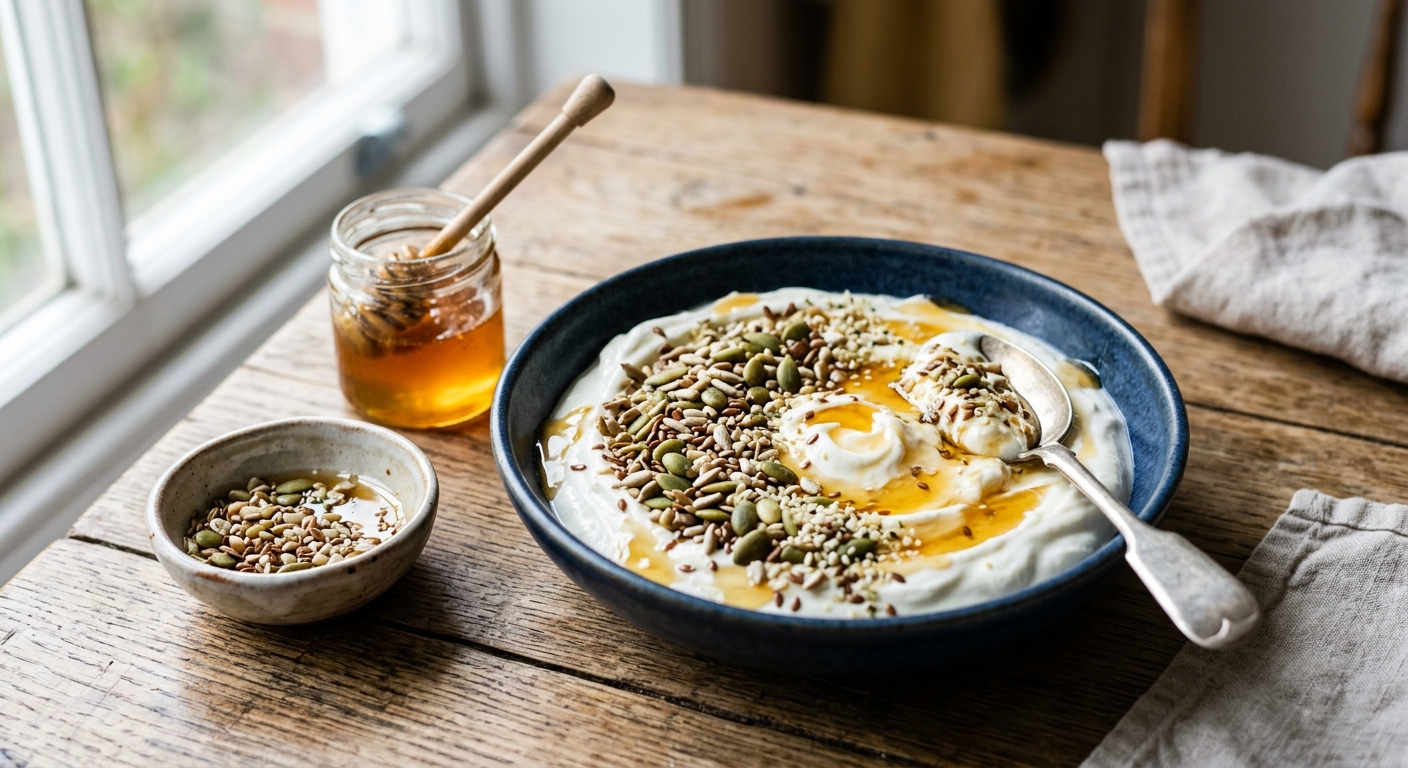
Skyr has been a cornerstone of Icelandic nutrition for over a thousand years, consumed by Viking settlers as a practical, shelf-stable source of dense protein and fat-soluble vitamins. Unlike Greek yogurt, which is made from whole milk strained of whey, traditional skyr begins with skimmed milk fermented with specific bacterial cultures, then strained multiple times until it reaches a consistency closer to soft cheese than yogurt. The result is a product with a higher protein-to-calorie ratio than almost any other dairy food on the planet, making it a legitimate nutritional powerhouse rather than a wellness trend.
What elevates this bowl beyond a simple breakfast is the precision layering of complementary ingredients. The mixed seed blend, combining pumpkin, sunflower, flaxseed, hemp, and sesame, delivers a complete amino acid profile, meaningful amounts of alpha-linolenic acid (an omega-3 fatty acid), and a remarkable concentration of zinc, magnesium, and selenium that skyr alone cannot provide. Raw honey contributes prebiotic oligosaccharides that nourish the same lactobacillus cultures present in the skyr, creating a genuine synbiotic effect in a single bowl. A brief toasting step for the seeds transforms both flavour and bioavailability, cracking the seed coat to improve absorption of fat-soluble nutrients.
This recipe goes beyond the standard scoop-and-drizzle approach by offering three distinct preparation methods, each suited to a different context. The stovetop method produces a warm, lightly cultured bowl ideal for cold mornings. The slow cooker method gently incubates the skyr overnight into an even thicker, creamier texture with deeper tang. The oven method creates a baked skyr pudding with a golden seed crust, transforming the same ingredients into an elegant high-protein dessert or brunch centrepiece. Every method is calibrated to the same nutritional targets, so you can choose based on occasion without compromising your intake goals.
4
servings
Ingredients
- 800 gplain full-fat skyr (or 0% skyr for lower fat)
- 60 graw pumpkin seeds (pepitas)
- 40 graw sunflower seeds
- 30 gwhole flaxseeds (linseeds)
- 25 ghulled hemp seeds
- 20 gwhite sesame seeds
- 80 graw wildflower honey (plus extra to drizzle)
- 1 tsppure vanilla extract
- 0.5 tspColima Sea SaltMicroplastic Free Salt
- 2 tbspcold water (for oven method batter only)
- 1 tspfinely grated lemon zest
- —Fresh berries or sliced fruit to serve (optional)
Instructions
Click on an item below to shop for the recommended items for this recipe on Amazon.
As an Amazon Associate, we earn from qualifying purchases.
- Combine the pumpkin seeds, sunflower seeds, flaxseeds, and sesame seeds in a dry, heavy-bottomed skillet (a cast iron pan is ideal) over medium heat. Toast, stirring constantly with a wooden spoon, for 3 to 4 minutes until the pumpkin seeds begin to pop and the sesame seeds turn pale gold. Add the hemp seeds in the final 30 seconds only, as their delicate oils scorch quickly. Transfer the entire seed mixture immediately to a cool plate and season lightly with the fine sea salt. Spread flat so steam escapes and the seeds stay crisp.
- Wipe the skillet clean with a paper towel. Reduce the heat to the lowest setting on your burner. Spoon the skyr into the skillet and add the vanilla extract and lemon zest. Using a silicone spatula, fold and stir gently for 2 to 3 minutes until the skyr is warmed to approximately 40 degrees Celsius (just warm to the touch, not steaming). Do not allow it to bubble or simmer, as temperatures above 46 degrees Celsius will begin to destroy the live lactobacillus cultures.
- Remove the skillet from the heat. Drizzle 60g of the honey directly over the skyr in the pan and fold it in with two or three slow strokes, leaving visible honey ribbons rather than incorporating it fully. The contrast between sweetened and unsweetened skyr in each spoonful is intentional.
- Divide the warm skyr among four wide, shallow bowls. Spoon the toasted seed mixture generously over each bowl, pressing it lightly into the surface so it adheres. Drizzle the remaining 20g of honey in a thin spiral over the top.
- Serve immediately while the skyr is warm and the seeds are still crisp. Add fresh berries alongside if desired. Consume within 20 minutes for optimal seed crunch.
- The evening before serving, check that your slow cooker’s Warm setting genuinely holds between 38 and 43 degrees Celsius. If you have a probe thermometer, place a cup of water in the cooker on Warm for 20 minutes and verify the temperature. This step is critical: a Warm setting that runs above 46 degrees Celsius will produce a grainy, over-acidified result rather than a creamy thickened skyr.
- Lightly grease the slow cooker insert with a neutral oil or line it with a large sheet of muslin (cheesecloth) draped over the sides. Spoon all 800g of skyr into the insert. Add the vanilla extract, lemon zest, and 40g of the honey, then stir gently until just combined. Do not whip or beat the mixture, as you want to preserve the dense, curd-like protein structure.
- Place the lid on the slow cooker, set it to Warm, and leave undisturbed for 7 to 8 hours (overnight is ideal). The skyr will consolidate further, releasing a small amount of additional whey around the edges. This is normal and desirable. Resist the urge to lift the lid during incubation, as temperature fluctuations will interrupt the thickening process.
- While the skyr finishes its final 30 minutes of incubation, toast the seed mixture. Combine pumpkin seeds, sunflower seeds, flaxseeds, and sesame seeds in a dry skillet over medium heat. Toast for 3 to 4 minutes, stirring constantly, until fragrant and lightly coloured. Add the hemp seeds for the final 30 seconds. Season with fine sea salt and spread on a plate to cool completely. Cooled seeds will be crunchier against the cold skyr at serving.
- In the morning, remove the slow cooker insert from the base and allow the skyr to cool for 5 minutes. If you used muslin, lift the cloth and drain any pooled whey (reserve it for smoothies, it is rich in B vitamins). Use a silicone spatula to loosen the edges, then scoop the thickened skyr into four bowls. The texture should be noticeably denser and more spoonable than when you started.
- Top each bowl generously with the cooled toasted seed mixture. Drizzle the remaining 40g of honey over the top. Serve at room temperature or briefly refrigerate for 15 minutes if a cooler bowl is preferred. Add fresh berries to serve.
- Pour 500ml of water into the pressure cooker pot and place the steam rack (trivet) inside. Set the cooker to Saute on Low (or the lowest heat setting available) and allow the water to warm for 5 minutes until it reads approximately 45 degrees Celsius on a probe thermometer. Switch off Saute mode and switch to Keep Warm. This water bath will maintain a stable incubation environment for the skyr.
- While the water warms, line a medium heatproof bowl (one that fits inside your pressure cooker on the trivet) with two layers of muslin or a clean, thin cotton tea towel. Spoon the 800g of skyr into the lined bowl. Add the vanilla extract, lemon zest, and 30g of the honey, folding in gently with a spatula. Gather the edges of the muslin loosely over the top (do not seal tightly, as some moisture needs to escape).
- Carefully lower the muslin-lined bowl onto the trivet inside the pressure cooker. Do not seal the lid with the pressure valve. Instead, rest the lid on top slightly ajar (about 1cm gap) so steam can escape but the ambient heat is retained. Keep the cooker on its Keep Warm setting for 20 to 25 minutes. During this time, the gentle heat will encourage additional whey to release through the muslin, further concentrating the protein and tightening the texture.
- While the skyr thickens in the water bath, toast the full seed mixture in a dry skillet on the stovetop over medium heat: pumpkin seeds, sunflower seeds, flaxseeds, and sesame seeds for 3 to 4 minutes, then hemp seeds for the final 30 seconds. Season with sea salt, transfer to a plate, and allow to cool while you finish the skyr.
- After 25 minutes, carefully lift the bowl from the pressure cooker using oven mitts (the bowl and trivet will be hot). Lift the muslin bundle from the bowl and allow it to hang over the sink for 1 to 2 minutes to drain any remaining excess whey. Unwrap the skyr: it should now be noticeably firmer and slightly drier in texture, almost quenelle-like. Divide among four bowls using two large spoons to form neat oval mounds.
- Spoon the toasted seed mixture over each bowl and drizzle the remaining 50g of honey in a generous zigzag. The dense, concentrated skyr will hold the seeds on its surface rather than letting them sink. Serve immediately, with fresh berries if desired.
- Preheat your oven to 170 degrees Celsius (340 degrees Fahrenheit), conventional mode (not fan-forced, as the seed topping can over-brown with fan circulation). Lightly grease four 200ml oven-safe ramekins with a neutral oil or butter and dust the inside of each with a pinch of fine sea salt. Place them on a rimmed baking sheet lined with parchment paper.
- In a large mixing bowl, combine the 800g of skyr with the vanilla extract, lemon zest, 60g of the honey, the 2 tablespoons of cold water, and a pinch of fine sea salt. Whisk vigorously for 90 seconds until the skyr loosens slightly and becomes aerated. It will not become liquid, but the texture should be scoopable rather than stiff. The water addition prevents the baked pudding from drying out and cracking during baking.
- Divide the skyr mixture evenly among the four prepared ramekins, filling each to about 1cm below the rim. Use the back of a spoon to create a slight depression in the centre of each ramekin (this prevents the pudding from doming too aggressively and cracking the seed crust).
- In a small bowl, combine all the seeds: pumpkin, sunflower, flaxseed, hemp, and sesame. Stir in the remaining 20g of honey and a tiny pinch of salt until all seeds are lightly coated. The honey will bind the seeds together into a cohesive crust. Divide the seed mixture equally among the four ramekins, pressing it gently onto the surface of the skyr so it sits flat and even.
- Transfer the baking sheet with the ramekins to the preheated oven. Bake for 28 to 32 minutes, checking at 28 minutes. The puddings are done when the edges are just set and pulling slightly from the ramekin walls, the centres still have a very slight wobble, and the seed topping is deep golden and fragrant. The pumpkin seeds should be puffed and lightly toasted.
- Remove from the oven and allow the ramekins to rest on the baking sheet for 5 minutes before serving. The puddings will firm up slightly as they cool. Serve warm in the ramekins, with an additional drizzle of raw honey at the table and fresh berries alongside. For a more dramatic presentation, run a thin knife around the edge of each ramekin and invert onto a plate so the seed crust faces upward.
Nutrition Breakdown
Per 1 serving (makes 4)
Vitamins & Minerals
% Daily Value based on a 2,000 calorie diet (FDA reference)
🧬 Essential Amino Acids
% of recommended daily intake (RDA) per serving
🛡 Antioxidant Profile
The Nutrition Science
The protein in skyr is overwhelmingly casein-based, accounting for roughly 80% of its total protein fraction, with whey making up the remainder. Casein is a slow-digesting micellar protein that forms a gel in the stomach acid environment, releasing amino acids gradually over 5 to 7 hours. This sustained amino acid release is particularly valuable for muscle protein synthesis, as it maintains plasma leucine concentrations above the muscle protein synthesis threshold for longer than fast-digesting whey alone. Per 100g, full-fat skyr typically delivers 10 to 11g of protein with only 60 to 65 calories, a protein efficiency ratio that outperforms even chicken breast on a gram-for-gram caloric basis.
The mixed seed blend is nutritionally strategic rather than decorative. Pumpkin seeds are among the richest plant sources of zinc (a cofactor for over 300 enzymatic reactions, including insulin synthesis and immune cell signalling) and provide meaningful amounts of tryptophan, the amino acid precursor to serotonin and melatonin. Flaxseeds contribute lignans and alpha-linolenic acid (ALA), the plant-based omega-3 that the body can partially convert to the long-chain forms EPA and DHA (at a conversion efficiency of approximately 5 to 15% in healthy adults). Hemp seeds are one of only a handful of plant foods that provide all nine essential amino acids in ratios that approach the WHO reference protein, making them a valuable addition to any plant-forward eating pattern. Toasting the seeds, critically, cracks the outer phytic acid-rich coat, reducing the phytate content that would otherwise chelate zinc, iron, and magnesium and impair their absorption. A 4-minute dry toast can reduce phytate by an estimated 20 to 35%.
Raw honey contributes more than sweetness in this formulation. Wildflower honey contains over 180 bioactive compounds, including flavonoids (quercetin, kaempferol), phenolic acids, hydrogen peroxide-producing glucose oxidase, and fructooligosaccharides that function as prebiotics. The prebiotics selectively stimulate the growth of Lactobacillus and Bifidobacterium species, the same bacterial genera present in skyr’s live cultures. Combining a probiotic food (skyr) with a prebiotic food (raw honey) in one bowl constitutes a synbiotic pairing, a combination that research suggests improves bacterial survival through the gastric environment and enhances colonisation efficiency compared to probiotics consumed alone.
Pro Tips
- If you cannot find authentic Icelandic skyr, Siggi’s or any Scandinavian-style strained skyr makes an excellent substitute. Do not substitute Greek yogurt directly as it contains more fat and less protein per gram; if you must substitute, use 0% fat Greek yogurt strained overnight through muslin to approximate the denser texture.
- For maximum probiotic benefit in the stovetop and slow cooker methods, avoid heating the skyr above 43 degrees Celsius. Use a probe or instant-read thermometer rather than guessing; this single precaution is the difference between a live-culture food and a pasteurised one.
- Toast seeds in larger batches (3 to 4 times this recipe’s quantity) and store in an airtight glass jar at room temperature for up to two weeks. Having pre-toasted seeds on hand reduces prep time to under 2 minutes and makes maintaining your daily zinc and magnesium targets effortless throughout the week.
This looks amazing, but I’d flag one thing for anyone with histamine sensitivities like me: plain skyr is typically fine, but some brands ferment longer than others, so it’s worth checking your specific brand’s production methods. The bigger concern here is honey, which can be surprisingly high in histamine depending on how it’s stored and aged. I’ve had much better luck with raw, fresh honey from local sources rather than processed varieties. The seeds are a great call though – pumpkin and sunflower are both low-histamine and give you those minerals you mentioned without any inflammatory kick. Has anyone tried this with a fresh Greek yogurt swap if skyr isn’t available in their area?
yo this is hitting different for me because after i left fine dining i was literally living off greek yogurt and wondering why i wasnt recovering well from workouts, then i learned about skyr and the casein protein structure is actually way more bioavailable plus that fermentation process makes it so much easier to digest. the seed combo here is genius too because youre getting those fat soluble vitamins to actually absorb all that calcium, not just piling protein on protein. gonna try toasting the seeds in a dry pan with a tiny bit of ghee to build more depth before mixing in, might hit different flavor wise
Oh wow, Lorraine B. makes such a good point about the fermentation timing – I actually discovered this the hard way during my elimination diet phase! I’ve been tracking my skyr reactions for about two years now and noticed my gut inflammation markers only improved when I switched to a brand with shorter fermentation (under 24 hours) / the longer fermented ones were definitely triggering my IBS flares even though I couldn’t figure out why at first. What really excited me here though is the seed mix – those are basically my gut heroes right now, especially the pumpkin seeds for their magnesium content which has genuinely helped my bloating. Has anyone else noticed differences between skyr brands, or is it