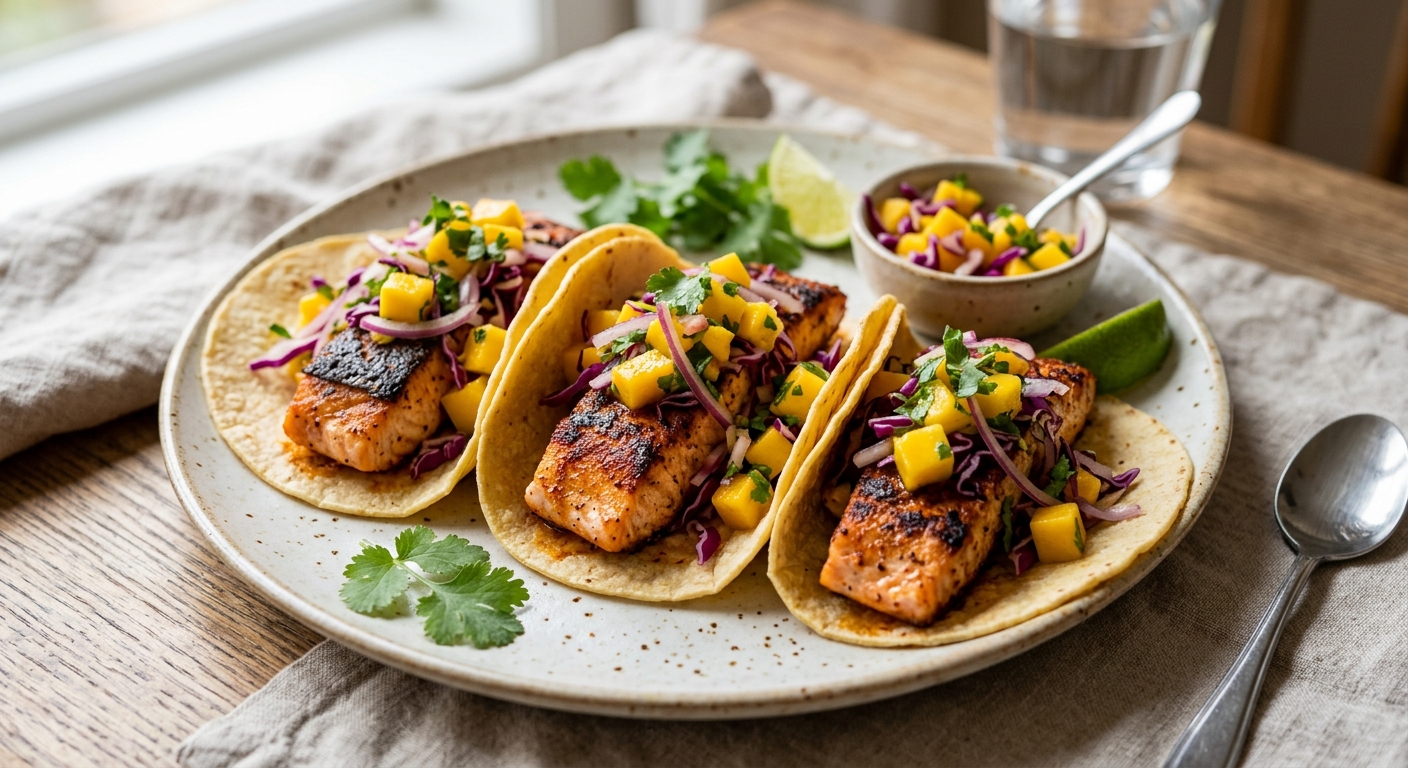
These are not your average beach-shack fish tacos. Every component of this recipe has been deliberately chosen to target systemic inflammation through complementary nutritional pathways. The star is a generous portion of skin-on salmon or mackerel, two of the most omega-3-dense fish available, providing EPA and DHA in the precise triglyceride form that your body absorbs most readily. Unlike plant-based ALA omega-3s that require conversion, the long-chain fatty acids in fatty fish act directly on inflammatory signaling cascades, suppressing the production of pro-inflammatory eicosanoids within hours of consumption.
The mango slaw is far more than a textural counterpoint. Fresh mango contributes beta-carotene and vitamin C, both of which quench reactive oxygen species generated during inflammatory responses. Purple cabbage brings a concentrated dose of anthocyanins, the same pigment-based antioxidants studied extensively for their ability to inhibit NF-kB, a master regulator of inflammation. Lime juice and zest add hesperidin and naringenin, citrus flavonoids that work synergistically with omega-3s to downregulate COX-2, the same enzyme targeted by ibuprofen. The entire dish is built on anti-inflammatory synergy, not just a single hero ingredient.
Corn tortillas keep this recipe gluten-free while providing a modest glycemic load that avoids the blood sugar spikes that themselves trigger inflammatory cytokine release. The avocado crema adds monounsaturated fat, which further supports the absorption of fat-soluble antioxidants from the slaw. This is precision cooking for a precision outcome: a measurably better inflammatory profile with every serving.
4
servings
Ingredients
- 600 gskin-on salmon fillets (or mackerel fillets), pin-boned
- 8 piecesmall corn tortillas (15cm / 6-inch)
- 2 tbspextra-virgin olive oil
- 1 tspsmoked paprika
- 1 tspground cumin
- 0.5 tspground coriander
- 0.5 tspgarlic powder
- 0.25 tspcayenne pepper
- 1 largeripe mango (approx. 300g flesh), peeled and julienned
- 250 gpurple cabbage, very finely shredded
- 1 mediumcarrot, peeled and julienned or grated
- 3 tbspfresh lime juice (from 2 limes)
- 1 tsplime zest
- 1 tbspraw honey
- 1 tbspapple cider vinegar
- 2 largeripe avocados, halved and pitted
- 3 tbspplain Greek yogurt (full-fat)
- 1 smalljalapeño, half finely minced (for crema), half thinly sliced (for topping)
- 20 gfresh cilantro, leaves picked, stems finely chopped
- 1 clovegarlic, minced
- 80 gthinly sliced radishes (approx. 6 radishes)
- —Colima Sea SaltMicroplastic Free Salt and freshly ground black pepper to taste
Instructions
Click on an item below to shop for the recommended items for this recipe on Amazon.
As an Amazon Associate, we earn from qualifying purchases.
- Make the mango slaw first so it has time to macerate. In a large mixing bowl, combine the shredded purple cabbage, julienned mango, and grated carrot. In a small bowl, whisk together the lime juice, lime zest, honey, and apple cider vinegar until the honey dissolves. Pour the dressing over the slaw, add the finely chopped cilantro stems, toss thoroughly, and season with a pinch of salt. Cover and refrigerate for at least 15 minutes, tossing once halfway through.
- Make the avocado crema. Scoop the avocado flesh into a blender or food processor. Add the Greek yogurt, minced jalapeño half, minced garlic, half of the cilantro leaves, and the juice of half a lime. Blend until completely smooth and creamy. Season generously with salt and pepper. Transfer to a bowl, press plastic wrap directly onto the surface to prevent browning, and set aside.
- Pat the salmon fillets thoroughly dry with paper towels. This step is critical for achieving a crispy skin: any surface moisture creates steam and prevents browning. In a small bowl, combine the smoked paprika, cumin, coriander, garlic powder, and cayenne. Sprinkle the spice blend evenly over the flesh side only; season the skin side with just salt and pepper.
- Heat a large cast iron skillet or heavy stainless steel skillet over medium-high heat until it is very hot, about 2 minutes. Add the olive oil and swirl to coat. Place the salmon fillets skin-side down in the pan. Immediately press each fillet firmly with a flexible spatula for the first 30 seconds to prevent the skin from curling. Cook undisturbed, skin-side down, for 5 to 6 minutes until the skin is deeply golden and crispy and the flesh has turned opaque about two-thirds of the way up the sides.
- Flip the fillets gently and cook flesh-side down for just 60 to 90 seconds more. The center should still be slightly translucent for optimal texture and to preserve heat-sensitive omega-3s. Transfer to a cutting board and let rest for 2 minutes, then use a fork to flake the fish into large, rustic chunks, keeping the crispy skin attached where possible.
- While the fish rests, warm the corn tortillas directly over a gas burner on medium flame, or in a dry skillet over medium-high heat, for 20 to 30 seconds per side until lightly charred and pliable. Wrap in a clean kitchen towel to keep warm.
- Assemble the tacos: spread a generous spoonful of avocado crema on each tortilla, top with the mango slaw, add the flaked fish, then finish with sliced jalapeño, radish slices, and the remaining cilantro leaves. Serve immediately with lime wedges.
- Make the mango slaw and avocado crema as described in steps 1 and 2 of the Stovetop method. Refrigerate both until serving.
- Create a poaching liquid in the slow cooker insert. Add 240ml (1 cup) of water or low-sodium fish stock, the juice of one lime, 1 teaspoon of smoked paprika, half a teaspoon of cumin, half a teaspoon of ground coriander, the garlic powder, and the finely chopped cilantro stems. Stir to combine. The liquid should just barely cover the bottom of the insert, creating a steaming-poaching environment rather than a full submersion.
- Pat the salmon fillets dry and season on both sides with salt, pepper, and the cayenne pepper. Lay the fillets in a single layer in the slow cooker insert on top of the poaching liquid. If your fillets are thick, position them with the thicker end toward the outside of the insert where heat is more intense. Drizzle the olive oil over the tops of the fillets.
- Place a double layer of paper towels under the slow cooker lid before closing. The paper towels absorb condensation, preventing dripping water from washing the seasoning off the fish and diluting the concentrated poaching aromatics around it. Cook on Low for 1 hour 30 minutes to 2 hours. The fish is done when it flakes easily with a fork and the thickest part reads 52 to 57 degrees Celsius (125 to 135 degrees Fahrenheit) on an instant-read thermometer.
- Using a wide slotted spatula or two spatulas, carefully transfer the poached fillets to a cutting board. The flesh will be very tender and may break apart, which is perfectly fine for tacos. Drizzle a tablespoon of the aromatic poaching liquid over the fish for extra flavor, then flake gently into large pieces.
- Warm tortillas in a dry skillet and assemble tacos with crema, slaw, flaked fish, sliced jalapeño, radish, and cilantro leaves. The tender, moist fish produced by slow poaching has a particularly luxurious quality that contrasts beautifully with the crisp, bright slaw.
- Make the mango slaw and avocado crema first, following steps 1 and 2 from the Stovetop method. Refrigerate both. The pressure cooker method is so fast that having everything else ready before you cook the fish is essential.
- Pour 240ml (1 cup) of water or fish stock into the Instant Pot or pressure cooker inner pot. Add the lime juice, half of the lime zest, smoked paprika, cumin, coriander, garlic powder, the finely chopped cilantro stems, and half a teaspoon of salt. Stir briefly. Place the steam rack or trivet that came with your appliance into the pot.
- Pat the salmon fillets dry and season on both sides with the cayenne, salt, and pepper. Arrange the fillets on the steam rack in a single layer. If they overlap slightly at the edges that is acceptable, but avoid stacking them. Drizzle the olive oil over the tops of the fillets. The fish will steam-cook on the rack rather than poach in the liquid, which keeps the texture slightly firmer than the slow cooker method while still being very moist.
- Secure the lid and set the pressure release valve to Sealing. Select Manual or Pressure Cook on High Pressure and set the timer for 3 minutes. The pot will take approximately 8 to 10 minutes to come to pressure. Once the cook time is complete, perform an immediate Quick Release by carefully turning the valve to Venting. Do not use Natural Release as residual heat will continue cooking the fish and risk making it dry.
- Open the lid carefully, tilting it away from you to avoid the steam. Check the thickest part of the fillets with an instant-read thermometer; they should read 52 to 57 degrees Celsius (125 to 135 degrees Fahrenheit). Use a wide spatula to transfer the fillets to a cutting board and flake into large chunks. The flesh will be moist, tender, and intensely seasoned from the pressurized aromatic steam.
- Warm tortillas directly over a gas flame or in a dry skillet. Assemble tacos immediately: crema, slaw, fish, sliced jalapeño, radishes, and fresh cilantro leaves. Serve with lime wedges.
- Preheat your oven to 220 degrees Celsius (425 degrees Fahrenheit) with a rack positioned in the upper third of the oven. Line a heavy-duty rimmed baking sheet with a single sheet of foil and set a wire rack on top if you have one; the rack allows hot air to circulate under the fish for more even cooking. If you do not have a wire rack, the foil-lined pan works well too.
- Make the mango slaw and avocado crema following steps 1 and 2 of the Stovetop method. Refrigerate both.
- In a small bowl, combine the smoked paprika, cumin, coriander, garlic powder, cayenne, half a teaspoon of salt, and quarter teaspoon of black pepper. Pat the salmon fillets dry with paper towels. Brush the flesh side of each fillet generously with olive oil, then press the spice rub evenly across the flesh side. Place the fillets skin-side down on the prepared rack or foil.
- Roast in the preheated oven for 12 to 15 minutes, depending on fillet thickness. A 2.5cm (1-inch) thick fillet will be done in 12 minutes; a 3cm fillet may need the full 15 minutes. The fish is done when it flakes easily at the thickest point and an instant-read thermometer reads 52 to 57 degrees Celsius (125 to 135 degrees Fahrenheit). The edges should show light caramelization from the spice rub and the skin should be set and lightly crisped from the oven’s dry heat.
- While the fish roasts, warm the corn tortillas wrapped in damp paper towels in the microwave for 30 to 45 seconds, or wrap them in foil and place them on the lower oven rack for the last 5 minutes of the fish’s cook time.
- Remove the fish from the oven and let it rest on the pan for 2 minutes. Use a fork or spatula to break it into large, generous flakes directly on the pan. Assemble tacos with avocado crema, mango slaw, roasted fish pieces, sliced jalapeño, radish slices, and fresh cilantro leaves. Serve immediately with lime wedges.
Nutrition Breakdown
Per 1 serving (makes 4)
Vitamins & Minerals
% Daily Value based on a 2,000 calorie diet (FDA reference)
🧬 Essential Amino Acids
% of recommended daily intake (RDA) per serving
🛡 Antioxidant Profile
The Nutrition Science
The anti-inflammatory mechanism of EPA (eicosapentaenoic acid) and DHA (docosahexaenoic acid) operates through several complementary pathways. Both fatty acids compete directly with arachidonic acid for incorporation into cell membrane phospholipids. When EPA and DHA predominate, the eicosanoids produced during the inflammatory cascade shift from the highly pro-inflammatory series-2 prostaglandins and series-4 leukotrienes (derived from arachidonic acid) toward the far less inflammatory series-3 and series-5 counterparts. Additionally, EPA and DHA are precursors to resolvins and protectins, a class of specialized pro-resolving mediators (SPMs) that actively switch off inflammation rather than merely suppressing it. A single serving of this recipe provides approximately 2,180mg of combined EPA and DHA, a dose within the range used in peer-reviewed clinical trials showing measurable reductions in CRP (C-reactive protein) and IL-6, two key biomarkers of systemic inflammation.
The anthocyanins in purple cabbage provide a mechanistically distinct but complementary anti-inflammatory action. These polyphenols inhibit the nuclear factor kappa-B (NF-kB) signaling pathway by blocking the phosphorylation and degradation of IkB-alpha, the inhibitory protein that normally keeps NF-kB sequestered in the cytoplasm. When NF-kB is activated, it drives the transcription of dozens of inflammatory cytokines including TNF-alpha, IL-1beta, and IL-6. By keeping NF-kB suppressed, anthocyanins reduce this cytokine storm at the transcriptional level, an upstream intervention that works synergistically with the downstream eicosanoid modulation achieved by omega-3s.
Vitamin D from the salmon adds a third layer of anti-inflammatory regulation. The vitamin D receptor (VDR) is expressed on virtually every immune cell, and activated vitamin D (calcitriol) shifts the immune response away from the inflammatory Th1 and Th17 phenotypes toward the regulatory Treg phenotype. Low vitamin D status is consistently associated with elevated inflammatory markers in epidemiological studies, and this recipe provides 71% of the daily value in a single meal, delivered in the D3 form from fish, which is significantly more bioavailable than plant-derived D2. The selenium from salmon further supports the antioxidant network by serving as a cofactor for glutathione peroxidase, the body’s primary intracellular peroxide-neutralizing enzyme.
Pro Tips
- Buy salmon or mackerel with the skin on and ask your fishmonger to scale it but leave it intact. The skin acts as a natural barrier during searing, protecting the delicate flesh from direct contact with the hot pan and enabling the impressive omega-3-rich fat just beneath the skin to baste the fillet from below as it renders.
- Salt the shredded purple cabbage lightly and let it sit for 5 minutes before adding the dressing. This draws out a small amount of water, concentrates the flavor, and creates a slightly more tender, less squeaky texture in the finished slaw without making it limp.
- To maximize antioxidant absorption from the mango slaw and the fat-soluble beta-carotene and astaxanthin, ensure each taco includes a portion of avocado crema. The monounsaturated fats in avocado are particularly efficient at facilitating the absorption of carotenoids, and studies show co-consumption with avocado can increase beta-carotene absorption by three to five fold compared to eating the same vegetables without fat.
Oh, this is right up my alley! I’ve been eating fatty fish at least four times a week for the past eight years, and it’s made such a noticeable difference in my joint pain and CRP levels. The mango slaw is genius too, since those antioxidants work beautifully alongside the omega-3s. I’m definitely making this tonight, though I’ll probably add some turmeric to the fish marinade since I’ve found that combination works best for my inflammation response. Thank you so much for featuring this powerhouse combo, it’s exactly the kind of intentional nutrition I’ve built my diet around.
This looks amazing, and I’m so glad to see the omega-3 content spelled out like that! I do have a quick question though, Irene: are you using corn tortillas in the recipe, and if so, have you experimented with the iodine levels? I’ve found that with Hashimoto’s, I have to be a bit careful about iodine timing around my thyroid medication, so I’m curious if you have any notes on that. Also wondering if the mango slaw ingredients are nightshade-free since I follow a modified AIP protocol, but this is otherwise exactly the kind of anti-inflammatory meal I’ve been trying to build into my rotation more regularly.
Oh, I love this combination, especially with the mango adding natural enzymes for digestion! I’m curious if you incorporate any turmeric or ginger into the slaw or as a finishing sprinkle over the fish, Irene? I’ve found that pairing omega-3s with anti-inflammatory spices really amplifies the effects, particularly when black pepper is present to boost curcumin absorption. The synergy between fatty fish and warming spices feels so aligned with how Ayurveda approaches food as medicine.