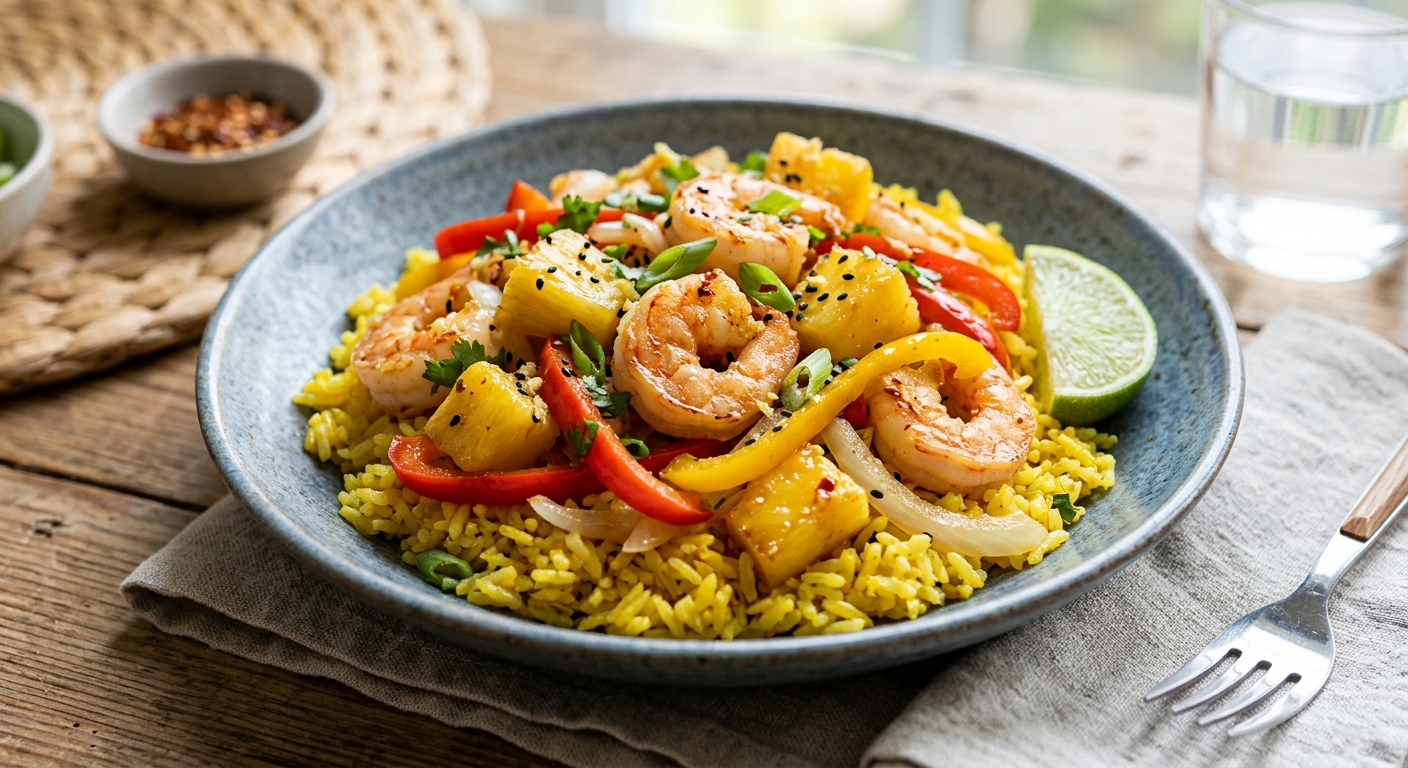
There are weeknight dinners, and then there are weeknight dinners that actively work to reduce inflammation, support joint health, and flood your body with micronutrients it craves. This Pineapple and Ginger Shrimp Stir-Fry with Turmeric Rice falls firmly in the second category. The combination is not accidental: pineapple brings its signature enzyme bromelain, a proteolytic compound with clinically studied anti-inflammatory properties; fresh ginger contributes gingerols and shogaols; and ground turmeric laced through the rice provides curcumin, arguably the most researched anti-inflammatory phytochemical on the planet. Together, they form a triumvirate of natural inflammation modulators wrapped in a dish that genuinely tastes like a tropical celebration.
Shrimp is the ideal protein vehicle for this recipe for reasons beyond convenience. A 150g serving delivers roughly 30g of complete protein, hitting all nine essential amino acids, while remaining exceptionally low in saturated fat. Shrimp is also one of the best dietary sources of selenium and iodine, two minerals chronically under-consumed in modern diets. Paired with jasmine rice enriched with turmeric and a splash of coconut milk, the base becomes creamy, fragrant, and deeply satisfying without tipping calorie counts into problematic territory. Red and yellow bell peppers add a crunch of vitamin C that amplifies the absorption of the dish’s non-heme iron, closing a nutritional feedback loop that most recipes leave open.
What makes this recipe distinctive on Calibrated Cuisine is the care taken to preserve the bioactive compounds through method-appropriate cooking. The stovetop method uses high-heat, short-time stir-fry technique to keep bromelain and gingerols intact. The pressure cooker method leverages a two-stage process, cooking the rice and braising a sauced shrimp component separately to avoid rubbery protein. The slow cooker adaptation builds a deeply flavoured pineapple-ginger braise that transforms the textural profile entirely, making it a different but equally compelling meal. Choose your method based on your schedule, not a compromise on flavour.
4
servings
Ingredients
- 600 graw shrimp, peeled and deveined (16/20 count)
- 300 gfresh pineapple, cut into 2cm chunks
- 300 gjasmine rice, rinsed until water runs clear
- 400 mllight coconut milk
- 200 mlwater (for rice)
- 1 largered bell pepper, thinly sliced
- 1 largeyellow bell pepper, thinly sliced
- 1 mediumwhite onion, thinly sliced
- 4 clovesgarlic, minced
- 30 gfresh ginger, peeled and finely grated (about 3cm piece)
- 2 tspground turmeric, divided
- 1 tspground cumin
- 0.5 tspground black pepper (enhances curcumin absorption)
- 3 tbsptamari (gluten-free soy sauce)
- 1 tbspfish sauce
- 1 tbspraw honey
- 1 tbsprice wine vinegar
- 1 tsptoasted sesame oil
- 3 tbspAvocado Oil100% Pure Avocado Oil or refined coconut oil, divided
- 3 stalksscallions (spring onions), thinly sliced, for serving
- 15 gfresh cilantro leaves, for serving
- 1 mediumlime, cut into wedges, for serving
- —Colima Sea SaltMicroplastic Free Salt and white pepper to taste
Instructions
Click on an item below to shop for the recommended items for this recipe on Amazon.
As an Amazon Associate, we earn from qualifying purchases.
- Make the turmeric rice first: combine the rinsed jasmine rice, coconut milk, water, 1 tsp of the turmeric, 0.25 tsp black pepper, and 0.5 tsp fine sea salt in a medium saucepan. Bring to a boil over high heat, stir once, then reduce heat to the lowest setting. Cover tightly and cook for 15 minutes without lifting the lid. Remove from heat and let steam, still covered, for 5 minutes before fluffing with a fork.
- While the rice steams, prepare the stir-fry sauce: whisk together the tamari, fish sauce, honey, rice wine vinegar, sesame oil, and the remaining 1 tsp turmeric in a small bowl. Set aside.
- Pat the shrimp thoroughly dry with paper towels. This step is critical for achieving a proper sear. Season lightly with salt and white pepper.
- Heat a wok or large skillet over the highest heat your stove allows for 2 minutes until it just begins to smoke. Add 2 tbsp of the avocado oil and swirl to coat. Add the shrimp in a single layer and cook without moving them for 60 to 90 seconds until pink and slightly charred at the edges. Flip each shrimp and cook 30 seconds more. Transfer to a plate immediately. The shrimp will be slightly underdone at this point, which is intentional.
- Return the wok to high heat. Add the remaining 1 tbsp oil. Add the onion and bell peppers and stir-fry, tossing constantly, for 2 to 3 minutes until softened at the edges but still with a bite. Push the vegetables to the sides of the wok.
- Add the garlic and ginger to the centre of the wok and stir-fry for 30 seconds until fragrant. Incorporate the vegetables from the sides. Add the pineapple chunks and toss everything together for 1 minute until the pineapple begins to caramelise.
- Pour the sauce over the wok contents and toss to coat. Return the shrimp and any resting juices to the wok. Toss everything together over high heat for 60 seconds until the shrimp are cooked through and the sauce coats everything in a glossy glaze. Taste and adjust salt if needed.
- Serve immediately over the turmeric rice, topped with sliced scallions, fresh cilantro, and a squeeze of lime.
- Build the braise base in the slow cooker insert: add the onion, red bell pepper, yellow bell pepper, garlic, grated ginger, pineapple chunks, ground turmeric (1.5 tsp), cumin, and black pepper. Stir to distribute evenly.
- Whisk together the tamari, fish sauce, honey, rice wine vinegar, sesame oil, and 100ml of the coconut milk in a bowl. Pour over the vegetable and pineapple mixture in the slow cooker. Stir gently, cover, and cook on Low for 2 hours and 40 minutes. The pineapple will break down slightly and the peppers will become tender and deeply flavoured.
- About 25 minutes before serving, make the turmeric rice: combine the rinsed jasmine rice, remaining coconut milk (300ml), water, 0.5 tsp turmeric, and 0.5 tsp fine sea salt in a medium saucepan. Bring to a boil over high heat, stir once, reduce to the lowest setting, cover tightly, and cook for 15 minutes. Remove from heat and steam covered for 5 more minutes before fluffing.
- Pat the shrimp dry and season lightly with salt and white pepper. Coat them in the remaining 1 tbsp avocado oil. Add the shrimp directly to the slow cooker, gently pushing them under the braising liquid. Replace the lid and cook on Low for a further 18 to 22 minutes, checking at 18 minutes. The shrimp are done when they are pink, opaque, and just curled. Do not overcook.
- Taste the braise and adjust seasoning with salt or a small splash of fish sauce if needed. The sauce will be thinner than the stovetop glaze but deeply savoury and fragrant. Serve ladled over turmeric rice, topped generously with scallions, cilantro, and fresh lime wedges.
- Cook the turmeric rice first using the Pressure Cook (Manual) function: add the rinsed jasmine rice, coconut milk, water, 1 tsp turmeric, 0.5 tsp salt, and 0.25 tsp black pepper to the inner pot. Seal the lid and set the steam release valve to Sealing. Select High Pressure and set the timer for 3 minutes. Once the cook cycle ends, allow a 10-minute natural pressure release, then manually release any remaining pressure. Carefully open the lid, fluff the rice with a fork, and transfer to a bowl. Cover loosely with foil to keep warm.
- Do not wash the inner pot. Use a paper towel to wipe out any remaining rice. Select the Saute (High) function. Add 2 tbsp avocado oil. When the display reads ‘Hot’, add the onion and bell peppers and saute for 3 to 4 minutes, stirring frequently, until beginning to soften.
- Add the garlic and ginger and saute for 60 seconds until fragrant. Add the pineapple and stir to combine. Saute for 1 minute.
- Pour in the tamari, fish sauce, honey, rice wine vinegar, and sesame oil. Stir to incorporate, scraping up any browned bits from the bottom of the pot with a wooden spoon (this prevents the Burn warning). Press Cancel to exit Saute mode.
- Pat the shrimp dry and season with salt and white pepper. Arrange the shrimp in a single layer on top of the pineapple and vegetable mixture. Do not stir. Seal the lid and set the steam release valve to Sealing. Select Low Pressure (not High) and set the timer for 1 minute. Use an immediate quick release as soon as the cycle ends.
- Open the lid carefully. The shrimp should be pink and just cooked through. If any appear translucent, replace the lid (without sealing) and let the residual heat finish them for 2 minutes on the Keep Warm setting. Drizzle with the remaining 1 tbsp avocado oil and sesame oil. Stir gently. Serve over the turmeric rice with scallions, cilantro, and lime.
- Preheat the oven to 220C (425F) with two large rimmed sheet pans inside for at least 10 minutes. Preheating the pans ensures immediate contact heat that jump-starts caramelisation. Start the turmeric rice on the stovetop during this time: combine the rinsed jasmine rice, coconut milk, water, 1 tsp turmeric, and 0.5 tsp salt in a saucepan. Bring to a boil, stir once, cover, and cook on the lowest setting for 15 minutes. Remove from heat and let steam covered for 5 minutes.
- Prepare the glaze: whisk together the tamari, fish sauce, honey, rice wine vinegar, sesame oil, remaining 1 tsp turmeric, cumin, and black pepper in a large bowl. Divide the glaze into two portions, roughly two-thirds and one-third.
- Toss the bell peppers, onion, garlic, ginger, and pineapple chunks in the larger portion of the glaze with 2 tbsp avocado oil. Spread in an even single layer across both preheated sheet pans, leaving space between pieces. Roast for 10 minutes.
- While the vegetables roast, pat the shrimp thoroughly dry and toss them in the reserved one-third portion of glaze with the remaining 1 tbsp avocado oil. Season lightly with salt and white pepper.
- After the vegetables have roasted for 10 minutes, remove the sheet pans from the oven and use a spatula to push the vegetable and pineapple mixture to the edges of each pan. Place the marinated shrimp in the centre of the pans in a single layer. Return to the oven and roast for a further 8 to 10 minutes, until the shrimp are pink and opaque and the pineapple edges are deeply caramelised. Watch closely after 8 minutes as shrimp can overcook quickly at this temperature.
- Remove from the oven and rest for 2 minutes. Scrape everything into a large serving bowl, making sure to include all the sticky caramelised glaze from the pans. Serve over turmeric rice topped with scallions, fresh cilantro, and lime wedges.
Nutrition Breakdown
Per 1 serving (makes 4)
Vitamins & Minerals
% Daily Value based on a 2,000 calorie diet (FDA reference)
🧬 Essential Amino Acids
% of recommended daily intake (RDA) per serving
🛡 Antioxidant Profile
The Nutrition Science
The anti-inflammatory credibility of this dish rests on three well-studied compounds working through complementary mechanisms. Curcumin, the active polyphenol in turmeric, has been documented in over 3,000 published studies. Its primary mechanism involves the suppression of Nuclear Factor kappa B (NF-kB), a transcription factor that acts as a master regulator of inflammation, controlling the expression of over 500 genes linked to inflammatory and immune responses. Critically, curcumin’s bioavailability is dramatically enhanced by piperine, the active compound in black pepper. A mere 20mg of piperine (achievable through half a teaspoon of ground black pepper) has been shown to increase curcumin absorption by up to 2000% by inhibiting hepatic and intestinal glucuronidation. This is why the recipe specifically includes black pepper in the rice. The fat from coconut milk further enhances absorption, as curcumin is fat-soluble.
Fresh ginger’s bioactive compounds, primarily 6-gingerol and its dehydrated form 6-shogaol, have demonstrated the ability to simultaneously inhibit both cyclooxygenase (COX) and lipoxygenase (LOX) enzymes. This dual inhibition is significant because most pharmaceutical NSAIDs target only the COX pathway. LOX products, including leukotrienes, are central mediators in allergic inflammation and asthma. Research published in the Journal of Medicinal Food has shown that ginger extract can reduce serum levels of TNF-alpha and IL-6, both key pro-inflammatory cytokines, in a dose-dependent manner. The 30g of fresh ginger in this recipe contributes a meaningful therapeutic dose rather than a mere flavouring quantity.
Shrimp’s selenium content deserves particular attention in the anti-inflammatory context. Selenium is the essential cofactor for glutathione peroxidase, the body’s primary endogenous antioxidant enzyme system. Glutathione peroxidase neutralises lipid hydroperoxides, reactive oxygen species that, when unchecked, drive oxidative stress and chronic low-grade inflammation. The 52mcg of selenium per serving represents 95% of the daily value, effectively saturating the production capacity of glutathione peroxidase for the day. Combined with the vitamin C from bell peppers, which regenerates oxidised glutathione back to its active reduced form, this dish creates a self-reinforcing antioxidant network rather than a collection of isolated nutrients.
Pro Tips
- Buy fresh pineapple rather than canned for the stovetop and oven methods. Canned pineapple has been heat-treated, which denatures bromelain entirely. For the slow cooker method, where you are braising rather than relying on enzymatic activity, canned will work in a pinch.
- The single most important technique for perfect shrimp in any method is thorough drying before cooking. Moisture on the surface of shrimp creates steam that prevents the Maillard reaction from occurring, leaving you with grey, boiled-tasting shrimp instead of sweet, caramelised ones. Use fresh paper towels and press firmly.
- To maximise curcumin bioavailability, eat this dish with a source of fat, which coconut milk already provides, and always include the black pepper in the rice. If you want to amplify the anti-inflammatory effect further, add an additional 0.5 tsp of freshly cracked black pepper to the sauce before serving.


This is such a smart combo, and I love that you’re thinking about the neuroinflammation angle because that’s where the epigenetic story gets really interesting to me. I’ve been experimenting with exactly this kind of pairing because curcumin and gingerols are both known methylation modulators, meaning they might actually be influencing gene expression patterns related to inflammatory pathways, not just reducing inflammation acutely. The shrimp adds choline too, which is a major methylation donor, so you’re essentially stacking your epigenetic support in one bowl. Have you noticed any cognitive or mood shifts since being intentional about these combinations, or is that something you’re still tracking?
This is exactly the kind of thoughtful combination I’ve been looking for, thank you for laying out the science so clearly. The bromelain/curcumin/gingerol trio is something I’m really intentional about because of how they work on neuroinflammation, and I love that you’re building them into one cohesive dish rather than treating them as separate supplements. Quick question, what’s the vitamin D situation with the shrimp in this recipe, or would you typically pair it with something to round that out? I’m always hunting for ways to hit my targets without overthinking prep on days when my energy is low.
This is such a practical question – I’ve been tracking the same thing since my IBS got really bad about four years ago, and I realized vitamin D absorption was actually limiting how well the anti-inflammatory compounds were working for me! The shrimp does have some D, but honestly pairing it with something like a simple side salad with olive oil based dressing or even just eating it with avocado slices has made a noticeable difference in my inflammation markers the next day. On low-energy days, I literally just add a handful of roasted salmon or canned sardines to bulk up the D content without extra prep – might be worth trying if you’re in that boat too?