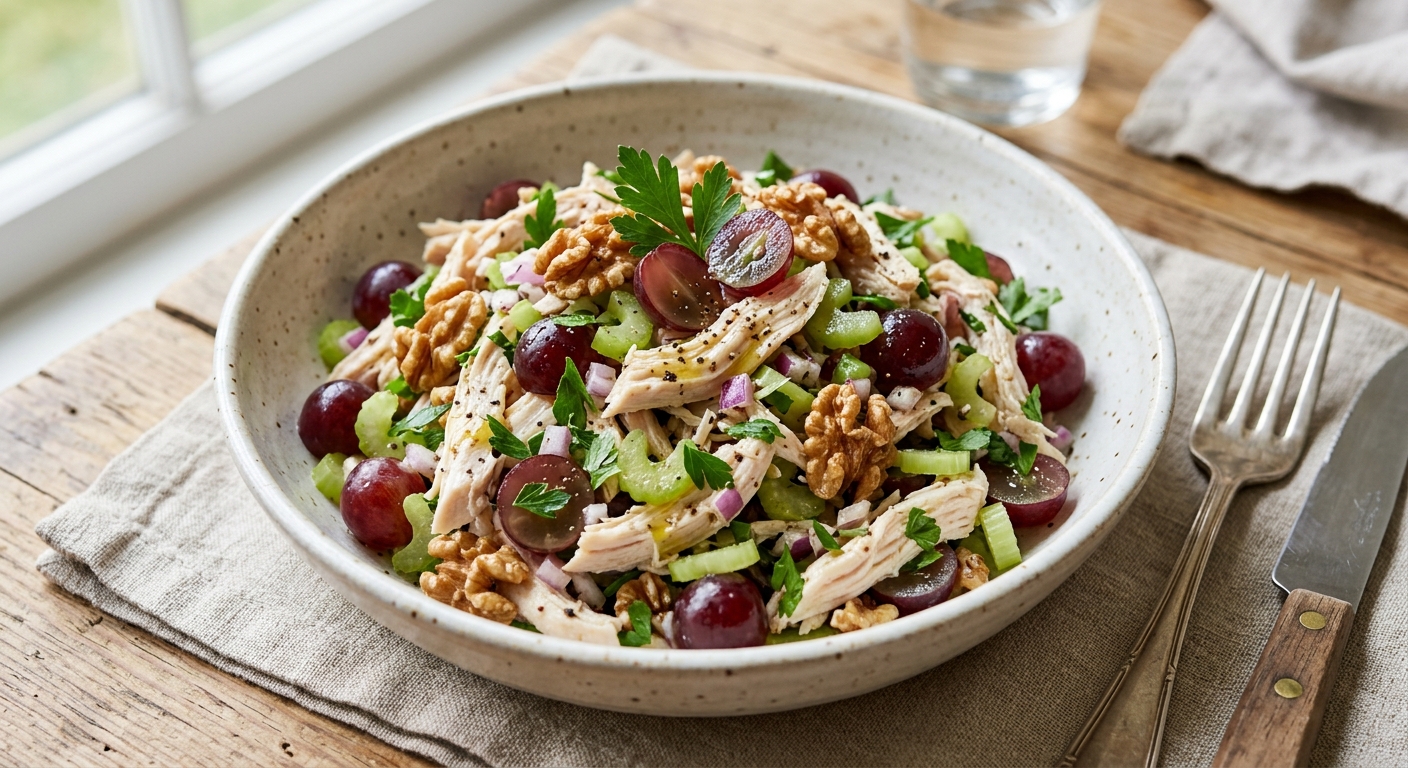
Some salads are merely meals. This one is a carefully constructed anti-inflammatory strategy disguised as something you genuinely cannot stop eating. The Grape and Walnut Chicken Salad brings together four nutritional heavyweights: resveratrol-dense red grapes, omega-3-rich walnuts, high-quality lean protein from chicken breast, and polyphenol-packed extra-virgin olive oil. Each ingredient earns its place not just for flavor, but for the specific biochemical contribution it makes to lowering inflammatory markers in the body.
The concept for this dish grew out of the Mediterranean dietary pattern, where fruit, nuts, lean protein, and quality fats coexist on the same plate as a matter of course. What makes this version different from a standard chicken salad is the deliberate selection of red (or black) grapes over green: the darker pigment signals a higher concentration of anthocyanins and resveratrol, the polyphenols that have been studied extensively for their role in modulating NF-kB inflammatory pathways. Paired with ellagic acid from walnuts and the oleocanthal in olive oil, this salad delivers an anti-inflammatory triple punch in a single bowl.
From a culinary standpoint, the technique of gently poaching or slow-cooking the chicken keeps it extraordinarily moist and allows it to absorb the aromatics in the cooking liquid, building flavor from the inside out. Toasting the walnuts in a dry pan for just a few minutes before adding them unlocks their volatile oils, transforming them from pleasant to extraordinary. The result is a salad that holds up beautifully for meal prep, tastes better after an hour in the refrigerator, and works as a light dinner, a protein-forward lunch, or a sophisticated dish for entertaining.
4
servings
Ingredients
- 700 gboneless skinless chicken breasts (about 2 large)
- 280 gred seedless grapes, halved
- 100 graw walnut halves
- 80 gcelery (about 3 stalks), thinly sliced
- 60 gred onion, finely diced
- 40 gflat-leaf parsley, roughly chopped
- 3 tbspextra-virgin olive oil
- 2 tbspfresh lemon juice
- 1 tsplemon zest
- 1 tbspDijon mustard
- 1 tspraw honey
- 2 clovesgarlic, minced
- 1 tspdried thyme
- 1 tspsmoked paprika
- 600 mllow-sodium chicken broth (for poaching)
- 1 wholebay leaf
- 4 cupsmixed salad greens or baby spinach, to serve
- —Colima Sea SaltMicroplastic Free Salt and cracked black pepper to taste
Instructions
Click on an item below to shop for the recommended items for this recipe on Amazon.
As an Amazon Associate, we earn from qualifying purchases.
- Toast the walnuts first: place them in a dry skillet over medium heat. Stir or toss every 30 seconds for 4 to 5 minutes until fragrant and lightly golden. Watch carefully as they can go from golden to burnt quickly. Transfer immediately to a cutting board, let cool for 5 minutes, then roughly chop. Set aside.
- Place the chicken breasts in a wide saucepan or deep skillet in a single layer. Pour in the chicken broth and add enough cold water to just cover the chicken by about 2cm. Add the bay leaf, a pinch of salt, and half the minced garlic. Bring to a gentle simmer over medium heat, which should take 8 to 10 minutes.
- Once you see the first bubbles breaking the surface, reduce the heat to medium-low to maintain a very gentle simmer (approximately 85 to 90 degrees Celsius). Cook for 15 to 18 minutes, or until the thickest part of the breast registers 74 degrees Celsius on an instant-read thermometer. Do not boil vigorously.
- Transfer the chicken to a cutting board and let it rest for 10 minutes. Reserve about 2 tablespoons of the poaching liquid. Once rested, use two forks to pull the chicken into generous shreds or cut into 1.5cm dice, depending on your preference.
- While the chicken rests, whisk together the olive oil, lemon juice, lemon zest, Dijon mustard, honey, remaining minced garlic, thyme, smoked paprika, and a pinch of salt and pepper in a large mixing bowl. Whisk in the reserved poaching liquid to loosen the dressing slightly.
- Add the shredded chicken, halved grapes, celery, red onion, and parsley to the bowl. Toss gently to coat everything evenly in the dressing. Taste and adjust seasoning. Fold in the toasted walnuts last to preserve their crunch.
- Serve immediately over a bed of mixed greens or baby spinach, or refrigerate the salad mixture (without the greens) for up to 3 days. The flavors deepen beautifully after an hour of resting in the refrigerator.
- Place the chicken breasts in the slow cooker insert in a single layer. Pour over the chicken broth. Add the bay leaf, half the minced garlic, dried thyme, smoked paprika, and a pinch of salt. The liquid does not need to fully submerge the chicken as the lid creates a steamy environment that cooks the top half gently.
- Set the slow cooker to Low and cook for 2.5 to 3 hours. Avoid lifting the lid during cooking as each peek adds approximately 20 minutes to the cook time. The chicken is ready when it reaches an internal temperature of 74 degrees Celsius and pulls apart easily with two forks.
- While the chicken cooks, prepare the remaining ingredients. Toast the walnuts in a dry skillet over medium heat for 4 to 5 minutes, stirring frequently, until fragrant and lightly golden. Transfer to a cutting board to cool, then roughly chop. Prep the grapes, celery, red onion, and parsley and keep them refrigerated until needed.
- Remove the cooked chicken from the slow cooker and let it rest on a cutting board for 10 minutes. Reserve 2 tablespoons of the cooking liquid from the insert. Shred the chicken with two forks into generous pieces while still warm, as it shreds far more easily at this stage than when cold.
- In a large bowl, whisk together the olive oil, lemon juice, lemon zest, Dijon mustard, honey, remaining raw garlic, and the reserved cooking liquid. Season with salt and pepper. Add the warm shredded chicken to the dressing and toss so it absorbs the flavors as it cools.
- Once the chicken mixture has cooled to room temperature (about 15 minutes), fold in the grapes, celery, red onion, parsley, and toasted walnuts. Taste and adjust seasoning. Serve over salad greens, or chill for at least 30 minutes for the flavors to fully develop.
- Place the chicken breasts in the pressure cooker pot. Add the chicken broth, bay leaf, half the minced garlic, dried thyme, smoked paprika, and a pinch of salt. The liquid should come at least one-third of the way up the chicken. If using an Instant Pot, ensure you have at least 240ml of liquid in the pot to achieve pressure.
- Seal the lid and set the pressure release valve to the Sealing position. Select Manual or Pressure Cook on High for 8 minutes for standard-sized breasts (approximately 175 to 200g each). For larger breasts over 250g, increase to 10 minutes. The pot will take approximately 8 to 10 minutes to come up to pressure before the timer begins.
- When the cook cycle ends, allow the pressure to release naturally for 5 minutes, then carefully switch the valve to Venting to release the remaining pressure. Never force the lid open while any pressure remains. Open the lid away from you to avoid the steam.
- While the pressure builds and the chicken cooks, toast the walnuts in a dry skillet on the stovetop over medium heat for 4 to 5 minutes until fragrant. Cool and roughly chop. In a large bowl, whisk together the olive oil, lemon juice, lemon zest, Dijon mustard, honey, the remaining raw garlic, salt, and pepper. Set both aside.
- Remove the chicken and let it rest on a cutting board for 5 minutes. Reserve 2 tablespoons of the cooking liquid from the pot. The chicken should shred with almost no effort at this stage. Shred it into generous pieces using two forks or the paddle attachment of a stand mixer for large batches.
- Whisk the reserved cooking liquid into the dressing to add body and depth. Toss the warm shredded chicken in the dressing first, then fold in the grapes, celery, red onion, parsley, and toasted walnuts. Taste, adjust seasoning, and serve immediately over greens or allow to chill for 30 minutes for a more cohesive flavor.
- Preheat your oven to 190 degrees Celsius (375 degrees Fahrenheit). Lightly coat a baking dish large enough to hold the chicken in a single layer with a little olive oil. In a small bowl, combine half the minced garlic, dried thyme, smoked paprika, half a teaspoon of salt, and 1 tablespoon of olive oil. Rub this mixture all over the chicken breasts.
- Place the seasoned chicken breasts in the prepared baking dish. Pour the chicken broth around (not over) the chicken, add the bay leaf, and cover the dish very tightly with aluminum foil. The foil seal is important: it creates a steamy environment that mimics poaching while the oven heat adds a gentle roasted quality to the exterior.
- Roast in the preheated oven for 25 to 28 minutes. Check for doneness at 25 minutes by inserting an instant-read thermometer into the thickest part of the largest breast. You are looking for 74 degrees Celsius. Avoid over-roasting: an extra 5 to 10 minutes past this point will dry out the breast noticeably.
- While the chicken roasts, toast the walnuts on a separate small baking sheet in the same oven for 6 to 8 minutes, checking them at 6 minutes. They should be fragrant and lightly darkened. Remove and let cool on the pan, then roughly chop once cool enough to handle.
- Remove the chicken from the oven and let it rest, still covered with foil, for 10 full minutes. This resting period allows the juices to redistribute throughout the meat. Uncover and transfer the chicken to a cutting board. Reserve 2 tablespoons of the pan juices.
- Slice or shred the chicken. In a large bowl, whisk together the remaining olive oil, lemon juice, lemon zest, Dijon mustard, honey, remaining raw garlic, the reserved pan juices, salt, and pepper. Add the chicken to the dressing while still slightly warm, then fold in the grapes, celery, red onion, and parsley.
- Add the cooled toasted walnuts just before serving to preserve their crunch. Taste and adjust seasoning. Serve over mixed greens or baby spinach. The roasted notes in the chicken add a pleasing complexity against the bright, sweet grapes that makes this oven version particularly well suited to entertaining.
Nutrition Breakdown
Per 1 serving (makes 4)
Vitamins & Minerals
% Daily Value based on a 2,000 calorie diet (FDA reference)
🧬 Essential Amino Acids
% of recommended daily intake (RDA) per serving
🛡 Antioxidant Profile
The Nutrition Science
The anti-inflammatory credentials of this salad rest on a convergence of well-studied bioactive compounds. Resveratrol, the stilbene polyphenol found predominantly in the skin of red and black grapes, has been shown in multiple clinical trials to reduce circulating levels of interleukin-6 (IL-6) and tumor necrosis factor-alpha (TNF-alpha), two key cytokines in the inflammatory cascade. At the quantities delivered by this recipe (approximately 0.8mg per serving from 70g of red grapes per person), the dose is consistent with those used in short-term human intervention studies that observed modest but significant reductions in CRP. Importantly, resveratrol’s bioavailability is enhanced by the concurrent presence of dietary fat, making the olive oil and walnuts in this dish functional partners rather than incidental additions.
Walnuts stand apart from other common nuts because their fat profile is dominated by alpha-linolenic acid (ALA), a plant-based omega-3 fatty acid. A 25g serving of walnuts (the amount per serving in this recipe) provides approximately 2.3g of ALA, which the body can partially elongate to EPA and DHA. While the conversion rate is modest (typically 5 to 10 percent for EPA), the anti-inflammatory contribution is augmented by walnut-specific ellagitannins. These compounds are metabolized by the gut microbiome into urolithins, a class of metabolites that have demonstrated the ability to inhibit aromatase and suppress NF-kB activation, the central transcription factor governing the body’s inflammatory response. Individuals with robust gut microbiomes, particularly those with adequate Gordonibacter and Ellagibacter species, convert ellagitannins most efficiently.
The oleocanthal in extra-virgin olive oil provides a third mechanistic pathway. Oleocanthal non-selectively inhibits both cyclooxygenase-1 (COX-1) and cyclooxygenase-2 (COX-2) enzymes, the same targets as non-steroidal anti-inflammatory drugs (NSAIDs), though at lower potency. Research from the Monell Chemical Senses Center estimates that 50ml of high-phenolic EVOO delivers an anti-inflammatory effect roughly equivalent to 10 percent of an adult ibuprofen dose. This recipe uses 3 tablespoons total across 4 servings, so the effect is modest but meaningful as part of a consistent dietary pattern. When resveratrol, walnut polyphenols, and oleocanthal act together, the synergy across multiple inflammatory pathways represents a more comprehensive anti-inflammatory strategy than any single compound could achieve alone.
Pro Tips
- Use the darkest red or black grapes you can find: Concord, Black Muscat, or Red Globe varieties have the highest anthocyanin and resveratrol concentrations. Pale green grapes contain significantly less of these polyphenols.
- Do not skip the toasting step for the walnuts. Heat volatilizes the aromatic compounds and breaks down some of the bitter tannins in the papery inner skin, resulting in a noticeably sweeter, more complex flavor that complements the grapes.
- For maximum resveratrol retention, avoid adding the dressing while the salad mixture is still hot. Resveratrol is relatively heat-stable but the lemon juice’s acidity is better preserved at lower temperatures, and the grape cell walls are less likely to collapse and release excess juice into the dressing if they have cooled.
omg the walnut and grape combo is SO good for you!! i actually started adding walnuts to like everything after i realized how zinc deficient my kids were, and now theyre obsessed with them mixed into salads. quick question though – is this kid friendly as written or would you suggest swapping anything out? my oldest hates celery texture (i know, i know lol) but i feel like this could be such a sneaky win for getting anti inflammatory foods into picky eaters if i can tweak it a little. the resveratrol from the grapes combined with those omega 3s literally has me SO excited about making this!!
This sounds like such a great salad! I’m totally with you on the walnut benefits, Diane. Just wanted to mention that since I manage a CBS gene mutation and sulfur sensitivities, I have to skip the celery in recipes like this (it’s surprisingly high in sulfur), but I’ve had good results swapping it for cucumber or even diced bell pepper to keep that crisp texture. The grape and walnut combo is genuinely wonderful though, and the resveratrol aspect is really appealing, so I’d definitely still make this with my substitution. Did your kids end up liking any other walnut applications beyond salads?
Oh this is exactly my kind of recipe! I’ve been incorporating more red grapes into my diet over the past couple years after noticing they seem to help with my joint stiffness, and the resveratrol angle is so encouraging. I’m definitely making this soon, though I’ll probably add a generous pour of extra virgin olive oil to the dressing since I’ve found that helps my inflammation markers even more than the lemon alone. Thank you so much for pairing walnuts and grapes together like this, the synergy piece really resonates with my own eight year journey of testing what actually moves the needle on my CRP levels.