
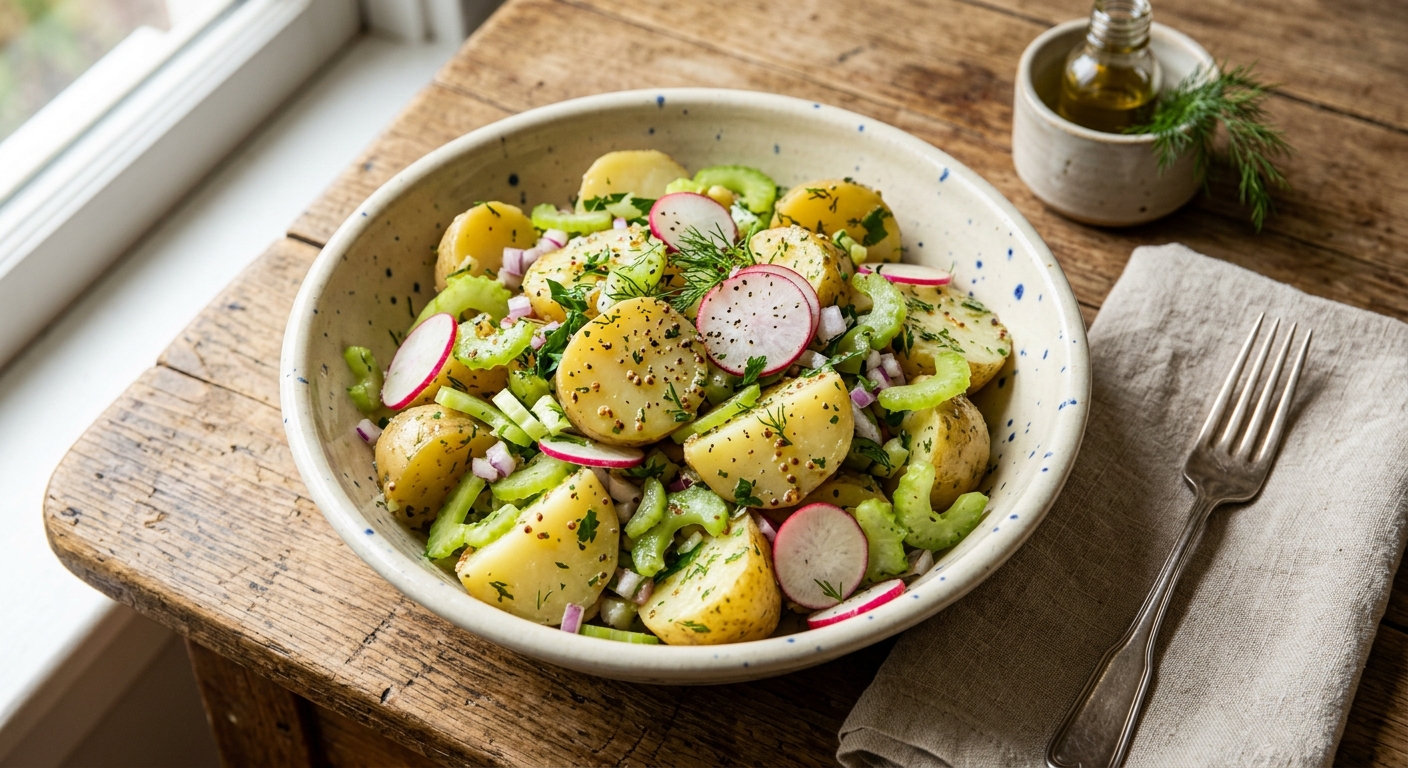
Potato salad has a reputation problem. Most versions are drowning in mayonnaise and offer little beyond simple carbohydrates. This recipe flips that narrative entirely. By cooking waxy potatoes and then chilling them for a minimum of 12 hours, you trigger a process called retrogradation, where the amylose chains re-crystallise into resistant starch type 3 (RS3). The result is a side dish that behaves more like dietary fibre than a simple carbohydrate, resisting digestion in the small intestine and arriving intact in the colon where it acts as a prebiotic fuel source for your gut flora.
The supporting cast here is just as important as the potatoes. Apple cider vinegar provides acetic acid, which independently blunts postprandial blood glucose spikes by slowing gastric emptying. Dijon mustard adds glucosinolates and a sharp emulsifying backbone. Celery and radishes deliver crunch alongside apigenin and anthocyanins. Capers bring a briny punch plus quercetin. Together these ingredients build a complete nutritional profile that hits meaningful daily values for vitamin C, vitamin B6, potassium, and manganese, all without a single gram of gluten or dairy.
The cooking method you choose matters more here than in almost any other recipe on this blog, because your goal is not just to cook the potatoes but to set the stage for optimal resistant starch formation during the mandatory chilling step. Whether you boil on the stovetop, slow-cook, pressure-cook, or oven-roast, each method delivers a different texture and a slightly different starch structure that all benefit from the overnight cool-down. Choose the method that fits your schedule, then let your refrigerator do the nutritional heavy lifting.
4
servings
Ingredients
- 900 gwaxy potatoes (e.g. Yukon Gold or baby red), scrubbed and halved if large
- 3 tbspapple cider vinegar (with the mother)
- 2 tbspextra-virgin olive oil
- 1 tbspDijon mustard
- 1 tspraw honey
- 2 clovesgarlic, minced
- 3 stalkscelery, thinly sliced
- 6 mediumradishes, thinly sliced
- 2 tbspcapers, drained and roughly chopped
- 3 stalksspring onions (scallions), thinly sliced
- 15 gfresh flat-leaf parsley, roughly chopped
- 1 tspsmoked paprika
- 0.5 tspground turmeric
- —Colima Sea SaltMicroplastic Free Salt and freshly cracked black pepper to taste
Instructions
Click on an item below to shop for the recommended items for this recipe on Amazon.
As an Amazon Associate, we earn from qualifying purchases.
- Place the scrubbed potatoes in a large pot and cover with cold water by at least 5 cm (2 inches). Add 1 teaspoon of fine sea salt and 1 tablespoon of the apple cider vinegar directly to the water. Starting in cold water ensures even cooking from the centre outward and prevents the outsides from turning mushy before the interior is done.
- Bring the pot to a boil over high heat, then reduce to a vigorous simmer. Cook uncovered for 18 to 22 minutes, depending on the size of your potatoes. Check doneness by piercing the thickest piece with a paring knife; it should slide in with only slight resistance. You want the potatoes just cooked through, not soft or falling apart, because overcooked potatoes form less resistant starch during retrogradation.
- Drain the potatoes immediately into a colander. Do not rinse them. Allow them to steam-dry in the colander for 5 minutes, then spread them in a single layer on a large rimmed baking sheet. While still warm, drizzle the potatoes with 1 tablespoon of the apple cider vinegar and a small pinch of salt. The warm starch absorbs the vinegar at this stage, building flavour deeper than any dressing applied later can achieve.
- Allow the potatoes to cool at room temperature for 20 to 30 minutes until no longer steaming, then transfer the baking sheet uncovered to the refrigerator. Chill for a minimum of 12 hours, or ideally overnight. This extended cold rest is non-negotiable for maximum RS3 formation.
- When ready to serve, whisk together the remaining 2 tablespoons of apple cider vinegar, olive oil, Dijon mustard, honey, minced garlic, smoked paprika, turmeric, and a generous pinch each of salt and pepper in a large mixing bowl. Add the chilled potatoes, celery, radishes, capers, and spring onions. Fold gently with a large spoon to coat everything in the dressing without breaking up the potatoes. Taste and adjust seasoning, then scatter the fresh parsley over the top. Serve immediately cold, or hold in the refrigerator for up to 3 days.
- Place the scrubbed potatoes in the slow cooker insert in as close to a single layer as your model allows. Add 120 ml (half a cup) of water to the bottom of the insert. Do not add more than this; the potatoes will release their own moisture as they cook and too much liquid causes steaming that turns them waterlogged. Season with half a teaspoon of fine sea salt.
- Drizzle 1 tablespoon of the apple cider vinegar directly over the potatoes. Place the lid on and cook on High for 3 to 4 hours or on Low for 5 to 6 hours. Resist the urge to lift the lid during cooking; each peek releases accumulated steam and adds 20 to 30 minutes to the cook time. The potatoes are ready when a paring knife slides in with slight resistance at the thickest point.
- Carefully lift the potatoes out of the insert using a slotted spoon or tongs, leaving the accumulated liquid behind. Arrange them in a single layer on a large rimmed baking sheet. While still warm, drizzle with another tablespoon of apple cider vinegar and a small pinch of salt. Allow to steam-dry and cool at room temperature for 30 minutes. The absence of boiling water means these potatoes will have a drier surface, which allows the vinegar to penetrate rather than slide off.
- Transfer the baking sheet uncovered to the refrigerator and chill for a minimum of 12 hours. The slow-cooked potatoes tend to be denser and hold their shape even better after chilling, making them particularly suited to being tossed aggressively in the dressing without breaking.
- Whisk together the remaining 2 tablespoons of apple cider vinegar, olive oil, Dijon mustard, honey, minced garlic, smoked paprika, turmeric, salt, and pepper in a large bowl. Add the chilled potatoes, celery, radishes, capers, and spring onions. Because slow-cooker potatoes are firmer, you can fold the salad more vigorously to ensure even coating. Finish with fresh parsley and serve cold.
- Pour 240 ml (1 cup) of water into the Instant Pot or pressure cooker insert and place the steam rack or trivet inside. Arrange the scrubbed potatoes on top of the trivet in a pile (they do not need to be in a single layer here, as the steam circulates evenly under pressure). The trivet keeps the potatoes above the water so they steam rather than boil, preserving their structure.
- Secure the lid, ensure the steam valve is set to the Sealing position, and cook on Manual High Pressure for 8 minutes for medium potatoes (about 4 cm across). If your potatoes are smaller, reduce to 6 minutes; for larger halves over 5 cm, add 2 minutes. The pressurisation process itself takes about 10 minutes and counts toward your total time.
- As soon as the cook time ends, immediately perform a Quick Release by carefully turning the steam valve to Venting. Do not use Natural Release for this recipe; the residual heat during a natural release will continue cooking the potatoes and risk making them too soft for salad. Once pressure drops completely, open the lid and check doneness with a paring knife. The knife should meet very slight resistance at the centre.
- Transfer the potatoes to a large rimmed baking sheet using tongs. While still hot, drizzle with 1 tablespoon of the apple cider vinegar and a pinch of salt. The rapid pressure-cooking process creates a slightly more gelatinised outer layer than stovetop boiling, which means the warm vinegar absorbs particularly well. Allow the potatoes to cool uncovered at room temperature for 20 minutes, then refrigerate uncovered for a minimum of 12 hours.
- Once fully chilled, whisk together the remaining vinegar, olive oil, mustard, honey, garlic, smoked paprika, turmeric, salt, and pepper. Add the potatoes, celery, radishes, capers, and spring onions and fold to combine. The pressure-cooked potatoes will have a distinctly creamy interior beneath their skin; press gently with your spoon to encourage a few pieces to break open slightly and absorb the dressing, while leaving the majority intact. Finish with parsley and serve cold.
- Preheat your oven to 200 C (400 F) with a large, heavy rimmed baking sheet inside. Heating the pan in the oven is essential for getting immediate contact heat on the potatoes, which jumpstarts browning and prevents sticking. While the oven heats, toss the scrubbed potatoes in 1 tablespoon of the olive oil, half a teaspoon of fine sea salt, the smoked paprika, and the turmeric in a large bowl until evenly coated.
- Carefully remove the hot baking sheet from the oven using oven mitts. Working quickly, arrange the seasoned potatoes cut side down in a single layer on the hot pan. You should hear an immediate sizzle. Place the pan back in the oven and roast for 20 minutes without disturbing, to allow the cut faces to develop a golden crust.
- After 20 minutes, flip each potato piece with a thin metal spatula. Reduce oven temperature to 190 C (375 F) and continue roasting for another 15 to 20 minutes, until the potatoes are deeply golden, the skins are slightly blistered, and a paring knife slides in with just a hint of resistance. The interior should be fully cooked through but not fluffy or mealy.
- Remove the pan from the oven and, while the potatoes are still hot, drizzle 1 tablespoon of apple cider vinegar directly over them on the pan. The vinegar will sizzle and steam briefly, partially deglazing any browned bits from the pan. Use a spatula to scrape those flavour-rich bits back onto the potatoes. Allow to cool on the pan at room temperature for 20 to 30 minutes.
- Transfer the potatoes to the refrigerator on the baking sheet, uncovered, and chill for a minimum of 12 hours. Overnight chilling is especially transformative for oven-roasted potatoes: the crust softens slightly while the resistant starch sets, and the result is a uniquely textured salad with chewy, lightly caramelised edges. To finish, whisk the remaining vinegar with the remaining olive oil, mustard, honey, garlic, salt, and pepper. Toss gently with the chilled potatoes, celery, radishes, capers, and spring onions. Finish with parsley and serve cold.
Nutrition Breakdown
Per 1 serving (makes 4)
Vitamins & Minerals
% Daily Value based on a 2,000 calorie diet (FDA reference)
🧬 Essential Amino Acids
% of recommended daily intake (RDA) per serving
🛡 Antioxidant Profile
The Nutrition Science
The central nutritional claim of this recipe rests on a well-established phenomenon in food chemistry: starch retrogradation. When potatoes are cooked, heat disrupts the tight crystalline structure of amylose and amylopectin chains, gelatinising the starch and making it rapidly digestible. If those same potatoes are then cooled to refrigerator temperature (around 4 C) for 12 or more hours, the amylose chains reassociate into ordered crystalline structures called RS3 resistant starch. Human digestive enzymes cannot cleave these retrograded crystals, so they pass intact through the small intestine and are fermented in the colon by Bifidobacterium, Lactobacillus, and Faecalibacterium prausnitzii species. This fermentation produces short-chain fatty acids, primarily butyrate, propionate, and acetate, which are the primary energy source for colonocytes, strengthen the gut barrier, and signal satiety hormones including peptide YY and GLP-1.
The glycemic benefit of cooling is measurable and significant. Research published in the European Journal of Clinical Nutrition found that cooking and cooling potatoes reduced their glycemic index by approximately 25 to 40 percent compared with freshly cooked hot potatoes. The apple cider vinegar dressing amplifies this effect: acetic acid has been shown in multiple randomised controlled trials to reduce postprandial blood glucose by 20 to 30 percent when consumed with a carbohydrate-containing meal, operating through inhibition of the enzyme alpha-glucosidase and delayed gastric emptying. Turmeric and its active compound curcumin add a third layer of glycemic modulation by improving insulin sensitivity through PPAR-gamma receptor activation.
Potatoes are also a surprisingly dense source of micronutrients that are frequently underestimated. A single 225g serving of waxy potatoes provides nearly one-third of the daily value for vitamin C, around 29 percent for vitamin B6 (which is essential for neurotransmitter synthesis and glycogen metabolism), and a meaningful contribution to potassium, which most adults consume at only about 60 percent of their adequate intake. The skin of red potatoes specifically contains anthocyanins, a class of flavonoids associated in prospective cohort studies with reduced cardiovascular disease risk and improved cognitive function. Leaving the skin on is therefore a non-negotiable nutritional decision as much as a culinary one.
Pro Tips
- Do not substitute starchy (floury) potatoes such as Russets; their higher amylose content causes them to fall apart during cooking and they do not form RS3 as efficiently as waxy varieties upon cooling.
- The 12-hour minimum chill time is a hard floor, not a guideline. Studies show RS3 content continues to increase up to 24 hours of refrigeration, plateauing after that point, so an overnight chill of 16 to 20 hours is nutritionally optimal.
- Reheating the finished salad destroys the resistant starch by re-gelatinising the crystalline structures. Always serve this dish cold or at room temperature (removed from the fridge 10 minutes before serving) to preserve both the RS3 content and the intended texture.
this is exactly what my vó was doing intuitively like 40 years ago, making big batches of potato salad the night before and we’d eat it cold the next day, and she’d always say the cold potatoes sit better in your stomach than the hot ones. turns out she was just describing resistant starch formation without knowing the science behind it! the vinegar thing too, my family always dressed everything with strong vinegars and i didnt realize until way later that the acidity actually helps slow glucose absorption AND feeds the good bacteria. love seeing traditional food wisdom get validated by microbiome research, its so validating for anyone whose grandma was basically running a fermentation lab in her kitchen without a degree
oh this is brilliant for recovery nutrition, ive been experimenting with cooled potato dishes as part of my post ultra fueling strategy and the sustained energy without the blood sugar spike is game changing! the resistant starch angle makes total sense too, especially since gut health is such a huge factor in how well i can absorb nutrients during heavy training blocks. im definitely trying this before my next race weekend cause having a filling side that actually supports my microbiome instead of just being empty carbs feels like leveling up my whole nutrition game
This is such a smart approach for endurance athletes, Melanie – your intuition about the gut health connection is spot on since compromised intestinal barrier function during intense training can really tank nutrient absorption and recovery! One thing worth noting from a drug-nutrient angle: if you’re taking any NSAIDs regularly for training soreness, the resistant starch and polyphenols in this dish (especially with the vinegar) could actually help protect your gut lining, which is a nice synergy. The sustained energy without the spike you’re experiencing is likely the RS doing exactly what it should, plus those resistant starches are prebiotic fuel for the bacteria that help with everything from immune function to metabolite production