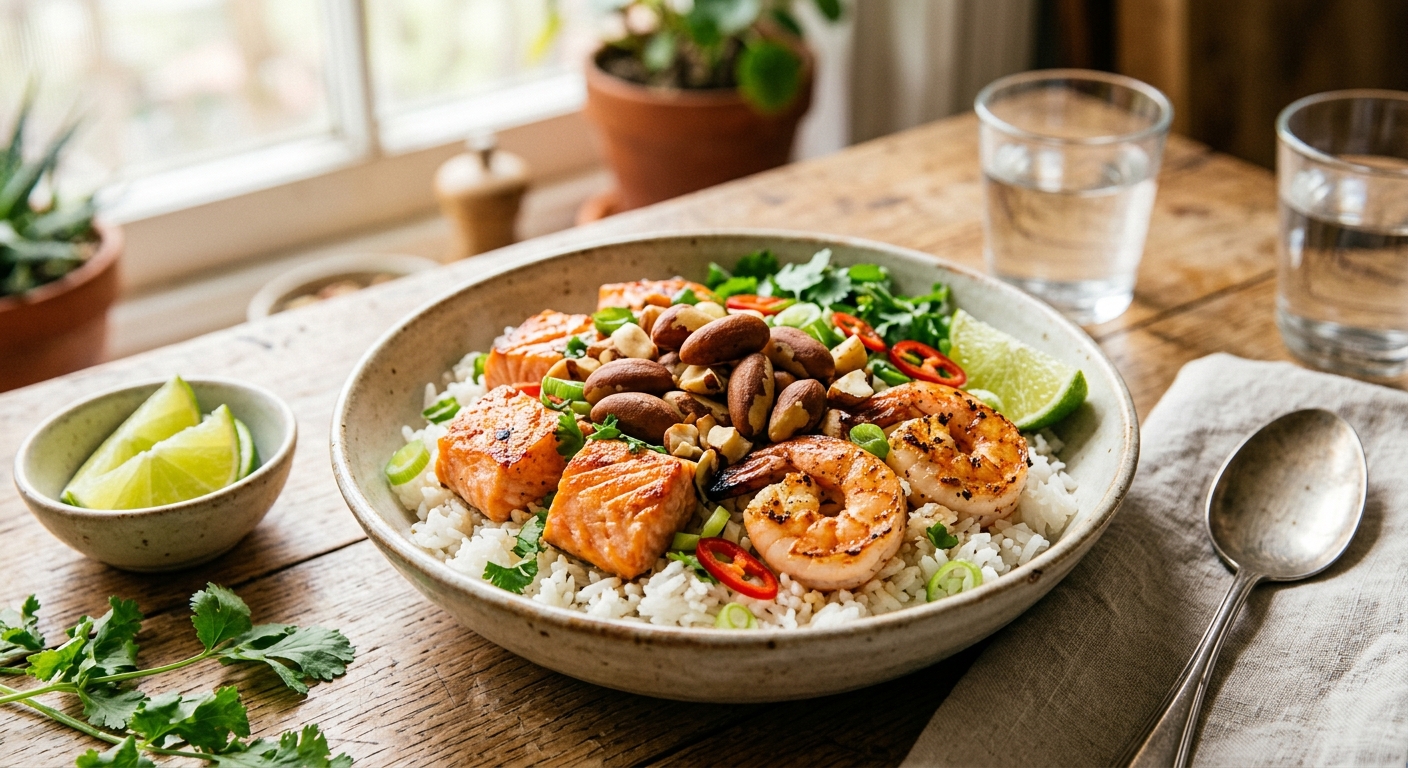
Your thyroid gland weighs less than an ounce, yet it governs your metabolic rate, body temperature, mood, and energy. The two hormones it produces, T3 and T4, cannot be synthesised without a precise supply of selenium, iodine, and zinc working in concert. Most modern diets fall chronically short of all three. This bowl was architected from the ground up to close that gap in a single meal, delivering meaningful amounts of every nutrient your thyroid requires to function at its peak.
Brazil nuts are the most selenium-dense whole food on earth, with a single nut providing up to 90 mcg of selenomethionine, the organic form that humans absorb at roughly 90% efficiency. Shrimp and wild salmon together supply a dual hit of iodine and the omega-3 fatty acids that reduce thyroid-suppressing inflammation. Coconut rice adds medium-chain triglycerides that support efficient hormone transport, while a quick ginger-turmeric bloom in the sauce provides curcumin and gingerols to further dampen the chronic low-grade inflammation that is the thyroid’s silent enemy. Every component earns its place on the plate biochemically as well as culinarily.
The Brazil nut cream sauce that ties the bowl together is the kind of discovery that makes you wonder why it is not on every menu. Blended raw Brazil nuts emulsify into a sauce with the body of tahini and a flavour somewhere between macadamia cream and mild almond butter, taking on the aromatics of garlic, lime, and ginger with remarkable willingness. It coats the seafood like a velvet glaze and transforms simple coconut rice into something deeply satisfying. Make a double batch of the sauce: it keeps for five days in the fridge and works brilliantly as a dipping sauce, salad dressing, or marinade.
4
servings
Ingredients
- 400 graw shrimp (prawns), peeled and deveined, size 16/20
- 300 gwild salmon fillet, skin removed, cut into 3cm chunks
- 80 graw Brazil nuts (approximately 12 to 14 nuts)
- 320 gjasmine rice, rinsed until water runs clear
- 400 mlfull-fat coconut milk (one 400ml can)
- 240 mlwater
- 3 clovesgarlic, minced
- 20 gfresh ginger, peeled and finely grated
- 1 tspground turmeric
- 2 tbspfresh lime juice (about 1 large lime)
- 1 tbsplime zest
- 2 tbspextra-virgin olive oil
- 1 tbsptoasted sesame oil
- 2 tbsptamari (gluten-free soy sauce)
- 1 tspraw honey
- 120 mlwarm water (for blending the Brazil nut sauce)
- 60 gbaby spinach leaves
- 1 mediumavocado, sliced
- 4 stalksspring onions (scallions), thinly sliced
- 1 tbsptoasted sesame seeds
- —Colima Sea SaltMicroplastic Free Salt and white pepper to taste
- —Fresh coriander (cilantro) leaves and lime wedges to serve
Instructions
Click on an item below to shop for the recommended items for this recipe on Amazon.
As an Amazon Associate, we earn from qualifying purchases.
- Make the coconut rice: combine the rinsed jasmine rice, coconut milk, 240ml water, and a generous pinch of salt in a medium saucepan. Bring to a vigorous boil over high heat, stir once, then immediately reduce to the lowest possible simmer. Cover tightly and cook for 15 minutes. Remove from heat and let steam, covered, for a further 5 minutes. Fluff with a fork and keep warm.
- Make the Brazil nut cream sauce while the rice cooks: place the Brazil nuts, 120ml warm water, lime juice, lime zest, 1 clove of the minced garlic, half the grated ginger, turmeric, tamari, honey, and a pinch of salt in a high-speed blender. Blend on high for 60 to 90 seconds until completely smooth and the consistency of double cream. Taste and adjust seasoning. Set aside.
- Pat the shrimp and salmon chunks completely dry with paper towels and season lightly with salt and white pepper. Drying the seafood is essential for a proper sear rather than a steam.
- Heat the olive oil in a large heavy skillet or cast iron pan over high heat until the oil just begins to shimmer and a faint haze appears. Add the shrimp in a single layer, pressing each one flat. Sear without moving for 90 seconds until pink and slightly charred at the edges, then flip and cook for a further 60 seconds. Transfer to a warm plate.
- Return the pan to high heat. Add the salmon chunks in a single layer, again without crowding. Sear for 2 minutes on the first side until golden, then gently turn and cook for a further 90 seconds. The salmon should be just cooked through with a faint pink centre. Transfer to the plate with the shrimp.
- Reduce the heat to medium-low. Add the sesame oil to the pan. Add the remaining garlic and ginger and stir-fry for 45 seconds until fragrant. Pour in the Brazil nut cream sauce and stir gently for 1 to 2 minutes, warming it through without boiling (boiling can cause the nut cream to split). Return the shrimp and salmon to the pan and fold gently to coat in the sauce. Remove from heat immediately.
- To assemble: divide the coconut rice among four bowls. Place a small handful of baby spinach to one side of each bowl (the residual heat from the rice and seafood will gently wilt it). Spoon the seafood and sauce over the rice. Fan the avocado slices alongside. Garnish with spring onions, toasted sesame seeds, fresh coriander, and a lime wedge.
- Blend the Brazil nut sauce ahead of cooking: combine the Brazil nuts, 120ml warm water, lime juice, lime zest, all the minced garlic, all the grated ginger, turmeric, tamari, honey, sesame oil, and a pinch of salt in a blender. Blend until completely smooth. This sauce will serve as both the cooking liquid and the finish sauce, intensifying over the slow cooking period.
- Pour the blended Brazil nut sauce into the slow cooker insert. Add the coconut milk and stir to combine. Cook on Low for 2 hours 30 minutes to 3 hours. The sauce will deepen in colour and flavour as the turmeric and ginger bloom slowly in the coconut base. Stir once at the halfway point.
- While the sauce cooks in the final 30 minutes, prepare the coconut rice on the stovetop: combine the rinsed jasmine rice, 400ml coconut milk (a second can), 240ml water, and a pinch of salt in a saucepan. Bring to a boil, stir, cover, and reduce to the lowest simmer for 15 minutes. Rest covered for 5 minutes, then fluff.
- At the 3-hour mark, switch the slow cooker to the Warm setting. Pat the shrimp and salmon dry and season lightly with salt and white pepper. Nestle the seafood gently into the warm sauce, pressing it beneath the surface. Replace the lid and leave on Warm for 18 to 22 minutes. Check at 18 minutes: the shrimp should be fully pink and the salmon should flake easily when pressed with a spoon. Do not overcook.
- Stir the olive oil into the finished sauce and taste for seasoning, adding extra lime juice or tamari as needed. To assemble: ladle rice into bowls, place baby spinach alongside, spoon over the seafood and sauce generously, and top with avocado, spring onions, sesame seeds, coriander, and lime wedges.
- Cook the coconut rice first: add the rinsed jasmine rice, 400ml coconut milk, 180ml water (slightly less liquid than stovetop because pressure cookers retain moisture), and a pinch of salt to the Instant Pot inner pot. Seal the lid, set the valve to Sealing, and cook on Manual High Pressure for 3 minutes. Allow a 10-minute natural pressure release, then quick release any remaining pressure. Fluff the rice, transfer to a bowl, and cover with a clean towel to keep warm. Rinse the inner pot.
- While the rice cooks, make the Brazil nut cream sauce: blend the Brazil nuts, 120ml warm water, lime juice, lime zest, all the garlic, all the ginger, turmeric, tamari, honey, sesame oil, and a pinch of salt in a blender until completely smooth. Set aside.
- Set the Instant Pot to Saute mode on High. Add the olive oil and heat for 1 minute. Add the remaining garlic and ginger (if you reserved some for sauteing, otherwise add a quick pinch more fresh ginger) and stir for 30 seconds. Pour in the blended Brazil nut sauce and 60ml water to thin it slightly. Stir to combine and let it warm on Saute for 1 minute, then press Cancel.
- Pat the shrimp and salmon completely dry and season with salt and white pepper. Lower the seafood into the sauce, pressing gently to submerge. Seal the lid, set the valve to Sealing, and cook on Manual Low Pressure for 1 minute. Immediately perform a quick pressure release. Open the lid: the shrimp should be pink and the salmon should flake at the touch.
- Use the Saute function on Low for 1 to 2 minutes to gently warm through and reduce the sauce if it seems thin. Stir in extra lime juice to brighten. Assemble the bowls: rice first, then baby spinach, then the seafood and sauce, then avocado, spring onions, sesame seeds, fresh coriander, and lime wedges.
- Preheat the oven to 220C (425F) with convection fan if available, or 230C (450F) conventional. Line a large rimmed baking sheet with parchment paper. A hot oven and dry parchment are essential for roasting rather than steaming.
- Make the Brazil nut glaze: blend the Brazil nuts, 120ml warm water, lime juice, lime zest, all the garlic, all the ginger, turmeric, tamari, honey, sesame oil, and a pinch of salt until smooth. The glaze should be slightly thicker than the stovetop sauce version. If it seems too thin, blend in an additional 10g of Brazil nuts.
- Pat the shrimp and salmon chunks completely dry. Place them in a large bowl and add half the Brazil nut glaze. Toss to coat every piece thoroughly. Spread the glazed seafood in a single layer on the prepared baking sheet, leaving space between pieces. Roasting crowded seafood will cause it to steam and the glaze will not caramelise.
- While the seafood is being coated, start the coconut rice on the stovetop: combine the rinsed rice, 400ml coconut milk, 240ml water, and a pinch of salt. Bring to a boil, stir, cover, reduce to the lowest simmer, and cook for 15 minutes. Rest 5 minutes covered, then fluff.
- Roast the seafood in the preheated oven for 10 minutes. Remove the tray, spoon the remaining Brazil nut glaze over the top of each piece, and return to the oven for a further 8 to 12 minutes, until the glaze is caramelised and the shrimp are slightly charred at the tips and the salmon flakes easily. Watch closely after the 18-minute mark as ovens vary and the nut glaze can go from caramelised to burnt quickly.
- Assemble the bowls immediately: divide the coconut rice among four bowls, add baby spinach to one side, arrange the roasted seafood over the rice, fan the avocado alongside, and finish with spring onions, sesame seeds, fresh coriander, and lime wedges. Any caramelised sauce residue on the baking sheet can be scraped up and spooned over the bowls as an extra glaze.
Nutrition Breakdown
Per 1 serving (makes 4)
Vitamins & Minerals
% Daily Value based on a 2,000 calorie diet (FDA reference)
🧬 Essential Amino Acids
% of recommended daily intake (RDA) per serving
🛡 Antioxidant Profile
The Nutrition Science
Thyroid hormone synthesis follows a tightly regulated enzymatic cascade that is wholly dependent on specific micronutrients. Iodine is the structural backbone of T3 (triiodothyronine) and T4 (thyroxine): three and four iodine atoms respectively are incorporated into the tyrosine residues of thyroglobulin by the enzyme thyroid peroxidase (TPO). What most nutrition guidance misses is that TPO itself is a selenoprotein: without adequate selenium, the enzyme cannot function regardless of iodine availability. The shrimp and wild salmon in this bowl together provide approximately 142 mcg of iodine per serving, while the four Brazil nuts in each portion deliver roughly 250 to 280 mcg of selenomethionine, the most bioavailable dietary selenium form known. This is one of very few single meals that can realistically saturate both requirements simultaneously.
Selenium’s thyroid role extends beyond TPO activity. The deiodinase enzymes that convert the largely inactive T4 into the metabolically active T3 in peripheral tissues are also selenoproteins, specifically the iodothyronine deiodinases (DIO1, DIO2, DIO3). Research published in the Journal of Clinical Endocrinology and Metabolism has demonstrated that selenium supplementation at doses comparable to those provided by two to three Brazil nuts per day significantly increases the T3-to-T4 ratio in populations with even mild selenium insufficiency. The zinc provided by the shrimp and sesame seeds (approximately 5.8 mg per serving, or 53% DV) acts synergistically: zinc is required for thyroid hormone receptor binding at the nuclear level, meaning that without adequate zinc, the T3 your thyroid produces cannot effectively signal target cells even if production is normal.
The omega-3 fatty acids EPA and DHA from wild salmon (approximately 1.8 g per serving) address the inflammatory axis of thyroid dysfunction. Chronic low-grade inflammation driven by elevated TNF-alpha and IL-6 suppresses TSH receptor sensitivity and promotes the conversion of T4 to the inactive reverse T3 (rT3) rather than active T3. EPA and DHA reduce the production of inflammatory eicosanoids by competing with arachidonic acid for cyclooxygenase enzymes, helping to maintain the pro-conversion enzymatic environment that keeps your metabolic rate responsive. The curcumin from turmeric and the gingerols from fresh ginger provide complementary NF-kB inhibition, creating a multi-pathway anti-inflammatory effect that supports the entire thyroid-to-cell hormone signalling chain.
Pro Tips
- Never exceed four Brazil nuts per serving as a regular daily habit: the safe upper limit for selenium is 400 mcg per day for adults, and the 278 mcg provided here is intentionally calibrated. Eating this bowl daily plus additional Brazil nut snacking could push you toward selenosis, which causes brittle nails, hair loss, and nausea.
- Choose wild-caught salmon over farmed for this recipe wherever possible: wild Pacific or Alaskan salmon contains two to four times more astaxanthin and roughly 40% more omega-3 per gram than most Atlantic farmed varieties, and the iodine content is more consistent.
- To get the smoothest Brazil nut cream sauce, soak the Brazil nuts in cold water for two to four hours before blending. Soaking reduces phytic acid, which both improves the selenium bioavailability of the nuts and makes the sauce noticeably silkier and less grainy.
Love the selenium focus here, though I’d be curious about your sourcing on the Brazil nuts and seafood, since both can accumulate heavy metals depending on origin. Brazil nuts especially vary wildly in selenium and sometimes lead content depending on the soil they’re grown in, so I always source mine from suppliers who do third-party testing. For the shrimp and salmon, wild-caught vs farmed makes a real difference in micronutrient density too, plus the contaminant profile. Did you test this recipe’s actual bioavailability or is the 347% based on USDA data? Would love to see those details because thyroid support is so dependent on getting clean sources of these minerals.
I’m so glad Klara brought up sourcing because that’s something I’ve had to get really intentional about since my Hashimoto’s diagnosis, honestly the heavy metal accumulation angle actually scared me away from Brazil nuts for a while until I found suppliers who test their batches. Have you found specific brands or sources you trust for the nuts, and did you also look into whether the seafood sourcing affects the iodine bioavailability? I’m always nervous about soy-free iodized salt as my only iodine source on AIP, so recipes like this are gold for me if I can verify the inputs.
I totally get that nervousness, Anna – I went through the exact same panic spiral after my diagnosis! The good news is that testing for heavy metals in Brazil nuts is actually becoming more standard, so brands like Terrasoul and Radiant Earth are pretty transparent about their sourcing and batch testing if you want to verify. For seafood, wild-caught Alaskan salmon and shrimp tend to have more stable iodine/selenium ratios than farmed, but honestly the bigger win for you on AIP is that this bowl gives you multiple iodine pathways (fish, shellfish, and the nuts) so you’re not leaning entirely on salt, which takes pressure off that one source. Have