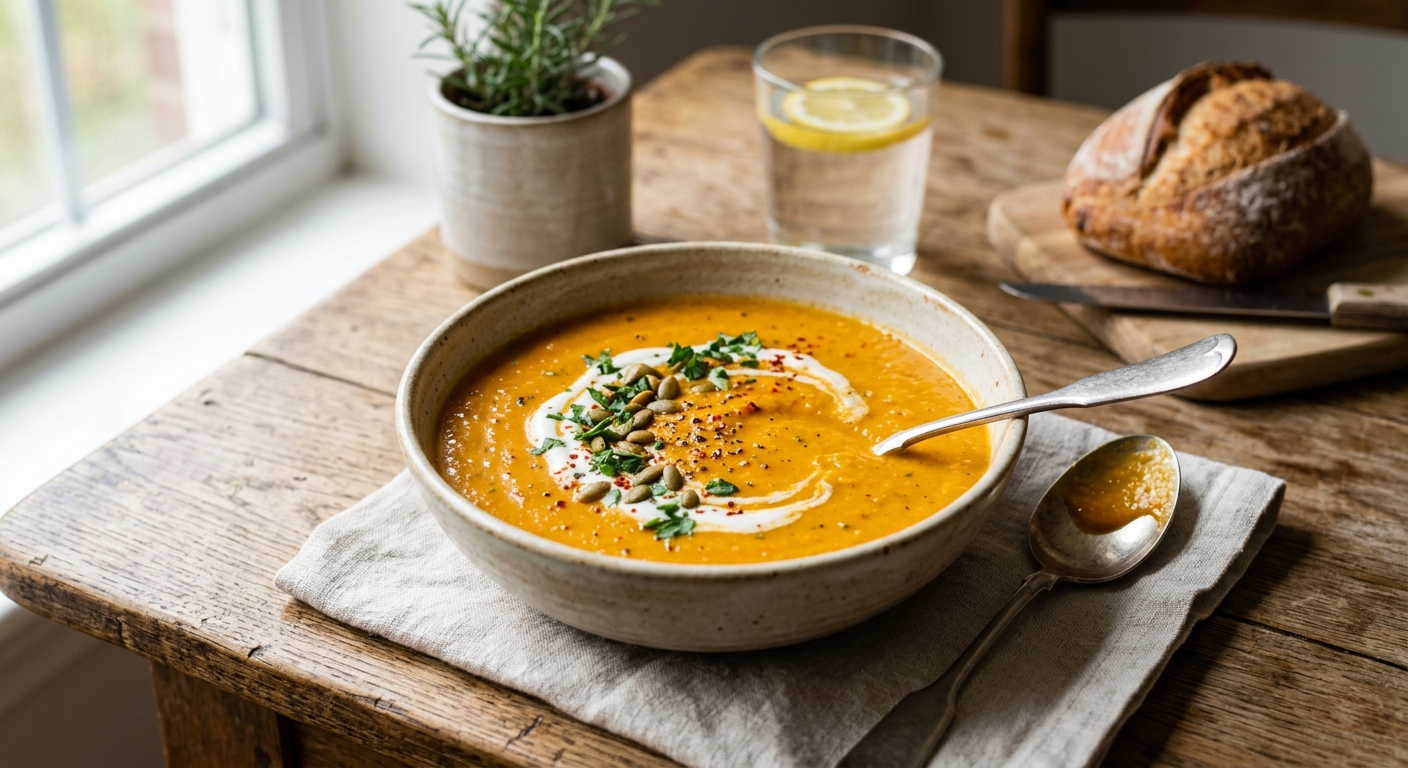
Some soups nourish quietly. This one announces itself. The moment fresh ginger hits hot olive oil and the sweet perfume of roasting carrots fills the kitchen, you know you are making something extraordinary. This Thermogenic Ginger and Cayenne Carrot Soup was built from the ground up as a metabolic powerhouse, pairing the natural thermogenic compounds in ginger and cayenne with one of the most beta-carotene-dense vegetables on the planet. The result is a silky, restaurant-worthy bowl that earns its place on a nutrition-focused table.
Carrots are the unsung heroes of the micronutrient world. A single 200g serving provides more than 100% of your daily vitamin A needs through beta-carotene, a fat-soluble precursor that your body converts on demand. Paired here with extra-virgin olive oil, a healthy fat that dramatically boosts carotenoid absorption, every spoonful is scientifically optimised for uptake. Fresh ginger contributes gingerols and shogaols, bioactive compounds linked to enhanced thermogenesis and digestive comfort, while cayenne delivers capsaicin, the compound responsible for its characteristic heat and its well-documented ability to temporarily elevate metabolic rate.
Whether you build it low and slow in a slow cooker for a hands-off weeknight meal, blast it to perfection in a pressure cooker for a fast lunch, or develop deep caramelised sweetness by roasting the carrots first in the oven before blending, every method produces a soup that is both genuinely delicious and precisely calibrated. Four servings, one pot, and a nutritional profile that covers a remarkable portion of your daily requirements for seven key nutrients.
4
servings
Ingredients
- 800 gcarrots, peeled and roughly chopped into 3cm pieces
- 1 largeyellow onion, roughly chopped
- 4 clovesgarlic, smashed and peeled
- 40 gfresh ginger, peeled and roughly sliced (about a 5cm knob)
- 2 tbspextra-virgin olive oil
- 1 tspcayenne pepper (reduce to 0.5 tsp for moderate heat)
- 1 tspground cumin
- 0.5 tspground turmeric
- 1 litrelow-sodium vegetable stock
- 200 mlfull-fat coconut milk
- 1 mediumorange, zested and juiced (about 60ml juice)
- 1 tbspapple cider vinegar
- —Colima Sea SaltMicroplastic Free Salt and freshly cracked black pepper to taste
- —To serve: a swirl of coconut milk, pumpkin seeds, fresh coriander leaves, a pinch of cayenne
Instructions
Click on an item below to shop for the recommended items for this recipe on Amazon.
As an Amazon Associate, we earn from qualifying purchases.
- Heat 2 tbsp olive oil in a large Dutch oven or heavy-bottomed saucepan over medium heat. Once the oil shimmers, add the chopped onion and a pinch of salt. Cook, stirring occasionally, for 7 to 8 minutes until the onion is soft, translucent, and beginning to turn golden at the edges.
- Add the smashed garlic and sliced ginger to the pot. Stir continuously for 90 seconds, until intensely fragrant and the ginger has softened slightly. Do not let the garlic brown or it will turn bitter.
- Add the cayenne, cumin, and turmeric directly onto the aromatics. Stir constantly for 30 seconds to bloom the spices in the residual oil. This step activates the fat-soluble compounds in the spices, deepening both flavour and bioavailability.
- Add the chopped carrots and toss well to coat every piece in the spiced oil. Pour in the vegetable stock. Raise the heat to medium-high and bring to a rolling boil, then reduce to a steady simmer. Cover partially with a lid and cook for 22 to 25 minutes, until the carrots are completely tender and yield easily when pierced with a knife.
- Remove from heat. Add the coconut milk, orange zest, orange juice, and apple cider vinegar. Using an immersion blender directly in the pot, blend the soup until completely smooth and velvety, about 2 minutes of continuous blending. Alternatively, transfer in batches to a countertop blender, leaving the lid slightly ajar and covered with a folded towel to release steam safely.
- Return the pot to low heat and taste for seasoning. Adjust salt, pepper, and cayenne to your preference. If the soup is too thick, loosen with a splash of hot stock or water. Ladle into bowls and finish with a swirl of coconut milk, a scatter of pumpkin seeds, fresh coriander, and a pinch of cayenne.
- In a small skillet, heat the olive oil over medium heat. Add the onion and cook for just 4 minutes until beginning to soften. Add the garlic, ginger, cayenne, cumin, and turmeric, and stir for 60 seconds until fragrant. Transfer this entire mixture into the bowl of your slow cooker. This brief bloom step concentrates the fat-soluble spice compounds before the long cook.
- Add the chopped carrots, vegetable stock, orange zest, and orange juice directly to the slow cooker. Stir everything together to combine. Do not add the coconut milk or apple cider vinegar yet as extended heat can cause coconut milk to separate and the vinegar will lose brightness over a long cook.
- Place the lid on the slow cooker and cook on Low for 7 hours or High for 3.5 hours. The carrots should be completely soft and the broth deeply fragrant. The long, gentle heat will mellow the ginger slightly and draw natural sweetness from the carrots.
- Turn the slow cooker off. Add the coconut milk and apple cider vinegar now. Using an immersion blender, blend directly in the slow cooker bowl until the soup is completely smooth. The residual heat is sufficient to warm the coconut milk through without curdling it. If you are using a countertop blender, allow the soup to cool for 10 minutes first, then blend in batches with the lid held down firmly.
- Taste and adjust seasoning. If the soup seems flat after the long cook, a little extra apple cider vinegar and a fresh pinch of cayenne will instantly revive the brightness and heat. Serve garnished as desired.
- Set your Instant Pot or electric pressure cooker to Saute mode on Normal heat. Add the olive oil and heat until it reads Hot on the display. Add the onion and cook, stirring, for 5 minutes until softened. Press Cancel to exit Saute mode.
- Immediately add the garlic, ginger, cayenne, cumin, and turmeric to the residual heat in the pot. Stir continuously for 45 seconds. The residual heat is enough to bloom the spices without burning them. Add the chopped carrots and toss to coat.
- Pour in the vegetable stock and deglaze by scraping the bottom of the pot with a wooden spoon to release any stuck bits. This is essential in a pressure cooker as stuck-on residue can trigger the burn warning. Add the orange zest and orange juice. Do not add coconut milk yet.
- Seal the lid and set the pressure release valve to Sealing. Cook on Manual High Pressure for 10 minutes. Once the cook cycle is complete, allow natural pressure release for 5 minutes, then carefully switch the valve to Venting to release the remaining pressure.
- Open the lid and check that the carrots are completely tender. Add the coconut milk and apple cider vinegar. Use an immersion blender to blend the soup directly in the pot until perfectly smooth and glossy. If using a countertop blender, work in small batches as the soup is very hot. Taste, season generously with salt and pepper, and add extra cayenne for more heat. Serve immediately with toppings.
- Preheat your oven to 210C (190C fan / 410F). Line a large rimmed baking sheet with parchment paper. Spread the chopped carrots, onion, garlic cloves, and ginger slices across the baking sheet in a single layer. Drizzle with the olive oil and season generously with salt and pepper. Toss well with your hands to coat everything evenly.
- Scatter the cayenne, cumin, and turmeric over the vegetables and toss once more. Roast on the middle rack for 35 to 40 minutes, flipping the carrots once at the 20-minute mark, until the edges are caramelised, slightly blistered, and deeply golden. The garlic should be soft and jammy inside its skin.
- Transfer all of the roasted vegetables, including any caramelised juices from the parchment, into a large saucepan or Dutch oven on the stovetop over medium heat. Pour in the vegetable stock, orange zest, and orange juice. Bring to a simmer and cook for 10 minutes to allow the stock to absorb the roasted flavours and fully hydrate any caramelised bits.
- Remove from heat and add the coconut milk and apple cider vinegar. Blend with an immersion blender until completely smooth. Because the roasted carrots have a denser, slightly drier texture than boiled ones, you may need to add an extra 100 to 150ml of hot stock or water to reach your preferred consistency. Blend again after any additions.
- Return to low heat for 3 to 4 minutes to bring the soup back to serving temperature. Taste carefully and season. The roasting process concentrates sweetness, so a slightly more generous hand with the cayenne and vinegar is recommended here to maintain balance. Serve in warmed bowls with all garnishes.
Nutrition Breakdown
Per 1 serving (makes 4)
Vitamins & Minerals
% Daily Value based on a 2,000 calorie diet (FDA reference)
🧬 Essential Amino Acids
% of recommended daily intake (RDA) per serving
🛡 Antioxidant Profile
The Nutrition Science
The metabolic effects of this soup are rooted in two well-characterised compounds: capsaicin from cayenne and gingerols from fresh ginger. Capsaicin binds to TRPV1 (transient receptor potential vanilloid 1) channels in the body, triggering a thermogenic response that research has shown can increase energy expenditure by 4 to 5% and fat oxidation by up to 16% in the hours following consumption. While the absolute caloric effect is modest, the consistent daily inclusion of capsaicin-containing foods is associated with measurable improvements in metabolic rate over time. Gingerols and their heat-converted counterparts shogaols exert complementary effects, enhancing gastrointestinal motility and reducing diet-induced inflammation.
The nutritional star of this soup is undeniably beta-carotene, the orange pigment that makes carrots their characteristic colour. A single serving of this recipe provides approximately 16.8mg of beta-carotene, far exceeding the amount needed to meet the full daily requirement for vitamin A (900mcg RAE for adults). Critically, this recipe is designed to maximise carotenoid absorption: beta-carotene is fat-soluble, meaning it requires dietary fat for uptake in the small intestine. The olive oil used for sauteing and the coconut milk blended into the finished soup both serve this precise purpose. Studies show that consuming carotenoids with even a modest amount of fat can increase absorption by three to five times compared to a fat-free preparation.
Turmeric and black pepper serve a supporting biochemical role here. Curcumin, the active polyphenol in turmeric, has notoriously poor bioavailability in isolation, but piperine, a compound in black pepper, inhibits the hepatic enzyme CYP3A4 that rapidly metabolises curcumin, increasing its bioavailability by up to 2000% according to some pharmacokinetic studies. The finishing crack of black pepper in this recipe is therefore not merely a seasoning choice but a deliberate nutritional strategy.
Pro Tips
- Use the freshest ginger you can find. Fresh ginger contains a significantly higher concentration of active gingerols than older, desiccated roots. The skin should be thin and papery; if it is thick and wrinkled, the root is past its prime. Frozen fresh ginger, grated directly from frozen, is an excellent alternative to fresh.
- For a dairy-free creamy swirl on top, reserve 2 tablespoons of your coconut milk before adding it to the soup. Whisk it with a tiny pinch of salt and a drop of lime juice, then drizzle from a spoon in concentric circles over the finished bowl for a professional presentation.
- The soup freezes exceptionally well for up to 3 months. Freeze in individual portions before adding the final coconut milk garnish. Reheat gently on the stovetop from frozen over medium-low heat, stirring frequently, and add a fresh swirl of coconut milk just before serving to restore the vibrant colour and richness.


I love where both of you are going with this, especially the bioavailability angle. I’d add one more layer: pairing the ginger and cayenne here with black pepper would really amplify the whole absorption story, not just for iron but especially if there’s any turmeric in the final blend. I’ve been making a similar soup with turmeric added to the ginger base, and I always make sure to crack fresh black pepper over each bowl because piperine is basically the key that unlocks curcumin absorption in the body. The bone broth suggestion is perfect too, Zack, since that simmering time lets all those spices really integrate their compounds into a warming, nour
good catch on the non-heme iron angle, francesca. the vitamin c from the ginger and carrots will def help absorption there, but honestly id throw a poached egg on top or add some bone broth as the base instead of water if iron is a focus for you. the real win in this soup for me is the zinc from the ginger though – that cayenne heat also helps with nutrient bioavailability overall, so its doing more work than people realize.
ooh this looks amazing, but im curious about the iron content – carrots are great but theyre non-heme iron so im always wondering if theres any way youre pairing this with something heme-based or if the vitamin c from the ginger really moves the needle on absorption here? ive been experimenting with adding bone broth to soups like this instead of regular stock and my last ferritin test actually showed improvement, so im wondering if thats a combo thats worth trying with this recipe!