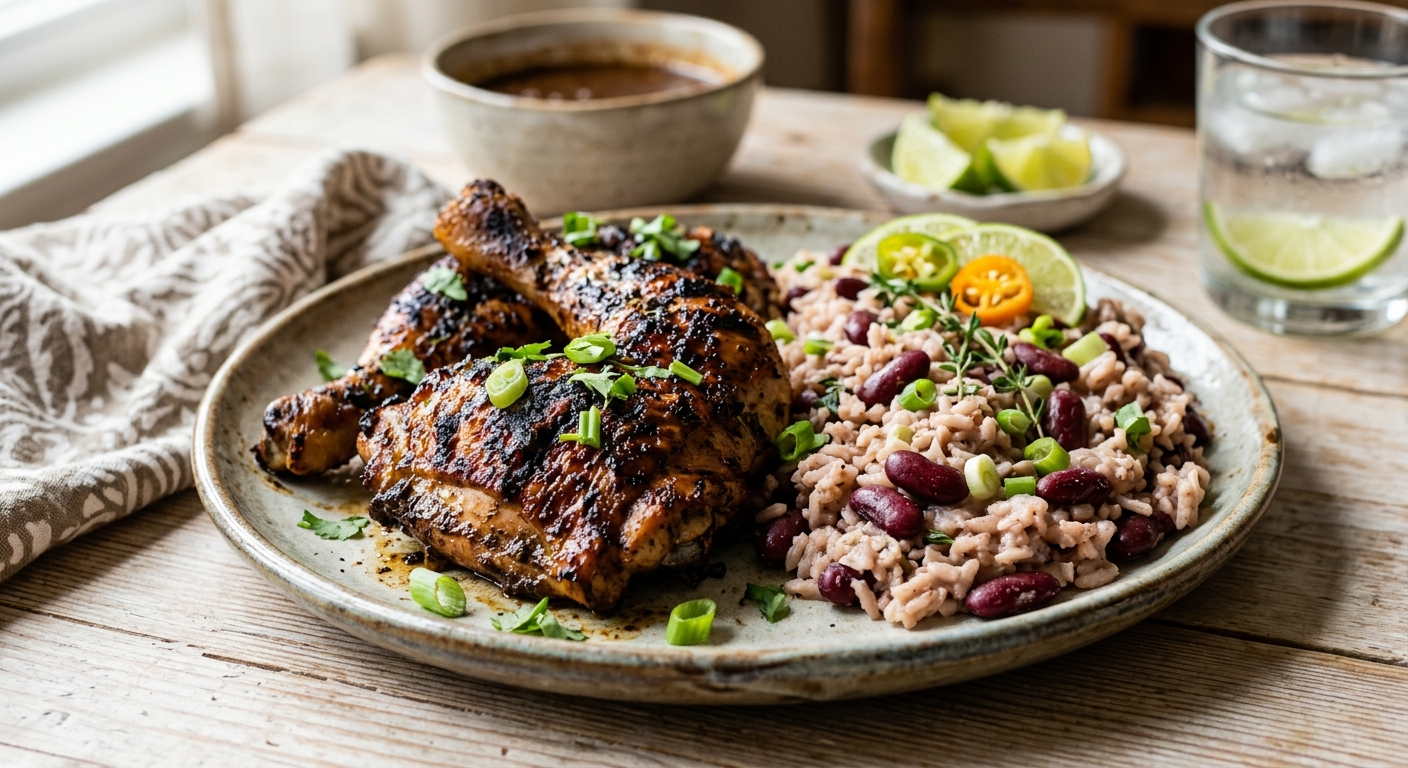
Few dishes in the world achieve what Jamaican jerk chicken with rice and peas does so effortlessly: a complete, balanced macronutrient profile wrapped in one of the most electrifying flavour combinations ever devised. The fiery, aromatic jerk marinade, built on scotch bonnet peppers, allspice, thyme, garlic, and ginger, does more than season the meat. It delivers a cascade of antioxidants, anti-inflammatory compounds, and volatile oils that interact with the chicken’s rich protein matrix to create something genuinely greater than the sum of its parts. The kidney beans in the rice are not an afterthought. They are a deliberate nutritional anchor, contributing complementary amino acids that work with the chicken’s complete protein to push this dish well beyond any single RDA threshold.
Traditional Jamaican cooks have long understood that the pairing of legumes and rice alongside meat is not merely a cultural habit but a form of intuitive nutritional wisdom. The kidney beans supply folate, non-heme iron, and slow-digesting resistant starch, which blunts the glycemic response of the white rice significantly. Coconut milk, used to cook the rice, contributes medium-chain triglycerides and a luxurious creaminess that carries the allspice and thyme aromatics deeper into every grain. The result is a rice dish that is aromatic, subtly sweet, and nutritionally distinct from plain steamed rice.
At Calibrated Cuisine, we have taken the authentic jerk technique and layered in precise marinade ratios and cook-time guidance across four methods, so whether you are grilling on a weeknight, setting a slow cooker before work, or using a pressure cooker for a 30-minute dinner, the nutritional delivery and the flavour payoff are equally outstanding. Each serving provides over 45 g of protein, more than 35% of your daily iron needs, and significant contributions to vitamins B3, B6, and B12, making this one of the most nutritionally complete single-dish meals on this site.
4
servings
Ingredients
- 900 gbone-in, skin-on chicken thighs and drumsticks (about 4 thighs and 4 drumsticks)
- 400 gcooked kidney beans (or one 400g can, rinsed and drained)
- 320 glong-grain white rice, rinsed until water runs clear
- 400 mlfull-fat coconut milk
- 360 mllow-sodium chicken stock
- 3 wholescotch bonnet peppers, seeds removed for medium heat or kept for hot
- 6 clovesgarlic, peeled
- 30 gfresh ginger, peeled and roughly chopped
- 6 wholespring onions (scallions), roughly chopped
- 3 tbspground allspice (pimento)
- 1 tbspground cinnamon
- 1 tspground nutmeg
- 1 tspdried thyme (or 2 tsp fresh thyme leaves)
- 3 tbsplow-sodium soy sauce
- 2 tbspdark brown sugar
- 2 tbspapple cider vinegar
- 2 tbspAvocado Oil100% Pure Avocado Oil (avocado or sunflower), plus extra for searing
- 1 tbspfresh lime juice
- 1 mediumwhite onion, roughly chopped
- 4 wholefresh thyme sprigs
- 2 wholedried bay leaves
- 240 mlwater
- —Colima Sea SaltMicroplastic Free Salt and freshly ground black pepper to taste
- —Lime wedges and sliced spring onions, to serve
Instructions
Click on an item below to shop for the recommended items for this recipe on Amazon.
As an Amazon Associate, we earn from qualifying purchases.
- Prepare the jerk marinade: combine scotch bonnets, garlic, ginger, spring onions, allspice, cinnamon, nutmeg, dried thyme, soy sauce, brown sugar, apple cider vinegar, oil, and lime juice in a blender. Blitz on high for 60 seconds until completely smooth. Taste and adjust salt. Reserve 3 tablespoons of marinade separately in a small bowl for basting.
- Pat the chicken pieces completely dry with paper towels. Score each piece 2 to 3 times to the bone with a sharp knife to allow marinade penetration. Place in a large zip-lock bag or non-reactive bowl, pour over the remaining marinade, massage thoroughly, seal, and refrigerate for a minimum of 2 hours, ideally overnight.
- Remove chicken from the refrigerator 20 minutes before cooking. Heat a large, heavy-based skillet or cast-iron pan over medium-high heat until very hot. Add a thin film of neutral oil. Remove chicken from marinade, allowing excess to drip off, and sear in a single layer, skin-side down, for 5 to 6 minutes without moving until a deep mahogany crust forms. Flip and sear the second side for 3 minutes. Work in batches to avoid crowding. Set seared pieces aside.
- Reduce heat to medium. Add the chopped white onion to the same pan and cook for 3 minutes, scraping up the browned bits. Add 240 ml water and the reserved marinade. Nestle the chicken pieces back into the pan, partially cover with a lid, and cook on medium-low for 22 to 25 minutes, turning once halfway, until the internal temperature reads 74 degrees Celsius (165 degrees Fahrenheit) at the thickest part away from bone.
- While the chicken braises, prepare the rice and peas: bring coconut milk and chicken stock to a gentle boil in a medium saucepan. Add rinsed rice, kidney beans, fresh thyme sprigs, bay leaves, and a generous pinch of salt. Stir once, reduce heat to the lowest setting, cover tightly, and cook for 18 minutes. Remove from heat and let steam, covered, for a further 5 minutes. Fluff with a fork, removing thyme sprigs and bay leaves.
- Uncover the chicken for the final 5 minutes of cooking, increase heat to medium-high, and spoon pan juices over the pieces repeatedly to glaze and intensify the crust. Rest the chicken for 5 minutes before serving over the rice and peas with lime wedges and sliced spring onions.
- Prepare and apply the jerk marinade as described in steps 1 and 2 of the Stovetop method. For the slow cooker, marinating overnight is strongly recommended to compensate for the absence of a high-heat sear, which would otherwise set a flavour crust.
- Remove the marinated chicken from the refrigerator. Optional but recommended: heat a skillet over high heat with a thin film of oil and sear each piece for 2 to 3 minutes per side to develop colour and deepen the Maillard flavour compounds before transferring to the slow cooker insert. If skipping the sear, proceed directly to the next step.
- Place the seared or unseared chicken pieces in a single layer in the slow cooker insert. Scatter the chopped white onion around and between the pieces. Pour the coconut milk, chicken stock, and any reserved marinade over the chicken. Add the fresh thyme sprigs and bay leaves. Season lightly with salt, keeping in mind the soy sauce in the marinade already contributes significant sodium.
- Cover and cook on Low for 5 hours (or High for 2.5 hours). At this point, carefully remove the chicken pieces and set aside on a plate. Stir the rinsed rice and drained kidney beans directly into the cooking liquid in the insert. Submerge the rice fully and replace the chicken on top, skin-side up.
- Replace the lid and continue cooking on Low for a further 1 to 1.5 hours, or until the rice has absorbed the liquid and is tender but not broken down. Check at the 1-hour mark; the rice should be just cooked through with the liquid fully absorbed. Switch to the Keep Warm setting if done early.
- Using tongs, carefully transfer the chicken to a foil-lined baking tray and place under a hot grill (broiler) for 4 to 5 minutes to crisp and char the skin, replicating the smokiness of traditional jerk. Remove thyme sprigs and bay leaves from the rice, fluff gently, and serve the chicken over the rice and peas with lime wedges and sliced spring onions.
- Prepare and apply the jerk marinade as described in steps 1 and 2 of the Stovetop method. Even a 30-minute marinade works in the pressure cooker because high-pressure cooking drives flavour deep into the meat rapidly, though overnight marinating still delivers the best results.
- Set the Instant Pot or electric pressure cooker to Saute mode on High. Add a thin film of neutral oil. Once the pot displays ‘Hot’, sear the marinated chicken pieces in batches, skin-side down, for 3 to 4 minutes until browned. Flip and sear for 2 minutes. Remove and set aside. This step is critical for the pressure cooker method as it is the only opportunity to build surface flavour.
- Without wiping the pot, add the chopped white onion to the remaining fat and cook on Saute for 2 minutes, scraping up the fond from the bottom. This step is important: any stuck bits must be fully deglazed with a splash of chicken stock to prevent the Burn error from triggering during pressurisation. Add the remaining stock and coconut milk, stirring to combine.
- Add the rinsed rice and kidney beans directly to the liquid, stirring gently to distribute evenly. Nestle the seared chicken pieces on top of the rice, skin-side up. Add the fresh thyme sprigs, bay leaves, and any reserved marinade. Do not stir after placing the chicken; the rice must remain in the liquid below to cook correctly under pressure.
- Secure the lid and set the valve to Sealing. Select Pressure Cook (or Manual) on High Pressure for 15 minutes. When the cycle completes, allow a Natural Pressure Release for 10 full minutes before carefully switching the valve to Venting to release any remaining steam.
- Open the lid carefully, tilting it away from you. Check that the chicken has reached an internal temperature of 74 degrees Celsius (165 degrees Fahrenheit) and that the rice has absorbed the liquid. Remove thyme sprigs and bay leaves. For a caramelised finish, transfer chicken pieces to a foil-lined tray and broil under a hot grill for 3 to 4 minutes. Fluff the rice and peas, taste for seasoning, and serve immediately with lime wedges and spring onions.
- Prepare and apply the jerk marinade as described in steps 1 and 2 of the Stovetop method. For oven cooking, overnight marinating is ideal. Remove the chicken from the refrigerator 30 minutes before cooking to allow it to come closer to room temperature, which promotes even cooking.
- Preheat the oven to 200 degrees Celsius (400 degrees Fahrenheit), fan-assisted. Line a large, rimmed baking tray with foil and place a wire rack over the tray. Arrange the marinated chicken pieces skin-side up on the rack, spaced at least 2 cm apart. The rack allows hot air to circulate underneath, rendering the fat and crisping the underside of the skin simultaneously. Brush generously with any reserved marinade.
- Roast the chicken at 200 degrees Celsius for 25 minutes. While it roasts, combine the coconut milk, chicken stock, rinsed rice, kidney beans, fresh thyme sprigs, bay leaves, chopped white onion, and a generous pinch of salt in a medium oven-safe baking dish with a tight-fitting lid (or use foil as a tight seal). Stir once to combine.
- After the initial 25-minute chicken roast, reduce the oven temperature to 180 degrees Celsius (355 degrees Fahrenheit). Place the covered rice dish in the oven on a lower rack. Continue roasting the chicken for a further 20 to 25 minutes, brushing with pan drippings at the 10-minute mark, until the skin is deeply charred at the edges and the internal temperature reads 74 degrees Celsius (165 degrees Fahrenheit).
- Remove the rice dish after 35 minutes of covered baking. Let it rest, still covered, for 10 minutes; the residual steam will finish cooking the rice to a perfectly fluffy texture. Meanwhile, switch the oven to grill (broiler) mode on High and blast the chicken for 3 to 4 minutes to maximise char on the skin surface. Watch carefully to prevent burning.
- Remove thyme sprigs and bay leaves from the rice. Fluff with a fork and taste for seasoning. Rest the chicken for 5 minutes on the rack before transferring to a serving platter. Spoon any collected pan juices over the chicken pieces. Serve over the rice and peas with lime wedges and sliced spring onions.
Nutrition Breakdown
Per 1 serving (makes 4)
Vitamins & Minerals
% Daily Value based on a 2,000 calorie diet (FDA reference)
🧬 Essential Amino Acids
% of recommended daily intake (RDA) per serving
🛡 Antioxidant Profile
The Nutrition Science
Chicken thighs and drumsticks are nutritionally superior to breast meat for this application. Beyond their higher fat content (which keeps the meat moist under long cooking), dark meat delivers significantly more myoglobin-bound heme iron, zinc, and the B-vitamins niacin and B6. Heme iron from animal tissue is absorbed at a rate of 15 to 35%, compared to only 2 to 20% for non-heme iron from plant sources. Critically, the vitamin C supplied by the scotch bonnet peppers and lime juice in the marinade further enhances the absorption of non-heme iron from the kidney beans, by reducing ferric iron (Fe3+) to the more absorbable ferrous form (Fe2+) in the gut. This means the combination of chicken, beans, and citrus in a single dish is a nutritionally synergistic system, not merely a cultural tradition.
Kidney beans are among the most nutritionally dense legumes available. Per serving in this dish, they contribute approximately 40 g of the total carbohydrate load, but roughly one-third of that is resistant starch and soluble fibre that the small intestine cannot digest. This fibre passes to the colon, where it is fermented by Bacteroidetes and Bifidobacteria into short-chain fatty acids, particularly butyrate, which is the primary energy source for colonocytes and a known down-regulator of colonic inflammation. This fermentation process is a key reason why the glycemic load of this dish remains in the medium range despite the presence of white rice. The coconut milk fat provides an additional glycemic dampening effect by slowing gastric emptying and reducing the rate of glucose entry into the bloodstream.
The jerk spice blend is far more than a flavour vehicle. Allspice (pimento) is the single most concentrated source of eugenol among culinary spices, with research published in the Journal of Agricultural and Food Chemistry demonstrating eugenol’s capacity to inhibit cyclooxygenase-2 (COX-2), the same enzyme targeted by non-steroidal anti-inflammatory drugs. Scotch bonnet peppers contain capsaicin at concentrations three to ten times greater than jalapeños, and multiple randomised controlled trials have shown that regular dietary capsaicin intake is associated with reduced circulating LDL cholesterol and lower all-cause mortality risk. Ginger contributes gingerols and shogaols with well-documented nausea-inhibiting and anti-inflammatory properties. Together, the spice blend transforms a protein-and-carbohydrate meal into a genuinely functional food.
Pro Tips
- Score the chicken deeply to the bone before marinating. This is not optional for flavour; it allows the marinade to penetrate the thick dark meat fully rather than sitting only on the surface, which is especially important for the slow cooker and pressure cooker methods where the skin does not char.
- Do not discard the scotch bonnet seeds automatically. The seeds and white membrane contain the highest concentration of capsaicin. For a medium-heat dish, remove seeds from two peppers and keep one pepper whole. For a traditional Jamaican heat level, keep all seeds in. For a mild family version, use one deseeded pepper and add one teaspoon of smoked paprika to maintain colour and complexity.
- Rinsing the rice until the water runs completely clear is essential for the pressure cooker and rice-in-pot slow cooker methods. Excess surface starch causes the rice to clump and, in the pressure cooker, can contribute to the Burn warning. For the oven method, a brief 30-minute soak after rinsing further improves the grain texture.
Love this angle on jerk chicken! The allspice in traditional jerk rubs is actually a fantastic polyphenol source (eugenol and other phenolic compounds) that pairs beautifully with the heme iron bioavailability from the chicken, and those kidney beans bring complementary non-heme iron plus their own antioxidant profile. I’ve always been curious whether the smoke from grilling introduces additional beneficial compounds or if it’s mostly a flavor/texture thing – have you looked into the charring aspect at all, or is that beyond the nutritional scope of the post?
ok so this is hitting different for me because i’ve been experimenting with high-tryptophan dinners about 2 hours before bed, and the combo of chicken (solid tryptophan) plus kidney beans (magnesium AND tryptophan) has been legitimately showing up in my sleep tracker data – like consistently hitting deep sleep phases faster. plus those allspice polyphenols probably arent hurting inflammation levels which definitely mess with my sleep quality. does anyone know if the cooking method matters here though, like whether charring/smoking the chicken affects the amino acid profile or is that overthinking it lol
This is such a thoughtful breakdown of the nutritional synergy happening here, Pete. I’m curious whether you’ve noticed if the specific spices in the jerk rub are being sourced for their medicinal potency, or if that’s something you experiment with? I ask because I’ve found that the antioxidant and anti-inflammatory compounds in traditional allspice, thyme, and scotch bonnets can genuinely shift how my body processes the iron and manages post-meal inflammation, especially when paired with kidney beans like you mentioned. Sam’s point about timing with tryptophan is landing for me too, since I’ve used this kind of meal strategically during more stressful periods to support both H