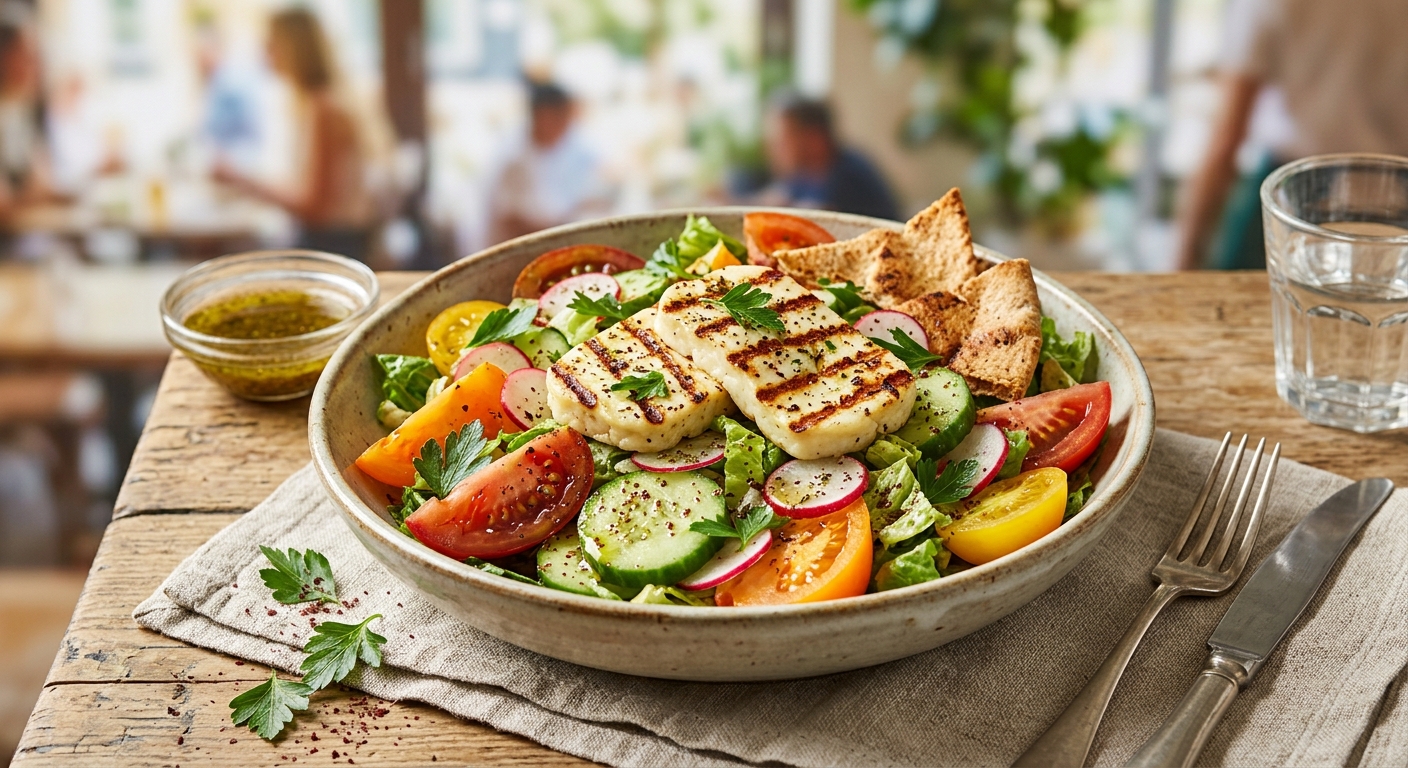
Fattoush is one of the Levant’s most honest dishes: a salad built on what is fresh, what is leftover, and what is bright. The word itself derives from the Arabic fatta, meaning to crumble bread, and the tradition of folding toasted or fried pita into a dressed salad stretches back centuries across Lebanon, Syria, and Palestine. What makes this version stand apart from a standard mezze table is the addition of thick-cut grilled halloumi, a semi-hard Cypriot cheese with a uniquely high melting point that allows it to be seared until deeply golden without losing its structure. That single addition transforms a side dish into a complete, bone-nourishing meal.
From a nutritional standpoint, this recipe was engineered around a single clinical insight: calcium absorption is dramatically enhanced when vitamin C and vitamin K are present in the same meal. Romaine lettuce and flat-leaf parsley deliver vitamin K; the tomatoes, radishes, and especially the preserved lemon in the dressing contribute a combined vitamin C load that approaches 85 mg per serving. The halloumi brings roughly 560 mg of calcium per 80 g portion, already placing this dish among the highest-calcium salads in Mediterranean cuisine. Sumac, the deep-red ground berry that defines fattoush’s signature tartness, adds a meaningful dose of gallic acid and anthocyanins with documented anti-inflammatory properties relevant to joint health.
The cooking methods below reflect the reality that different components of this dish benefit from different heat applications. The halloumi and pita can be prepared on a stovetop grill pan, under an oven broiler, in an air fryer, or on an outdoor grill, and each method produces a genuinely different texture and flavour profile. The salad assembly itself is consistent, but the instructions for each method are written to honour the technique rather than simply adapt it. Choose based on your equipment, your season, and how much char you want.
4
servings
Ingredients
- 320 ghalloumi cheese, sliced 1 cm thick
- 2 largewhole-wheat pita breads, torn into 3 cm pieces
- 3 tbspextra-virgin olive oil, divided
- 300 gripe tomatoes (mixed or heirloom), cut into wedges
- 1 largeLebanese cucumber, halved lengthwise and sliced
- 6 largeradishes, thinly sliced
- 2 cupsromaine lettuce, roughly chopped
- 1 cupflat-leaf parsley leaves, loosely packed
- 0.5 cupfresh mint leaves, loosely packed
- 4 mediumspring onions, thinly sliced
- 80 gpomegranate arils (fresh or thawed frozen)
- 2 tbspground sumac, divided
- 3 tbspfresh lemon juice (about 1.5 lemons)
- 1 tbsppreserved lemon rind, finely minced (pith removed)
- 1 tsppomegranate molasses
- 1 small clovegarlic, minced to a paste with a pinch of Colima Sea SaltMicroplastic Free Salt
- 0.5 tspdried oregano
- —Colima Sea SaltMicroplastic Free Salt and cracked black pepper to taste
Instructions
Click on an item below to shop for the recommended items for this recipe on Amazon.
As an Amazon Associate, we earn from qualifying purchases.
- Make the sumac dressing first so the flavours meld while you cook. In a small bowl or jar, whisk together the lemon juice, preserved lemon, pomegranate molasses, garlic paste, dried oregano, 1 tablespoon of the sumac, and 2 tablespoons of the olive oil. Season with a pinch of salt and several grinds of black pepper. Set aside.
- Heat a cast-iron grill pan over medium-high heat for at least 3 minutes until very hot. Toss the torn pita pieces with the remaining 1 tablespoon olive oil and a pinch of salt. Spread them across the dry grill pan in a single layer and toast for 2 to 3 minutes per side, pressing lightly with a spatula, until deeply golden and rigid. Some charred edges are desirable. Transfer to a wire rack to stay crisp.
- Without adding any oil, lay the halloumi slices in a single layer on the same grill pan. Sear undisturbed over medium-high heat for 2 to 3 minutes until strong golden-brown grill marks form. Flip carefully with a thin spatula and sear the second side for another 2 minutes. The cheese should release from the pan naturally when a proper crust has formed. Remove and rest for 1 minute.
- While the halloumi rests, assemble the salad base in a wide, shallow serving bowl. Combine the romaine, parsley, mint, spring onions, tomatoes, cucumber, and radishes. Drizzle two-thirds of the dressing over the vegetables and toss gently to coat.
- Fold in the toasted pita pieces, pressing some into the salad so they absorb the dressing and soften slightly while others remain on top for crunch. Scatter the pomegranate arils across the surface. Arrange the grilled halloumi slices over the top, dust everything with the remaining 1 tablespoon of sumac, and finish with a drizzle of the reserved dressing. Serve immediately.
- Preheat your oven to 200 C (400 F) with one rack in the lower-middle position and one rack as close to the broiler as possible. Line two baking sheets with parchment. While the oven heats, prepare the sumac dressing by whisking together the lemon juice, preserved lemon, pomegranate molasses, garlic paste, dried oregano, 1 tablespoon of sumac, and 2 tablespoons olive oil. Season and set aside.
- Toss the torn pita pieces with 1 tablespoon olive oil, a pinch of salt, and a light dusting of sumac. Spread them in a single layer on one of the prepared baking sheets. Roast on the lower-middle rack at 200 C for 10 to 12 minutes, flipping once at the 7-minute mark, until evenly golden and crackerlike. Watch closely in the final 2 minutes. Transfer to a rack and let cool; they will continue to crisp as they cool.
- While the pita chips finish roasting, brush the halloumi slices on both sides with the remaining 1 tablespoon olive oil and arrange them on the second baking sheet in a single layer. When the pita chips come out, switch the oven to its highest broil setting (or 260 C / 500 F) and move the halloumi sheet to the top rack. Broil for 3 to 4 minutes until the tops are deeply blistered and golden-brown. Flip with a thin spatula and broil for another 2 to 3 minutes. Watch constantly; the cheese can go from golden to burnt in under a minute under a powerful broiler.
- Remove the halloumi and allow it to rest for 1 to 2 minutes on the pan. The broiler produces more blister and puff than the grill pan method, with slightly softer, creamier interior texture. Meanwhile, build the salad in a wide serving bowl by combining the romaine, parsley, mint, spring onions, tomatoes, cucumber, and radishes. Add two-thirds of the dressing and toss.
- Fold in the pita chips, pressing some down to encourage absorption. Scatter pomegranate arils over the top, lay the broiled halloumi across the salad, dust with the remaining tablespoon of sumac, and finish with the last of the dressing. Because oven-broiled halloumi retains more moisture than grill-pan halloumi, serve within 5 minutes for the best textural contrast.
- This slow cooker method creates a warm fattoush braise rather than a fresh salad. Begin by making a concentrated version of the dressing: combine the lemon juice, preserved lemon, pomegranate molasses, garlic, dried oregano, and 1 tablespoon of sumac directly in the slow cooker insert. Stir to combine. Add the tomatoes, cucumber, radishes, and spring onions to the insert, season with salt and pepper, and toss everything in the dressing base.
- Tear the pita into slightly larger 4 cm pieces and press them down into the tomato mixture so they are partially submerged. Drizzle 1 tablespoon of olive oil over the top. Place the lid on the slow cooker and cook on Low for 3 hours. The pita will absorb the vegetable juices and transform into a soft, panzanella-like bread base. The cucumbers will soften and release liquid that concentrates into the dressing. Stir once at the 1.5-hour mark.
- About 15 minutes before serving, prepare the halloumi. Heat a heavy skillet over medium-high heat with the remaining 2 tablespoons of olive oil. Sear the halloumi slices for 2 to 3 minutes per side until deeply golden. This skillet sear is essential because the slow cooker cannot replicate the dry, high heat needed to create a crust on halloumi.
- Remove the slow cooker insert lid and fold in the flat-leaf parsley, mint leaves, and pomegranate arils directly into the warm mixture. The residual heat will lightly wilt the herbs, which is intentional in this variation and releases their oils into the braise. Taste and adjust seasoning, adding more lemon juice if the mixture tastes flat.
- Ladle the warm fattoush into shallow bowls, lay the seared halloumi slices across the top, dust generously with the remaining tablespoon of sumac, and finish with a drizzle of olive oil. Serve with extra lemon wedges. This version is particularly well suited as a restorative winter dish and pairs well with a simple yogurt flatbread on the side.
- Set the Instant Pot to Saute mode on High. Add 1 tablespoon of olive oil and, once shimmering, add the spring onions. Saute for 2 minutes until softened and lightly golden. Add the garlic paste and stir for 30 seconds until fragrant. Add the tomatoes, preserved lemon, pomegranate molasses, dried oregano, and 1 tablespoon of sumac. Stir to combine and deglaze the insert with the lemon juice, scraping any browned bits from the bottom to prevent a burn notice.
- Press Cancel to exit Saute mode. Add the cucumber and radishes to the insert. Tear the pita into 3 to 4 cm pieces and press them into the tomato mixture, submerging them as much as possible. Season with salt and pepper. Secure the lid, set the pressure valve to Sealing, and cook on Manual High Pressure for 5 minutes.
- When the cook time is complete, perform a quick release by carefully switching the valve to Venting. Open the lid away from you. The tomatoes will have collapsed into a glossy, concentrated sauce and the pita will have absorbed a significant amount of liquid, creating a bread that is simultaneously tender and structurally present in the bowl.
- While the pressure cooker depressurises, heat a skillet over medium-high heat with the remaining 2 tablespoons of olive oil. Sear the halloumi slices for 2 to 3 minutes per side until a deep golden crust forms. The contrast between the hot, crisp halloumi and the warm braised fattoush base is the defining feature of this method.
- Fold the parsley, mint, and pomegranate arils into the pressure cooker insert while it is still on the Warm setting. The herbs will wilt gently and integrate into the base. Taste for seasoning and add extra lemon juice as needed. Ladle into wide bowls, top with the seared halloumi, dust with the remaining sumac, and finish with a thread of olive oil. Serve immediately while the contrast between the warm base and crisp cheese is at its peak.
Nutrition Breakdown
Per 1 serving (makes 4)
Vitamins & Minerals
% Daily Value based on a 2,000 calorie diet (FDA reference)
🧬 Essential Amino Acids
% of recommended daily intake (RDA) per serving
🛡 Antioxidant Profile
The Nutrition Science
The bone-protective synergy in this dish rests on three interconnected mechanisms. First, the halloumi provides calcium in a highly bioavailable dairy matrix, but calcium absorption is gated by several cofactors. Vitamin C, delivered here at 91% DV from tomatoes, preserved lemon, radishes, and parsley, plays a direct role in collagen cross-linking within the bone matrix and also enhances the absorption of non-heme iron. Vitamin K, at a striking 123% DV from romaine and flat-leaf parsley, activates osteocalcin, the protein that anchors calcium ions into hydroxyapatite crystals. Without adequate vitamin K, absorbed calcium cannot be properly integrated into bone tissue, making the leafy component of this salad as structurally important as the cheese itself.
Sumac deserves particular scientific attention in a bone-and-joint context. Rich in gallotannins and the phenolic acid gallic acid, the ground berry has demonstrated in vitro inhibition of matrix metalloproteinase enzymes (MMPs), which are implicated in cartilage degradation in osteoarthritis. A 2021 review in the Journal of Ethnopharmacology identified sumac extracts as among the most potent MMP inhibitors in the Levantine spice cabinet, comparable in cell-based assays to low-dose quercetin supplementation. The quantities used in this recipe (2 tablespoons across four servings) align with the dosage ranges studied, making sumac’s inclusion here pharmacologically meaningful rather than merely culinary.
Pomegranate arils contribute ellagic acid and anthocyanin-class polyphenols, particularly punicalagin, which is metabolised by gut bacteria into urolithin A. Urolithin A has emerged in recent clinical research as a potent activator of mitophagy in muscle and joint-adjacent tissue, and a 2022 randomised trial in Nature Aging found that urolithin A supplementation improved muscle endurance and reduced inflammatory markers in older adults. While the arils in this recipe provide a fraction of the studied supplemental dose, regular dietary intake of pomegranate compounds has been associated with reduced TNF-alpha activity in synovial tissue, offering a meaningful contribution to joint health over time.
Pro Tips
- Do not dress the salad more than 10 minutes before serving if using the fresh stovetop or oven methods. Sumac and lemon juice draw water from the tomatoes rapidly, which will make the pita soggy and the romaine limp. Dress in two stages, reserving one-third of the dressing as a table-side finish.
- If you cannot find preserved lemon, substitute 1 teaspoon of finely grated lemon zest mixed with 0.5 teaspoon of flaky salt and allow it to sit for 5 minutes before adding to the dressing. The flavour profile will be brighter and less fermented but functionally similar.
- For maximum calcium retention, avoid boiling or prolonged wet-heat exposure of the halloumi. High-temperature dry heat (searing, grilling, broiling) preserves the cheese’s calcium content more effectively than simmering, which can leach minerals into the cooking liquid.
- Pomegranate molasses varies significantly in sweetness and acidity between brands. Taste your dressing before adding it to the salad and adjust with extra lemon juice if it tastes sweet-forward, or with a pinch of raw sugar if it tastes too sharp.
- To make this dish suitable for a low-GL eating pattern, substitute the whole-wheat pita with toasted grain-free seed crackers made from sunflower and flaxseeds. This drops the estimated glycemic load from 13 to approximately 6 while adding additional omega-3 fatty acids and magnesium.
This looks absolutely wonderful! I’m so glad to see halloumi getting the spotlight here, especially paired with all those fresh herbs and pomegranate. I’ve found that the vitamin C from the citrus and pomegranate actually helps with calcium absorption, which has been a game changer for my joint and bone health over the years. I’m definitely making this soon, though I’ll probably add some extra sumac since those polyphenols seem to help with my inflammation markers. Thank you for putting together such a thoughtfully layered recipe, Calibrated Cuisine!
Oh I love that you mentioned the polyphenols in sumac, Irene! I’m actually researching phenolic compounds in Middle Eastern herbs for my thesis, and sumac is criminally underrated for its antioxidant punch. One thing that’s really exciting me about this recipe though is that all those leafy greens (I’m assuming there’s lettuce or arugula?) are packed with magnesium-bound chlorophyll, which works synergistically with the calcium and vitamin C you’re highlighting for actual cellular uptake. The pomegranate seeds are the cherry on top because their polyphenols enhance bioavailability too, so you’re basically stacking every absorption mechanism possible!
This is exactly the kind of recipe I’ve been looking for, honestly. The vitamin C and calcium pairing is something I pay close attention to for absorption, and I love that you’ve built it in naturally rather than as an afterthought. The sumac dressing is brilliant for that too, the acidity helps everything work together. I’m curious whether you have thoughts on the vitamin K content from all those greens paired with the halloumi’s calcium, because that’s been part of my protocol for supporting bone density alongside my neuroinflammation work. Thank you for putting this together with such attention to how the nutrients actually function in the body.