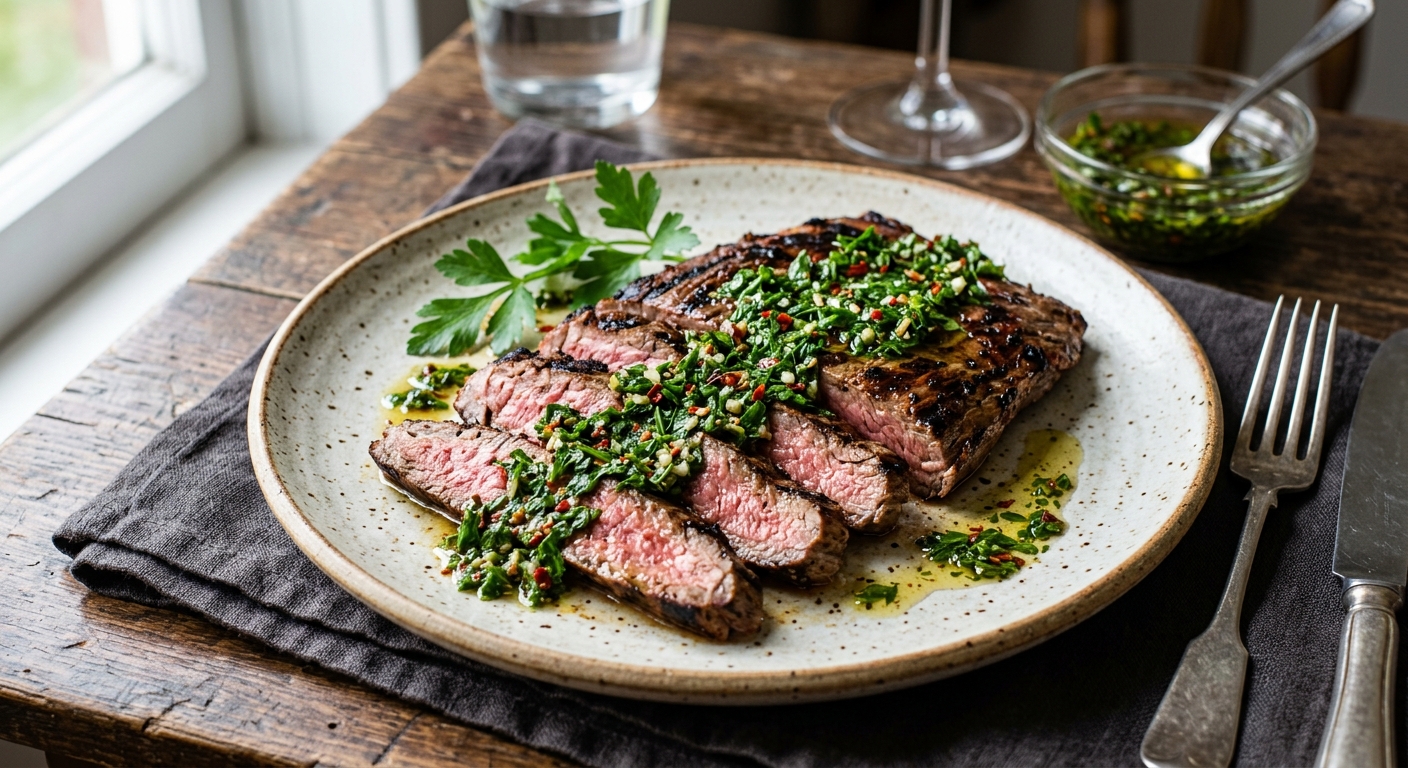
Few dishes in the world culinary canon are as simultaneously elemental and electric as the Argentine parrilla tradition. Steak and chimichurri are not a pairing so much as a philosophy: the deep, iron-rich savoriness of well-raised beef meeting a bright, acidic, herb-packed sauce that cuts through richness and floods the palate with green flavor. At Calibrated Cuisine, we have taken that philosophy and mapped it onto your body’s genuine mineral needs, because this dish is one of the most efficient natural sources of bioavailable heme iron and zinc that you can put on a dinner plate.
The star of the nutritional story here is heme iron. A 170g serving of flank steak provides roughly 3.9mg of iron in its most absorbable form, contributing approximately 22% of the daily value on its own. But here is where the chimichurri earns its place beyond flavor: the dense concentration of fresh flat-leaf parsley adds non-heme iron alongside a significant hit of vitamin C, and vitamin C is one of the most potent enhancers of non-heme iron absorption known to nutritional science. Red wine vinegar contributes additional acidity that further supports iron solubility in the gut. The result is a synergistic meal where the sauce is not a garnish but a genuine nutritional amplifier.
Zinc, the often-overlooked sibling of iron in the mineral world, is equally impressive here. Beef is the single richest dietary source of zinc outside of oysters, and flank steak delivers approximately 7mg per serving, covering around 64% of the daily value. Zinc is essential for immune function, wound healing, protein synthesis, and testosterone regulation, yet surveys consistently show that a significant portion of adults fall short of optimal intake. Paired with the anti-inflammatory polyphenols of oregano and parsley, the quercetin and luteolin content of the herbs, and the healthy fat profile of extra-virgin olive oil that helps fat-soluble antioxidants absorb efficiently, this dish is engineered to taste extraordinary and perform nutritionally at the highest level.
4
servings
Ingredients
- 680 gflank steak, trimmed (about 1.5 lbs)
- 60 mlextra-virgin olive oil, plus more for searing
- 3 tbspred wine vinegar
- 60 gfresh flat-leaf parsley, finely chopped (about 1 large bunch, leaves and tender stems)
- 2 tbspfresh oregano leaves, finely chopped (or 2 tsp dried)
- 4 clovesgarlic, minced
- 1 smallshallot, finely minced
- 1 tspred pepper flakes
- 1 tspsmoked paprika
- 1 tspground cumin
- 0.5 tspdried thyme
- 60 mllow-sodium beef broth (for slow cooker and pressure cooker methods)
- —Colima Sea SaltMicroplastic Free Salt and freshly cracked black pepper to taste
Instructions
Click on an item below to shop for the recommended items for this recipe on Amazon.
As an Amazon Associate, we earn from qualifying purchases.
- Make the chimichurri base: combine the chopped parsley, oregano, minced garlic, minced shallot, red pepper flakes, and red wine vinegar in a medium bowl. Stir in 60ml of olive oil in a slow stream, whisking to emulsify. Season with 0.5 tsp fine sea salt and a few cracks of black pepper. Set aside half of this chimichurri (the serving sauce) in a separate bowl, covered, at room temperature.
- Season and marinate the steak: pat the flank steak dry with paper towels. Rub it all over with smoked paprika, cumin, dried thyme, 1 tsp fine sea salt, and 0.5 tsp black pepper. Spoon 2 to 3 tablespoons of the remaining chimichurri over the steak and press it into the surface. Let the steak marinate at room temperature for 15 to 20 minutes while you prepare your pan.
- Heat a large cast-iron skillet over high heat for 3 to 4 minutes until it is visibly smoking. Add a thin film of olive oil and swirl to coat. Carefully lay the flank steak flat in the pan, pressing it down firmly with a spatula to ensure full contact. Sear undisturbed for 4 to 5 minutes until a deep mahogany crust forms and the steak releases naturally from the pan.
- Flip the steak once and sear the second side for 3 to 4 minutes for medium-rare (internal temperature 52 to 54 degrees C / 125 to 130 degrees F) or 4 to 5 minutes for medium (57 to 60 degrees C / 135 to 140 degrees F). Use an instant-read thermometer to check. In the final minute, tilt the pan slightly and baste the steak with the pan juices using a spoon.
- Transfer the steak to a cutting board and tent loosely with foil. Rest for 8 to 10 minutes without cutting. This resting period allows the muscle fibers to relax and the juices to redistribute, which is essential for a lean cut like flank steak.
- Slice the steak thinly (about 5mm slices) against the grain at a slight diagonal angle. The grain of flank steak runs lengthwise along the muscle, so slicing perpendicular to it shortens the long muscle fibers and dramatically improves tenderness. Arrange on a warm serving platter, spoon the reserved chimichurri generously over the top, and serve immediately.
- Prepare a wet rub: in a small bowl, mix together the smoked paprika, cumin, dried thyme, 1 tsp fine sea salt, and 0.5 tsp black pepper with 1 tablespoon of olive oil to form a paste. Pat the flank steak dry with paper towels and rub this spice paste firmly all over both sides. Roll the steak loosely and place it in the slow cooker insert.
- Add liquid and aromatics: scatter the minced garlic and minced shallot directly over the steak. Pour the 60ml of beef broth around the base of the steak (not over the top, to preserve the spice crust). Add 1 tablespoon of the red wine vinegar and 0.5 tsp of the red pepper flakes directly to the broth. Cover with the lid.
- Cook on Low for 6 to 8 hours or on High for 3 to 4 hours. The steak is done when it is fork-tender and pulls apart easily along the grain. Unlike the stovetop version, you are deliberately taking this cut past medium to develop a rich, braise-style texture that absorbs the aromatics deeply. The internal temperature will exceed 85 degrees C.
- While the steak finishes, make the fresh chimichurri: combine the chopped parsley, oregano, remaining red wine vinegar, red pepper flakes, and minced garlic (if any garlic is left from the marinade step, you may add an additional minced clove here for brightness). Whisk in 60ml of olive oil and season with salt and black pepper. This chimichurri should be made no more than 1 hour before serving to retain the fresh herb color and volatile aromatic compounds.
- Carefully transfer the cooked steak to a cutting board. Use two forks to shred the meat along the grain into thick, juicy strips. Skim any excess fat from the braising juices in the slow cooker insert, then spoon 2 to 3 tablespoons of those juices over the shredded meat to keep it moist. Plate generously and spoon the fresh chimichurri over each portion at the table.
- Set your Instant Pot or electric pressure cooker to the Saute function on High. While it heats, pat the flank steak completely dry with paper towels and season both sides generously with the smoked paprika, cumin, dried thyme, salt, and black pepper.
- Add 1 tablespoon of olive oil to the heated pot. Sear the flank steak for 3 minutes per side without moving it, developing a golden-brown crust. The steak may need to be cut in half to fit the pot. Remove the seared steak and set aside.
- Add the minced garlic and shallot to the pot with the residual fat and saute for 60 seconds, stirring constantly, until fragrant. Pour in the 60ml of beef broth and 1 tablespoon of the red wine vinegar, scraping the bottom of the pot vigorously with a wooden spoon or silicone spatula to deglaze and lift all of the browned fond. This fond is rich in Maillard reaction compounds that deepen the final flavor.
- Return the seared steak to the pot. Lock the lid and set the valve to Sealing. Cook on Manual High Pressure for 25 minutes. When the cycle finishes, allow a natural pressure release for 10 minutes, then carefully switch the valve to Venting to release any remaining steam.
- While the pressure releases, make the fresh chimichurri in a bowl: combine the chopped parsley, oregano, remaining minced garlic (use 2 fresh cloves here for brightness, separate from those cooked in the pot), red pepper flakes, and the remaining red wine vinegar. Whisk in the 60ml of olive oil and season with salt and black pepper. This uncooked sauce retains the full volatile aromatic oils and vitamin C content of the herbs.
- Open the lid and transfer the steak to a cutting board. Let it rest for 5 minutes. Slice thinly against the grain for a firmer texture, or shred with two forks for a more tender result. Spoon a portion of the reduced pot braising liquid over the meat, then finish generously with the fresh chimichurri. Serve immediately.
- Preheat your oven to 120 degrees C (250 degrees F). Place a wire rack inside a rimmed baking sheet and set aside. Pat the flank steak completely dry and season all over with the smoked paprika, cumin, dried thyme, salt, and black pepper. Rub 1 tablespoon of olive oil over the surface.
- Make the chimichurri while the oven preheats: combine the chopped parsley, oregano, minced garlic, minced shallot, red pepper flakes, and red wine vinegar in a bowl. Whisk in the 60ml of olive oil. Season with salt and pepper. Divide in half: one half goes into the refrigerator covered (the serving sauce, brought back to room temperature before serving), and the other half is spread lightly over the top of the seasoned steak.
- Place the steak on the prepared wire rack and slide it into the low oven. Cook for 20 to 25 minutes until an instant-read thermometer inserted into the thickest part reads 46 to 49 degrees C (115 to 120 degrees F). This is about 6 to 8 degrees below your target final temperature, as the sear will add the remaining heat.
- Remove the steak from the oven and set it on a cutting board uncovered for 5 minutes. Meanwhile, heat a large cast-iron skillet over the highest possible heat on the stovetop for 3 to 4 minutes until smoking aggressively. Add a thin film of high-smoke-point oil (or additional olive oil) to the pan.
- Sear the low-oven steak for 60 to 90 seconds per side only. Because the interior is already at near-target temperature, you need only the briefest surface contact to develop a deeply charred, aromatic crust reminiscent of the Argentine parrilla. The Maillard reaction at high heat drives the flavor compounds in the paprika and cumin into a complex, smoky bark.
- Rest the steak uncovered for 5 minutes (the reverse-sear method requires less resting time than a traditional sear because the heat gradient through the meat is far more even). Slice thinly against the grain and plate immediately. Spoon the reserved room-temperature chimichurri over the slices and serve with any accumulated carving juices drizzled on top.
Nutrition Breakdown
Per 1 serving (makes 4)
Vitamins & Minerals
% Daily Value based on a 2,000 calorie diet (FDA reference)
🧬 Essential Amino Acids
% of recommended daily intake (RDA) per serving
🛡 Antioxidant Profile
The Nutrition Science
The iron in this dish arrives in two distinct chemical forms, and understanding the difference explains why this meal is nutritionally superior to a plant-based iron source alone. Heme iron, derived from the hemoglobin and myoglobin proteins in beef, is absorbed at a rate of 15 to 35 percent regardless of what else you eat in the same meal. Non-heme iron, which arrives from the parsley in the chimichurri, has a much lower baseline absorption rate of 2 to 20 percent, but this rate is dramatically upregulated by the vitamin C present in the same parsley. Vitamin C reduces ferric iron (Fe3+) to ferrous iron (Fe2+) directly in the gut lumen, and ferrous iron is the only form the intestinal divalent metal transporter 1 (DMT1) can actively absorb. This means the chimichurri is not decorative: it is a bioavailability-enhancing delivery system engineered by culinary tradition centuries before nutritional science could explain it.
Zinc absorption from beef also benefits from the protein matrix of the meat itself. The digestion of animal protein releases cysteine-containing peptides that chelate zinc and ferry it across the intestinal wall, a mechanism that does not occur with plant-based zinc sources. At approximately 7mg per serving, this dish covers 64% of the zinc DV and delivers it in the form most likely to actually reach systemic circulation. Zinc’s role in the body spans over 300 enzymatic reactions, including the carbonic anhydrase enzyme system (critical for CO2 transport in blood), the superoxide dismutase antioxidant enzyme (which requires both zinc and copper), and the entire machinery of DNA repair and protein synthesis. Chronic subclinical zinc deficiency is associated with impaired immune response, delayed wound healing, and reduced testosterone production in men.
The herb antioxidants in the chimichurri deserve equal scientific attention. Parsley is one of the richest sources of the flavone luteolin in the culinary world, and luteolin has been shown in cell and animal studies to inhibit the NF-kB inflammatory pathway with a potency comparable to some pharmaceutical anti-inflammatory compounds. Oregano contributes rosmarinic acid, a phenolic ester formed from caffeic acid and 3,4-dihydroxyphenyllactic acid, which demonstrates particularly strong lipid antioxidant activity, protecting the polyunsaturated fatty acids in the olive oil from oxidative degradation both during cooking and during digestion. Critically, by keeping the chimichurri raw and only briefly heated in some methods, you preserve the volatile aromatic compounds (terpenes, aldehydes, and alcohols responsible for the green, grassy, peppery notes) alongside the heat-labile vitamin C, making the uncooked sauce both the flavor peak and the nutritional peak of the entire dish.
Pro Tips
- Always slice flank steak strictly against the grain, perpendicular to the long muscle fibers. Slicing with the grain leaves long, chewy fibers that no amount of good cooking can fix. Look for the lines running lengthwise down the steak and cut across them at a slight diagonal.
- For the brightest chimichurri color and the most potent antioxidant content, make it no more than 2 hours before serving. Parsley oxidizes and browns relatively quickly once chopped, and vitamin C begins to degrade when exposed to air and light. If making ahead, press plastic wrap directly onto the surface of the chimichurri in the bowl to exclude air.
- The smoked paprika in the dry rub is doing double nutritional duty: it contributes beta-carotene and capsanthin (a carotenoid antioxidant unique to peppers) while its fat-soluble pigments bloom most efficiently when heated in the olive oil, so ensure good contact between the spice-rubbed surface and the hot oiled pan.
I’m so drawn to this take on chimichurri, especially seeing the herb focus brought to the foreground. One thing I keep exploring in my own cooking is how chimichurri becomes even more bioavailable when you add fresh cracked black pepper to the blend, alongside the parsley and oregano, since both those herbs are rich in polyphenols that benefit so much from piperine’s enhancement. I’ve been experimenting with finishing the steak itself with a pinch of turmeric and black pepper after searing, which sounds unconventional but creates this beautiful bridge between Argentine tradition and the anti-inflammatory benefits we’re all after. Have you noticed differences in how the fresh herbs shine depending on how
Love this take on chimichurri! I’m always excited to see herb-forward dishes highlighted for their antioxidant content, since so many people don’t realize parsley and oregano are nutritional powerhouses beyond just flavor. Quick question though, has anyone experimented with pairing this with a plant-based iron source to make it work for vegetarian clients? I’m thinking something like a marinated mushroom or legume-based steak could absorb that chimichurri just as beautifully while adding vitamin C from the vinegar to boost iron absorption, though I’d love to hear if you’ve tested that angle since the mineral density is really what makes this recipe shine.
yeah this is exactly the kind of dish i build clients around. the flank is solid for zinc and b6, but real talk – that chimichurri is doing heavy lifting here. fresh parsley has ridiculous bioavailable copper and folate, oregano’s packed with quercetin, and the vinegar actually helps iron absorption which matters on red meat. i’ve seen clients dial in their mineral panels way faster when theyre eating herb-forward stuff like this versus taking standalone supplements. what pairing were you gonna ask about?