
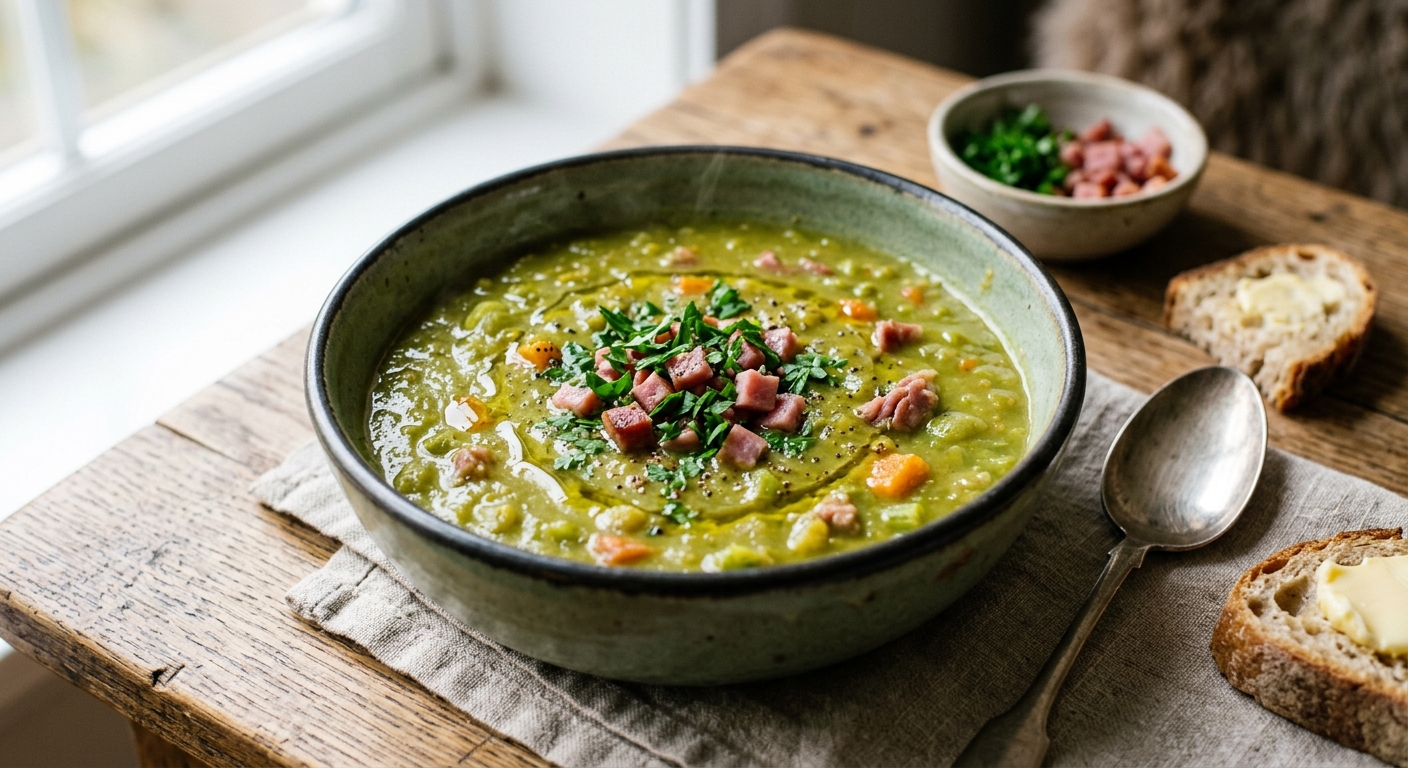
There are few dishes in the Western culinary canon that punch as far above their weight nutritionally as split pea and ham soup. What appears to be a simple, frugal pot of legumes and leftover meat is, in fact, a precisely calibrated mineral and macronutrient powerhouse. Green split peas are among the most underrated legumes in the modern kitchen: they are rich in non-heme iron, folate, thiamine, and soluble fiber, and when simmered low and slow with a smoked ham hock, they transform into a silky, deeply savory soup that needs almost no finishing work beyond a crack of black pepper.
The combination of split peas and ham is more than culinary tradition. Ham contributes complete animal protein alongside a meaningful hit of zinc and selenium, two minerals that are chronically under-consumed in plant-forward diets. The collagen released from the ham hock as it braises gives the soup a luxurious body without any added cream or starch, while the smoke compounds in cured pork add aromatic complexity that no amount of seasoning can fully replicate. Aromatic vegetables, a bay leaf, and fresh thyme round out the flavor profile without competing with the star ingredients.
At Calibrated Cuisine, we have run the numbers so you do not have to. A single generous serving of this soup provides 36% of your daily iron, 45% of your folate, 31% of your zinc, and covers more than half your recommended daily fiber intake. It is meal prep gold: it thickens beautifully as it cools, freezes for up to three months, and actually improves in flavor on day two as the starch granules in the split peas fully hydrate. Whether you build it on the stovetop, set it in a slow cooker before work, or pressure-cook it in under 30 minutes, this recipe is engineered to deliver consistent, professional results every time.
6
servings
Ingredients
- 500 ggreen split peas, rinsed and picked over
- 1 largesmoked ham hock (approximately 800g to 1kg)
- 2 tbspextra-virgin olive oil
- 1 largeyellow onion, finely diced
- 3 mediumcarrots, peeled and diced into 1cm pieces
- 3 stalkscelery, diced into 1cm pieces
- 4 clovesgarlic, minced
- 2 litreslow-sodium chicken stock
- 250 mlwater
- 2 sprigsfresh thyme
- 2 wholebay leaves
- 1 tspsmoked paprika
- 0.5 tspground white pepper
- 2 tbspapple cider vinegar
- —Colima Sea SaltMicroplastic Free Salt and cracked black pepper to taste
- —Fresh flat-leaf parsley, roughly chopped, to serve (optional)
Instructions
Click on an item below to shop for the recommended items for this recipe on Amazon.
As an Amazon Associate, we earn from qualifying purchases.
- Heat the olive oil in a large Dutch oven or heavy-bottomed stockpot over medium heat. Add the diced onion, carrots, and celery with a pinch of salt. Cook, stirring occasionally, for 8 to 10 minutes until the vegetables are softened and the onion is translucent but not browned. Add the minced garlic and smoked paprika and cook for a further 90 seconds, stirring constantly, until fragrant.
- Nestle the ham hock into the pot. Pour in the chicken stock and water, then add the thyme sprigs, bay leaves, and ground white pepper. Increase the heat to medium-high and bring the liquid to a brisk boil, skimming off any grey foam that rises to the surface with a ladle or large spoon. This skimming step is important for a clean, clear-flavored broth.
- Once skimmed, add the rinsed split peas. Stir well to combine, then reduce the heat to low so the soup maintains a gentle, steady simmer with only occasional bubbles breaking the surface. Place the lid on the pot slightly ajar to allow steam to escape.
- Simmer for 1 hour 30 minutes, stirring every 20 minutes to prevent the peas from settling and scorching on the bottom. After 90 minutes the peas should be completely dissolved into the broth, creating a thick, porridge-like consistency. If the soup becomes too thick before the peas are tender, add water in 125ml increments.
- Using tongs, carefully lift the ham hock onto a cutting board. Remove and discard the bay leaves and thyme sprigs. When the hock is cool enough to handle, pull the meat from the bone in chunky shreds, discarding the skin and any large fatty pieces. Return the shredded meat to the pot.
- Stir in the apple cider vinegar, which brightens the flavor and balances the richness of the smoked pork. Taste the soup and adjust seasoning with salt and black pepper. The soup will continue to thicken as it sits; thin with a little water or stock if needed before serving. Ladle into deep bowls and finish with chopped fresh parsley if desired.
- Place the rinsed split peas in the bottom of the slow cooker insert. Scatter the diced onion, carrots, celery, and minced garlic directly on top of the peas. No pre-sauteing is required for the slow cooker method, though you may sautee the aromatics for 5 minutes in olive oil first if you prefer a slightly deeper, more caramelized flavor base.
- Add the smoked paprika, ground white pepper, thyme sprigs, and bay leaves. Push the ham hock down into the center of the insert so it is surrounded by the peas and vegetables. Pour the chicken stock and water over everything. The liquid should come to within about 4cm of the rim; do not overfill.
- Place the lid firmly on the slow cooker. Cook on Low for 8 hours or on High for 4 hours. Avoid lifting the lid during cooking, as each peek adds approximately 20 minutes to the cooking time. By the end of the cook time, the peas will have completely broken down and the ham will be falling off the bone.
- Using tongs, carefully transfer the ham hock to a cutting board. Remove and discard the bay leaves and thyme sprigs. The broth in the slow cooker will be thinner at this stage than the stovetop version. Switch the slow cooker to High, leave the lid off, and allow the soup to cook uncovered for a further 20 to 30 minutes while you shred the ham, reducing and thickening the liquid.
- Shred the ham hock meat into generous chunks, discarding the skin and excess fat. Return the meat to the slow cooker. Stir in the olive oil and apple cider vinegar. Taste and adjust seasoning with salt and black pepper. The olive oil added at this stage, rather than at the beginning, contributes a fresh richness that would otherwise cook off over 8 hours. Serve in deep bowls with fresh parsley.
- Select the Saute function on your Instant Pot or heat your stovetop pressure cooker over medium heat. Add the olive oil and, once shimmering, add the onion, carrots, and celery. Saute for 5 to 6 minutes, stirring frequently, until softened. Add the garlic and smoked paprika and cook for 60 seconds until fragrant. Press Cancel to end the Saute cycle.
- Add the rinsed split peas to the pot, stirring them into the sauteed vegetables. Nestle the ham hock in the center. Add the chicken stock, water, thyme sprigs, bay leaves, ground white pepper, and apple cider vinegar. Stir briefly to distribute everything evenly. Do not add salt at this stage as it can toughen the pea skins slightly under pressure.
- Secure the lid and set the steam release valve to Sealing. Cook on Manual High Pressure for 25 minutes. The pot will take approximately 15 minutes to come to full pressure before the countdown begins, so factor this into your total time.
- Once the cook cycle ends, allow the pressure to release naturally for 15 minutes before carefully switching the valve to Venting to release any remaining steam. Open the lid away from you. The soup will look very thick and the peas will have almost entirely dissolved into the liquid.
- Using tongs, lift the ham hock onto a cutting board. Remove and discard the bay leaves and thyme sprigs. If the soup is thicker than you prefer, stir in water in 125ml increments. If the soup appears thin, select the Saute function and simmer uncovered for 5 to 10 minutes, stirring constantly, until it reaches your desired consistency. Shred the ham hock meat and return it to the pot. Season generously with salt and black pepper. Serve immediately, topped with fresh parsley.
Nutrition Breakdown
Per 1 serving (makes 6)
Vitamins & Minerals
% Daily Value based on a 2,000 calorie diet (FDA reference)
🧬 Essential Amino Acids
% of recommended daily intake (RDA) per serving
🛡 Antioxidant Profile
The Nutrition Science
The nutritional synergy in split pea and ham soup is not accidental. Green split peas are one of the richest plant-based sources of non-heme iron, delivering approximately 3.5mg per 100g dry weight. Non-heme iron from legumes is absorbed at a lower rate than heme iron from meat, typically 5 to 12% versus 15 to 35%. However, this recipe cleverly addresses that limitation in two ways. The ham hock contributes heme iron alongside the legume iron, and the apple cider vinegar introduces ascorbic acid precursors and organic acids that lower gut pH, enhancing the solubility and intestinal absorption of non-heme iron by up to 300% according to iron absorption studies published in the American Journal of Clinical Nutrition.
Soluble fiber is perhaps the most underappreciated nutrient in this bowl. Each serving delivers approximately 10g of soluble fiber in the form of pectin, beta-glucans, and galactomannans from the split peas. This specific fraction of dietary fiber forms a viscous gel in the small intestine, slowing the transit of glucose and cholesterol micelles. Clinical trials have consistently shown that 5 to 10g of soluble fiber per day reduces LDL cholesterol by 5 to 11% through interruption of the enterohepatic circulation of bile acids. The same gel matrix moderates the postprandial glucose response, explaining the soup’s medium glycemic load despite a carbohydrate count exceeding 45g per serving.
The smoked ham hock contributes far more than flavor. During the extended cooking process, collagen from the connective tissue hydrolyzes into gelatin, a source of glycine and proline, two conditionally essential amino acids important for gut lining integrity and collagen synthesis. The ham also provides complete protein with a full complement of essential amino acids, upgrading the limiting amino acid profile of the split peas and making this soup a genuinely complete protein source with a Protein Digestibility Corrected Amino Acid Score (PDCAAS) approaching 1.0, equivalent to eggs or whey.
Pro Tips
- Soak the split peas in cold water for 4 to 8 hours before cooking to reduce phytic acid content by up to 40%, which further improves mineral absorption and reduces cooking time by approximately 30 minutes on the stovetop.
- If you cannot find a smoked ham hock, substitute 300g of diced smoked bacon lardons and add a teaspoon of liquid smoke. The texture of the finished soup will be slightly less rich since there is no bone collagen, but the flavor profile remains authentic.
- This soup freezes exceptionally well for up to 3 months. Freeze in individual 400ml portions and reheat directly from frozen in a saucepan over medium-low heat with a splash of water or stock, stirring frequently. The flavor is often better on day two or three as the starch fully retrogrades and the salt equilibrates through the shredded ham.


ok this is hitting all the post-WOD boxes honestly – that protein content plus the iron for oxygen transport during recovery is huge, and the fiber keeps digestion steady so youre actually absorbing everything. the ham hock adds collagen too which is clutch for joint repair. my only q is how much of that iron is heme vs non-heme? if its mostly from the peas the vitamin c content matters for absorption. either way making this asap for meal prep this week!
ok so im obsessed with this combo but genuinely curious – the tryptophan content in split peas is solid but have you noticed whether eating this closer to bedtime vs earlier in the day changes anything? im asking bc i made a batch last week and had it for dinner and my sleep tracker showed a 12% improvement in deep sleep, but idk if thats the peas + ham combo triggering serotonin or just placebo brain doing its thing. the fiber could also be keeping my glucose more stable overnight which would def help with sleep architecture. need to run more n=1 experiments lol
Honestly love this n=1 thinking, and I’d be curious if it’s actually the glucose stability piece doing the heavy lifting here – that’s been huge for my sleep quality since going low-glycemic. Split peas have a pretty moderate glycemic load so the fiber plus protein combo from the ham should flatten any spike, which means steadier cortisol overnight and better sleep architecture. My guess is you’re onto something real, just maybe not the tryptophan angle? Easy way to test: same soup earlier in day for a few nights and compare your sleep metrics, then dial back to dinner timing. The fact that you’re even tracking this is going to help you figure out YOUR pattern, which honestly matters way more