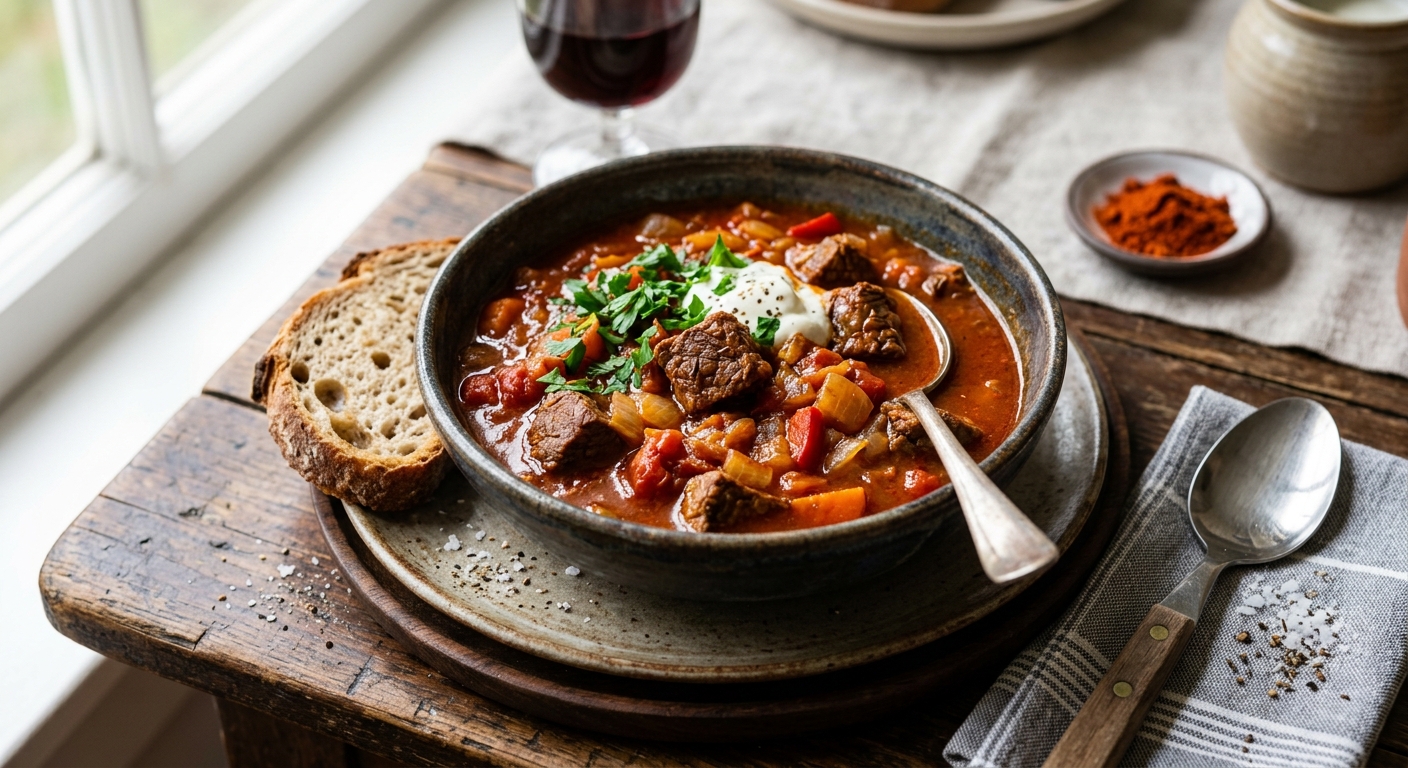
Hungarian goulash is one of Europe’s great peasant dishes, born from the necessity of feeding cattle drovers on the Hungarian plains, and refined over centuries into a stew of extraordinary depth. At its heart are three things: beef, onion, and paprika. Lots of paprika. The spice is not a garnish here but the structural backbone of the dish, providing colour, body, and a complex sweetness that no other spice can replicate. This recipe honours that tradition while building in a precise nutritional architecture that makes it one of the most mineral-dense meals you can prepare in a single pot.
The central nutritional story of this goulash is a partnership: iron and vitamin C. Beef chuck is a serious source of heme iron, the form most readily absorbed by the body. Red bell peppers and tomatoes flood the dish with ascorbic acid, which acts at the intestinal wall to chemically reduce ferric iron to the more absorbable ferrous form, while also inhibiting competing absorption blockers like phytates. The result is a dish where the iron you eat is very largely the iron you absorb. For anyone managing low iron stores, eating iron-rich plant foods alongside meat, or simply trying to meet daily mineral targets, this synergy is genuinely transformative.
Beyond iron, this goulash contributes meaningful amounts of zinc, vitamin B12, vitamin B6, potassium, and selenium from the beef, alongside vitamin A precursors and quercetin from the paprika and peppers. Hungarian sweet paprika alone contributes more vitamin C per gram than many fresh vegetables, particularly when added off the heat to preserve its ascorbic acid content. The recipe is calibrated for four generous servings, each providing over one third of your daily iron target. Serve with crusty sourdough, egg noodles, or soured cream to round out the meal.
4
servings
Ingredients
- 700 gbeef chuck, cut into 3 cm cubes
- 2 tbspextra-virgin olive oil
- 2 largeyellow onions, finely diced
- 4 clovesgarlic, minced
- 3 tbspHungarian sweet paprika
- 1 tspsmoked paprika
- 1 tsphot Hungarian paprika or cayenne (optional)
- 1 tspground caraway seeds
- 2 largered bell peppers, seeded and cut into 2 cm pieces
- 1 largegreen bell pepper, seeded and cut into 2 cm pieces
- 400 gcanned whole plum tomatoes, crushed by hand
- 2 tbsptomato paste
- 500 mlbeef stock, low sodium
- 350 gwaxy potatoes, cut into 2 cm cubes
- 1 tbspred wine vinegar
- 2 tspColima Sea SaltMicroplastic Free Salt
- 1 tspfreshly ground black pepper
- 2 mediumbay leaves
- 2 tbspflat-leaf parsley, finely chopped, for serving
- —Soured cream and crusty bread or egg noodles, to serve
Instructions
Click on an item below to shop for the recommended items for this recipe on Amazon.
As an Amazon Associate, we earn from qualifying purchases.
- Pat the beef cubes completely dry with paper towels. Season generously with 1 teaspoon of salt and the black pepper. Heat the olive oil in a large Dutch oven over high heat until shimmering and just beginning to smoke. Working in two or three batches to avoid crowding, sear the beef on two or three sides until a deep mahogany crust forms, about 3 to 4 minutes per side. Transfer each batch to a plate and set aside. Do not discard the fond on the bottom of the pot.
- Reduce the heat to medium. Add the diced onions to the same pot with a pinch of salt and cook, stirring and scraping up the browned bits with a wooden spoon, for 12 to 15 minutes until the onions are completely soft, golden, and beginning to caramelise. This low and slow step is the flavour foundation of the entire dish. Do not rush it.
- Remove the pot from the heat entirely. This step is critical: add the sweet paprika, smoked paprika, hot paprika if using, and ground caraway seeds directly onto the onions and stir vigorously for 30 seconds using residual heat only. Paprika contains sugars that scorch instantly over direct flame, turning bitter. Returning the pot to the heat too soon is the most common goulash mistake.
- Return the pot to medium heat and add the garlic. Stir for 1 minute until fragrant. Add the tomato paste and cook, stirring, for 2 minutes until it deepens in colour. Pour in the crushed tomatoes and beef stock, stirring to combine. Add the bay leaves and return the seared beef along with any accumulated juices to the pot. Bring to a gentle boil, then reduce the heat to low. Cover with the lid slightly ajar and simmer for 1 hour.
- After 1 hour, add the cubed potatoes and all three colours of bell peppers. Stir to incorporate. Continue simmering, partially covered, for a further 35 to 45 minutes until the beef is completely tender and yielding when pressed, the potatoes are cooked through, and the sauce has reduced to a thick, glossy, deeply red gravy.
- Discard the bay leaves. Stir in the red wine vinegar and the remaining teaspoon of salt. Taste and adjust seasoning. Ladle into wide bowls, top with chopped parsley and a generous spoonful of soured cream. Serve immediately with crusty bread or buttered egg noodles.
- Prepare the stovetop sear and onion-paprika base before anything goes into the slow cooker, as this step cannot be replicated inside the appliance. Pat the beef dry, season with salt and pepper, and sear in batches in a heavy skillet over high heat until deeply browned on two sides, about 3 to 4 minutes per side. Transfer directly to the slow cooker insert.
- In the same skillet over medium heat, cook the onions for 10 to 12 minutes until softened and golden. Remove from heat and stir in all three paprikas and the caraway seeds for 30 seconds off the flame. Return to medium heat, add the garlic, and cook 1 minute. Add the tomato paste and cook 2 minutes. Pour in the crushed tomatoes and beef stock, scraping the pan clean. Transfer the entire contents of the skillet into the slow cooker over the beef.
- Tuck the bay leaves in, add the cubed potatoes, and stir gently to combine. Ensure the beef is mostly submerged. Set the slow cooker to Low for 7 to 8 hours or High for 4 hours. Do not add the bell peppers yet.
- In the final 90 minutes of cooking on Low (or final 45 minutes on High), add the red and green bell peppers. Press them below the surface of the liquid, replace the lid, and continue cooking until they are tender but still hold their shape. This preserves significantly more ascorbic acid than cooking them the full duration.
- Once the beef is fall-apart tender and the peppers are cooked, discard the bay leaves. Stir in the red wine vinegar. Taste and adjust salt. The sauce in the slow cooker will be thinner than the stovetop version. If you prefer a thicker gravy, ladle about 250 ml of the liquid into a small saucepan, bring to a rapid boil, and reduce by half before stirring it back in. Serve topped with parsley and soured cream.
- Set the Instant Pot or electric pressure cooker to Saute on High. Add the olive oil and, once shimmering, sear the beef in batches until browned on two sides, about 3 minutes per side. Work in batches and do not crowd. Transfer each batch to a bowl. The browning is important for flavour complexity that pressure alone cannot create.
- Without rinsing the insert, reduce to Saute on Normal. Add the onions and cook, stirring and scraping the browned fond from the base, for 8 to 10 minutes until deeply softened. Press Cancel to turn off the heat. Add the sweet paprika, smoked paprika, hot paprika if using, and caraway seeds. Stir for 30 seconds in the residual heat only. Deglazing the pot thoroughly at this stage also prevents the burn warning during pressurisation.
- Press Saute on Normal again. Add the garlic and cook 1 minute. Add the tomato paste and stir for 90 seconds until it darkens slightly. Pour in the beef stock and crushed tomatoes, scraping the bottom completely clean with a wooden spoon. Cancel Saute. Return the seared beef and its juices to the insert. Add the potatoes, bay leaves, salt, and pepper. Do not add the bell peppers yet.
- Secure the lid, set the valve to Sealing, and cook on Manual High Pressure for 35 minutes. When the cycle completes, allow a natural pressure release for 15 minutes, then carefully turn the valve to Venting to release any remaining steam. Open the lid away from you.
- Remove the bay leaves. Set the pot back to Saute on Normal. Add the bell peppers and cook, stirring gently, for 6 to 8 minutes until they are just tender and bright. This short saute at atmospheric pressure preserves the majority of their vitamin C rather than destroying it under steam. Stir in the red wine vinegar, taste for seasoning, and serve with parsley and soured cream.
- Preheat the oven to 160 degrees C (325 degrees F) with a rack positioned in the lower third. Pat the beef completely dry and season with salt and pepper. Heat the olive oil in a large oven-safe Dutch oven over high heat on the stovetop. Sear the beef in batches without crowding until browned on two or three sides, about 3 to 4 minutes per side. Transfer to a plate.
- Reduce heat to medium. Cook the onions in the same pot for 12 to 15 minutes until completely softened and golden, scraping up the fond. Remove from heat. Off the flame, stir in all the paprikas and caraway seeds for 30 seconds. Return to medium heat, add the garlic, and cook 1 minute. Stir in the tomato paste and cook for 2 minutes until it turns a shade darker.
- Pour in the crushed tomatoes and beef stock. Stir thoroughly to deglaze. Return the seared beef and accumulated juices to the pot. Add the bay leaves, potatoes, and the remaining salt. Stir to combine. Nestle the red and green bell peppers on top. The oven’s gentle even heat means the peppers can go in at the start without disintegrating, though they will be softer than in the stovetop version.
- Bring the contents to a bare simmer on the stovetop. Place the lid firmly on the Dutch oven and transfer to the preheated oven. Braise for 1 hour 45 minutes, then carefully remove the lid and continue cooking uncovered for a further 30 minutes. The exposed surface will reduce and concentrate, the top of the stew will caramelise slightly at the edges, and the sauce will develop a rich, almost lacquered appearance.
- Remove from the oven using oven mitts. Discard the bay leaves. Stir in the red wine vinegar. The sauce should be thick and deeply coloured. If it is still quite liquid, place the pot on the stovetop over medium-high heat and reduce for 5 to 10 minutes uncovered. Taste and adjust seasoning. Rest the goulash for 10 minutes before serving, allowing the collagen in the beef to re-absorb some of the braising liquid. Finish with parsley and soured cream.
Nutrition Breakdown
Per 1 serving (makes 4)
Vitamins & Minerals
% Daily Value based on a 2,000 calorie diet (FDA reference)
🧬 Essential Amino Acids
% of recommended daily intake (RDA) per serving
🛡 Antioxidant Profile
The Nutrition Science
The iron-vitamin C synergy in this goulash is one of the best-documented nutrient interactions in human nutrition. Dietary iron exists in two forms: heme iron from animal tissue, which is absorbed at roughly 15 to 35 percent efficiency regardless of other dietary factors, and non-heme iron from plants and spices, which is absorbed at only 2 to 10 percent under normal conditions. This recipe delivers both. The beef chuck contributes approximately 3.5 mg of heme iron per serving, while the paprika, tomatoes, and potatoes add a further 3.3 mg of non-heme iron. Ascorbic acid from the red bell peppers and tomatoes (providing over 148 mg of vitamin C per serving, which is 164 percent of the daily value) chemically reduces ferric iron (Fe3+) to ferrous iron (Fe2+) in the intestinal lumen, the only form that can pass through the enterocyte transporter DMT1. Studies show this conversion can increase non-heme iron absorption by two to four times in a single meal.
Hungarian sweet paprika deserves particular attention as a nutritional ingredient rather than just a spice. A single tablespoon of high-quality Hungarian paprika contains approximately 4 to 6 mg of vitamin C, 0.9 mg of iron, and significant amounts of capsanthin and beta-carotene. This recipe uses three tablespoons, making paprika itself a meaningful micronutrient contributor. The critical technique of adding paprika off the heat is not merely a culinary tradition. Ascorbic acid begins to degrade above 70 degrees C, and the antioxidant carotenoids in paprika can isomerise under prolonged high heat. Blooming the spice in residual heat rather than in a hot pan preserves more of these heat-sensitive compounds while still releasing the fat-soluble carotenoids into the olive oil.
Zinc from the beef chuck (approximately 8.4 mg per serving, 76 percent of daily value) works synergistically with the vitamin B6 (53 percent DV) and B12 (121 percent DV) also present in this dish to support haemoglobin synthesis, immune function, and DNA repair. It is worth noting that the absence of high-phytate foods such as wholegrains or legumes in this recipe further supports mineral absorption: phytic acid is the primary dietary inhibitor of both iron and zinc absorption, and its absence means more of the minerals in this goulash are bioavailable than the raw numbers suggest.
Pro Tips
- Buy the best Hungarian sweet paprika you can find: look for paprika imported from Szeged or Kalocsa with a bright red colour and a sweet, slightly warm aroma. Paprika stored in a warm cupboard for over six months loses its colour and most of its vitamin C. Keep it in a sealed jar away from heat and light.
- Do not skip the searing step even in the slow cooker and pressure cooker methods. The Maillard reaction during searing creates hundreds of flavour compounds that cannot develop any other way, and the fond left in the pan is essential to the depth of the final sauce.
- For maximum iron absorption, avoid drinking tea, coffee, or calcium-rich dairy within one hour of eating this meal. Tannins in tea and polyphenols in coffee are significant inhibitors of non-heme iron absorption. If you take a calcium supplement, take it at a separate meal.



Oh this is *exactly* the kind of pairing I’ve been leaning into during perimenopause because iron absorption has become such a thing for me, especially with heavier periods some months. The vitamin C + iron combo feels like a cheat code when you’re trying to keep your energy up without relying entirely on supplements. I make something similar but throw in some extra paprika (more phytoestrogens never hurt) and serve it over something with a bit of calcium, so it’s a more complete nutrient moment. Do you find the slow simmering changes the nutrient profile much, or is it pretty stable?
What a wonderful post, and Miranda, I’m so glad you brought up perimenopause because this is exactly the kind of nutritional strategy I wish more of my students understood when they’re going through big life changes! I made a traditional Hungarian goulash for decades the old way, but after learning about that vitamin C and iron synergy, I started adding fresh bell peppers at the end along with the tomatoes, and honestly, the flavor is even brighter now while doing so much more for absorption. For my next class, I’m planning to build this recipe around that science piece so folks can see how traditional comfort food actually becomes MORE nourishing when you understand the chemistry behind it, not less. This is the kind
Miranda, that’s exactly the right instinct – the perimenopause window is when iron bioavailability becomes critical, and vitamin C really does shift the equation measurably. One thing worth noting here is that beef goulash also delivers heme iron (the more absorbable form), so you’re getting a double benefit compared to plant-based iron sources. If you ever want to push absorption further, adding a splash of vinegar or fermented ingredients to the braise can lower pH slightly and help even more. Have you noticed a difference in your energy levels since tuning in to these pairings?