
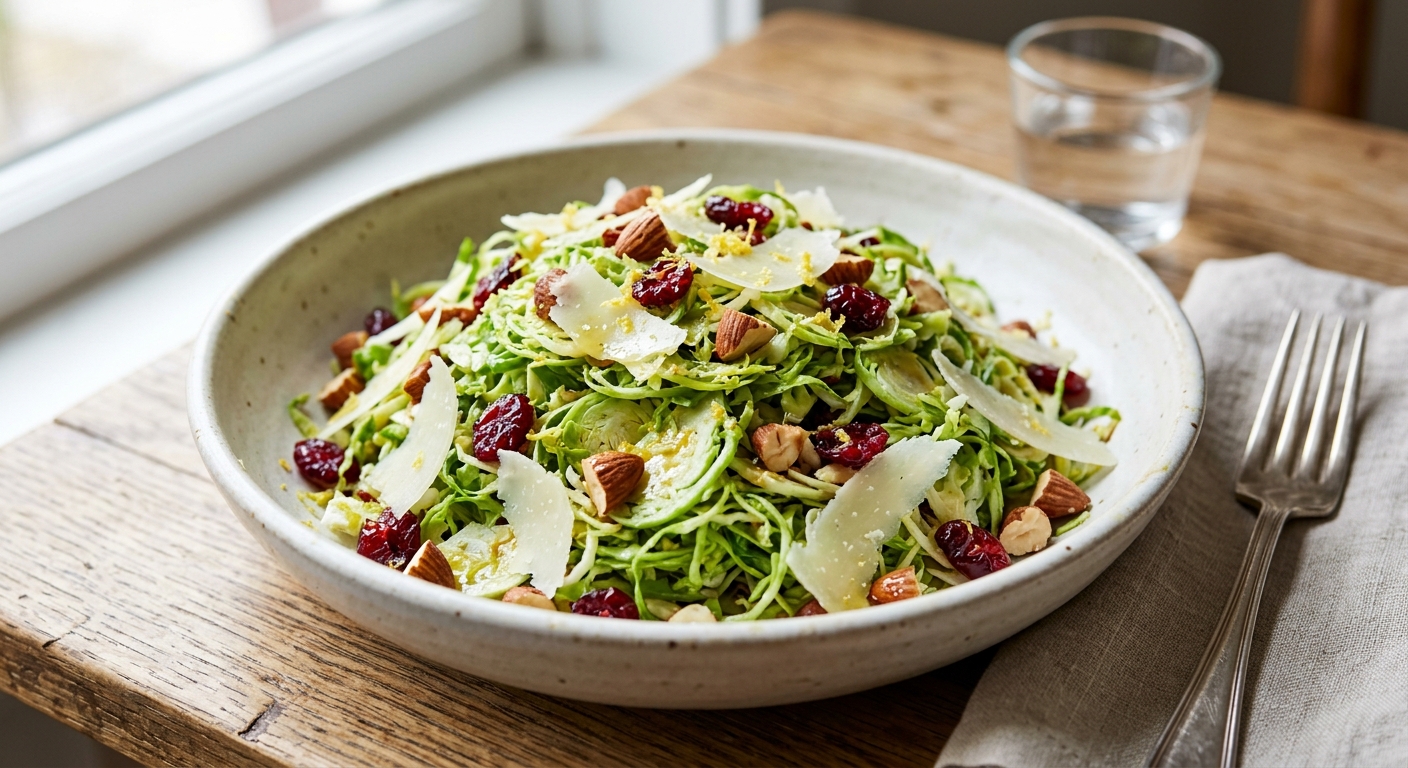
Brussels sprouts have spent decades as the most unfairly maligned vegetable on the dinner table. Overboiled into sulfurous submission, they earned their bad reputation the hard way. But shaved raw and dressed with a zippy lemon vinaigrette, they reveal an entirely different character: crisp, slightly nutty, and pleasantly bitter in the way that makes you reach for another forkful. This Shaved Brussels Sprout Salad with Parmesan is the dish that converts skeptics, and it does so while delivering a genuinely extraordinary nutritional payload.
From a nutritional engineering standpoint, this salad is close to perfect. Brussels sprouts are one of the few vegetables that provide meaningful amounts of both Vitamin C and Vitamin K simultaneously, two nutrients that most adults are quietly under-consuming. The raw preparation is intentional and scientifically important: Vitamin C is heat-sensitive and degrades rapidly during cooking, so keeping the sprouts uncooked preserves nearly all of that ascorbic acid. The Parmesan adds a savory umami depth alongside a notable hit of calcium and phosphorus, while the toasted almonds contribute Vitamin E and heart-healthy monounsaturated fats that also improve the absorption of fat-soluble Vitamin K.
Whether you are building this salad in its classic raw form, or opting for one of the warm, roasted, or braised variations using the oven or stovetop to soften and caramelize the sprouts, each method has been calibrated to preserve as much nutritional value as possible while developing distinct and genuinely delicious flavors. Prepare one, prepare all four, but prepare to be surprised by how much a humble sprout can do.
4
servings
Ingredients
- 680 gBrussels sprouts, stem ends trimmed
- 60 gParmesan cheese, freshly shaved with a vegetable peeler
- 60 graw almonds, roughly chopped
- 50 gdried cranberries, unsweetened or lightly sweetened
- 3 tbspextra-virgin olive oil
- 3 tbspfreshly squeezed lemon juice (about 1.5 lemons)
- 1 tsplemon zest
- 1 tbspDijon mustard
- 1 tsphoney or pure maple syrup
- 1 clovegarlic, finely minced or grated
- 2 tbspshallot, finely minced (about 1 medium shallot)
- —Colima Sea SaltMicroplastic Free Salt and freshly cracked black pepper to taste
Instructions
Click on an item below to shop for the recommended items for this recipe on Amazon.
As an Amazon Associate, we earn from qualifying purchases.
- Shave the Brussels sprouts as thinly as possible using a sharp chef’s knife or a mandoline set to 1.5mm. Work in halves: cut each sprout in half through the core, place flat-side down, and slice across into thin ribbons. Separate the ribbons with your fingers and discard any tough core pieces. Place shaved sprouts in a large bowl and set aside.
- Place a large (30cm) heavy skillet, preferably cast iron, over medium heat. Add the chopped almonds and toast them dry, stirring frequently, for 3 to 4 minutes until golden and fragrant. Watch carefully as they can burn quickly. Transfer to a small bowl and set aside.
- Return the skillet to medium heat and add 2 tablespoons of the olive oil. Add the minced shallot and cook, stirring, for 90 seconds until softened and translucent. Add the garlic and cook for 30 seconds more until fragrant but not browned.
- Add the shaved Brussels sprouts directly to the skillet. Season with a generous pinch of salt and several grinds of pepper. Toss with tongs to coat in the aromatics. Cook for 3 to 4 minutes, tossing every minute, until the sprouts are just wilted and have turned a brighter, deeper green but still retain some texture. Do not overcook.
- Remove the pan from heat. Whisk together the remaining 1 tablespoon of olive oil, lemon juice, lemon zest, Dijon mustard, and honey in a small bowl. Pour this dressing over the warm sprouts in the skillet and toss immediately so the residual heat helps the sprouts absorb the vinaigrette.
- Transfer the dressed sprouts to a large serving bowl or platter. Top with the toasted almonds, dried cranberries, and shaved Parmesan. Taste and adjust seasoning with additional salt, pepper, or lemon juice. Serve immediately while still warm.
- Divide the Brussels sprouts into two equal portions (approximately 340g each). For the first portion, leave the sprouts whole or halve them through the core. For the second portion, shave them into thin ribbons as described in the stovetop method and refrigerate, covered, until assembly.
- In the slow cooker insert, combine the whole or halved sprouts, 1 tablespoon of the olive oil, the minced shallot, garlic, 1 tablespoon of lemon juice, 2 tablespoons of water, a generous pinch of salt, and black pepper. Toss everything together to coat. Spread into an even layer.
- Place the lid on the slow cooker and cook on High for 2 to 2.5 hours, or until the sprouts are completely tender, lightly caramelized at the edges, and reduced in volume by roughly half. Resist lifting the lid during the first 2 hours to maintain temperature and moisture.
- While the braised sprouts finish cooking, toast the chopped almonds in a dry skillet over medium heat for 3 to 4 minutes, stirring frequently, until golden. Set aside. Whisk together the remaining 2 tablespoons of olive oil, remaining 2 tablespoons of lemon juice, lemon zest, Dijon mustard, and honey to make the vinaigrette.
- When the braised sprouts are done, remove the slow cooker insert from the base and allow the sprouts to cool for 10 minutes. Transfer to a large mixing bowl. Add the reserved raw shaved sprouts to the bowl and toss to combine, so the warmth of the braised portion gently takes the chill off the raw ribbons without cooking them further.
- Pour the vinaigrette over the combined sprouts and toss well. Fold in the dried cranberries and most of the toasted almonds. Transfer to a serving platter, top with shaved Parmesan and remaining almonds, and serve immediately.
- Prepare an ice bath: fill a very large bowl with cold water and a generous amount of ice and set it beside your sink. Shave all 680g of Brussels sprouts into thin ribbons using the technique described in the stovetop method. Place the shaved sprouts in a steamer basket that fits inside your pressure cooker or Instant Pot insert.
- Pour 240ml (1 cup) of cold water into the bottom of the pressure cooker insert. Lower the steamer basket with the shaved sprouts into the pot. Secure the lid and set the steam-release valve to the sealing position. Select the Steam function (or manual/pressure cook) and set to 2 minutes at high pressure.
- While the cooker comes to pressure and steams, toast the chopped almonds in a dry skillet on the stovetop over medium heat for 3 to 4 minutes until golden and fragrant. Remove from heat. Whisk together all 3 tablespoons of olive oil, all the lemon juice, lemon zest, Dijon mustard, honey, garlic, and minced shallot in a large mixing bowl to form the vinaigrette. Season with salt and pepper.
- When the 2-minute cook time ends, perform an immediate quick pressure release by carefully switching the steam-release valve to venting. Open the lid as soon as pressure has fully released. Working quickly, lift the steamer basket out and plunge the shaved sprouts directly into the prepared ice bath. Stir gently for 60 to 90 seconds until completely cooled to halt carryover cooking.
- Drain the sprouts thoroughly in a colander, then spread on a clean kitchen towel and pat firmly dry. Excess water will dilute the dressing. Add the dried, cooled sprouts directly to the bowl with the vinaigrette and toss to coat. Let stand for 5 minutes to allow the sprouts to absorb the dressing.
- Transfer to a serving platter or individual bowls. Top with shaved Parmesan, toasted almonds, and dried cranberries. Finish with a final crack of black pepper and serve at room temperature.
- Preheat your oven to 220C (425F) with a large rimmed baking sheet inside on the middle rack, allowing the sheet to preheat for at least 10 minutes. This is critical for achieving immediate sear and caramelization on contact, rather than steaming. Shave approximately 340g of the Brussels sprouts into thin ribbons and refrigerate. Halve the remaining 340g through the core for roasting.
- Toss the halved sprouts with 2 tablespoons of the olive oil, the minced shallot, a generous pinch of salt, and black pepper in a large bowl until evenly coated. Remove the hot baking sheet from the oven using heavy oven mitts. Working quickly, pour the seasoned sprouts onto the hot sheet and spread into a single layer, cut-side down, with space between each piece.
- Roast for 18 to 22 minutes, rotating the pan once at the 12-minute mark, until the cut sides are deeply caramelized and dark golden-brown and the outer leaves are crisped. While the sprouts roast, scatter the chopped almonds on a small separate baking sheet and place in the oven for the final 5 minutes of roasting time only, watching carefully.
- While the sprouts roast, whisk together the remaining 1 tablespoon of olive oil, all the lemon juice, lemon zest, Dijon mustard, honey, and garlic in a large mixing bowl. Season with salt and pepper. Remove the shaved raw sprouts from the refrigerator.
- As soon as the roasted sprouts come out of the oven, immediately add them to the large bowl with the raw shaved sprouts and the vinaigrette. Toss everything together vigorously. The heat from the roasted sprouts will very slightly wilt the raw ribbons without cooking them, creating a beautiful contrast of crisp raw and tender roasted textures.
- Transfer to a serving platter. Scatter the toasted almonds and dried cranberries over the top. Lay the shaved Parmesan across the surface and serve immediately while the roasted sprouts are still warm.
Nutrition Breakdown
Per 1 serving (makes 4)
Vitamins & Minerals
% Daily Value based on a 2,000 calorie diet (FDA reference)
🧬 Essential Amino Acids
% of recommended daily intake (RDA) per serving
🛡 Antioxidant Profile
The Nutrition Science
The pairing of Brussels sprouts with olive oil and almonds in this recipe is not merely culinary instinct but nutritional strategy. Vitamins C and K are chemically opposite in one critical respect: Vitamin C is water-soluble and heat-sensitive, degrading significantly above 70C, while Vitamin K1 (phylloquinone) is fat-soluble and requires dietary fat for intestinal absorption. By keeping a substantial portion of the sprouts raw, we preserve the majority of the ascorbic acid. By dressing them with olive oil and including almonds, we create the lipid-rich environment that enables Vitamin K to be absorbed through the intestinal wall via chylomicron transport. They are nutrients that literally need each other’s company to be fully utilized.
Brussels sprouts belong to the Brassica oleracea species alongside broccoli, kale, and cabbage, and they share the family’s signature glucosinolate chemistry. When the cell walls of a Brussels sprout are disrupted by cutting or chewing, the enzyme myrosinase is released and converts glucoraphanin into sulforaphane, one of the most well-studied dietary phytochemicals in cancer-prevention research. Crucially, cooking above approximately 65C deactivates myrosinase, which is one scientific argument for the raw and lightly cooked preparations in this recipe. Mustard seed (as in Dijon mustard) contains heat-stable myrosinase, which is why the vinaigrette can partially restore sulforaphane production even in the warmer cooked variations of this dish.
The Parmesan in this recipe contributes more than flavor. It provides a meaningful dose of calcium (approximately 55mg per 15g serving) in a highly bioavailable form alongside phosphorus. Notably, Vitamin K2 (primarily menaquinone forms, found in fermented and aged dairy) works synergistically with Vitamin D to direct calcium into bones and teeth rather than soft tissues. While Parmesan is a modest source of K2 compared to fermented foods like natto, the combination of K1 from the sprouts and the calcium matrix from the cheese makes this salad a genuinely coherent bone-health package in a single bowl.
Pro Tips
- For maximum Vitamin C retention, shave and dress the raw sprouts no more than 30 minutes before serving. The acid from the lemon juice will help slow enzymatic browning, but prolonged exposure to air degrades ascorbic acid measurably.
- If using a mandoline, use the hand guard without exception and set it to 1.5mm to 2mm. A thickness greater than 3mm produces a texture that is too tough and chewy in the raw portions. A sharp chef’s knife is safer for beginners and produces excellent results with practice.
- Taste the dressed salad before adding the Parmesan and adjust the salt level accordingly. Parmesan is assertively salty and can easily push the dish over the threshold if you have already salted generously. Add the cheese first, toss, taste, then correct.
The shaving technique is key here – you’re basically breaking down cell walls to increase bioavailability of both the C and K, which is a nice win compared to chopped. That said, I’d push back slightly on the raw prep if someone’s doing serious micronutrient extraction: a 90 second blanch (then ice bath) actually preserves most of the C while making the K even more absorbable, plus it softens the glucosinolates for better digestion. The Parmesan choice is smart for K2, but if histamine sensitivity is a concern like Lorraine mentioned, that’s worth considering. I’ve been playing with raw shaved + lightly toasted spr
This looks solid for micronutrient density, especially the K2 from the Parmesan. Quick question though – how are you thinking about this in a training context? I’m curious if you’d recommend this as a pre-ride (raw, lower glycemic load) or more of a recovery day salad since it’s pretty veggie-heavy. I’ve been experimenting with timing my cruciferous intake around hard efforts since they’re anti-inflammatory, and the vitamin C is definitely useful for immune support during heavy training blocks. What’s the total carb load on this including the cranberries and almonds?
Love this recipe! Just a heads up for anyone with histamine sensitivities like me: raw Brussels sprouts and aged Parmesan can both be triggers, so I’d suggest blanching the sprouts briefly to reduce histamine levels and maybe swapping the aged Parm for fresh mozzarella instead. The lemon vinaigrette is perfect as-is since fresh lemon is low-histamine, and honestly the toasted almonds and fresh cranberries keep all that great nutrient density intact.