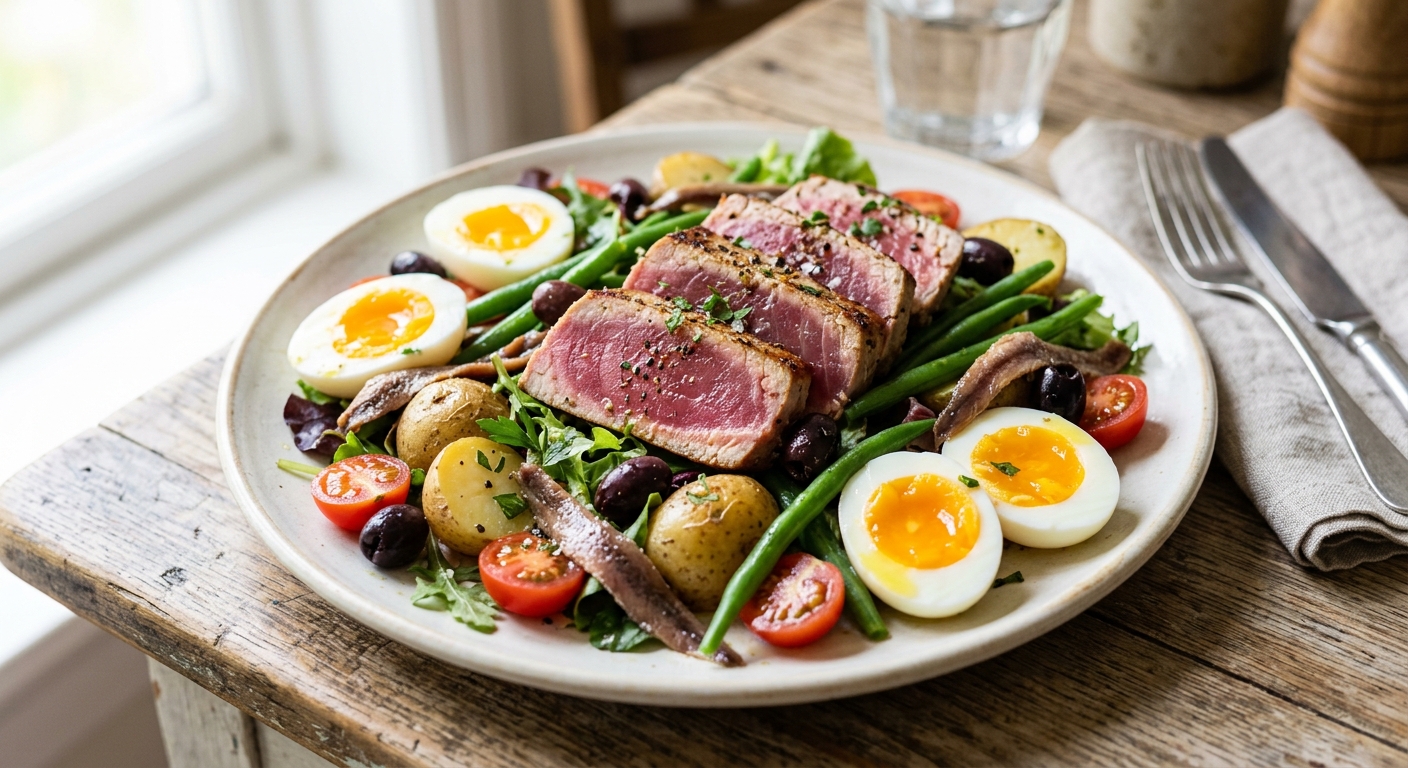
Salade Nicoise is one of those rare dishes where classical French culinary tradition and modern nutritional science are in complete agreement. Originating from the sun-drenched port city of Nice on the French Riviera, this composed salad was built around the abundant seafood and garden produce of the Mediterranean coast. Today, we are reclaiming it as what it always was: a masterclass in balanced, whole-food eating that happens to taste extraordinary. Our version centers on fresh sushi-grade yellowfin tuna steaks, seared hard on the outside and left gloriously rare at the center, delivering a texture and flavor that canned tuna simply cannot match.
From a nutritional architecture standpoint, this dish is almost impossibly well-designed. The tuna provides complete protein with all nine essential amino acids in near-perfect ratios, along with EPA and DHA omega-3 fatty acids that support cardiovascular and cognitive health. The eggs contribute choline and additional high-quality protein. The haricots verts and baby potatoes bring folate, potassium, and resistant starch. The Nicoise olives and extra-virgin olive oil provide oleocanthal, a natural anti-inflammatory compound, alongside monounsaturated fats that dramatically increase the bioavailability of fat-soluble carotenoids from the salad greens. Every component earns its place on the plate, both gastronomically and biochemically.
We have developed three distinct preparation methods here. The stovetop method produces the definitive sear on the tuna and gives you precise control over each component. The oven method is ideal for batch cooking and hands-off preparation, using gentle roasting to cook the vegetables while the tuna finishes under the broiler. The slow cooker and pressure cooker methods are included for readers who want warm, confit-style tuna or need to prepare everything in advance for meal prep, though we recommend the stovetop or oven for the traditional experience. Whichever method you choose, the nutritional profile remains exceptional.
4
servings
Ingredients
- 680 gsushi-grade yellowfin tuna steaks (4 x 170g), about 2.5cm thick
- 400 gbaby new potatoes, halved
- 300 gharicots verts (French green beans), trimmed
- 4 largeeggs
- 200 gcherry tomatoes, halved
- 120 gNicoise or Kalamata olives, pitted
- 60 ganchovy fillets in olive oil (about 16 fillets), drained
- 100 gmixed salad greens (mesclun or baby romaine)
- 4 tbspcapers, rinsed and drained
- 1 smallred onion, very thinly sliced into rings
- 4 tbspextra-virgin olive oil, divided
- 3 tbspred wine vinegar
- 1 tbspDijon mustard
- 1 tsphoney
- 2 clovesgarlic, minced
- 2 tbspfresh flat-leaf parsley, finely chopped
- 1 tbspfresh thyme leaves
- —Colima Sea SaltMicroplastic Free Salt and freshly cracked black pepper to taste
- —Colima Sea SaltMicroplastic Free Salt (such as Maldon) for finishing the tuna
Instructions
Click on an item below to shop for the recommended items for this recipe on Amazon.
As an Amazon Associate, we earn from qualifying purchases.
- Make the vinaigrette first so it can mellow while you cook. In a small jar or bowl, combine 3 tablespoons of the olive oil, the red wine vinegar, Dijon mustard, honey, minced garlic, parsley, and thyme. Season generously with salt and pepper, whisk vigorously until emulsified, then set aside.
- Place the baby potatoes in a medium saucepan, cover with cold salted water by 5cm, and bring to a boil over high heat. Reduce to a vigorous simmer and cook for 12 to 15 minutes until a knife slides in with no resistance. In the last 4 minutes of potato cooking, add the haricots verts to the same pot and blanch until bright green and just tender-crisp. Use a slotted spoon to transfer the beans immediately to a bowl of ice water to stop the cooking and preserve their color. Drain the potatoes and beans when ready and toss them warm with half the vinaigrette.
- In a separate small saucepan, bring water to a boil. Gently lower the eggs in with a spoon and cook for exactly 7 minutes for jammy yolks (or 9 minutes for fully set). Transfer immediately to an ice bath for 5 minutes, then peel carefully. Slice in half lengthwise just before plating.
- Pat the tuna steaks completely dry with paper towels, this is critical for a proper sear. Season both sides with fine sea salt and cracked black pepper. Heat a large cast-iron skillet or heavy stainless-steel pan over the highest heat your burner allows for at least 2 full minutes until the pan is smoking. Add the remaining 1 tablespoon of olive oil, swirl once, and immediately lay the tuna steaks away from you into the pan. Do not move them. Sear for exactly 90 seconds per side for a rare center (internal temperature 46 to 49 degrees C). Transfer to a cutting board and let rest for 2 minutes, then slice against the grain into 1cm-thick slices.
- Arrange the salad greens across four plates or a large platter. Layer the dressed potatoes and beans over the greens. Scatter the cherry tomatoes, red onion rings, olives, capers, and anchovy fillets artfully across the salad. Arrange the seared tuna slices prominently in the center and place the halved soft-boiled eggs alongside. Drizzle the remaining vinaigrette over everything and finish the tuna with a pinch of flaky sea salt. Serve immediately.
- Prepare the olive oil confit base. Place the tuna steaks in the insert of a 4-quart or larger slow cooker. Pour enough extra-virgin olive oil over the tuna to fully submerge the steaks (you will need approximately 240 to 360ml of additional olive oil beyond the recipe amount for this method). Add the garlic cloves whole and unminced, the thyme leaves, and a generous pinch of salt and pepper. The oil should completely cover the fish.
- Set the slow cooker to Low. Cover and cook for 1.5 to 2 hours. The tuna is done when it flakes easily with a fork but still looks moist and slightly translucent at the very center. Because slow cookers vary, check at the 90-minute mark. The oil temperature should not exceed 60 degrees C for true confit; if your slow cooker runs hot, prop the lid open slightly with a chopstick.
- While the tuna confits, cook the potatoes and eggs on the stovetop using a medium saucepan. Cover potatoes with cold salted water, bring to a boil, and cook 12 to 15 minutes until tender. Boil the eggs separately for 7 minutes (jammy) or 9 minutes (set), then transfer to an ice bath. Blanch the haricots verts in the potato water for 4 minutes after removing the potatoes, then shock in ice water.
- Make the vinaigrette by whisking together 3 tablespoons of the confit olive oil (scooped from the slow cooker after the tuna is done, as it will be infused with garlic and thyme), the red wine vinegar, Dijon mustard, honey, minced fresh garlic, and parsley. Season to taste. Toss the warm potatoes and beans with half the vinaigrette.
- Using a large slotted spoon or fish spatula, carefully lift the confit tuna from the oil and allow it to drain briefly. It will be tender and may break apart slightly, which is expected and desirable for this preparation. Arrange the salad greens, dressed vegetables, cherry tomatoes, red onion, olives, capers, and anchovies on plates. Break the confit tuna into generous chunks over the top, add the halved eggs, and drizzle with the remaining vinaigrette. The warm, oil-rich tuna will gently wilt the greens, creating a warm-salad effect.
- Add 240ml of water to the pressure cooker pot and place the steam rack or trivet inside. Arrange the baby potatoes on the trivet. Seal the lid and cook on High Pressure for 4 minutes, then perform a quick pressure release. Use tongs to transfer the potatoes to a bowl, then toss them immediately with half the vinaigrette (made by combining 3 tbsp olive oil, red wine vinegar, mustard, honey, garlic, parsley, thyme, salt, and pepper) so they absorb flavor while hot.
- Return the pot to saute mode (or use a separate small saucepan on the stovetop) with fresh water. Bring to a boil and blanch the haricots verts for 3 to 4 minutes until just tender-crisp. Transfer to an ice bath immediately. In the same boiling water, cook the eggs for 7 minutes (lower gently with a spoon), then transfer to the ice bath for 5 minutes before peeling.
- Pat the tuna steaks completely dry and season generously with salt and pepper on both sides. Discard the water from the pot. Switch the Instant Pot to Saute on High (or use the hottest setting available). Add 1 tablespoon of olive oil. When the oil shimmers and just begins to smoke, sear the tuna steaks for 90 seconds per side without moving them. If your pot is too small to fit all four steaks without crowding, sear in two batches and tent the first batch loosely with foil to keep warm.
- Rest the seared tuna on a cutting board for 2 minutes, then slice against the grain into 1cm pieces. While it rests, toss the haricots verts with the remaining vinaigrette.
- Assemble the plates: salad greens as the base, followed by the dressed potatoes and beans, then cherry tomatoes, red onion rings, olives, capers, and anchovy fillets. Lay the sliced tuna across the center, arrange the halved eggs around it, and finish with a final drizzle of any remaining vinaigrette and a pinch of flaky sea salt over the tuna.
- Preheat your oven to 220 degrees C (200 degrees C fan / 425 degrees F). Line two rimmed baking sheets with parchment paper. Toss the halved baby potatoes with 1.5 tablespoons of olive oil, salt, and pepper on the first baking sheet and arrange cut-side down in a single layer. Roast on the middle rack for 20 minutes until golden on the cut side and tender when pierced. In the last 8 minutes, add the haricots verts to the second baking sheet, toss with 0.5 tablespoon olive oil, salt, and pepper, and roast in the oven alongside the potatoes until slightly blistered and tender-crisp.
- While the vegetables roast, bring a small saucepan of water to a boil. Lower the eggs in gently and cook for exactly 7 minutes for jammy yolks or 9 minutes for fully set yolks. Transfer immediately to an ice bath for 5 minutes, then peel and halve just before serving.
- Make the vinaigrette: whisk together the remaining 2 tablespoons of olive oil, red wine vinegar, Dijon mustard, honey, minced garlic, parsley, and thyme. Season well. As soon as the roasted potatoes and beans come out of the oven, toss them with half the vinaigrette on the baking sheet while still hot so they absorb the dressing.
- Switch the oven to broil on its highest setting. Pat the tuna steaks thoroughly dry with paper towels and season both sides generously with salt and cracked pepper. Place the tuna steaks on the now-empty first baking sheet (or a foil-lined sheet), brush the tops lightly with a thin film of olive oil. Position the rack so the tuna is about 8 to 10cm from the broiler element. Broil for 2 minutes, then flip carefully with a thin spatula and broil for a further 1.5 to 2 minutes. The exterior should be lightly charred and crusted while the interior remains medium-rare to rare. Rest for 2 minutes on a cutting board, then slice against the grain.
- Spread the salad greens across a large serving platter or individual plates. Arrange the roasted potatoes and haricots verts over the greens. Add the cherry tomatoes, red onion rings, olives, capers, and anchovy fillets. Place the sliced tuna and halved eggs prominently over the top. Drizzle generously with the remaining vinaigrette and finish with flaky sea salt. The warm roasted vegetables will create a beautifully integrated warm-and-cool composed salad.
Nutrition Breakdown
Per 1 serving (makes 4)
Vitamins & Minerals
% Daily Value based on a 2,000 calorie diet (FDA reference)
🧬 Essential Amino Acids
% of recommended daily intake (RDA) per serving
🛡 Antioxidant Profile
The Nutrition Science
The headline nutritional story of this dish is its exceptional selenium content. A single 170g portion of yellowfin tuna contains approximately 110 to 130mcg of selenium, already near the 400mcg upper tolerable intake limit on its own. Combined with the eggs and anchovies, one serving of this salad delivers over 260% of the Daily Value. Selenium is the critical cofactor for the family of selenoprotein enzymes, most notably glutathione peroxidase and thioredoxin reductase, which constitute the body’s primary defense against reactive oxygen species. Populations with adequate selenium status show measurably lower incidence of certain cancers and thyroid dysfunction, and the organic selenomethionine form found in fish and eggs is substantially more bioavailable than inorganic selenium supplements.
The omega-3 fatty acid profile of this dish also deserves attention. Yellowfin tuna provides EPA (eicosapentaenoic acid) and DHA (docosahexaenoic acid) in the long-chain form that the human body can directly incorporate into cell membranes and use for eicosanoid synthesis without the inefficient conversion step required from plant-derived ALA. A 170g serving of fresh yellowfin tuna contains approximately 600 to 800mg of combined EPA and DHA. The American Heart Association recommends 500mg per day for cardiovascular health, meaning this single meal meets and exceeds that target. The olive oil in the vinaigrette and the egg yolk fat present in this dish further enhance the absorption of fat-soluble micronutrients including vitamins D, K, and the carotenoids from the salad greens and tomatoes.
The choline contribution from the two egg halves per serving (approximately 125mg from eggs alone, supplemented by additional choline from the tuna) addresses one of the most widespread nutritional deficiencies in modern diets. Choline is essential for the synthesis of phosphatidylcholine, the dominant phospholipid in cell membranes, and for acetylcholine neurotransmitter production. The National Institutes of Health estimates that over 90% of Americans consume less than the Adequate Intake for choline. The combination of eggs and tuna in this single dish delivers nearly 40% of the AI in one meal, making Nicoise a particularly valuable option for pregnant women, who have substantially elevated choline requirements for fetal brain development.
Pro Tips
- The single most important technique for a perfect sear on the tuna is absolute dryness. Pat the steaks with paper towels at least twice, pressing firmly on all surfaces. Any surface moisture creates steam that prevents the Maillard browning reaction, and you will end up with a gray, steamed exterior instead of a deep mahogany crust.
- For the classic Nicoise vinaigrette, the ratio of oil to vinegar is closer to 2:1 rather than the standard 3:1 of most vinaigrettes. The extra acidity is intentional; it cuts through the richness of the tuna, eggs, and anchovies and brightens the entire dish. Do not be tempted to reduce the vinegar.
- Tuna steaks continue to carry-over cook significantly after leaving the heat due to their density. Pull them off the pan when the sides are still showing a band of red about 5mm wide. By the time you slice, they will be a perfect medium-rare gradient from seared exterior to pink, silky center. Overcooking tuna to opaque gray is the most common and most heartbreaking mistake in this dish.
Love seeing people connect the dots here! The vitamin C angle Francesca mentioned is such a game changer for iron absorption, especially when you’re pairing heme iron from the tuna with the non-heme iron in those potatoes and greens – that acidic lemon dressing is basically doing the nutritional heavy lifting. And Sophia, the choline + omega-3 combo for cognitive function is legit, though I’d gently push back on the BDNF claim being that direct (the research is still pretty emerging there), but either way this salad is genuinely one of the most nutrient-dense meals you can eat in one bowl, so even placebo aside, your body’s
ok this is literally my dream meal because the heme iron from the tuna is already so absorbable, but then you’ve got the vitamin C in the tomatoes and lemon dressing ramping it up even more, and the eggs are adding that extra bioavailable iron too. ive been tracking my ferritin for months and dishes like this honestly move the needle way better than any supplement i’ve tried, plus the omega-3s are such a bonus for inflammation. the eggs and potatoes wont block the iron either which is the thing people always miss – no calcium-heavy dairy competing for absorption here.
omg this is exactly what ive been eating before my comprehensive exams and i swear theres actually something to it beyond placebo. the combo of epa/dha from the tuna plus the choline in the eggs is supposed to upregulate BDNF expression and i genuinely noticed sharper memory consolidation after sessions where i ate this vs when i just grabbed whatever. plus the iron from the tuna is so much more bioavailable than plant sources so your mitochondria actually has the oxygen it needs for sustained focus. did you account for the cooking temp of the tuna when you calculated the omega-3 content though, bc i read that high heat can degrade some of the longer chain