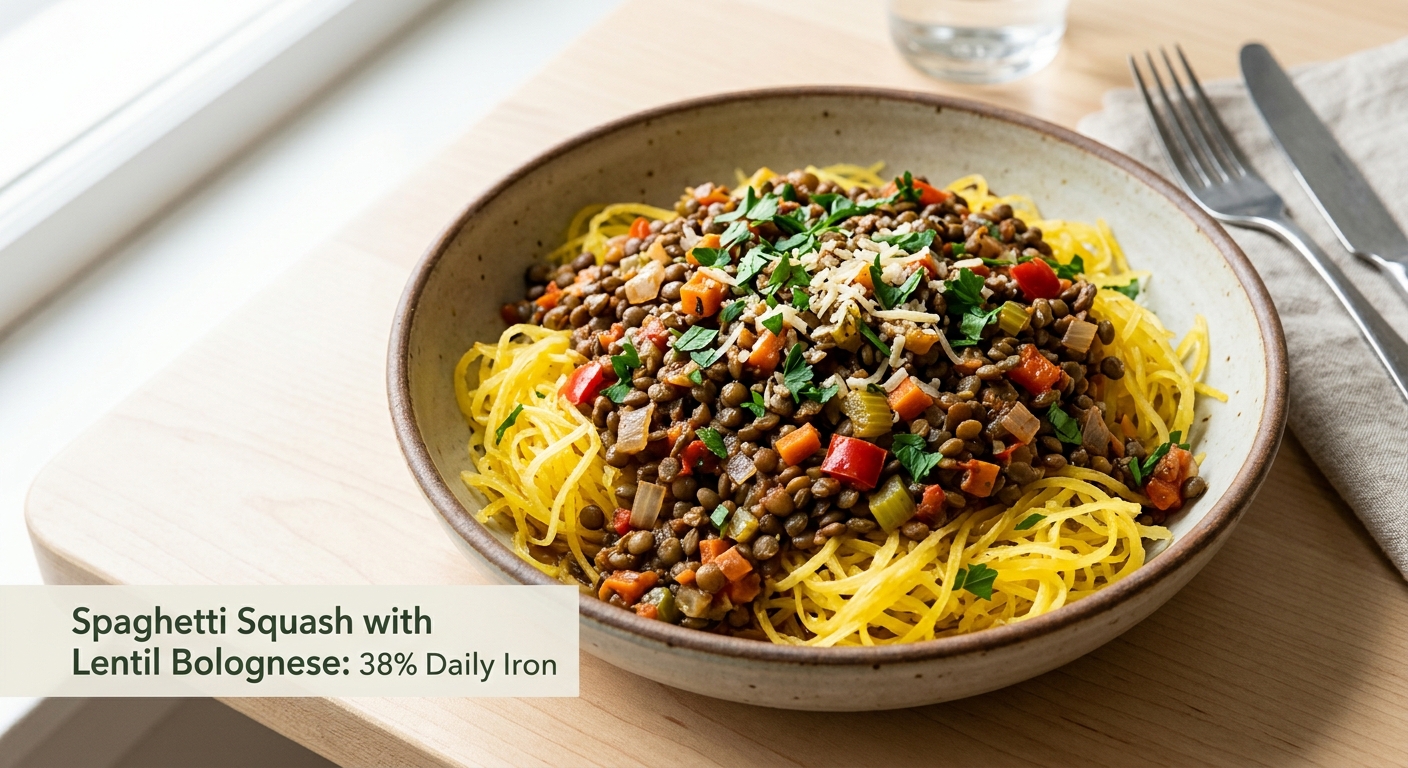
There is a quiet magic in the moment a fork drags through a roasted spaghetti squash and golden ribbons emerge, ready to cradle whatever sauce you choose. Pair those ribbons with a lentil Bolognese built on French green lentils, San Marzano tomatoes, soffritto vegetables, and a finishing hit of fresh herbs, and you have a meal that earns its place on both a nutritionist’s spreadsheet and a Sunday dinner table. The sauce mimics the low, slow richness of a traditional meat ragu through the browning of aromatics, a splash of dry red wine, and a long simmer that concentrates umami from tomato paste and a Parmesan rind.
Iron deficiency remains the most common micronutrient shortfall worldwide, and plant-based eaters face an uphill climb because non-heme iron from legumes absorbs less efficiently than the heme iron in meat. This recipe tackles that challenge head-on. Each serving delivers approximately 6.8 mg of iron, representing 38% of the daily value, and every element of the dish is engineered to maximise absorption. The tomatoes and bell pepper contribute over 60 mg of vitamin C per serving, which research consistently shows can increase non-heme iron absorption by two to three times. Finishing with a squeeze of lemon at the table amplifies that effect further.
Beyond iron, the combination of spaghetti squash and green lentils creates an exceptional fiber profile: roughly 14 grams per serving, spanning both soluble fiber from the lentils (which feeds beneficial gut bacteria and moderates blood sugar) and the structural fiber of the squash (which adds bulk and supports motility). The result is a glycemic load of just 13, meaning the meal delivers lasting satiety without a sharp glucose spike, making it an excellent choice for anyone managing blood sugar or simply trying to stay energised through a long afternoon.
4
servings
Ingredients
- 1 large (about 1.4kg)spaghetti squash
- 250 gFrench green lentils (Puy-style), rinsed and picked over
- 3 tbspextra-virgin olive oil, divided
- 1 medium (about 160g)yellow onion, finely diced
- 3 clovesgarlic, minced
- 2 medium (about 180g total)carrots, finely diced
- 2 stalks (about 100g)celery, finely diced
- 1 medium (about 150g)red bell pepper, finely diced
- 3 tbsptomato paste
- 120 mldry red wine (such as Chianti or Barbera)
- 800 gcrushed San Marzano tomatoes (one 800g tin)
- 480 mllow-sodium vegetable broth
- 1 tspdried oregano
- 1 tspdried thyme
- 1 sprigfresh rosemary
- 1 pieceParmesan rind (optional, omit for vegan)
- 2 tbspfresh flat-leaf parsley, roughly chopped
- 1 tbspfresh basil leaves, torn
- 0.5 tspred pepper flakes
- 1 tbspfresh lemon juice
- —Colima Sea SaltMicroplastic Free Salt and freshly cracked black pepper to taste
- —Freshly grated Parmesan or nutritional yeast to serve
Instructions
Click on an item below to shop for the recommended items for this recipe on Amazon.
As an Amazon Associate, we earn from qualifying purchases.
- Preheat your oven to 200C (400F). Halve the spaghetti squash lengthwise using a sturdy chef’s knife. Scoop out the seeds with a large spoon. Brush the cut faces with 1 tablespoon of the olive oil and season generously with salt and pepper. Place cut-side down on a parchment-lined baking sheet. Roast for 40 to 45 minutes, until the skin yields easily when pressed and a fork slides through the flesh without resistance.
- While the squash roasts, heat the remaining 2 tablespoons of olive oil in a large Dutch oven or heavy-bottomed saucepan over medium heat. Add the onion, carrots, and celery (the soffritto base) and cook, stirring occasionally, for 8 to 10 minutes until the vegetables are completely soft and the onion is translucent. Do not rush this step; the sweetness that develops here is the backbone of the sauce.
- Add the garlic, red bell pepper, and red pepper flakes to the pot. Cook for 2 minutes, stirring frequently, until the garlic is fragrant. Push the vegetables to the edges of the pot, add the tomato paste to the cleared center, and cook the paste undisturbed for 90 seconds until it deepens to a brick-red color and smells slightly caramelised. Stir everything together.
- Pour in the red wine and scrape up any browned bits from the bottom of the pot. Let the wine reduce by half, about 2 to 3 minutes. Add the rinsed lentils, crushed tomatoes, vegetable broth, oregano, thyme, rosemary sprig, and Parmesan rind if using. Stir well and bring the mixture to a gentle boil.
- Reduce heat to low, cover with the lid slightly ajar, and simmer for 35 to 40 minutes, stirring every 10 minutes, until the lentils are completely tender and the sauce has thickened to a ragu consistency. Remove and discard the rosemary sprig and Parmesan rind. Stir in the lemon juice, taste, and adjust seasoning with salt and pepper.
- When the squash is done, flip the halves cut-side up and allow to cool for 5 minutes. Use a fork to scrape the flesh into long spaghetti-like strands directly in the shell. Divide the squash strands among four bowls or serve directly in the shells. Ladle the lentil Bolognese generously over the squash, then scatter parsley and basil over the top. Finish with grated Parmesan or nutritional yeast and serve immediately.
- The night before or in the morning, build your flavor base without the stovetop browning step: place the diced onion, carrots, celery, red bell pepper, garlic, tomato paste, red pepper flakes, oregano, thyme, rosemary sprig, rinsed lentils, crushed tomatoes, and vegetable broth directly into the slow cooker insert. Pour the red wine over everything. Nestle in the Parmesan rind if using. Stir everything together until the tomato paste is fully dissolved into the liquid.
- Place the lid on the slow cooker and cook on Low for 7 to 8 hours or on High for 3.5 to 4 hours. Because the slow cooker traps all moisture, you do not need to stir during cooking. The lentils will absorb liquid gradually and the sauce will thicken on its own. Avoid lifting the lid during the first 6 hours on Low, as each peek adds approximately 20 minutes to cooking time.
- About 50 minutes before you plan to eat, preheat the oven to 200C (400F). Halve the spaghetti squash, scoop out the seeds, brush the cut faces with olive oil, season with salt and pepper, and place cut-side down on a parchment-lined baking sheet. Roast for 40 to 45 minutes until tender. The squash roasts while you finish the sauce.
- Once the slow cooker cook time is complete, remove the lid and check the sauce consistency. If it appears thinner than desired, switch the slow cooker to High, leave the lid off, and cook for an additional 15 to 20 minutes to reduce. Remove the rosemary sprig and Parmesan rind. Stir in the lemon juice, taste, and adjust seasoning. Stir in 1 tablespoon of olive oil at this stage to add back the richness that the sauteing step would have provided.
- Flip the roasted squash halves and let cool 5 minutes. Fork the flesh into strands. Serve the slow-cooked Bolognese, which will have a deeper, more melded flavor than the stovetop version, generously ladled over the squash strands. Top with fresh parsley, basil, and Parmesan or nutritional yeast.
- Set your Instant Pot or electric pressure cooker to Saute on Medium heat. Add 2 tablespoons of olive oil. Once shimmering, add the onion, carrots, and celery. Saute for 6 minutes, stirring frequently, until softened. Add the garlic, bell pepper, and red pepper flakes and cook for 90 seconds. Add the tomato paste and stir it into the vegetables, cooking for 1 minute until it begins to caramelise against the hot insert.
- Pour in the red wine and scrape the bottom of the insert thoroughly with a wooden spoon or silicone spatula to deglaze. This step is critical in a pressure cooker: any stuck-on bits will trigger a burn warning. Let the wine reduce for 2 minutes. Press Cancel to stop the Saute function.
- Add the rinsed lentils, crushed tomatoes, vegetable broth, oregano, thyme, rosemary sprig, and Parmesan rind if using. Stir well. Secure the lid and set the pressure valve to Sealing. Select Pressure Cook (Manual) on High Pressure for 15 minutes. The pot will take approximately 10 minutes to come up to pressure before the countdown begins.
- While the sauce is under pressure, prepare the spaghetti squash: if you have an oven, preheat to 220C (425F), halve the squash, oil and season it, and roast cut-side down for 35 to 40 minutes, timing it to finish around the same time the sauce is ready. Alternatively, halve the squash and place it cut-side up in a microwave-safe dish with 60ml of water, cover with plastic wrap, and microwave on High for 10 to 12 minutes until the strands pull away easily.
- When the pressure cook cycle finishes, allow a natural pressure release for 10 minutes, then carefully switch the valve to Venting to release any remaining pressure. Open the lid away from you. Remove the rosemary sprig and Parmesan rind. The sauce will look slightly thin immediately after pressure release; switch back to Saute on Low and simmer uncovered for 3 to 5 minutes, stirring, until it thickens to a ragu consistency. Stir in the lemon juice, taste, and adjust seasoning.
- Fork the cooked squash into strands and divide among bowls. Ladle the Bolognese over the top. Garnish with parsley, basil, and Parmesan or nutritional yeast. The pressure cooker method produces lentils that are supremely creamy and a sauce that tastes like it has simmered all afternoon, making it the best method when time is short but depth of flavor is non-negotiable.
- Preheat the oven to 200C (400F). First, partially cook the lentils: bring 480ml of water to a boil in a small saucepan, add the rinsed lentils, reduce to a simmer, and cook for 15 minutes. The lentils should be about halfway cooked, still with a firm bite. Drain and set aside. This pre-cook step is what makes the oven method work without a stovetop simmer.
- While the lentils par-cook, make the sauce base in a large oven-safe Dutch oven or deep braising dish on the stovetop. Heat 2 tablespoons of olive oil over medium-high heat. Add the onion, carrots, celery, and bell pepper. Cook for 5 minutes until beginning to soften, then add the garlic, red pepper flakes, and tomato paste. Cook for 1 minute. Pour in the red wine and deglaze the pan, scraping up any browned bits. Let it reduce for 1 minute, then add the crushed tomatoes, remaining vegetable broth, oregano, thyme, rosemary sprig, Parmesan rind, and the par-cooked lentils. Stir to combine, bring to a bubble, then remove from heat.
- Cover the Dutch oven tightly with its lid (or a double layer of foil) and place it on the lower rack of the oven. Simultaneously, halve the spaghetti squash lengthwise, scoop out the seeds, brush the cut faces with the remaining 1 tablespoon of olive oil, season generously with salt and pepper, and place cut-side down on a parchment-lined baking sheet on the upper rack.
- Bake both the sauce and the squash at 200C (400F) for 40 to 45 minutes. After 30 minutes, remove the lid or foil from the Dutch oven to allow the sauce to reduce and concentrate for the remaining 10 to 15 minutes. The squash is done when its skin dimples under gentle pressure and the cut face is golden around the edges.
- Remove both from the oven. Discard the rosemary sprig and Parmesan rind from the sauce. Stir in the lemon juice, taste, and adjust seasoning with salt and pepper. Allow the squash to cool for 5 minutes, then flip and fork the flesh into strands. The oven method produces a particularly thick, jammy Bolognese with lightly caramelised edges where the sauce met the sides of the dish. Serve over squash strands topped with fresh herbs and Parmesan or nutritional yeast.
Nutrition Breakdown
Per 1 serving (makes 4)
Vitamins & Minerals
% Daily Value based on a 2,000 calorie diet (FDA reference)
🧬 Essential Amino Acids
% of recommended daily intake (RDA) per serving
🛡 Antioxidant Profile
The Nutrition Science
The most important nutritional interaction in this dish is the deliberate pairing of non-heme iron with ascorbic acid. Non-heme iron, the form found in all plant foods, enters the digestive tract as ferric iron (Fe3+), which the intestinal mucosa cannot readily absorb. Vitamin C reduces ferric iron to ferrous iron (Fe2+) in the gut lumen, a form that transports across the intestinal epithelium via the DMT-1 transporter up to three times more efficiently. With 62 mg of vitamin C per serving, primarily from the red bell pepper and crushed tomatoes, this recipe maximises that conversion. Finishing with a squeeze of fresh lemon juice at the table adds a further 10 to 15 mg of ascorbic acid and ensures the vitamin C is present in its active, unconjugated form right at the point of consumption.
French green lentils are nutritionally distinguished from red or brown lentils in one important way: they retain their seed coat during cooking, which preserves a higher proportion of polyphenols including tannins and flavonoids. While tannins were once considered anti-nutrients that inhibited iron absorption, current research from the Journal of Nutritional Biochemistry suggests that at the concentrations present in cooked lentils alongside competing vitamin C, the net effect on iron bioavailability remains positive. Those same polyphenols also feed Bifidobacterium and Lactobacillus species in the colon, acting as prebiotics that support the microbiome independently of the fiber content. The 14 grams of total fiber per serving, split roughly evenly between soluble and insoluble forms, further explains the recipe’s low glycemic load of 13 despite containing 58 grams of carbohydrates.
Manganese is the quiet hero of this recipe at 61% DV per serving. Manganese is an essential cofactor for manganese superoxide dismutase (MnSOD), the primary mitochondrial antioxidant enzyme that neutralises superoxide radicals generated during cellular energy production. Lentils are among the richest dietary sources of manganese, and the spaghetti squash contributes an additional meaningful amount. Together with the copper (50% DV) and zinc (25% DV) in this meal, this recipe provides a complete set of trace mineral cofactors for the major antioxidant enzyme systems, making it a genuinely functional food from a biochemical standpoint rather than simply a vehicle for macronutrients.
Pro Tips
- Microwave the whole spaghetti squash for 3 to 4 minutes before cutting it in half; this softens the skin just enough to make the knife pass through safely without the squash rolling under the blade.
- Never skip the step of cooking tomato paste directly in the hot oil for 60 to 90 seconds before adding liquids; the Maillard reactions that occur during that brief dry-heat phase create dozens of new flavor compounds that make the sauce taste slow-cooked even when it is not.
- For maximum iron absorption, avoid drinking tea or coffee with this meal; polyphenols in both beverages bind non-heme iron in the gut and can reduce absorption by up to 60%. Wait at least one hour after eating before having either beverage.
- Leftover Bolognese keeps refrigerated for up to 5 days and freezes beautifully for 3 months; freeze it flat in zip-lock bags for quick weeknight meals. The spaghetti squash is best shredded fresh, but the cooked squash halves can be refrigerated up to 3 days before forking.
- To make this dish fully vegan, omit the Parmesan rind from the sauce and serve with nutritional yeast (2 tablespoons adds 4 mcg of B12, roughly 167% DV, completing the nutritional profile for plant-based eaters).
oh this is so helpful to see broken down! ive struggled with lentils during flares because the fiber can be rough on my gut, but ive found that cooking them longer/softer and pureeing some into the sauce instead of keeping them whole makes a huge difference for me. the iron thing is huge too since crohns can mess with absorption, so having that vitamin c boost from tomatoes right there is actually genius. definitely gonna try this when im in a better stretch because i miss having a hearty bolognese that doesnt wreck me
Carey, I’m so glad you shared that adaptation because you’ve just described exactly what I teach in my classes about digestive comfort and nutrition working together, not against each other. Your instinct about pureeing some lentils while keeping others whole is brilliant for both texture and that creamy mouthfeel that makes bolognese feel indulgent, and I’m definitely going to suggest this technique to my students with similar concerns next week. The fact that you’re thinking about vitamin C absorption alongside your own gut needs shows real food wisdom, and I hope you’ll give this a try during a good stretch because you absolutely deserve to enjoy something this satisfying and nourishing.
This is such a smart combo! I love that you’re highlighting the iron content because lentils + spaghetti squash together actually create a really practical absorption advantage. The vitamin C from the tomatoes in the bolognese helps your body absorb that non-heme iron way more efficiently, and the fiber keeps your gut happy. I’ve been recommending similar layered dishes to clients who struggle to hit their iron targets on plant-based diets, so I’m definitely saving this one. Does your recipe use any particular lentil variety, or does it work equally well with red, brown, or green?
love that you mentioned the vitamin c and iron absorption combo because i’ve totally felt the difference in my own training, especially during base building phases when i need sustained energy! red lentils break down faster which is honestly perfect for me post-long run when i want something that wont sit heavy, but i’ve been experimenting with green lentils for the days before tempo runs because they hold their shape and the slower digestion seems to give me steadier fuel. curious if you’ve noticed your clients performing differently on the different varieties or if its more about what their guts can actually tolerate?
Love the athlete perspective here! One thing I’d gently flag for anyone following along: tomatoes in bolognese can be a sneaky histamine trigger, especially if the sauce simmers for a while (which increases histamine content). I’ve had to learn this the hard way during training cycles when I needed reliable energy. For my own cooking, I use fresh tomato paste added at the end rather than canned, or swap in fresh carrots/beets for depth. The red lentil breakdown you mentioned is actually great for histamine sensitivity too since faster cooking means less histamine accumulation, so that intuition about post-run meals might help folks managing gut sensitivity alongside performance!