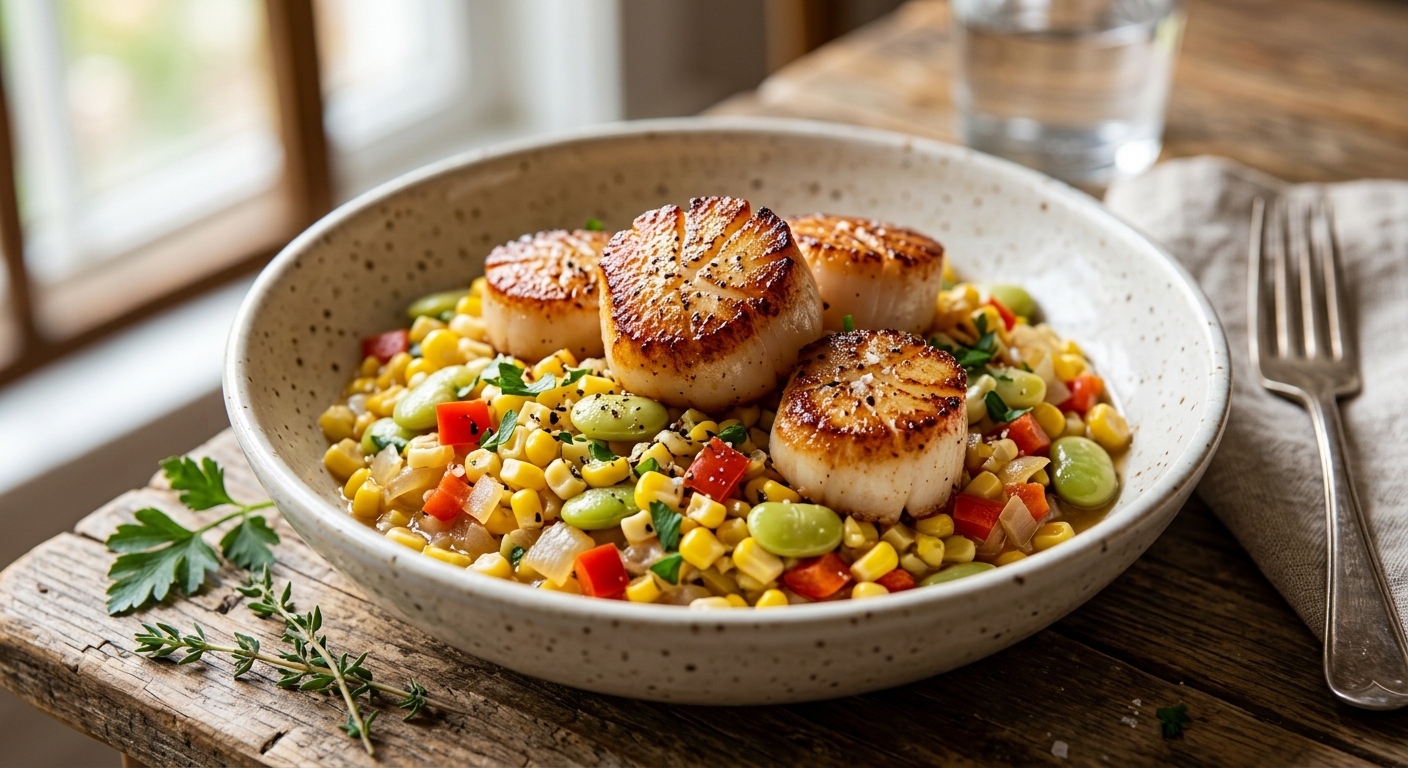
Succotash is one of America’s oldest dishes, rooted in Indigenous Narragansett cooking and built on the foundational pairing of corn and beans. But when you add seared sea scallops to that ancient base, something remarkable happens nutritionally. Sea scallops are among the most concentrated sources of Vitamin B12 and Zinc in the entire food kingdom, and placing them atop a legume-and-vegetable succotash creates a synergistic mineral profile that very few single-dish meals can rival. This is not a nutritional compromise dressed up as dinner; this is a genuinely elegant plate that would be at home in a fine-dining setting.
The genius of this recipe lies in layered texture and temperature contrast. The succotash, built with sweet corn kernels, creamy butter beans, charred red bell pepper, and fresh thyme, is warm and yielding. The scallops, seared hard in a screaming-hot pan, develop a caramelized crust through the Maillard reaction that delivers deep savory complexity. A finish of lemon zest and chives lifts the whole dish into brightness. Whether you use the stovetop for maximum crust control, the pressure cooker to develop deeply flavored beans from scratch, or the oven for a hands-off roasted version, the result is calibrated, calculated, and completely satisfying.
From a Dietary Reference Intake standpoint, a single serving of this dish provides approximately 85% DV for Vitamin B12, 42% DV for Zinc, 28% DV for Iron, and 40% DV for Folate, all from whole-food sources with high bioavailability. The heme-adjacent zinc in scallops is absorbed at nearly twice the rate of plant-based zinc, and the vitamin C from bell peppers actively enhances non-heme iron absorption from the beans. This is nutritional engineering you can taste.
4
servings
Ingredients
- 600 glarge dry-pack sea scallops (about 16 scallops), side muscle removed and patted very dry
- 400 gfresh or thawed frozen corn kernels (from about 3 ears of corn)
- 300 gcooked butter beans or lima beans (canned, drained and rinsed, or freshly cooked)
- 1 largered bell pepper, finely diced
- 1 mediumyellow onion, finely diced
- 3 clovesgarlic, minced
- 120 mldry white wine (such as Sauvignon Blanc or Pinot Grigio)
- 120 mllow-sodium chicken or vegetable stock
- 2 tbspextra-virgin olive oil
- 1 tbspunsalted butter
- 1 tbspfresh thyme leaves
- 2 tbspfresh chives, thinly sliced
- 1 tspsmoked paprika
- 1 tsplemon zest, finely grated
- 1 tbspfresh lemon juice
- —Colima Sea SaltMicroplastic Free Salt and freshly ground black pepper to taste
- —Colima Sea SaltMicroplastic Free Salt for finishing the scallops
Instructions
Click on an item below to shop for the recommended items for this recipe on Amazon.
As an Amazon Associate, we earn from qualifying purchases.
- Season the scallops generously on both sides with fine sea salt and black pepper at least 15 minutes before cooking. Place them on a wire rack uncovered so the surface dries further. Meanwhile, bring a wide, heavy-bottomed skillet (ideally cast iron or stainless steel) to medium heat.
- Add 1 tablespoon of the olive oil to the skillet and cook the onion and red bell pepper with a pinch of salt over medium heat, stirring occasionally, for 6 to 7 minutes until softened and just beginning to color at the edges. Add the garlic and smoked paprika and cook for 90 seconds, stirring constantly, until fragrant.
- Increase the heat to medium-high. Add the corn kernels and cook undisturbed for 2 minutes to develop a light char, then stir and cook for another 2 minutes. Pour in the white wine and let it bubble vigorously, scraping up any browned bits, for 2 minutes until reduced by half. Add the stock and butter beans, reduce heat to medium-low, and simmer gently for 5 minutes. Stir in the thyme, lemon zest, and lemon juice. Season to taste. Keep warm over the lowest heat setting.
- In a separate large skillet (cast iron strongly preferred), heat the remaining 1 tablespoon of olive oil over the highest heat your burner allows. Wait until the oil just begins to smoke. Working in two batches to avoid crowding, place the scallops flat-side down in the pan. Do not move them. Sear for exactly 90 seconds to 2 minutes until a deep golden-brown crust forms on the bottom. Flip once with tongs or a thin spatula and sear for another 60 to 90 seconds. The scallop should feel slightly springy in the center when pressed.
- Remove seared scallops to a warm plate. Add the butter to the hot pan, let it foam, and baste the scallops briefly with the browned butter using a spoon. Divide the succotash between four warm bowls, nestle four scallops on top of each portion, spoon any pan butter over them, and finish with fresh chives and a pinch of flaky sea salt.
- Combine the diced onion, red bell pepper, garlic, smoked paprika, thyme, white wine, and stock directly in the slow cooker insert. Stir to distribute the spices. Add the butter beans and corn kernels on top. Season with 1 teaspoon fine sea salt and a generous amount of black pepper. Do not stir once the corn is added; layering keeps the beans from going mushy on the bottom.
- Place the lid on the slow cooker and cook on Low for 3 to 4 hours. The corn will release starch into the liquid, the beans will soften further and absorb the wine and stock aromatics, and the whole mixture will develop a rich, slightly thickened consistency that a quick stovetop version cannot replicate. Check at the 3-hour mark; the succotash is ready when the liquid has reduced to a glossy, sauce-like coating rather than a broth.
- About 25 minutes before you are ready to eat, stir the lemon zest, lemon juice, and butter into the slow cooker insert. Replace the lid and set to Warm. Meanwhile, season the scallops on both sides with fine sea salt and black pepper and allow them to sit at room temperature for 10 minutes.
- Heat a large cast iron or stainless steel skillet over the highest heat until smoking. Add the olive oil. Sear the scallops in two uncrowded batches, 90 seconds per side without moving them, until a mahogany crust forms. After flipping, add the butter to the pan and baste the scallops continuously for the final 60 seconds of cooking.
- Spoon the slow-cooker succotash into four warm bowls. The long braise will have given it a deeper, more complex sweetness than the stovetop version. Place four seared scallops over each portion, drizzle with the pan butter, and finish with chives and flaky sea salt.
- Set the Instant Pot or electric pressure cooker to Saute on High. Add 1 tablespoon of olive oil and cook the onion and red bell pepper with a pinch of salt, stirring frequently, for 4 to 5 minutes until softened. Add the garlic and smoked paprika and cook for 60 seconds. Pour in the white wine and deglaze the pot thoroughly, scraping every bit of the fond from the bottom (this prevents a burn warning and, more importantly, builds flavor). Let the wine reduce for 90 seconds.
- Add the stock, butter beans, and corn kernels to the pot. Stir once gently to combine. Add the thyme. Lock the lid in place, set the steam release valve to Sealing, and cook on Manual High Pressure for 5 minutes. The pressure cooking intensifies the corn’s sweetness and fuses the flavors in a way that takes the stovetop version 15 additional minutes to achieve.
- When cooking is complete, perform a Quick Release by carefully turning the steam release valve to Venting. Once all steam has escaped and the float valve drops, open the lid away from you. Stir in the butter, lemon zest, and lemon juice. The residual heat will melt the butter and integrate everything. Season aggressively with salt and pepper. The succotash should be thick and glossy; if it seems thin, switch back to Saute and simmer uncovered for 2 to 3 minutes.
- While the Instant Pot is releasing pressure, season the scallops with salt and pepper. Heat a separate large skillet (cast iron or heavy stainless) over the highest heat until a drop of water evaporates instantly on contact. Add the remaining tablespoon of olive oil. Sear the scallops in two uncrowded batches, 90 seconds per side, without touching or moving them until the crust releases naturally from the pan. Finish with butter basting after the flip.
- Divide the pressure-cooked succotash among four bowls and top each with four seared scallops. The pressure-cooker succotash will have the most uniform, cohesive texture of all three methods. Finish with fresh chives, flaky sea salt, and any browned butter from the searing pan.
- Preheat your oven to 220C (425F) with a rack in the upper-middle position and a second rack on the top position for broiling later. Line a large rimmed baking sheet with parchment paper. Toss the corn kernels, diced red bell pepper, and diced onion with 1.5 tablespoons of olive oil, the smoked paprika, garlic, thyme, and a generous pinch of salt and pepper directly on the baking sheet. Spread into a single even layer.
- Roast on the upper-middle rack for 15 minutes, stirring once at the halfway point, until the corn is charred in spots and the onion and peppers have caramelized edges. Remove the tray from the oven and immediately add the butter beans, white wine, stock, and butter to the hot tray. Stir to combine, scraping up any caramelized bits. The residual heat of the tray will begin to reduce the liquid; return the tray to the oven and roast for an additional 8 to 10 minutes until the liquid has reduced to a glossy sauce coating the vegetables.
- While the succotash finishes roasting, prepare the scallops. Pat them very dry with paper towels and arrange them in a single layer on a small separate rimmed baking sheet lined with lightly oiled parchment or foil. Season the tops generously with salt, black pepper, and a very light drizzle of olive oil. Do not crowd the pan.
- When the succotash is done, remove it from the oven and switch the oven setting to Broil on High. Move the oven rack to the top position. Place the tray of scallops directly under the broiler, 10 to 12 cm (4 to 5 inches) from the element. Broil for 3 to 4 minutes, watching constantly, until the tops of the scallops are golden and opaque and just cooked through. Do not flip; broiling from above mimics the sear effect on the top surface while the hot pan conducts heat from below.
- Stir the lemon zest and lemon juice into the roasted succotash tray and taste for seasoning. Divide the succotash between four warm bowls. Using a thin spatula, carefully lift four scallops onto each bowl. Finish with fresh chives and flaky sea salt. The oven method produces the most deeply caramelized succotash of all four methods, with a roasted-vegetable intensity that pairs beautifully with the broiled scallop tops.
Nutrition Breakdown
Per 1 serving (makes 4)
Vitamins & Minerals
% Daily Value based on a 2,000 calorie diet (FDA reference)
🧬 Essential Amino Acids
% of recommended daily intake (RDA) per serving
🛡 Antioxidant Profile
The Nutrition Science
Vitamin B12 and Zinc from scallops represent two of the most clinically significant nutrients in the modern diet because both are difficult to obtain in high amounts from plant sources and both are commonly deficient in adults who reduce animal protein intake. A 150-gram serving of sea scallops delivers approximately 1.8 to 2.2 micrograms of Vitamin B12, meeting roughly 75 to 90% of the adult RDA of 2.4 micrograms. Crucially, this B12 is bound to protein in its natural methylcobalamin and adenosylcobalamin forms, which are utilized more efficiently than the cyanocobalamin form found in most supplements. B12 is essential for myelin sheath synthesis, DNA replication in rapidly dividing cells, and the conversion of homocysteine to methionine, with deficiency linked to irreversible neurological damage and elevated cardiovascular risk.
The zinc story is equally compelling. Scallops contain approximately 3 to 4 mg of zinc per 150g serving, and this zinc is associated with sulfur-containing amino acids in shellfish protein, increasing its fractional absorption to an estimated 35 to 40%, compared to 15 to 25% for phytate-bound zinc in legumes. The butter beans in this succotash contribute an additional 0.8 to 1.0 mg of zinc, but their phytate content would ordinarily reduce its bioavailability. Here, the acid from the white wine and lemon juice partially degrades phytates during cooking, meaningfully improving mineral release. Zinc is a cofactor for over 300 enzymatic reactions, is essential for immune function and wound healing, and plays a direct structural role in testosterone biosynthesis and sperm motility.
Perhaps the most elegant nutritional interaction in this dish is the vitamin C from red bell peppers acting on the non-heme iron in the butter beans. Non-heme iron (Fe3+) must be reduced to its ferrous form (Fe2+) before intestinal absorption via the DMT-1 transporter. Ascorbic acid accomplishes this reduction directly in the gut lumen, and research published in the American Journal of Clinical Nutrition demonstrates that consuming as little as 25mg of vitamin C with a non-heme iron source can increase iron absorption by 67%. One serving of this succotash delivers approximately 62mg of vitamin C alongside 2.5 to 3mg of bean-sourced non-heme iron, meaning the actual absorbed iron from this meal may be significantly higher than the raw figures suggest.
Pro Tips
- The single most important technique in this recipe is keeping your scallops genuinely dry before searing. Wet-pack scallops (treated with sodium tripolyphosphate to retain water) will steam instead of sear and release a cloudy liquid into your pan. Ask your fishmonger specifically for dry-pack scallops, and if using frozen, thaw them overnight in the refrigerator on a rack over a plate so any liquid drips away.
- Do not add the lemon juice to the succotash until the last moment before serving. The acid from lemon juice will cause the bright orange-red pigments in the bell pepper to fade and will break down the vitamin C content through oxidation. Stirring it in off the heat just before plating preserves both color and nutritional potency.
- For the slow cooker and pressure cooker methods, building the Maillard flavor that you lose by not searing the vegetables on the stove is achieved by using a full tablespoon of smoked paprika and allowing the fond from the Saute function to develop fully before deglazing. Do not skip the deglazing step as those browned proteins are concentrated flavor and resistant starch that enriches the final dish.
This is exactly the kind of recipe I’ve been searching for – the B12 and zinc combination is particularly meaningful for me since both support myelin integrity and immune regulation in ways I’m always trying to optimize. I’m curious about the ratio of scallops to beans you’re using, since I’ve found that pairing shellfish with legumes sometimes creates better bioavailability than either alone. Do you have thoughts on whether this holds up nutritionally if someone needs to swap the lima beans for another legume due to sensitivities? Thank you for breaking down the micronutrient matrix so clearly – it makes meal planning feel less like guesswork and more like actual medicine.
This is such a thoughtful question about the shellfish and legume synergy, Nadia! I’m actually exploring this exact dynamic in my thesis research on phytonutrient pharmacology, and you’re right that the amino acid complementarity really does enhance mineral absorption, especially for zinc. If you need to swap the limas, I’d suggest black beans or lentils since they have similarly robust folate profiles, though I’m curious whether you’ve noticed differences in how your body responds to different legume types, especially regarding that myelin support you mentioned. The magnesium-bound chlorophyll in the roasted peppers would also be working overtime there to support mineral bioavailability, so you might
omg the lima beans in this succotash are such a sleeper probiotic play – if you ferment them even just 24 hours with some salt and whey you unlock so much better mineral bioavailability for all that zinc and b12 the scallops are bringing! ive been doing fermented legume sides for months now and honestly the combo of shellfish + fermented beans feels like such a gut-health power move since the scallops have those beneficial amino acids and the fermented veggies add the microbial diversity. would love to know if anyone here has tried fermenting their succotash ingredients before cooking them
oh wait you’re onto something i hadn’t fully considered with the shellfish + fermented legumes combo! the amino acid profile of scallops really would synergize well with the metabolites from fermentation. ive mostly been fermenting the veggies separately and then adding them to cooked dishes, but im genuinely curious now if you do a quick ferment on the lima beans before they go into the succotash or after? like does the cooking process affect the beneficial bacteria at all or is it more about the mineral unlock happening during fermentation that sticks around? also if anyone wants to try this, a whey-based lacto ferment on beans is so forgiving – i always have extra whey
Oh this sounds wonderful, Nadia! I’m so glad you’re thinking about B12 and zinc together since they really do work synergistically, especially for nerve support. Quick question for the author though, is the corn in this recipe fresh or frozen? I ask because I always want to make sure people know that cooking methods matter less with corn than with some of those goitrogens like kale or broccoli, but the actual nutrient density can shift depending on how it’s processed. Also, scallops are such a stellar source of selenium on top of that B12 and zinc, which is the trifecta I always look for when I’m meal planning for thyroid support!
Love this question about the corn processing, Tammy! I’d add that for us managing blood sugar, the form of corn matters even more from a glycemic angle – frozen corn actually tends to have a lower glycemic load than fresh because the starches are partially gelatinized during the freezing process, so it spikes me way less predictably than fresh kernels. The scallops + legume combo here is *chef’s kiss* for stable glucose though, so either way you’re getting that selenium + the protein buffer to flatten the corn’s impact. Definitely a selenium/B12/zinc trifecta worth celebrating for thyroid support!