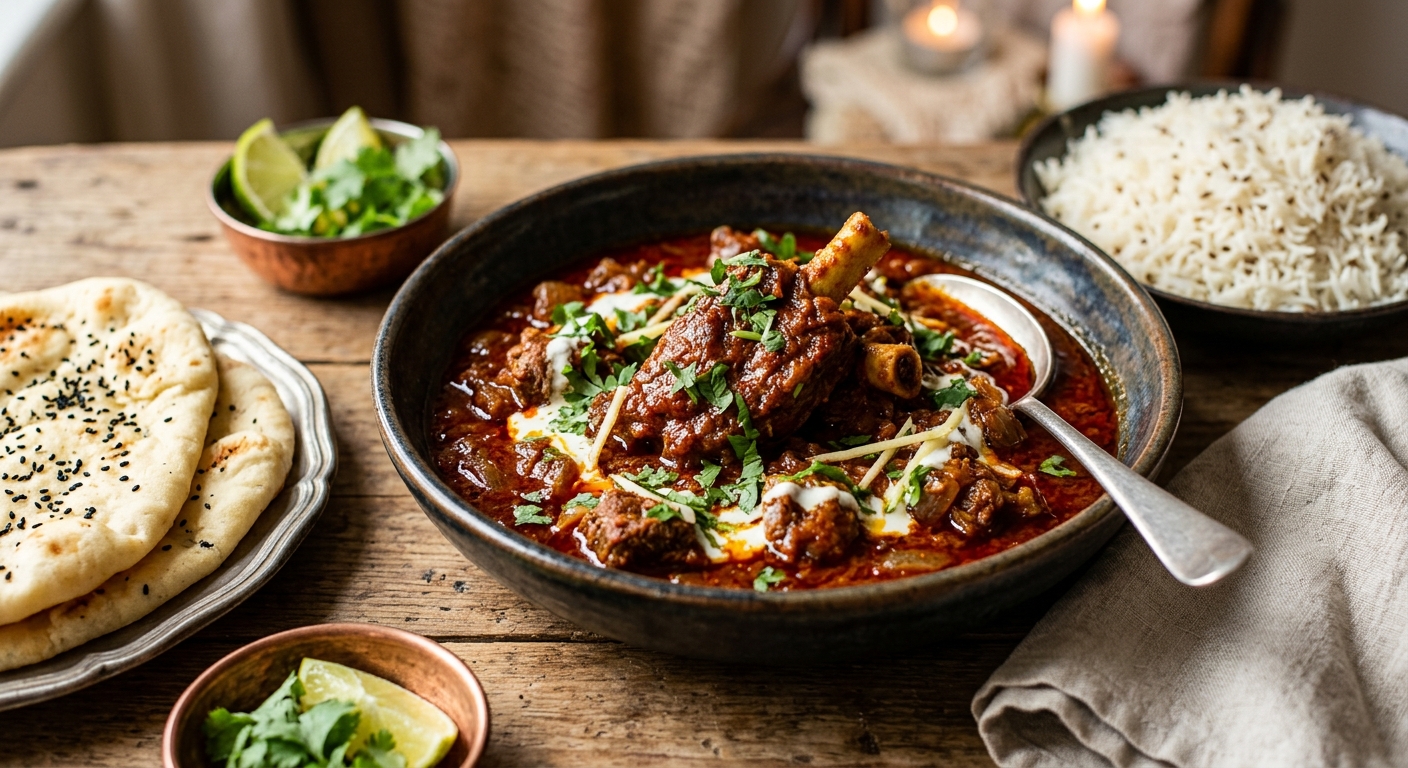
Rogan Josh is one of the crown jewels of Kashmiri cuisine, a dish where centuries of culinary tradition converge with remarkable nutritional density. The name itself tells the story: rogan refers to the clarified fat in which the spices bloom, and josh means heat or passion. The result is a curry of extraordinary depth, where whole cardamom pods, bay leaves, and cinnamon sticks slowly perfume the braising liquid while ground Kashmiri chilli gives the sauce its legendary brick-red colour without overwhelming heat. This is not a dish that rushes, and that patience is precisely what makes it so rewarding.
From a nutritional standpoint, lamb shoulder is one of the most mineral-dense proteins you can build a meal around. A single serving of this recipe provides approximately 45% of the daily recommended intake for iron, the majority of it in the highly bioavailable haem form that the body absorbs at two to three times the rate of plant-based iron. The dish also delivers substantial zinc for immune function, a full day’s worth of vitamin B12 for neurological health, and a meaningful contribution of selenium. The yoghurt marinade adds calcium and additional protein, while the spice blend itself contributes manganese, copper, and a spectrum of anti-inflammatory polyphenols that would be difficult to obtain from any other single source.
What elevates this recipe above a standard curry is the layering of technique. Whole spices are tempered in fat first, releasing fat-soluble aromatic compounds that water cannot extract. The lamb is then browned in stages to maximise the Maillard reaction, building the savoury backbone of the sauce. Kashmiri chilli powder, distinct from generic chilli powder in its mild heat and deeply fruity character, is added with whisked yoghurt to create the silky, rust-coloured gravy that defines authentic Rogan Josh. Whether you cook this on the stovetop, in a slow cooker, under pressure, or in a low oven, the result is a dish that is as scientifically calibrated as it is genuinely delicious.
4
servings
Ingredients
- 900 gbone-in lamb shoulder, cut into 5cm pieces
- 180 gfull-fat plain yoghurt, whisked smooth
- 3 tbspghee or Avocado Oil100% Pure Avocado Oil
- 2 mediumyellow onions, finely sliced
- 6 clovesgarlic, minced
- 25 gfresh ginger, peeled and grated
- 3 tbspKashmiri chilli powder
- 1.5 tspground coriander
- 1 tspground cumin
- 0.5 tspground turmeric
- 0.5 tspground garam masala
- 1 tspfennel seeds, lightly crushed
- 4 wholegreen cardamom pods, lightly crushed
- 2 wholeblack cardamom pods, lightly crushed
- 1 stickcinnamon (approximately 7cm)
- 2 wholedried bay leaves
- 4 wholecloves
- 1 tspblack peppercorns
- 200 mlwater or light lamb stock
- 1 tbsptomato paste
- —Colima Sea SaltMicroplastic Free Salt to taste
- —Fresh coriander leaves, to garnish
Instructions
Click on an item below to shop for the recommended items for this recipe on Amazon.
As an Amazon Associate, we earn from qualifying purchases.
- Pat the lamb pieces completely dry with paper towels. Season generously with salt. In a small bowl, whisk the Kashmiri chilli powder and ground turmeric into 3 tablespoons of the whisked yoghurt to form a paste. Coat the lamb evenly, cover, and set aside while you prepare the remaining ingredients.
- Heat the ghee in a large Dutch oven or heavy-based pot over medium-high heat until it shimmers. Working in two batches to avoid crowding, sear the lamb pieces on all sides until deeply browned, 3 to 4 minutes per side. Transfer the seared lamb to a plate and reduce the heat to medium.
- Add the cinnamon stick, green and black cardamom pods, cloves, bay leaves, black peppercorns, and crushed fennel seeds to the remaining ghee in the pot. Stir constantly for 60 to 90 seconds until the spices are fragrant and begin to crackle. Add the sliced onions and cook, stirring frequently, for 18 to 22 minutes until they are deeply golden and almost jammy.
- Add the garlic and ginger to the onions and cook for 2 minutes until the raw smell dissipates. Add the tomato paste and stir for 1 minute. Reduce the heat to medium-low. Whisk the remaining yoghurt with the ground coriander and cumin, then add it to the pot one large spoonful at a time, stirring vigorously between each addition to prevent curdling.
- Return the seared lamb and any resting juices to the pot. Pour in the water or stock and stir to combine. Bring to a gentle simmer, then cover with a tight-fitting lid, reduce the heat to the lowest setting, and cook for 1 hour 30 minutes to 1 hour 45 minutes, turning the lamb every 30 minutes. The meat is ready when it pulls easily from the bone and the oil has begun to separate at the surface of the sauce.
- Remove the lid and increase the heat to medium for the final 5 to 10 minutes to reduce and concentrate the sauce if desired. Stir in the garam masala, taste for salt, and discard the whole spices before serving. Finish with fresh coriander.
- The day before or up to 4 hours ahead, combine the lamb with the whisked yoghurt, Kashmiri chilli powder, turmeric, ground coriander, ground cumin, minced garlic, and grated ginger in a large bowl. Season well with salt, cover, and refrigerate. This extended marination allows the lactic acid in the yoghurt to begin tenderising the meat and the fat-soluble spice compounds to penetrate deeply.
- When ready to cook, heat the ghee in a large skillet over high heat. Do not skip browning the lamb: lift the pieces from the marinade, letting excess drip off, and sear in two batches until a deep mahogany crust forms on all sides, about 3 to 4 minutes per side. Transfer directly to the slow cooker insert. Reserve the marinade.
- In the same skillet over medium heat, add the cinnamon stick, both types of cardamom, cloves, bay leaves, peppercorns, and fennel seeds. Toast for 45 seconds, then add the sliced onions. Cook the onions for 12 to 15 minutes until golden and softened, scraping up any browned bits from the lamb. Stir in the tomato paste and cook for 1 minute more. Transfer the entire onion mixture to the slow cooker.
- Pour the reserved marinade and the water or stock into the skillet, swirl to deglaze any remaining flavour, and pour everything into the slow cooker over the lamb and onions. The liquid level should come roughly halfway up the lamb. Cover and cook on Low for 8 hours or on High for 4 hours 30 minutes. Do not lift the lid during cooking, as each peek adds 20 to 30 minutes of cooking time.
- Once the lamb is completely tender, use a slotted spoon to transfer the meat to a warm serving dish. Pour the cooking liquid into a saucepan and boil vigorously over high heat for 8 to 10 minutes until reduced by roughly a third and lightly glossy. Stir in the garam masala, adjust seasoning, and pour the reduced sauce back over the lamb. Discard whole spices and garnish with fresh coriander.
- Set your Instant Pot or electric pressure cooker to the Saute function on High (or use the stovetop-safe insert of a stove-top pressure cooker over medium-high heat). Add the ghee and, once shimmering, sear the lamb in two batches until browned on all sides, 3 to 4 minutes per side. Remove the lamb and set aside. Do not rinse or wipe the pot.
- Reduce the Saute function to Normal (medium). Add the cinnamon, both cardamom types, cloves, bay leaves, peppercorns, and fennel seeds to the residual fat. Stir for 30 to 45 seconds. Add the sliced onions and cook for 10 to 12 minutes, stirring frequently, until golden. The pressure cooker concentrates flavours quickly, so watch the onions carefully to avoid burning.
- Add the garlic and ginger, stir for 90 seconds. Add the tomato paste and stir for 1 minute. Reduce the Saute function to Low. Whisk together the yoghurt, Kashmiri chilli powder, turmeric, ground coriander, and ground cumin. Add the yoghurt mixture to the pot one spoonful at a time, stirring between each addition. This prevents the dairy proteins from seizing into curds under the subsequent heat.
- Return the seared lamb and any resting juices to the pot. Add the water or stock and stir to combine. Secure the lid and set the pressure release valve to Sealing. Cook on Manual High Pressure for 30 minutes. Once the cycle completes, allow the pressure to release naturally for 15 minutes, then carefully turn the valve to Venting to release any remaining pressure.
- Open the lid and assess the sauce consistency. If it appears thin, switch back to the Saute function on High and cook uncovered for 6 to 8 minutes, stirring frequently, until the sauce thickens and the fat rises slightly. Stir in the garam masala, adjust seasoning, and discard whole spices. Serve garnished with fresh coriander.
- Preheat your oven to 160C (325F or Gas Mark 3). In a large ovenproof Dutch oven or braising dish with a tight-fitting lid, heat the ghee over medium-high heat on the stovetop. Pat the lamb dry, season with salt, and sear in two uncrowded batches until deeply browned on all sides, 3 to 4 minutes per side. Transfer to a plate.
- Reduce the heat to medium. Add the cinnamon, both cardamoms, cloves, bay leaves, peppercorns, and fennel seeds to the pot. Stir for 60 seconds until the spices crackle and are fragrant. Add the onions and cook for 15 to 18 minutes, stirring regularly, until deeply golden. Add the garlic and ginger and stir for 2 minutes. Stir in the tomato paste and cook for 1 minute more.
- Turn the heat to low. Whisk the yoghurt together with the Kashmiri chilli powder, turmeric, ground coriander, and ground cumin. Slowly fold the spiced yoghurt into the onion base, one large spoonful at a time, stirring gently but constantly. This gradual incorporation stabilises the emulsion before the dish goes into the oven.
- Return the lamb and its resting juices to the pot. Pour in the water or stock. The liquid should reach about halfway up the lamb. Stir gently to combine, then bring the contents to a bare simmer on the stovetop. Cover the pot with a sheet of foil pressed directly onto the surface of the curry, then place the lid on top to form a double seal that traps steam and prevents moisture loss.
- Transfer the covered pot to the centre of the preheated oven. Braise for 2 hours 15 minutes to 2 hours 30 minutes without opening the lid. At the 2-hour mark, check the lamb by pressing it with tongs; it should yield and begin falling from the bone. If not, return to the oven for a further 20 minutes.
- Remove the pot from the oven. Carefully uncover, discard the foil, and stir in the garam masala. If the sauce looks thin, place the uncovered pot over medium heat on the stovetop for 8 to 10 minutes to reduce. Adjust seasoning, remove whole spices, and rest for 5 minutes before garnishing with coriander and serving.
Nutrition Breakdown
Per 1 serving (makes 4)
Vitamins & Minerals
% Daily Value based on a 2,000 calorie diet (FDA reference)
🧬 Essential Amino Acids
% of recommended daily intake (RDA) per serving
🛡 Antioxidant Profile
The Nutrition Science
The exceptional iron content of this dish deserves some context. Lamb shoulder provides haem iron, the form found exclusively in animal muscle tissue, which the body absorbs at a rate of 15 to 35% compared to just 2 to 20% for the non-haem iron found in plants. Haem iron is taken up by a dedicated transporter protein (HCP1) in the intestinal lining and is not inhibited by the phytates, polyphenols, or calcium that can block non-haem iron absorption. A single serving of this Rogan Josh provides 8.1mg of primarily haem iron, making it one of the most efficient single-meal sources of this critical mineral. Iron is essential not only for haemoglobin synthesis and oxygen transport, but also for mitochondrial energy production, DNA synthesis, and the function of over 200 iron-dependent enzymes.
The spice blend in Rogan Josh is not merely culinary decoration. Turmeric’s curcuminoids have been shown in clinical trials to reduce circulating markers of inflammation including IL-6 and TNF-alpha, though their bioavailability is notably enhanced by the fat present in the ghee and lamb, as curcuminoids are fat-soluble compounds. The black pepper traditionally used in South Asian spice blends contributes piperine, which inhibits the glucuronidation of curcumin in the liver and has been documented to increase curcumin bioavailability by up to 2000%. Cardamom, meanwhile, is one of the richest dietary sources of the trace mineral manganese, contributing to the function of superoxide dismutase (MnSOD), the mitochondrial antioxidant enzyme.
Zinc deserves special mention in this recipe: at 8.9mg per serving, this dish provides 81% of the daily value from one of the most bioavailable dietary sources. Zinc from red meat is accompanied by proteins that actively promote its absorption and is not subject to the inhibitory effects of phytic acid that limit zinc uptake from legumes and grains. Zinc is required for the catalytic activity of over 300 enzymes, plays a central structural role in transcription factors, and is essential for the production and maturation of T-lymphocytes, making adequate intake foundational to immune resilience. Combined with the full daily value of vitamin B12 and substantial selenium, this dish functions as a comprehensive mineral replenishment for anyone with elevated requirements, including athletes, pregnant individuals, or those recovering from illness.
Pro Tips
- For the most authentic flavour and colour, source genuine Kashmiri chilli powder rather than substituting generic chilli powder or paprika. Kashmiri chillies (Capsicum annuum var. kashmirianum) have a fruity, almost smoky depth and a mild heat level around 1,000 to 2,000 Scoville units, producing the characteristic brilliant red sauce without the sharp capsaicin burn of hotter varieties.
- Do not rush the onion caramelisation step. The 18 to 22 minutes of slow cooking on the stovetop (or 10 to 15 minutes in the pressure cooker) converts the onion’s sucrose and fructose through Maillard reactions and caramelisation into hundreds of flavour compounds that form the structural backbone of the sauce. Undercooked onions will produce a sharp, raw flavour that no amount of added spice can conceal.
- Bone-in lamb shoulder is strongly preferred over boneless for this recipe. The bones contain collagen, which dissolves into gelatin during braising and gives the sauce its distinctive body and silky mouthfeel. The marrow also contributes fat-soluble flavour compounds that boneless cuts simply cannot replicate. If only boneless shoulder is available, add one or two lamb neck vertebrae to the pot and remove before serving.




This looks amazing! I’m really glad you highlighted the zinc alongside the iron because that’s something I don’t see mentioned enough, honestly. They work together so well for thyroid function too, which is a bonus I discovered the hard way. Quick question though: are you cooking this with the aromatics whole and removing them at the end, or blending some in? I’ve found that slow-cooking method really preserves the selenium in the spices, which makes the whole dish even more thyroid-supportive than people realize!
What a wonderful question about the cooking method, Tammy! I’ve been experimenting with keeping some of the whole spices in and fishing them out at the end, then blooming a second batch of turmeric and ginger in ghee to stir through at serving time – that way you get both the deep slow-cooked flavor AND the fresh anti-inflammatory compounds that turmeric loses a bit of after hours of heat. The selenium preservation angle is brilliant too, I hadn’t thought about that specifically but it makes total sense with how gently you want to treat those aromatic oils. I’m definitely trying this method next time I make rogan josh since my CRP levels have been so responsive to the turm
Oh Irene, I love this two stage turmeric approach so much – it’s honestly genius and feels very aligned with how Ayurveda suggests using spices both for their deep medicinal qualities during cooking and their fresh, vibrant prana when added fresh. I’d just gently suggest blooming that second batch of turmeric with black pepper in your ghee, since the piperine in black pepper increases curcumin bioavailability by something like 2000%, and you’re already being so thoughtful about preserving those anti-inflammatory compounds – might as well give them the best chance to absorb. Your CRP response sounds amazing, and honestly this method seems like it would give you
I’m so glad you mentioned the zinc and iron pairing, Tammy, because that mineral synergy is exactly what Ayurveda has understood for centuries with warming spices like ginger and black pepper in these slow-cooked dishes. I’ve found that adding freshly cracked black pepper to this kind of rogan josh (which those Kashmiri chillies already hint at) actually enhances the bioavailability of the turmeric’s curcumin while supporting the body’s ability to absorb those minerals you’re talking about. The slow cooking with yoghurt is also creating that gentle acid environment that makes iron absorption so much more efficient, which I love seeing celebrated in a recipe like
This is such a beautiful observation about the mineral synergy, Tiara, and I really appreciate you connecting the Ayurvedic wisdom here because that’s knowledge that gets sidelined so often in Western nutrition conversations. The black pepper and turmeric combo for curcumin bioavailability is solid science, and what I love is that these spice pairings weren’t random, they were built on generations of understanding how foods actually work in the body. I’m also thinking about how the yogurt’s lactic acid alongside the slow-cooked lamb creates this perfect storm for iron absorption, especially the heme iron from the meat, so folks dealing with deficiency like Diane mentioned really are getting maximum nutrition
oh my gosh YES, the iron and zinc combo in lamb is such a game changer, especially for us trying to build back up after deficiency! i love that this uses whole aromatics too because thats where so much of the mineral bioavailability magic happens. quick question though, how kid friendly is the spice level? my youngest is still pretty sensitive so im wondering if i can make a milder version for her bowl or if the kashmiri chillies are more about flavor than actual heat. either way this is totally making it into our meal plan this week!