
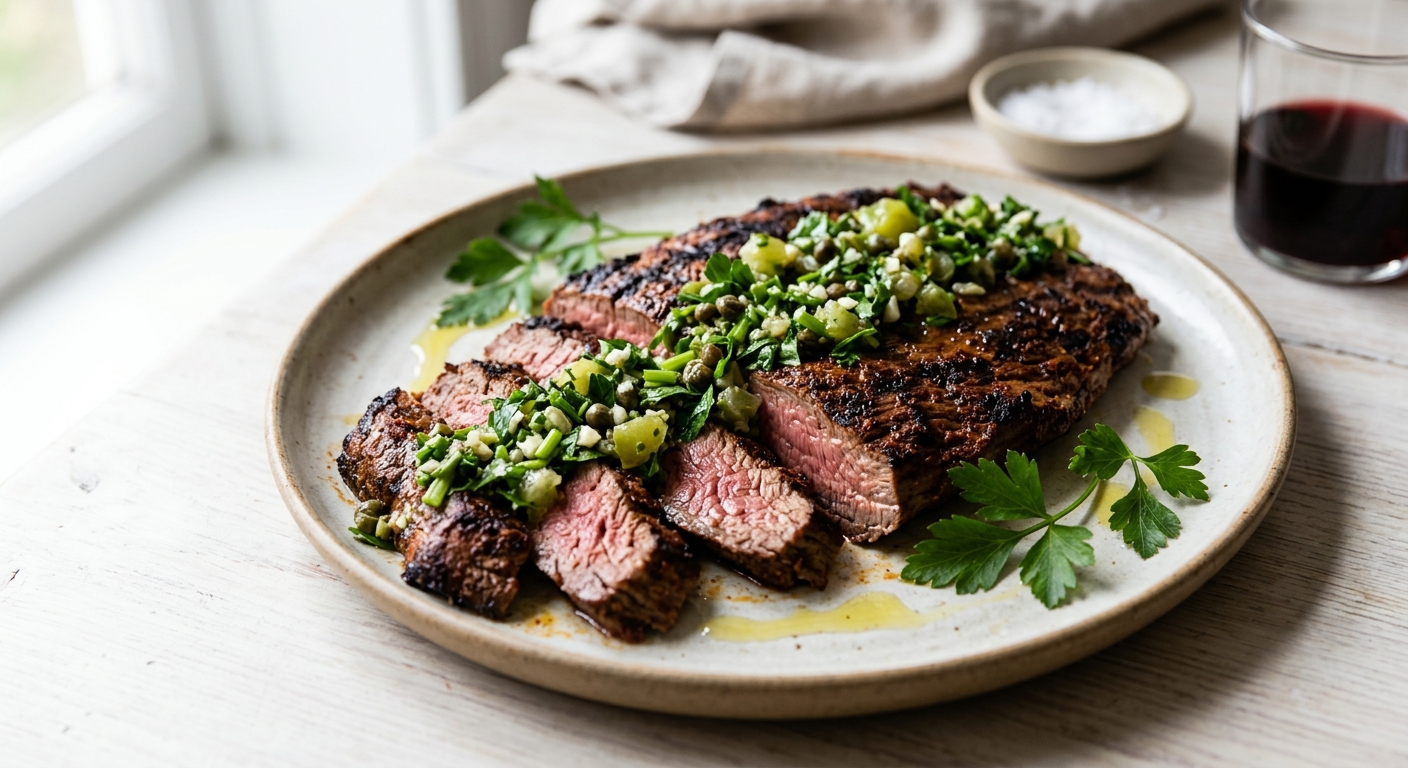
There is a reason nutrition scientists get excited about pairing red meat with fresh herbs and citrus: it is not just good cooking, it is strategic nutrient engineering. Flank steak is one of the leanest, most iron-dense cuts of beef available, delivering a significant hit of heme iron, the form your body absorbs at rates of 15 to 35 percent compared to just 2 to 20 percent for plant-based non-heme iron. When you drench that steak in a salsa verde built on flat-leaf parsley, tomatillos, and lemon juice, you are flooding the meal with ascorbic acid, the very compound that reduces ferric iron to ferrous iron and keeps it soluble all the way through your small intestine.
Salsa verde is one of the great unsung workhorses of the professional kitchen. Italian in spirit, endlessly flexible in execution, it transforms a simple grilled or braised steak into something restaurant-worthy in under ten minutes. The base of blanched parsley, raw garlic, capers, anchovies, and good olive oil provides not just vitamin C but also a complex layering of glutamates that intensifies the savory depth of the beef. The tomatillos add a gentle tartness and a second wave of vitamin C that many versions omit, pushing the total ascorbic acid content of this dish well past the threshold needed to meaningfully enhance iron bioavailability.
What makes this recipe genuinely special for Calibrated Cuisine is that the nutritional story is fully intact no matter which cooking method you choose. The stovetop and grill-pan approach delivers the caramelised crust and smokiness that flank steak is famous for. The slow cooker transforms the same cut into a fall-apart braise that carries the salsa verde into every fiber of the meat. The pressure cooker version achieves a similar tenderness in a fraction of the time. The oven method uses a reverse-sear technique to give you precise internal temperature control with a final broil for color. Each method is a genuine culinary choice, not a workaround.
4
servings
Ingredients
- 700 gflank steak, trimmed of excess sinew
- 2 tbspextra-virgin olive oil, divided
- 1 tspsmoked paprika
- 1 tspground cumin
- 4 clovesgarlic, 2 minced for rub and 2 for salsa verde
- 60 gflat-leaf parsley, leaves and tender stems
- 200 gfresh tomatillos, husked, rinsed, and roughly chopped
- 30 gcapers, drained and rinsed
- 4 filletsoil-packed anchovy fillets
- 1 wholelemon, zest and juice
- 3 tbspextra-virgin olive oil, for salsa verde
- 1 tspDijon mustard
- —Colima Sea SaltMicroplastic Free Salt and cracked black pepper to taste
Instructions
Click on an item below to shop for the recommended items for this recipe on Amazon.
As an Amazon Associate, we earn from qualifying purchases.
- Pat the flank steak completely dry with paper towels. In a small bowl, combine the minced garlic, smoked paprika, cumin, 1 tablespoon of olive oil, half a teaspoon of salt, and a generous grind of black pepper. Rub the mixture all over both sides of the steak, pressing it firmly into the meat. Allow the steak to sit at room temperature for 20 to 30 minutes. This step is critical: a cold steak will drop the pan temperature dramatically and steam rather than sear.
- While the steak marinates, prepare the salsa verde. Roughly chop the parsley and place it in a food processor along with the remaining 2 garlic cloves, tomatillos, capers, anchovy fillets, lemon zest, lemon juice, Dijon mustard, and the 3 tablespoons of olive oil. Pulse 8 to 10 times until the mixture is finely chopped but still has visible texture. Do not puree it to a smooth sauce. Season with salt and pepper, taste, and set aside. The salsa verde can be made up to 2 hours ahead and stored at room temperature.
- Heat a large cast-iron grill pan over high heat for 4 to 5 minutes until it is intensely hot and just beginning to smoke. Add the remaining 1 tablespoon of olive oil and immediately lay the steak flat in the pan away from you. Press it down gently with a spatula for the first 30 seconds to ensure full contact across the surface.
- Cook without moving for 4 to 5 minutes until a deep brown, well-developed crust forms on the underside. Flip once using tongs and cook for a further 4 to 5 minutes for medium-rare (internal temperature of 52 to 54 degrees Celsius). Flank steak is a thin, lean cut that becomes tough and dry if taken past medium, so use an instant-read thermometer and pull it early.
- Transfer the steak to a wire rack set over a cutting board and rest, uncovered, for at least 8 minutes. Resting is not optional: the internal temperature will carry-over cook to 57 degrees Celsius, and the juices need time to redistribute into the muscle fibers. Slice thinly against the grain at a 45-degree angle. Arrange on a warm platter and spoon the salsa verde generously over the top. Serve immediately.
- Pat the flank steak dry and cut it into two equal pieces so it fits flat in the slow cooker insert. In a small bowl, mix the smoked paprika, cumin, minced garlic, 1 tablespoon of olive oil, three-quarters of a teaspoon of salt, and a generous amount of black pepper. Rub the mixture all over both pieces of steak.
- Heat a large heavy skillet over high heat until smoking. Add 1 tablespoon of olive oil and sear the steak pieces for 2 minutes per side until a browned crust develops. This searing step is not strictly necessary for food safety, but it contributes significant depth of flavor through Maillard reaction products that will permeate the braising liquid and enhance the final dish. Do not skip it if time allows.
- Place the seared steak pieces in the slow cooker insert in a single layer. Add 80 milliliters of water to the skillet, scrape up any browned bits with a wooden spoon, and pour that liquid over the steak. Scatter the tomatillos directly into the cooker around the steak. They will soften and meld into the braising liquid, contributing acidity and a secondary source of vitamin C that survives partial cooking in a slow, low-temperature environment.
- Set the slow cooker to Low and cook for 6 to 7 hours. The steak is ready when it pulls apart easily with two forks. Avoid cooking on High, as the rapid temperature increase causes the muscle fibers to contract sharply and squeeze out moisture, producing a drier result.
- While the steak finishes cooking, prepare the fresh salsa verde. Combine the parsley, remaining 2 garlic cloves, capers, anchovy fillets, lemon zest, lemon juice, Dijon mustard, and 3 tablespoons of olive oil in a food processor. Pulse to a coarse, textured sauce. This is made fresh at this stage specifically to preserve its ascorbic acid content and bright green color. Use the braised tomatillos from the cooker for a richer, smoky version if preferred. Shred the beef directly in the cooker using two forks, taste the braising juices, and adjust salt. Serve over rice, in warm tortillas, or on a grain bowl with a generous spoonful of fresh salsa verde over each portion.
- Pat the flank steak dry and cut it into two or three sections to fit in the pot. Combine the smoked paprika, cumin, minced garlic, 1 tablespoon of olive oil, salt, and pepper, and rub all over the steak. Set the Instant Pot or pressure cooker to the Saute function on High and allow it to preheat for 2 minutes until the display reads ‘Hot’.
- Add 1 tablespoon of olive oil to the pot and sear the steak pieces in batches for 2 minutes per side, pressing them flat for good contact. The small surface area of a pressure cooker insert makes it challenging to get even browning on large pieces, so working in batches is important. Remove the seared pieces and set aside.
- Add 100 milliliters of water to the insert and use a wooden spoon to scrape all the browned fond from the bottom of the pot. This deglazing step is essential in pressure cooking: any stuck residue can trigger the burn warning on electric models. Add the roughly chopped tomatillos to the liquid and stir briefly. Place the seared steak pieces back in the pot, overlapping slightly if needed.
- Secure the lid, set the valve to Sealing, and cook on High Pressure for 25 minutes. After the cooking cycle completes, allow the pressure to release naturally for 10 minutes before carefully turning the valve to Venting to release any remaining steam. The steak should be very tender and easily shredded.
- While the pressure releases, prepare the salsa verde in a food processor by combining parsley, the remaining 2 garlic cloves, capers, anchovies, lemon zest, lemon juice, Dijon mustard, and 3 tablespoons of olive oil. Pulse to a coarse texture. Remove the steak and shred it with two forks, discarding any remaining sinew. Return the shredded beef briefly to the cooking juices to absorb maximum flavor. Serve topped generously with the fresh salsa verde, which delivers the critical vitamin C payload in its most bioavailable, heat-preserved form.
- Preheat the oven to 120 degrees Celsius (250 degrees Fahrenheit). Place a wire rack inside a rimmed baking sheet. Pat the steak completely dry and rub it thoroughly with the spice mixture of smoked paprika, cumin, minced garlic, 1 tablespoon of olive oil, salt, and pepper. Place it on the wire rack. The elevated rack allows hot air to circulate under the meat, ensuring even cooking from all sides without the bottom sitting in pooled juices.
- While the oven heats, prepare the salsa verde. Combine the parsley, remaining 2 garlic cloves, tomatillos, capers, anchovies, lemon zest, lemon juice, Dijon mustard, and 3 tablespoons of olive oil in a food processor. Pulse to a coarse, chunky texture. Taste and adjust seasoning. Because this method uses no braising liquid, the tomatillos stay raw in the salsa verde, maximising their vitamin C contribution. Cover and set aside at room temperature.
- Transfer the baking sheet to the oven and roast the steak for 25 to 30 minutes, checking the internal temperature beginning at the 20-minute mark. You are aiming for 46 to 48 degrees Celsius at the thickest point. The steak will look pale and unappetizing at this stage, which is entirely expected. Remove it from the oven when the target temperature is reached.
- Switch the oven to Broil on High (or as high as your broiler will go) and position the rack approximately 10 centimeters from the heating element. Allow the broiler to preheat for 3 to 4 minutes. Return the steak on its rack to the broiler and cook for 2 minutes on the first side, then flip carefully with tongs and broil for a further 1 to 2 minutes until a well-browned, slightly charred crust develops. Watch it closely as broiler intensity varies significantly between oven models.
- Remove immediately when the internal temperature reaches 52 to 54 degrees Celsius and transfer to a cutting board. Rest for 8 minutes. The reverse-sear method requires a shorter rest than conventional methods because the interior of the steak was already brought up to temperature slowly and evenly before the sear. Slice thinly against the grain at a 45-degree angle and serve over a pool of the fresh salsa verde, with additional sauce alongside.
Nutrition Breakdown
Per 1 serving (makes 4)
Vitamins & Minerals
% Daily Value based on a 2,000 calorie diet (FDA reference)
🧬 Essential Amino Acids
% of recommended daily intake (RDA) per serving
🛡 Antioxidant Profile
The Nutrition Science
The central nutritional mechanism in this dish is the iron-ascorbate interaction, one of the most well-documented nutrient synergies in human biochemistry. Heme iron from the flank steak is already the most bioavailable form of dietary iron, absorbed via a dedicated heme transporter in the duodenum independent of luminal chemistry. However, the salsa verde’s ascorbic acid enhances total iron absorption through a second pathway: it reduces ferric iron (Fe3+), the oxidised form that is largely insoluble at intestinal pH, to ferrous iron (Fe2+), which is readily transported by the divalent metal transporter-1 (DMT-1) on enterocyte brush borders. Studies consistently show that 25 to 75 milligrams of vitamin C consumed with a meal can increase non-heme iron absorption by two to four times, a clinically meaningful effect particularly for individuals with elevated iron requirements.
Flank steak deserves more recognition in precision nutrition contexts. As a skirt-adjacent cut from the abdominal musculature, it has a higher proportion of fast-twitch oxidative muscle fibers compared to loin cuts, which correlates with elevated myoglobin content and therefore higher intrinsic iron levels. The 700 grams of raw flank steak in this recipe delivers approximately 23 milligrams of total iron across four servings. Combined with the parsley’s contribution of non-heme iron (parsley is among the most iron-dense leafy herbs, at roughly 6 milligrams per 100 grams), the total iron per serving approaches 6 milligrams before absorption enhancement is factored in. With the vitamin C from tomatillos and lemon juice activating DMT-1 transport, effective absorbed iron per meal is substantially higher than the raw figures suggest.
The anchovy fillets in the salsa verde are not merely a flavour decision. They contribute selenium, a trace mineral that functions as a cofactor for glutathione peroxidase, the enzyme family responsible for neutralising lipid hydroperoxides generated during red meat digestion. The zinc from the beef (approximately 6.4 milligrams per serving) supports the same antioxidant enzyme networks and additionally plays a direct role in immune function and protein synthesis signaling. Together, iron, zinc, selenium, and vitamin C create an unusually comprehensive mineral and antioxidant profile from a single main course, which is precisely the kind of calibrated nutrient density this blog exists to showcase.
Pro Tips
- Always slice flank steak against the grain and at a 45-degree angle to the cutting board. The muscle fibers run visibly along the length of the cut, and slicing perpendicular to them shortens those fibers dramatically, producing a tender chew even if the steak is slightly overcooked.
- Make extra salsa verde and refrigerate it for up to 3 days. The vitamin C content degrades over time on exposure to air and light, so store it in a small jar filled to the brim with a thin layer of olive oil on top to minimise oxidation.
- If using the stovetop or oven method and serving immediately, let the steak rest on a wire rack rather than a flat plate. Resting on a flat surface traps steam under the meat and softens the crust you worked hard to build.
omg YES this is exactly why i started pairing my iron rich meals with citrus or bright greens, i didnt even know the science behind it but my kids would actually eat their steak when i loaded it with that salsa verde! my oldest was testing low for iron last year and our doc recommended exactly this kind of combo, so now im obsessed with making sure the vitamin c is RIGHT there with the iron sources. gonna try this flank steak recipe asap – is it kid friendly or do i need to chop it up small? im always looking for ways to sneak those minerals past my picky eaters without them realizing theyre basically eating a nutrient powerhouse lol
This is such a smart pairing, and Diane, you totally intuited the biochemistry without even knowing it! I see this exact principle play out in my pharmacy when patients on iron supplements struggle with absorption, but adding even a small glass of OJ or some fresh herbs with vitamin C makes a real difference. The beauty of this recipe is that it’s not forcing micronutrients into an unappetizing “healthy” format, it’s just making the nutrients actually *work* together, which feels like the whole point of functional nutrition done right.
This is such a clinically smart combo, and I’m genuinely excited about it for postpartum recovery too. Iron depletion is so real after birth, and the heme iron from beef plus that vitamin C boost makes this feel like actual medicine masquerading as dinner. My question though, does the salsa verde have any choline content that you calculated, or is this primarily a micromineral absorption play? I’ve been obsessed with combining iron-rich foods with choline sources lately since both matter so much for my supply and baby’s development, but I’m curious if I’m overthinking it or if there’s real synergy there like there is with the iron and C.