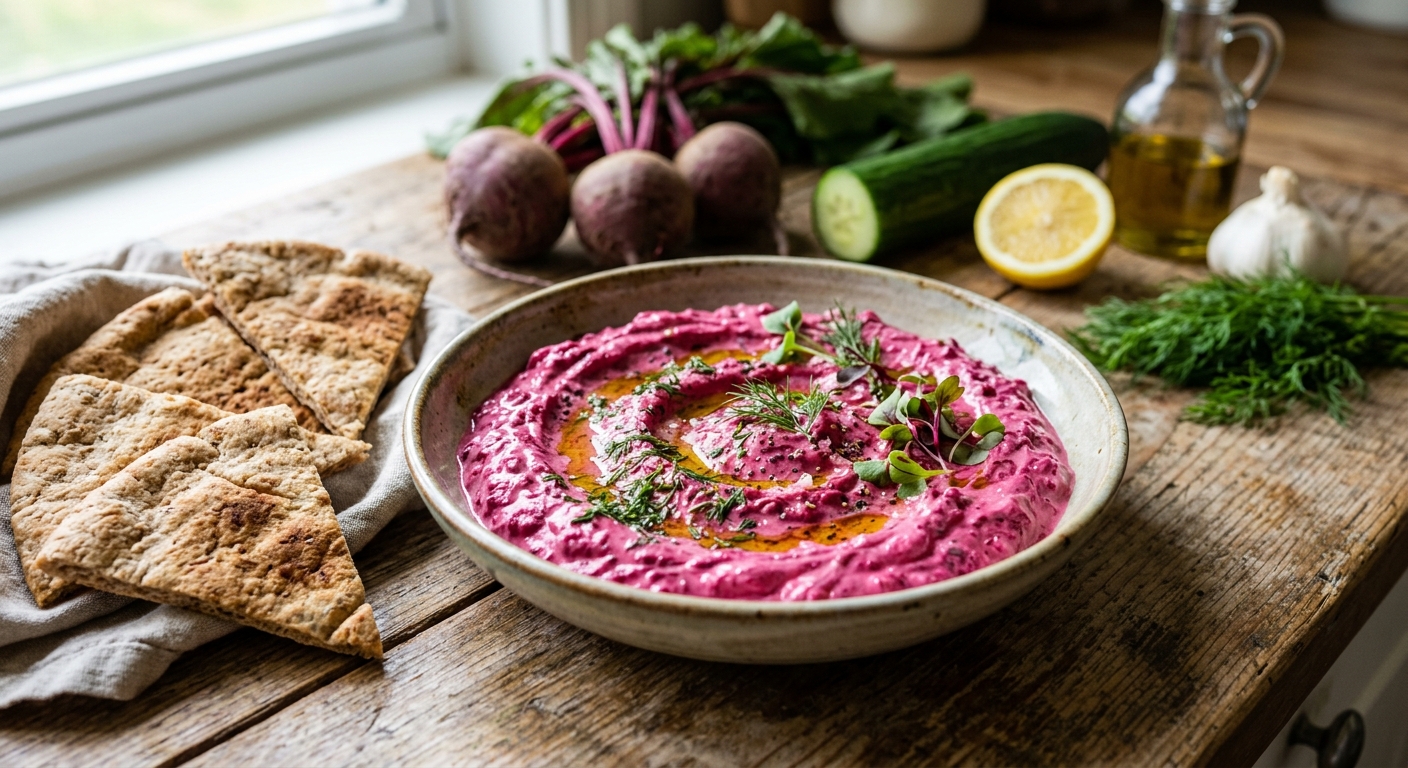
Tzatziki is one of the Mediterranean’s most beloved condiments, but this beet-forward reinvention transforms it into something genuinely extraordinary. Deep magenta beets are cooked until tender and silky, then folded into strained Greek yogurt with grated cucumber, fresh dill, lemon zest, and a generous press of garlic. The result is simultaneously earthy, bright, creamy, and herbaceous. It is the kind of dish that disappears from the table long before anyone expected it to.
For anyone focused on bone density and joint integrity, this recipe is a precision instrument. Greek yogurt contributes calcium and phosphorus in a highly bioavailable form, while beets deliver manganese, a mineral critical for the synthesis of proteoglycans in cartilage. The olive oil in the dip provides fat-soluble vitamin K2 absorption support, and the whole grain pita adds magnesium and additional manganese. Every element is working in concert, not just for flavor, but for skeletal and connective tissue health.
What makes this recipe especially appealing for Calibrated Cuisine readers is its versatility. The tzatziki works as a dip with pita, a spread on grain bowls, a sauce over grilled fish or chicken, or a cooling counterpart to spicy dishes. The beets can be prepared well in advance using any of the three cooking methods below, meaning the final assembly takes less than ten minutes once your beets are ready. Whether you roast, pressure-cook, or slow-cook the beets, each method produces a subtly different texture and depth of flavor worth exploring.
4
servings
Ingredients
- 400 graw beets (about 3 medium), scrubbed and trimmed
- 500 gfull-fat Greek yogurt, strained overnight if possible
- 200 gEnglish cucumber (about half a large cucumber)
- 3 clovesgarlic, finely minced or pressed
- 3 tbspextra-virgin olive oil, divided
- 2 tbspfresh lemon juice
- 1 tspfinely grated lemon zest
- 3 tbspfresh dill, finely chopped, plus extra for garnish
- 1 tbspfresh mint leaves, finely chopped
- 1 tspred wine vinegar
- 4 pieceswhole grain pita breads (approximately 60g each)
- 2 tbspwalnuts, toasted and roughly chopped, for garnish
- —Colima Sea SaltMicroplastic Free Salt and freshly ground black pepper to taste
- —Colima Sea SaltMicroplastic Free Salt for finishing
- —Pinch of ground cumin (optional, for garnish)
Instructions
Click on an item below to shop for the recommended items for this recipe on Amazon.
As an Amazon Associate, we earn from qualifying purchases.
- Place the whole, unpeeled scrubbed beets in a medium saucepan and cover with cold water by at least 5 cm. Add a generous pinch of salt. Bring to a boil over high heat, then reduce to a steady simmer. Cook uncovered for 35 to 45 minutes, depending on size, until a skewer passes through the thickest part of each beet with no resistance. Add more water if the level drops below the beets.
- While the beets cook, prepare the cucumber base. Grate the cucumber on the large holes of a box grater directly onto a clean kitchen towel. Sprinkle with a pinch of salt, gather the towel, and squeeze firmly over the sink to extract as much liquid as possible. You should remove at least 3 to 4 tablespoons of water. Transfer the squeezed cucumber to a medium mixing bowl.
- Drain the beets and transfer them immediately to a bowl of ice water for 5 minutes. This stops the cooking and makes peeling effortless. Once cooled, rub the skins off with your fingers under cold running water wearing kitchen gloves if desired to avoid staining. Pat dry with paper towels.
- Finely grate approximately 200g of the cooked beets on the large holes of the box grater (or pulse briefly in a food processor for a smoother texture). Press the grated beet lightly in a clean towel to remove some excess moisture, then add to the bowl with the cucumber.
- To the cucumber and beet mixture, add the Greek yogurt, minced garlic, 2 tablespoons of olive oil, lemon juice, lemon zest, red wine vinegar, fresh dill, and fresh mint. Season generously with fine sea salt and black pepper. Fold everything together gently with a spatula until fully incorporated. Taste and adjust seasoning, adding more lemon or salt as needed. Cover and refrigerate for at least 20 minutes to let the flavors meld.
- When ready to serve, warm the whole grain pitas directly over a gas burner on medium-low heat for about 30 seconds per side until lightly charred and pliable, or wrap in a damp cloth and microwave for 20 seconds. Transfer the tzatziki to a wide shallow bowl, swirl the top with the back of a spoon, drizzle with the remaining tablespoon of olive oil, scatter the toasted walnuts and extra dill over the top, and finish with flaky sea salt and an optional pinch of ground cumin. Serve immediately with the warm pita alongside.
- Wrap each scrubbed whole beet individually in a small piece of aluminum foil, twisting the ends closed tightly. This traps steam around each beet to cook it evenly without any added water. Arrange the foil packets in a single layer in the slow cooker insert. No liquid is needed.
- Set the slow cooker to High and cook for 4 to 5 hours, or Low for 7 to 8 hours. The beets are done when a skewer pushed through the foil into the beet center meets no resistance. Beets on the larger side will need the maximum time. Avoid lifting the lid during cooking as this releases accumulated steam and adds 20 to 30 minutes to the cook time.
- When the beets are done, carefully open the foil packets away from you to release the hot steam. Allow the beets to cool until comfortable to handle, about 20 minutes. Peel the skins by rubbing them with paper towels or your fingers. Wearing disposable gloves is recommended. The skins will slip off cleanly.
- While the beets cool, prepare the cucumber. Grate the cucumber on the large holes of a box grater onto a kitchen towel. Salt lightly, then twist the towel tightly and squeeze out all excess water over the sink. Set the drained cucumber aside in a mixing bowl. The slow-cooked beets will be especially sweet and dense, so taste as you go when adding the lemon juice and vinegar.
- Finely grate or pulse 200g of the cooled beets. Fold them into the cucumber along with the Greek yogurt, minced garlic, 2 tablespoons olive oil, lemon juice, lemon zest, red wine vinegar, fresh dill, and mint. Season thoroughly with salt and pepper. Because slow-cooked beets are sweeter than boiled ones, increase the red wine vinegar by up to half a teaspoon if you prefer a more tangy dip. Chill for at least 20 minutes before serving.
- Warm the whole grain pita breads by wrapping them in foil and placing them in the now-empty slow cooker set to Warm for 10 to 15 minutes, or toast them in a dry skillet over medium heat for 30 seconds per side. Plate the chilled tzatziki as described, drizzle with remaining olive oil, top with walnuts, dill, and flaky salt, and serve with the warm pita.
- Pour 250ml of cold water into the pressure cooker or Instant Pot insert. Place the trivet or a steamer basket inside. Arrange the whole, unpeeled scrubbed beets on the trivet in a single layer. If using an Instant Pot, secure the lid and set the steam release valve to Sealing. Select Pressure Cook on High for 20 minutes for medium beets (about 130g each) or 25 minutes for larger beets.
- Once the cook time is complete, allow the pressure to release naturally for 10 minutes, then carefully switch the valve to Venting to release any remaining pressure. Open the lid away from you. Test the beets with a skewer; they should offer absolutely no resistance. If slightly firm, reseal and cook on High for an additional 3 to 5 minutes.
- Transfer the hot beets using tongs to a bowl of cold water for 5 minutes until cool enough to handle. Peel the skins by rubbing with paper towels; they will slip off effortlessly. The pressure-cooked beets will appear deeply colored and dense. Pat dry and set aside.
- Prepare the cucumber while the beets cool: grate, salt, and squeeze out all liquid in a kitchen towel as described above. The pressure cooker method produces beets with very little residual surface moisture, so you can grate them directly without pressing. Finely grate 200g of the cooled beets and add directly to the squeezed cucumber in a mixing bowl.
- Add the Greek yogurt, garlic, 2 tablespoons olive oil, lemon juice, lemon zest, red wine vinegar, dill, and mint to the bowl. Fold together and season aggressively with sea salt and black pepper. Because pressure cooking extracts deep earthy flavors, the garlic and lemon will harmonize particularly well here; do not reduce them. Refrigerate the tzatziki for at least 20 minutes. Toast the whole grain pita in a dry skillet or directly over a flame, plate the tzatziki with a drizzle of the remaining olive oil, garnish with walnuts, dill, and flaky salt, and serve immediately.
- Preheat your oven to 200 degrees C (180 degrees C fan, 400 degrees F). Place each scrubbed whole beet on a square of aluminum foil large enough to wrap it completely. Drizzle each beet with a small splash of olive oil (using about half a tablespoon of the total) and season with a pinch of salt. Wrap each beet tightly in its foil, crimping the edges firmly to seal in all steam. Arrange the packets on a baking sheet.
- Roast in the center of the preheated oven for 55 to 70 minutes. Begin checking at the 55-minute mark by carefully piercing through the foil with a skewer. The beets are perfectly roasted when the skewer slides through with zero resistance and a sweet, caramelized aroma fills the kitchen. Larger beets may need the full 70 minutes or a few minutes more. Do not rush this step; under-roasted beets will be starchy and disappointing.
- Remove the baking sheet from the oven and allow the foil packets to rest unopened for 10 minutes. This resting period continues the cooking gently via residual steam and makes peeling far easier. Open the foil carefully, allowing the steam to escape away from you. Let the beets cool until comfortable to handle, about 15 minutes.
- Peel the cooled roasted beets by rubbing the skins with paper towels. The skins should come away in sheets. Roasted beets will be noticeably drier and more concentrated in flavor than boiled or slow-cooked beets. Finely grate 200g of the peeled beets into a mixing bowl. No pressing or draining is necessary; the dry texture integrates beautifully into the yogurt.
- Prepare the cucumber by grating, salting, and squeezing dry as described. Combine the grated roasted beet and squeezed cucumber in a mixing bowl. Add the Greek yogurt, garlic, 2 tablespoons olive oil, lemon juice, lemon zest, red wine vinegar, fresh dill, and mint. Fold gently to combine. The roasted beets will give this version a slightly sweeter, smokier profile; balance this by ensuring the full amount of lemon juice and red wine vinegar is used. Season generously with salt and pepper and refrigerate for at least 20 minutes.
- For the pita, increase the oven to 220 degrees C after the beets come out. Brush the whole grain pitas lightly with olive oil on both sides, place on the hot baking sheet, and bake for 4 to 5 minutes until lightly puffed and golden at the edges. Alternatively, cut into wedges before baking for crisp pita chips, which hold up beautifully for scooping thick tzatziki. Plate and garnish as described, finishing with a final drizzle of olive oil, toasted walnuts, fresh dill, and flaky sea salt.
Nutrition Breakdown
Per 1 serving (makes 4)
Vitamins & Minerals
% Daily Value based on a 2,000 calorie diet (FDA reference)
🧬 Essential Amino Acids
% of recommended daily intake (RDA) per serving
🛡 Antioxidant Profile
The Nutrition Science
The bone and joint benefits of this dish are anchored by three intersecting nutrient pathways. First, the calcium from Greek yogurt (approximately 200mg per 125g serving of full-fat strained yogurt) is among the most bioavailable dietary sources of this mineral, with an absorption rate of roughly 30 to 35 percent, substantially higher than plant-based calcium. Calcium works alongside the phosphorus also concentrated in yogurt to form hydroxyapatite, the crystalline mineral that gives bone its compressive strength. Vitamin K from dill and olive oil activates osteocalcin, the protein that anchors calcium into the bone matrix, making these co-nutrients critically important rather than incidental.
Beets contribute manganese, a mineral that is frequently overlooked in bone health discussions but is biochemically indispensable. Manganese is a required cofactor for glycosyltransferase enzymes that synthesize glycosaminoglycans, the long-chain sugar molecules that form the backbone of cartilage proteoglycans. Cartilage that lacks adequate proteoglycan density loses its ability to resist compressive load, contributing to the joint degradation seen in osteoarthritis. One serving of this tzatziki delivers approximately 0.95mg of manganese, covering over 40 percent of the daily adequate intake. Beets also supply dietary nitrates that convert to nitric oxide in the body, a vasodilator that improves blood flow to joint tissue and supports synovial membrane nutrition.
The fermentation-adjacent nature of strained Greek yogurt provides an additional layer of benefit. The live Lactobacillus cultures present in high-quality Greek yogurt have been shown in multiple clinical trials to modulate the gut-immune axis, reducing circulating levels of interleukin-6 and C-reactive protein, two key markers of systemic inflammation that drive both osteoporosis progression and cartilage catabolism. Combined with the betalain antioxidants from beets and the quercetin from garlic, this dish assembles a genuinely multi-modal anti-inflammatory and bone-supportive nutritional profile within a single, satisfying serving.
Pro Tips
- Strain your Greek yogurt in a fine-mesh sieve lined with cheesecloth overnight in the refrigerator for an exceptionally thick and creamy tzatziki that holds its shape beautifully when plated. Even yogurt labeled ‘strained’ benefits from an extra hour of draining.
- Do not skip the cucumber-squeezing step. Excess cucumber moisture is the single most common reason tzatziki turns watery within an hour of assembly. The goal is to remove enough liquid that the grated cucumber feels almost dry to the touch.
- Beet-stained hands and cutting boards are the only real drawback of this recipe. Wearing nitrile gloves during peeling and working on a plastic rather than wooden cutting board will prevent lasting discoloration. A spray of cooking oil on the board before the beets makes cleanup significantly easier.

Love where Sam’s head’s at with the sleep angle, and yeah, the casein timing is solid. One thing I’d add though – roasting those beets low and slow (around 275F for longer) versus high heat really preserves the manganese bioavailability, since it’s sensitive to oxidation. I’ve noticed clients absorb it way better when the beets still have that earthy depth instead of getting caramelized. The whole grain pita also matters more than people think for the mineral pairing, since the fiber helps regulate glucose spikes that can interfere with serotonin conversion. Simple swap but it changes the functional outcome.
okay this is clever because the whole grain pita + greek yogurt combo is gonna hit different for sleep quality – the carbs help with tryptophan uptake and the casein protein in yogurt has those sleep-promoting peptides, plus manganese actually plays a role in serotonin synthesis which feeds into melatonin production. my sleep tracker showed solid REM improvement the night i did a similar tzatziki experiment with added pumpkin seeds for extra magnesium, so im genuinely curious if the beets themselves (theyre loaded with folate) contribute anything to the sleep equation or if im just pattern-matching data at this point lol
Oh this is RIGHT up my alley – I’ve been tracking my manganese intake super closely since I realized it was tanking my joint inflammation! The Greek yogurt base is perfect because I’ve noticed that the probiotics + calcium combo actually helps me absorb micronutrients way better than when I was doing dairy-free / the bloating I used to get with regular yogurt is completely gone now with the Greek version. That low-temp beet roasting tip from Chris is golden though – I actually tested this in my own kitchen last month and the slower roast made such a difference in how my gut handled the beets (less of that heavy feeling I get with high-heat roasted veggies). Definitely