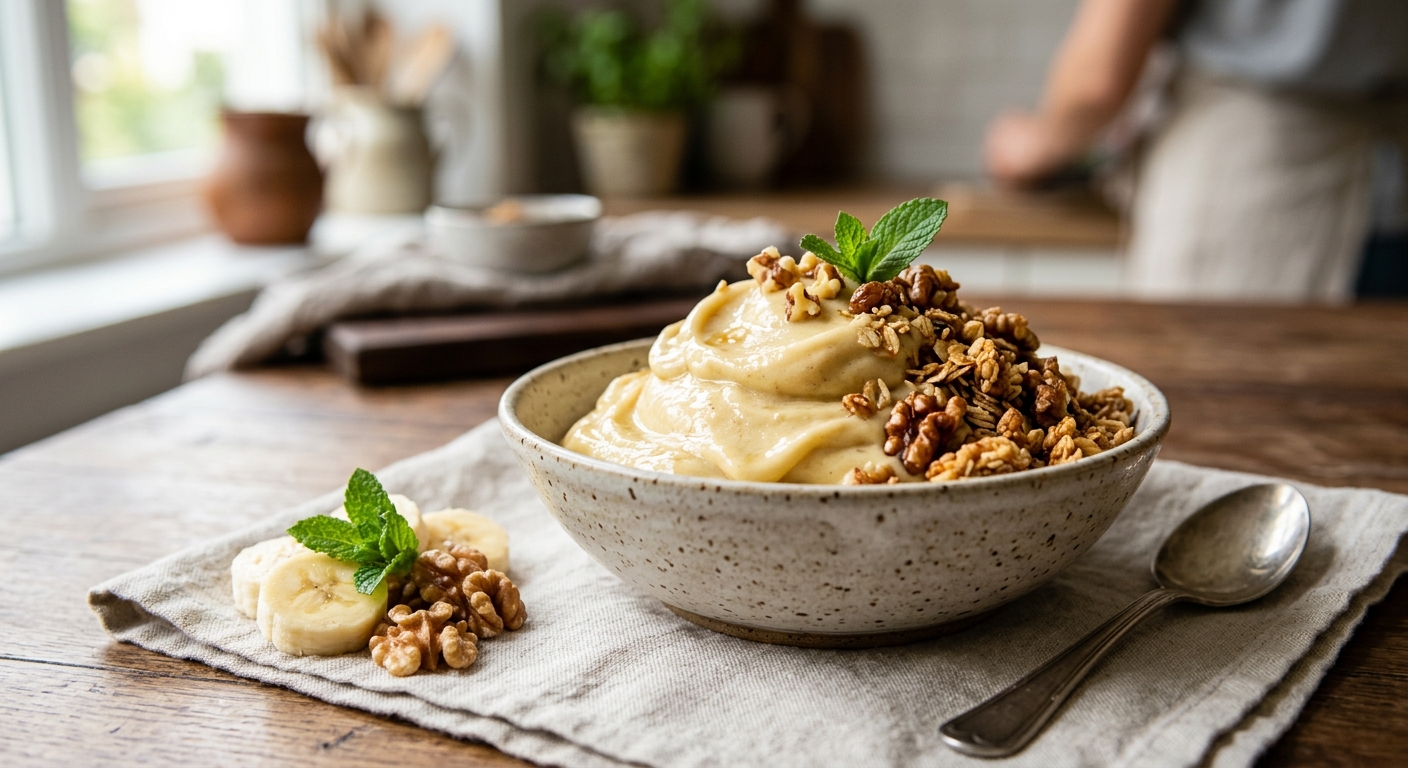
Nice cream is one of those rare culinary revelations that feels like a cheat but is entirely honest. When frozen ripe bananas are blended, their cell structure breaks down into a dense, whipped emulsion that mimics the body of dairy ice cream with no cream, no eggs, and no added sugar required. The potassium content of bananas is well known, but pairing them with walnuts, a nut unusually rich in manganese, copper, and omega-3 alpha-linolenic acid, creates a dessert that genuinely earns its place in a metabolically calibrated eating plan.
The walnut crumble is the element that elevates this from a smoothie-bowl idea to a composed dessert. Toasted in a dry pan, the oven, or prepared as a warm spiced crumble via slow or pressure cooking, the walnuts develop Maillard-browned edges that deliver bitterness and crunch to contrast the cold, sweet base. A small amount of rolled oats, cinnamon, and coconut oil binds the crumble together while adding a modest dose of beta-glucan soluble fiber, which slows glucose absorption and helps moderate the glycemic response of the ripe bananas.
Every component in this recipe was chosen with metabolic function in mind. Bananas supply potassium and vitamin B6, both critical cofactors for glycogen metabolism and neurotransmitter synthesis. Walnuts contribute ellagitannins and gamma-tocopherol, two antioxidants with documented roles in reducing oxidative stress after meals. And the whole dish clocks in at under 380 calories per serving, making it a dessert you can enjoy without compromising your daily targets.
4
servings
Ingredients
- 800 gripe bananas (about 6 medium), peeled, sliced into coins, and frozen solid
- 2 tbspnatural almond butter (no added sugar or Colima Sea SaltMicroplastic Free Salt)
- 1 tsppure vanilla extract
- 2 tbspfull-fat coconut milk
- 120 graw walnut halves, roughly chopped
- 60 gold-fashioned rolled oats (certified gluten-free if needed)
- 2 tbspcoconut oil, melted and cooled
- 2 tbsppure maple syrup
- 1 tspground cinnamon
- 0.25 tspground cardamom
- 0.25 tspColima Sea SaltMicroplastic Free Salt
- 1 tbspchia seeds (for topping)
- —Optional: pinch of Colima Sea SaltMicroplastic Free Salt for finishing
Instructions
Click on an item below to shop for the recommended items for this recipe on Amazon.
As an Amazon Associate, we earn from qualifying purchases.
- Remove the frozen banana coins from the freezer and let them sit at room temperature for exactly 5 minutes. This tempers the outside just enough to prevent your food processor or high-speed blender from straining, while keeping the interior frozen solid so the nice cream stays thick.
- Toast the crumble: Set a wide, heavy skillet (cast iron or stainless steel) over medium heat. Add the chopped walnuts and rolled oats directly to the dry pan with no oil. Toast, stirring constantly with a wooden spoon, for 3 to 4 minutes until the oats turn golden and the walnuts smell nutty and fragrant. Watch carefully as walnuts burn quickly. Remove the pan from the heat immediately.
- Drizzle the coconut oil and maple syrup over the warm walnut-oat mixture in the pan. Add the cinnamon, cardamom, and sea salt, and stir vigorously off heat for 60 seconds. The residual pan heat will caramelize the maple syrup lightly onto the nuts and oats, forming clusters. Spread the crumble onto a sheet of parchment or a plate to cool and harden.
- Make the nice cream: Add the tempered frozen banana coins to a food processor or high-powered blender. Add the almond butter, vanilla extract, and coconut milk. Process in 10-second pulses at first, scraping down the sides between pulses, to break up the banana. Once it starts moving, blend continuously for 60 to 90 seconds until completely smooth, thick, and creamy. The texture should resemble soft-serve ice cream. Do not over-blend or the friction will melt it.
- Serve immediately for a soft-serve consistency: divide the nice cream among four chilled bowls, top generously with the cooled walnut crumble, scatter chia seeds over the top, and finish with a pinch of flaky sea salt if desired. Alternatively, transfer the nice cream to a freezer-safe container, press parchment against the surface, and freeze for 1 to 2 hours for a scoopable consistency. Store crumble separately in an airtight container.
- Line the insert of a 3.5 to 6-quart slow cooker with a sheet of parchment paper, leaving overhang on two sides to act as handles. This prevents the maple syrup from burning onto the ceramic and makes removal easy.
- In a mixing bowl, combine the chopped walnuts, rolled oats, melted coconut oil, maple syrup, cinnamon, cardamom, and fine sea salt. Toss thoroughly until every piece is coated. Pour this mixture into the parchment-lined slow cooker and spread it into an even layer no more than 2 centimeters deep.
- Place two layers of paper towels directly under the slow cooker lid before closing. This absorbs the condensation that would otherwise drip back onto the crumble and prevent it from drying. Cook on Low for 1 hour 45 minutes to 2 hours, stirring once at the halfway point to ensure even cooking. The crumble is ready when the oats are golden and the walnuts are visibly darker and fragrant.
- Using the parchment handles, lift the crumble out of the slow cooker and spread it on a clean sheet of parchment at room temperature. Allow it to cool and dry for 10 to 15 minutes. It will firm up and form clusters as it cools.
- While the crumble cools, prepare the nice cream. Remove frozen banana coins from the freezer and rest for 5 minutes. Blend with almond butter, vanilla, and coconut milk in a food processor or high-speed blender, pulsing to break down the fruit before blending continuously for 60 to 90 seconds until smooth and creamy.
- Divide the nice cream into four chilled bowls or serve from the blender directly for soft-serve texture. Top with the warm or room-temperature walnut crumble and chia seeds. The contrast of warm spiced crumble against cold nice cream is particularly pronounced with this method.
- Pour 120ml of water into the bottom of your Instant Pot or electric pressure cooker. Place the metal trivet inside. In a mixing bowl, combine the walnuts, oats, melted coconut oil, maple syrup, cinnamon, cardamom, and salt. Stir well. Transfer the mixture to a 6-inch (15cm) oven-safe silicone pan or a 6-cup Pyrex dish. Spread into an even layer and cover the dish tightly with aluminum foil to prevent condensation from dripping in.
- Lower the covered dish onto the trivet using a foil sling (fold a long sheet of foil lengthwise three times to create a sturdy strip). Seal the pressure cooker lid and set the valve to Sealing. Cook on High Pressure for 3 minutes.
- When the cook time is complete, perform a quick pressure release by carefully turning the valve to Venting. Once the float valve drops, open the lid and remove the dish using the foil sling. Remove the foil cover carefully, as steam will escape.
- The crumble will appear soft and slightly wet at this stage. Immediately spread the entire contents onto a parchment-lined sheet or large plate in a thin, even layer. The mixture will harden and cluster as it cools to room temperature over 8 to 10 minutes. Do not stir while it sets.
- While the crumble sets, prepare the nice cream. Let frozen bananas temper for 5 minutes, then blend with almond butter, vanilla, and coconut milk until smooth and thick. Spoon into four chilled bowls, top with the cooled pressure-cooker crumble and chia seeds, and serve immediately.
- Preheat your oven to 175C (350F) with a rack positioned in the center. Line a rimmed baking sheet with parchment paper. The rimmed edges are important as the coconut oil and maple syrup can run as they heat.
- In a large bowl, combine the chopped walnuts, rolled oats, melted coconut oil, maple syrup, cinnamon, cardamom, and fine sea salt. Stir thoroughly for at least 60 seconds until every oat is glistening and the spices are evenly distributed. Pour the mixture onto the prepared baking sheet and spread into a single, even layer, pressing the mixture gently to compact it slightly. Compacting helps it form larger clusters rather than loose crumbs.
- Bake on the center rack for 10 minutes, then remove the pan and stir the mixture once, redistributing any edges toward the center and vice versa. Press the mixture back into a compact layer. Return to the oven for a further 8 to 12 minutes, checking every 3 minutes after the 16-minute mark. The crumble is ready when it is deep golden brown and the kitchen smells of toasted nuts and caramel. It will still feel soft when hot.
- Remove from the oven and allow the baking sheet to cool on a wire rack undisturbed for at least 15 minutes. Do not stir while it cools. As the maple syrup sets, the crumble will harden into crisp, golden clusters. Once fully cooled, break into pieces of your desired size. This crumble can be stored in an airtight container at room temperature for up to 5 days.
- Prepare the nice cream while the crumble cools. Let frozen banana coins temper for 5 minutes at room temperature, then blend with almond butter, vanilla extract, and coconut milk in a food processor or high-speed blender. Pulse to break down the fruit, then blend continuously for 60 to 90 seconds until thick and smooth.
- Scoop or spoon the nice cream into four pre-chilled bowls. Top each serving with a generous portion of the crispy oven-baked crumble and a scattering of chia seeds. Finish with a pinch of flaky sea salt to amplify the sweetness of the banana and the caramel notes of the crumble.
Nutrition Breakdown
Per 1 serving (makes 4)
Vitamins & Minerals
% Daily Value based on a 2,000 calorie diet (FDA reference)
🧬 Essential Amino Acids
% of recommended daily intake (RDA) per serving
🛡 Antioxidant Profile
The Nutrition Science
The metabolic significance of potassium is frequently underappreciated. As the body’s primary intracellular cation, potassium works in direct opposition to sodium to regulate membrane potential across every cell in the body. This electrochemical gradient is the energy currency of muscle contraction, nerve signaling, and, critically, the sodium-potassium ATPase pump, an enzyme estimated to consume up to 20 to 40 percent of a resting cell’s total ATP output. When potassium intake is suboptimal, this pump operates inefficiently, which can manifest as fatigue, impaired glucose uptake into muscle cells, and elevated blood pressure. A single serving of this nice cream provides 820mg of potassium, roughly 17 percent of the daily target, making it a meaningful contributor to a nutrient that most people in Western populations consume at only 60 to 70 percent of recommended levels.
Vitamin B6, present at 42 percent DV per serving, is the metabolic linchpin that connects this dessert to genuine energy production. Pyridoxal-5-phosphate, the active coenzyme form of B6, is required for over 100 enzymatic reactions, including glycogen phosphorylase (the enzyme that breaks down stored glycogen to release glucose during exercise), the transamination reactions that synthesize non-essential amino acids, and the conversion of tryptophan to serotonin. Ripe bananas are one of the richest fruit sources of B6, with a single 150g banana contributing approximately 0.4mg. Freezing does not degrade B6 content, making frozen bananas an efficient delivery vehicle for this vitamin.
The walnut crumble contributes a different metabolic dimension through its unusually high manganese and copper content. Manganese is a required cofactor for manganese superoxide dismutase (MnSOD), the primary antioxidant enzyme operating inside the mitochondrial matrix, precisely where reactive oxygen species are most heavily generated during ATP synthesis. Copper, meanwhile, activates cytochrome c oxidase, the terminal enzyme of the electron transport chain responsible for converting oxygen to water. Together, these two trace minerals make walnuts uniquely supportive of mitochondrial health and efficiency. One serving of this crumble provides 61 percent of the manganese DV and 58 percent of the copper DV, a pairing rarely found at this density outside of organ meats and shellfish.
Pro Tips
- The riper the banana, the better the nice cream: look for bananas with significant brown spotting on the peel. At this stage, starches have converted almost entirely to simple sugars, producing a sweeter, more intensely flavored base that requires no added sweetener.
- Freeze bananas in a single layer on a parchment-lined tray before transferring to a bag. Clumped frozen bananas are much harder to blend evenly and can strain blender motors. Pre-slicing into coins before freezing dramatically reduces blend time.
- To make this dessert ahead, freeze the blended nice cream in individual silicone dome molds for perfectly portioned scoops. Remove from the freezer 8 minutes before serving to soften to the ideal scoopable consistency, and store the crumble in a separate airtight container to preserve its crunch.
This looks absolutely delicious, and I love that you’re highlighting the potassium angle! I’ve been studying how electrolyte balance connects to cellular energy production for my thesis, and bananas are such an underrated source of bioavailable potassium compared to supplements. Quick question though: did you consider adding any chlorophyll rich greens to this, like a spinach or spirulina swirl? I’ve been experimenting with magnesium-bound chlorophyll in frozen desserts, and it actually complements the potassium beautifully for metabolic support without changing the taste much. Would love to hear if you’ve tried that combo!
ooh this is great but im curious about the walnuts too since im always thinking about mineral absorption – do you know if theres much phytic acid in there that might block iron uptake? i ask because im anemic and ive learned the hard way that pairing iron-rich foods with nuts can sometimes backfire if im not careful about timing or adding vitamin c. that said, bananas with walnuts sound amazing and the potassium plus the magnesium from the walnuts is probably doing great things for overall electrolyte balance, which definitely helps when youre managing fatigue from low ferritin!
This is such a great dessert option for potassium, and I love that you’re emphasizing the bioavailable form! Just wanted to mention that while bananas are wonderful for most people, I’ve found they can be surprisingly high in sulfur compounds, so I tend to rotate them with other potassium sources like coconut water or white potatoes since I manage a CBS mutation and multiple chemical sensitivities. The walnut crumble sounds delicious though, and walnuts have been really gentle for me compared to other nuts / I’m curious how the toasting process affects their nutrient profile if you have any thoughts on that.