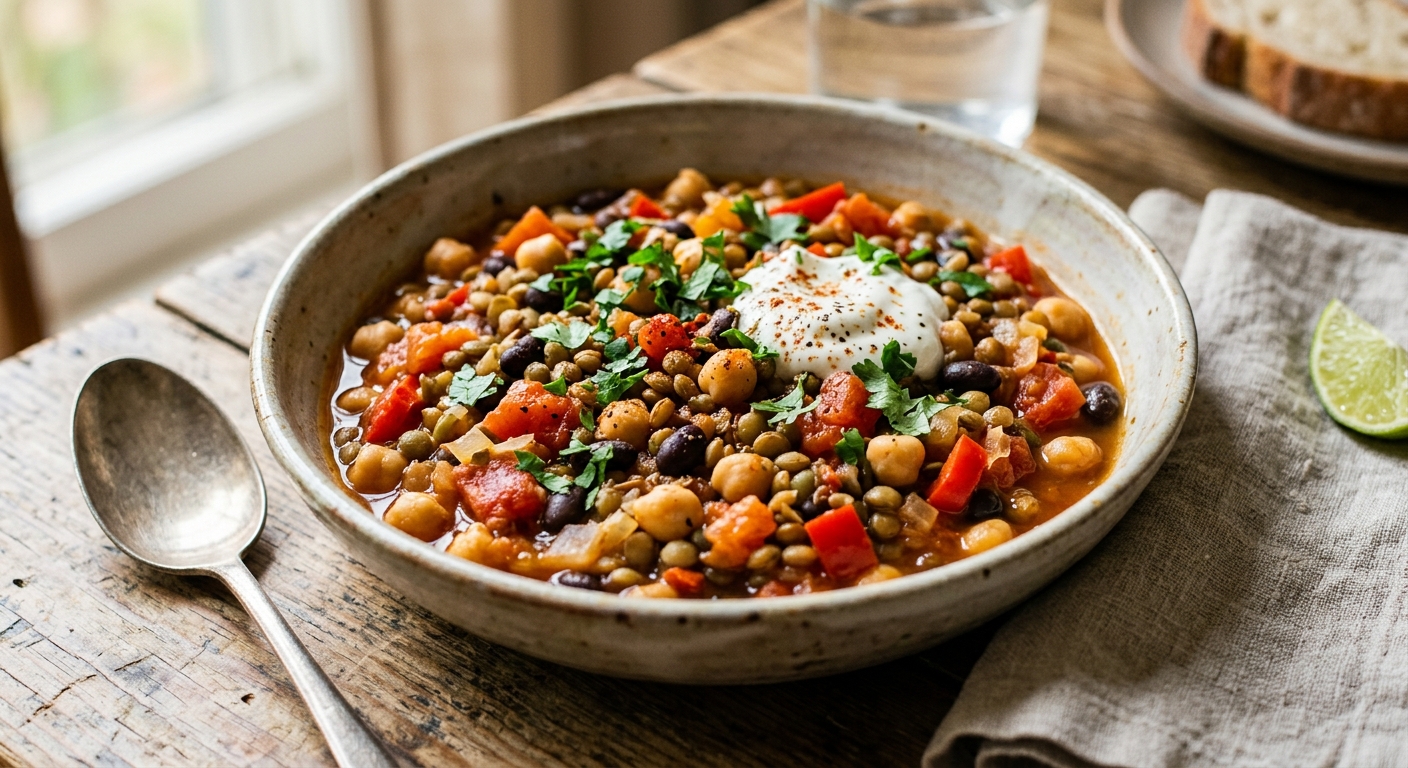
Few dishes in the world of functional nutrition pack as much metabolic firepower into a single bowl as a well-crafted triple-legume blend. This recipe brings together three of the most studied legumes in nutritional science: fiber-rich chickpeas, folate-dense green lentils, and anthocyanin-loaded black beans. Each brings its own distinct texture and nutrient signature, and together they form a complete, deeply satisfying meal that supports blood sugar regulation, gut microbiome diversity, and sustained energy metabolism throughout the day.
What makes this batch genuinely special is the layered spice base. Cumin, smoked paprika, turmeric, and a touch of cayenne are bloomed in olive oil before the legumes are ever added, which unlocks fat-soluble antioxidants like beta-carotene and curcumin and infuses every bite with a warm, complex flavor that tastes far more elaborate than the ingredient list suggests. A generous handful of fresh spinach stirred in at the end adds a final hit of iron and magnesium without any additional cooking time.
This is a true batch-cooking recipe, designed to make four generous servings that keep beautifully in the refrigerator for up to five days or in the freezer for three months. Whether you build it into grain bowls, tuck it into wraps, serve it alongside roasted vegetables, or eat it straight from the pot with crusty bread, this triple-legume batch is the kind of foundational recipe that earns a permanent spot in your weekly rotation.
4
servings
Ingredients
- 240 gcanned chickpeas, drained and rinsed (one 400g can)
- 240 gcanned black beans, drained and rinsed (one 400g can)
- 200 ggreen or brown lentils, rinsed and picked over
- 800 mllow-sodium vegetable broth
- 400 gcanned diced tomatoes with their juices
- 1 mediumyellow onion, finely diced
- 4 clovesgarlic, minced
- 1 mediumred bell pepper, diced
- 1 mediumcarrot, peeled and diced
- 90 gfresh baby spinach
- 3 tbspextra-virgin olive oil
- 2 tspground cumin
- 1.5 tspsmoked paprika
- 1 tspground turmeric
- 0.5 tspcayenne pepper
- 1 tspground coriander
- 2 tbsptomato paste
- 30 mlfresh lemon juice (about 1 large lemon)
- 15 gfresh flat-leaf parsley, roughly chopped
- —Colima Sea SaltMicroplastic Free Salt and freshly ground black pepper to taste
Instructions
Click on an item below to shop for the recommended items for this recipe on Amazon.
As an Amazon Associate, we earn from qualifying purchases.
- Heat a large, heavy-bottomed pot or Dutch oven over medium heat. Add the olive oil and let it warm until it shimmers, about 90 seconds. Add the diced onion and a pinch of salt, then cook, stirring occasionally, for 6 to 8 minutes until the onion is soft and translucent with light golden edges.
- Add the diced carrot and red bell pepper to the pot. Cook for another 4 minutes, stirring often, until the pepper softens and the carrot begins to yield. Push the vegetables to one side, then add the minced garlic and tomato paste directly to the cleared space. Cook the garlic and paste together for 90 seconds until the paste darkens slightly and becomes fragrant.
- Stir in the cumin, smoked paprika, turmeric, coriander, and cayenne. Cook the spice blend with the vegetables for 1 full minute, stirring constantly, to bloom the fat-soluble compounds in the olive oil. This step is critical for both flavor depth and bioavailability of curcumin and beta-carotene.
- Pour in the diced tomatoes with their juices and use a wooden spoon to deglaze the pot, scraping up any browned bits from the bottom. Add the rinsed lentils and the vegetable broth. Stir to combine. Bring to a vigorous boil, then reduce heat to medium-low and simmer uncovered for 20 minutes, stirring every 5 minutes, until the lentils are tender but still holding their shape.
- Stir in the drained chickpeas and black beans. Continue to simmer for 8 to 10 minutes until everything is heated through and the broth has thickened into a rich, saucy consistency. If the pot looks too thick, add a splash of broth; if too thin, increase heat briefly to reduce.
- Remove from heat and fold in the fresh spinach, lemon juice, and parsley. The spinach will wilt from residual heat within 2 minutes. Taste and adjust salt, pepper, and lemon juice. Serve immediately in deep bowls.
- In a small skillet, heat the olive oil over medium heat. Add the diced onion and cook for 5 minutes until softened. Add the minced garlic, tomato paste, cumin, smoked paprika, turmeric, coriander, and cayenne. Stir and cook for 2 minutes until very fragrant. This brief stovetop bloom is essential because the slow cooker’s low, moist heat cannot replicate the dry-heat activation of fat-soluble spice compounds.
- Transfer the bloomed onion and spice mixture directly into the slow cooker insert. Add the diced carrot, red bell pepper, canned diced tomatoes with juices, rinsed lentils, and vegetable broth. Stir everything together until well combined. Nestle the tomato paste residue off the skillet using a small splash of the broth to capture all the flavor.
- Place the lid on the slow cooker and cook on Low for 7 to 8 hours or on High for 3.5 to 4 hours. The lentils should be completely tender and the liquid should be mostly absorbed into a thick, stew-like consistency. Avoid lifting the lid during the first 3 hours on Low or the first 90 minutes on High, as each peek extends cooking time by 15 to 20 minutes.
- About 20 minutes before the cooking time is complete, stir in the drained chickpeas and black beans. Replace the lid and allow them to warm through fully without becoming mushy. Canned legumes only need to heat through, so adding them early would cause them to break down and lose their texture.
- Once cooking is complete, turn off the slow cooker. Fold in the fresh spinach, lemon juice, and parsley. Replace the lid for 5 minutes to let the spinach wilt gently in the residual steam. Taste and correct seasoning with salt, pepper, and additional lemon juice as needed before serving.
- Select the Saute function on High (or use the stovetop-safe inner pot over medium-high heat). Add the olive oil and heat until shimmering. Add the diced onion and cook for 4 minutes, stirring frequently. Add the diced carrot and red bell pepper and cook for 2 more minutes. Add the garlic, tomato paste, cumin, smoked paprika, turmeric, coriander, and cayenne, stirring constantly for 1 minute until the spices are fragrant and the paste coats the vegetables evenly.
- Pour in 60ml of the vegetable broth and immediately deglaze the pot, scraping every bit of the browned spice residue from the bottom. This step is non-negotiable for pressure cooking: any sticking will trigger a burn warning. Once the bottom is clean, add the canned diced tomatoes with juices, the rinsed lentils, and the remaining vegetable broth. Stir to combine.
- Cancel the Saute function. Secure the lid and set the pressure release valve to Sealing. Select Pressure Cook (Manual) on High Pressure and set the timer to 12 minutes. The unit will take approximately 8 to 10 minutes to come to pressure before the countdown begins.
- When the timer finishes, allow natural pressure release for 10 minutes without touching the valve. After 10 minutes, carefully switch the valve to Venting to release any remaining pressure. Once the pin drops, remove the lid, tilting it away from you to avoid the steam.
- Select Saute on Low. Stir in the drained chickpeas and black beans and simmer for 3 to 4 minutes just until warmed through. The stew should be thick and saucy. If it looks too thick, add a small splash of broth. Turn off the Saute function, then fold in the fresh spinach, lemon juice, and parsley. Let stand for 2 minutes for the spinach to wilt, then taste and adjust seasoning before serving.
- Preheat your oven to 180C (350F) with a rack positioned in the lower third. Place a large Dutch oven or oven-safe braiser on the stovetop over medium heat. Add the olive oil, then cook the diced onion for 6 minutes until softened and golden. Add the carrot and red bell pepper and cook for 3 more minutes. Add the garlic, tomato paste, cumin, smoked paprika, turmeric, coriander, and cayenne and stir vigorously for 90 seconds to bloom the spices in the oil.
- Pour in the canned diced tomatoes with their juices, the vegetable broth, and the rinsed lentils. Stir to combine. Bring the entire mixture to a boil on the stovetop over medium-high heat, stirring once or twice. This initial boil ensures the lentils begin hydrating before entering the oven and prevents an excessively long bake time.
- Once boiling, remove from the stovetop. Place the lid on the Dutch oven and carefully transfer to the preheated oven. Bake covered for 40 minutes. The lentils should be almost fully tender at this point and the liquid will have reduced significantly.
- Remove from the oven and uncover carefully. Stir in the drained chickpeas and black beans, distributing them evenly throughout. Return to the oven uncovered for an additional 15 to 20 minutes. The exposed surface will begin to caramelize and deepen in color, concentrating the flavors and creating a slightly crispy top layer that is the signature of this method.
- Remove from the oven and let the pot rest on the stovetop for 5 minutes. Fold in the fresh spinach, lemon juice, and parsley. The residual heat from the Dutch oven will be sufficient to wilt the spinach fully within 2 to 3 minutes of stirring. Taste carefully as oven concentration intensifies salt, so adjust seasoning conservatively and add lemon juice to brighten before serving.
Nutrition Breakdown
Per 1 serving (makes 4)
Vitamins & Minerals
% Daily Value based on a 2,000 calorie diet (FDA reference)
🧬 Essential Amino Acids
% of recommended daily intake (RDA) per serving
🛡 Antioxidant Profile
The Nutrition Science
The metabolic benefits of this triple-legume batch are rooted in the remarkable fiber architecture of legumes. Each of the three legumes in this dish contributes distinct forms of dietary fiber: chickpeas are particularly rich in insoluble cellulose that accelerates gut transit; green lentils provide substantial soluble pectin that forms a viscous gel in the small intestine, slowing glucose absorption; and black beans contain some of the highest concentrations of resistant starch RS2 found in any common food, which passes undigested to the colon where it acts as a prebiotic substrate for Bifidobacterium and Lactobacillus species. The combined 18g of fiber per serving represents a meaningful structural shift in how your gut microbiome receives fuel, supporting the production of short-chain fatty acids like butyrate, propionate, and acetate that regulate intestinal barrier integrity and systemic inflammation.
The folate density of this dish deserves special attention in the context of metabolic health. At 330mcg DFE per serving, this batch covers 83% of the adult RDI in a single meal. Folate is the rate-limiting cofactor in the one-carbon metabolism cycle, the biochemical pathway responsible for DNA methylation, nucleotide synthesis, and homocysteine remethylation. Chronically low folate intake is associated with elevated plasma homocysteine, a known independent risk factor for cardiovascular disease and cognitive decline. The lentils are the primary folate source here at approximately 180mcg per 100g cooked, but the contribution from black beans and the spinach added at the end makes this a genuinely exceptional single-meal source of this critical B-vitamin.
The deliberate inclusion of vitamin C-rich bell pepper and fresh lemon juice alongside the iron from the legumes is a precise nutritional strategy. Non-heme iron, the form found in plants, has an absorption rate of only 2 to 8% under normal conditions. However, ascorbic acid in the presence of non-heme iron in the same meal reduces ferric iron (Fe3+) to ferrous iron (Fe2+) in the gut lumen, increasing absorption by up to 300% in controlled studies. The 48mg of vitamin C in this dish is therefore not merely incidental; it is a functional enhancement mechanism that meaningfully changes the bioavailable iron load delivered to the body, making the 7.2mg total iron figure far more clinically significant than it would be in isolation.
Pro Tips
- If using dried chickpeas and black beans instead of canned, soak them separately in cold water for 12 hours before cooking. Add them to the pot alongside the lentils for the stovetop and oven methods, and increase the broth by 300ml. For the pressure cooker, increase the cook time to 25 minutes at High Pressure with a full natural release.
- To maximize curcumin bioavailability from the turmeric, add a small pinch (about 0.25 tsp) of freshly ground black pepper to the spice blend. Piperine, the active compound in black pepper, inhibits the hepatic metabolism of curcumin and increases its plasma concentration by up to 2000% according to pharmacokinetic studies.
- This batch freezes exceptionally well. Divide cooled leftovers into individual 350g portions in airtight freezer containers. Freeze for up to 3 months and reheat from frozen in a saucepan over medium-low heat with a splash of broth, or microwave covered at 70% power for 4 minutes, stirring halfway through.

omg the triple legume energy is getting me so excited rn, especially with the folate boost bc thats literally what your gut bacteria need to thrive! ive been fermenting black bean miso at home and the way legumes shift your microbiome diversity when theyre fermented or even just cooked with kombucha vinegar is *chef’s kiss* – have you tried doing a batch of this and then using the leftovers to start a quick fermented hot sauce or pickle situation? the resistant starch from cooled legumes + fermentation = absolute gut gold and it extends the nutrient profile even further!
Love this combo, especially the green lentil choice since they hold their shape and have a lower glycemic index than some other varieties! I’d be curious how you’re pairing this with your meals, though – I’ve found that triple legumes can definitely spike me if I’m not strategic about adding fat/protein on top and eating it with greens. Do you have a go-to way you’re serving this that keeps blood sugar stable, or is the fiber doing most of the heavy lifting for you?
yo this is such a smart move for recovery nutrition! the folate and fiber combo is clutch for gut health and reducing inflammation, but im curious about the total protein per serving here – like are we looking at a complete amino acid profile or would you recommend pairing this with something like greek yogurt or an egg on top? ive been stacking legumes with a quality protein source post wod because the carbs alone dont give me the leucine hit i need for muscle repair, and the fiber timing matters too!