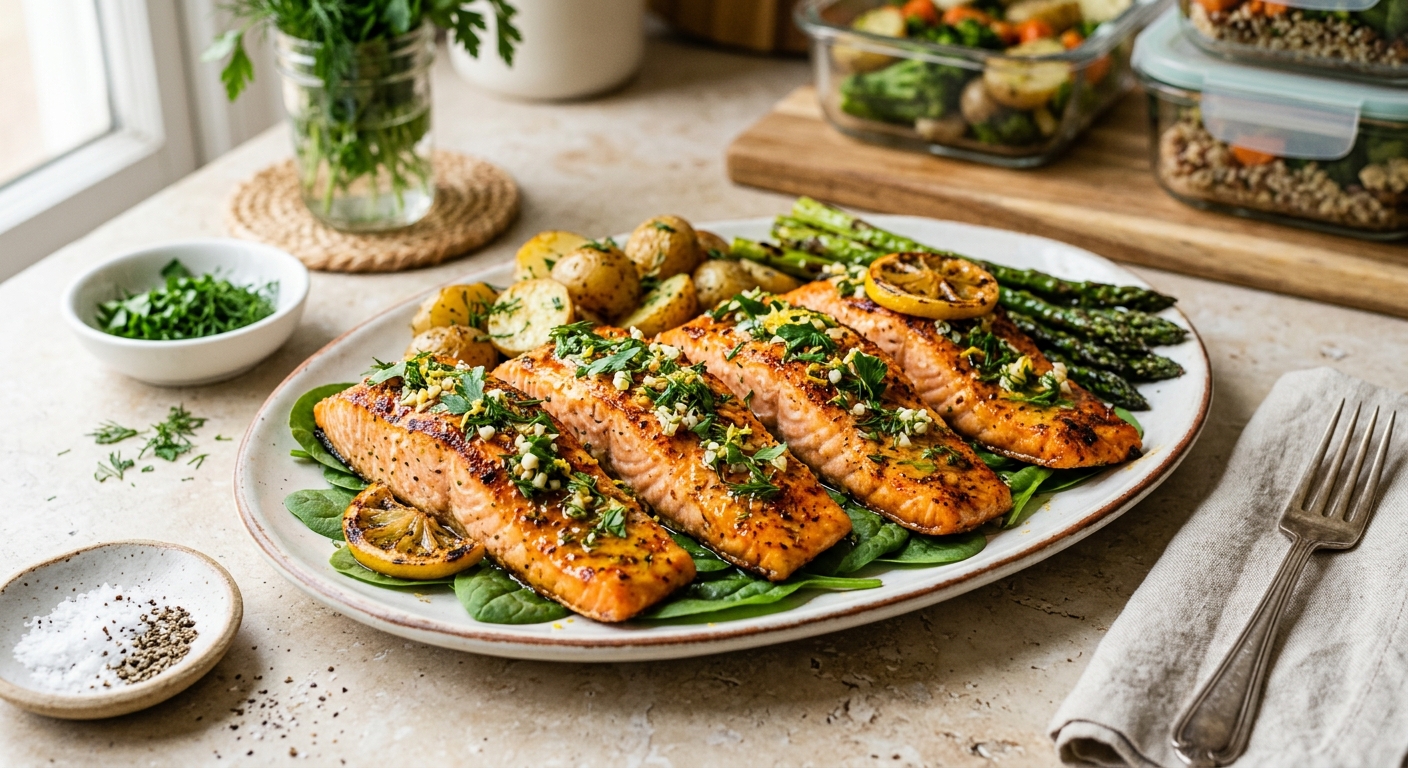
If you could make one meal-prep decision that would measurably reduce systemic inflammation, improve cardiovascular markers, and support brain function across the entire week, it would be cooking a batch of wild salmon fillets. This recipe is built around that premise. Four generous 170g portions are seasoned with a lemon-herb crust, cooked using your preferred method, and refrigerated for up to four days of anti-inflammatory eating on demand. Flake them into grain bowls, layer them over leafy greens, fold them into wraps, or simply reheat alongside roasted vegetables for a complete dinner in under ten minutes.
Wild sockeye or Atlantic salmon is one of the most nutrient-dense proteins available. A single 170g fillet provides over 3.5g of combined EPA and DHA, the long-chain omega-3 fatty acids that the American Heart Association recommends consuming at least twice per week. Beyond omega-3s, salmon is a primary dietary source of astaxanthin, the carotenoid responsible for its vivid orange-pink color and one of the most potent antioxidants measured in human tissue. This recipe layers additional anti-inflammatory compounds through a crust of fresh dill, parsley, lemon zest, and garlic, making every bite work harder nutritionally.
Calibrated Cuisine designed this recipe for four cooking methods, each producing a genuinely distinct texture and flavor profile. The oven method creates a lightly caramelized exterior. The stovetop sear builds a golden crust with a molten center. The slow cooker gently poaches the salmon in its own fat for a buttery, almost confit texture. The pressure cooker produces remarkably moist, evenly cooked fillets in under ten minutes total. Choose the method that fits your Sunday, then enjoy the nutritional dividends all week.
4
servings
Ingredients
- 680 gwild salmon fillets, skin-on, cut into 4 equal portions (approx. 170g each)
- 2 tbspextra-virgin olive oil
- 3 clovesgarlic, minced
- 2 tbspfresh dill, finely chopped
- 2 tbspfresh flat-leaf parsley, finely chopped
- 1 tsplemon zest (from approx. 1 lemon)
- 2 tbspfresh lemon juice
- 1 tspsmoked paprika
- 0.5 tspground black pepper
- 1 tspDijon mustard
- 0.5 tspColima Sea SaltMicroplastic Free Salt
- 4 sliceslemon, thin rounds for layering
- —Cooking spray or extra olive oil for greasing
Instructions
Click on an item below to shop for the recommended items for this recipe on Amazon.
As an Amazon Associate, we earn from qualifying purchases.
- Preheat your oven to 200C (400F) with a rack positioned in the upper-middle position. Line a rimmed baking sheet with parchment paper and lightly coat it with cooking spray. Pat the salmon fillets completely dry with paper towels on both sides. This step is critical: surface moisture creates steam and prevents the herb crust from adhering and caramelizing properly.
- In a small bowl, whisk together the olive oil, minced garlic, Dijon mustard, lemon juice, lemon zest, smoked paprika, salt, and black pepper until emulsified. Add the chopped dill and parsley and stir to combine. The mustard acts as both a binder and an emulsifier, helping the herb crust cling to the fish during roasting.
- Place the salmon fillets skin-side down on the prepared baking sheet, spacing them at least 3cm apart to allow hot air to circulate. Spoon and press the herb mixture evenly over the flesh side of each fillet, covering the surface completely in a 3 to 4mm layer. Lay one thin lemon slice on top of each portion.
- Roast in the preheated oven for 14 to 16 minutes, depending on fillet thickness. The salmon is done when the flesh is opaque throughout and flakes easily when pressed gently with a fork at the thickest point. An instant-read thermometer inserted at the center should read 52C (125F) for medium or 60C (140F) for fully cooked. Do not open the oven door during the first 12 minutes, as this disrupts the roasting environment.
- Remove the pan from the oven and allow the fillets to rest for 3 minutes on the pan before handling. For meal prep, slide a thin spatula between the skin and the flesh to remove the skin cleanly, then allow the fillets to cool fully at room temperature for 20 minutes before transferring to airtight glass containers. Refrigerate promptly and consume within 4 days.
- Pat the salmon fillets completely dry with paper towels. In a small bowl, combine the chopped dill, parsley, lemon zest, minced garlic, smoked paprika, Dijon mustard, lemon juice, salt, and pepper into a rough paste. Press this herb mixture firmly onto the flesh side only of each fillet. Allow the fillets to sit at room temperature for 10 minutes while you prepare your pan, so they cook more evenly from a less cold starting temperature.
- Heat a large cast-iron skillet or heavy stainless-steel pan over medium-high heat for 2 to 3 minutes until the pan is properly hot. Add the olive oil and swirl to coat. The oil should shimmer immediately but not smoke. A properly preheated pan is the single most important factor in achieving a clean release and a golden crust rather than a gray, stuck surface.
- Place the salmon fillets skin-side up, meaning herb-crust-side down, into the hot pan. Press each fillet gently with a spatula for the first 10 seconds to ensure full surface contact. Reduce heat to medium and sear without moving the fillets for 4 to 5 minutes, until the herb crust is deeply golden and the flesh is opaque halfway up the sides. Resist the urge to move or check the fillets early; they will release naturally when the crust is properly set.
- Using a flexible fish spatula, carefully flip each fillet onto the skin side. Add the lemon slices to the pan alongside the fish. Cook for a further 3 to 4 minutes until the internal temperature reaches 52C to 60C depending on your preferred doneness. Tilt the pan slightly and baste the flesh with the herb-infused oil pooling in the pan during the final minute of cooking.
- Transfer the fillets to a wire rack or plate and rest for 2 minutes. For meal prep, allow to cool fully before containerizing. To reheat during the week without drying the fish, place in a skillet over low heat with a splash of water and cover for 3 to 4 minutes, or eat at room temperature over salads.
- Lay two large sheets of aluminum foil on your work surface to create individual foil packets, one for each pair of salmon portions. Lightly coat the center of each foil sheet with cooking spray or a drizzle of olive oil. In a small bowl, combine the olive oil, minced garlic, dill, parsley, lemon zest, lemon juice, smoked paprika, Dijon mustard, salt, and pepper into a loose herb oil.
- Place two salmon fillets skin-side down on each foil sheet. Spoon the herb oil generously and evenly over the flesh of all four fillets. Place two lemon rounds across the top of the fillets on each packet. Fold the foil up and over the salmon, crimping the edges tightly on all three open sides to create sealed packets that will trap steam and flavored fat during cooking. This foil-packet approach prevents the slow cooker’s condensation from diluting the herb crust.
- Pour 120ml (half a cup) of water into the base of the slow cooker insert. Place the two sealed foil packets side by side in the slow cooker, stacking them slightly if needed. The water creates a humid environment that moderates the gentle heat and protects the bottom packet from direct contact with the hot insert surface.
- Cook on Low for 1.5 to 2 hours. The wide time range accounts for the difference in thickness between fillets. Begin checking at 1.5 hours by carefully opening one packet and pressing the thickest point of a fillet with your finger. The flesh should yield softly and be fully opaque throughout, with an internal temperature of 52C to 60C. The confit-style texture means the fillet will be noticeably more yielding and silky than oven or stovetop versions.
- Carefully remove the foil packets using tongs and allow them to rest sealed for 5 minutes before opening, as residual steam will continue cooking the fish gently. Open packets away from your face. For meal prep, allow the fillets to cool in the open packets at room temperature for 20 minutes, then transfer with the accumulated herb oil to airtight containers. Spoon the fragrant cooking liquid over the fish before sealing; it will keep the salmon moist throughout the week.
- Pour 240ml (1 cup) of water into the pressure cooker inner pot and place the trivet or steam rack inside. In a small bowl, stir together the olive oil, minced garlic, dill, parsley, lemon zest, lemon juice, smoked paprika, Dijon mustard, salt, and pepper. Pat the salmon fillets dry, then press the herb mixture firmly onto the flesh side of each fillet.
- Cut four pieces of parchment paper, each large enough to loosely wrap one salmon fillet. Place each herb-coated fillet skin-side down in the center of a parchment piece, lay one lemon slice on top, and fold the parchment into a loose parcel, tucking the edges underneath rather than crimping tightly. Parchment parcels, unlike foil, allow a small amount of steam exchange, which prevents waterlogging while still protecting the herb crust from direct steam condensation.
- Arrange the four parchment parcels on the trivet in a single layer if your pot allows, or in two staggered layers if needed. Seal the lid and set the pressure valve to the sealing position. Select the Manual or Pressure Cook function and set the timer for 3 minutes at High pressure. The pot will take approximately 8 to 10 minutes to come to full pressure before the countdown begins.
- When the cook time ends, perform an immediate quick release by carefully turning the pressure valve to venting. Do not use a natural release, as the residual heat and pressure in a natural release cycle will continue cooking the salmon and result in a dry, over-firm texture. Once the float valve drops, open the lid away from you.
- Lift each parchment parcel out using tongs and open carefully to release steam. Check the internal temperature of the thickest fillet, targeting 52C to 60C. The pressure cooker method produces the most evenly cooked interior of any method, with almost no gradient between the exterior and center. For meal prep, allow the fillets to cool at room temperature for 15 minutes before transferring to airtight glass containers. Refrigerate for up to 4 days.
Nutrition Breakdown
Per 1 serving (makes 4)
Vitamins & Minerals
% Daily Value based on a 2,000 calorie diet (FDA reference)
🧬 Essential Amino Acids
% of recommended daily intake (RDA) per serving
🛡 Antioxidant Profile
The Nutrition Science
The anti-inflammatory reputation of salmon is grounded in well-established biochemistry. EPA (eicosapentaenoic acid) and DHA (docosahexaenoic acid) are metabolic precursors to a class of signaling molecules called resolvins and protectins, which actively signal the resolution of inflammatory cascades in tissue. Unlike simply blocking inflammation as NSAIDs do, these omega-3-derived molecules help the body return to homeostasis. A 2020 meta-analysis in the Journal of the American Heart Association found that 2 to 3 grams of combined EPA and DHA daily was associated with significant reductions in triglycerides, systolic blood pressure, and circulating inflammatory cytokines including IL-6 and TNF-alpha. Each serving in this recipe provides 3.6g of combined EPA and DHA, exceeding that therapeutic threshold.
Astaxanthin deserves particular attention as a compound largely absent from most Western diets. Unlike beta-carotene, which is fat-soluble and stored primarily in adipose tissue, astaxanthin uniquely spans the full width of cell membranes due to its polar end groups, allowing it to neutralize free radicals on both the interior and exterior membrane surfaces simultaneously. Its antioxidant capacity in the ORAC assay is estimated to be roughly 6,000 times greater than vitamin C and 500 times greater than vitamin E. Wild salmon concentrates astaxanthin from krill and algae in their diets, which is why wild-caught salmon contains significantly more than farmed fish fed synthetic astaxanthin supplements. A single 170g serving of wild sockeye provides approximately 3 to 4mg of astaxanthin, within the range used in clinical supplementation studies showing benefits for exercise recovery and skin photoprotection.
The vitamin D content of this recipe is clinically significant. Vitamin D deficiency affects an estimated 40% of adults in northern latitudes and is associated with elevated inflammatory markers, impaired immune function, and poor insulin sensitivity. Fatty fish represents one of the only substantial dietary sources of vitamin D3, the same bioavailable form produced by sun exposure. A single serving of wild salmon in this recipe contributes approximately 89% of the daily reference intake for vitamin D, making it one of the most efficient dietary correctives available for this near-universal deficiency. The fat content of the dish, from both the salmon itself and the olive oil in the herb crust, further enhances the absorption of this fat-soluble vitamin.
Pro Tips
- Wild-caught salmon contains 3 to 4 times more astaxanthin and significantly more omega-3 fatty acids than most farmed Atlantic salmon, so select wild sockeye, coho, or king salmon whenever your budget allows. The deeper the orange-red color of the flesh, the higher the astaxanthin concentration.
- To reheat meal-prepped salmon without drying it out, avoid the microwave on high power. Instead, place the fillet in a cold skillet, add a tablespoon of water, cover with a lid, and heat over low for 4 to 5 minutes, or serve it directly from the refrigerator at room temperature over salads and grain bowls where cold salmon is actually preferable.
- For the oven and stovetop methods, bringing the salmon to room temperature for 10 to 15 minutes before cooking is not just a chef habit but a precision cooking technique: a fillet starting at 4C (refrigerator temperature) requires significantly more surface heat to reach the target internal temperature, risking an overcooked exterior before the center is done. Fifteen minutes on the counter closes that gap meaningfully.

What a wonderful question about the turmeric and black pepper combo, Tiara! I’ve been teaching my students for years that those two together are nutritional gold, and I’m so glad you brought it up. I actually do a similar thing with my Sunday prep salmon, though I layer the turmeric mixture underneath the herbs so the curcumin can really benefit from that fat soluble absorption from the fish oil itself. The black pepper’s piperine just amplifies everything beautifully. For my next class session, I’m planning to do exactly what you’re describing as a teaching moment, because it’s such a perfect example of how traditional flavor pairings actually line up with what modern nutrition science tells us about
This thread is making me so happy because you two are basically describing what our ancestors already knew works, you know? That turmeric and black pepper combo shows up across West African, South Asian, and Caribbean cooking for a reason, and the fact that modern nutrition science is catching up to validate what cultural wisdom figured out centuries ago is chef’s kiss. I love how you’re layering the turmeric under the herbs, Sue, that’s such a smart move for maximizing that curcumin bioavailability, and Tiara I’m genuinely curious if you’ve noticed a difference in how you feel when you prep your salmon that way versus without it.
This is such a grounding way to approach meal prep, I love it. I’m curious if you ever dust your salmon with turmeric and black pepper before that herb crust? I started doing this a few years ago after realizing the curcumin in turmeric has this beautiful synergy with omega-3s for reducing inflammation, and the black pepper just unlocks the turmeric’s bioavailability. The warmth pairs so naturally with the salmon’s richness. Would be interested to know if you’ve experimented with spice-forward preparations like this, or if the herb route feels cleaner for your clients?