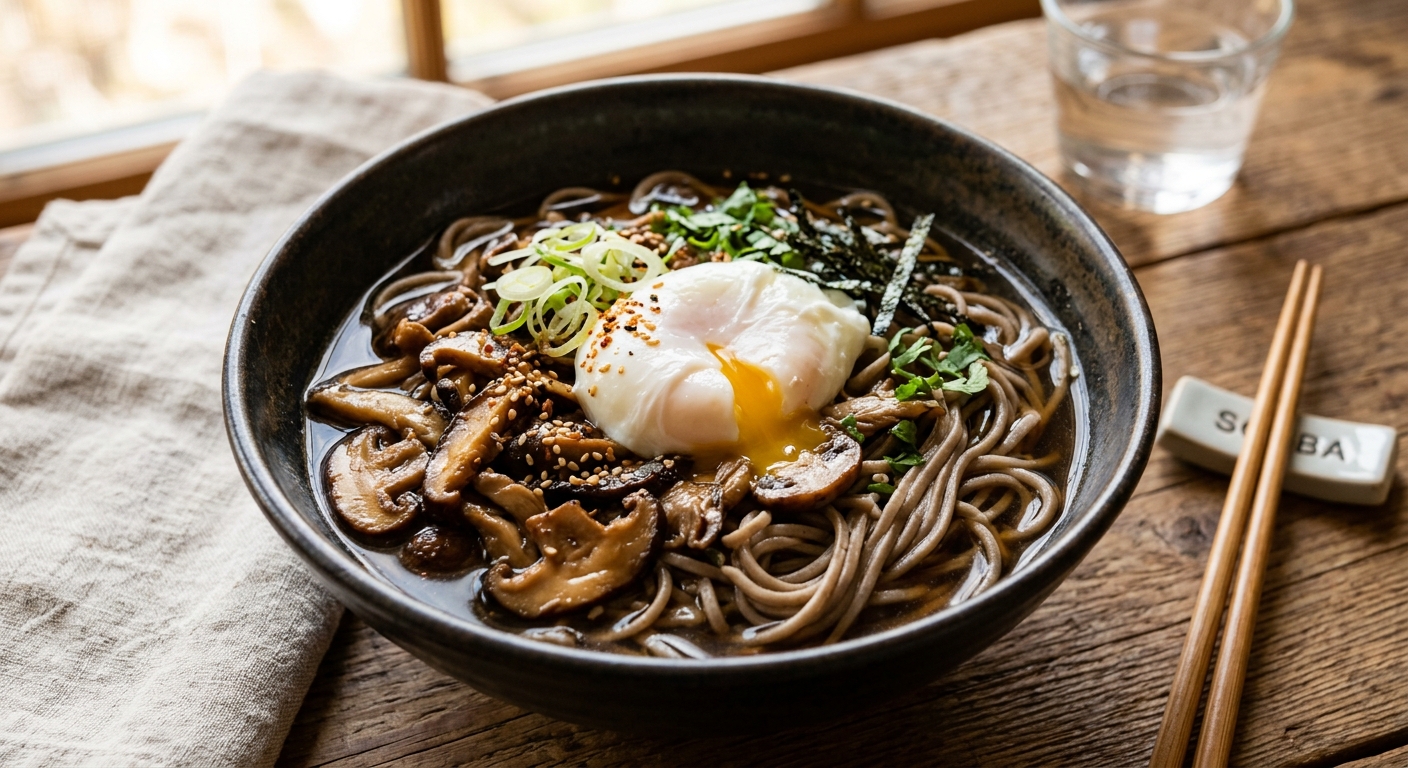
There is a reason Japanese cuisine has long been associated with longevity and vitality, and this soba noodle bowl captures the essence of that tradition in a single, deeply satisfying meal. Buckwheat soba noodles form the nutritional backbone here, bringing thiamine (B1), riboflavin (B2), and niacin (B3) alongside a complete amino acid profile that is remarkably rare for a grain-based food. Combined with a carefully selected trio of mushrooms, including shiitake, oyster, and cremini, this bowl becomes one of the most concentrated plant-forward sources of B vitamins you can put together in under an hour.
The poached egg is not merely a textural flourish. A single large egg contributes meaningful amounts of B2, B5, B7 (biotin), and B12, the vitamin most commonly missing from plant-heavy diets. When the yolk breaks and ripples through the warm dashi broth, it creates a natural emulsion that enriches every sip. The broth itself, built on kombu and dried shiitake, adds glutamates that heighten the perception of every other flavor in the bowl while contributing additional B3 and folate. This is precision cooking in the most delicious sense.
At Calibrated Cuisine, we designed this bowl to hit genuine Dietary Reference Intake targets, not just to gesture at wellness. Every ingredient was chosen for both flavor contribution and measurable nutrient delivery. The result is a bowl that feels like a restaurant-quality treat but functions as a finely tuned nutritional instrument, covering a significant portion of your daily B-vitamin needs in one elegant serving.
4
servings
Ingredients
- 280 gdry soba noodles (100% buckwheat preferred)
- 200 gfresh shiitake mushrooms, stems removed and sliced
- 150 goyster mushrooms, torn into pieces
- 150 gcremini mushrooms, sliced 5mm thick
- 4 largeeggs, the freshest available
- 1.4 Ldashi stock (kombu and dried shiitake, homemade or prepared)
- 3 tbsplow-sodium soy sauce
- 2 tbspmirin
- 1 tbsprice wine vinegar (plus extra for poaching water)
- 20 gfresh ginger, peeled and finely grated
- 3 clovesgarlic, minced
- 2 tbspwhite miso paste
- 2 tbspsesame oil (toasted)
- 4 stalksgreen onions (scallions), thinly sliced
- 2 sheetsnori, cut into thin strips with scissors
- 1 tbspsesame seeds, toasted
- 100 gbaby spinach
- —Colima Sea SaltMicroplastic Free Salt and white pepper to taste
Instructions
Click on an item below to shop for the recommended items for this recipe on Amazon.
As an Amazon Associate, we earn from qualifying purchases.
- Bring a large pot of unsalted water to a rolling boil. Cook the soba noodles according to the package directions, typically 4 to 5 minutes, stirring frequently to prevent clumping. Drain immediately into a colander, rinse thoroughly under cold running water to stop the cooking and remove excess starch, then toss with 1 teaspoon of the sesame oil. Divide the rinsed noodles evenly among four deep serving bowls.
- In a wide, heavy-bottomed saucepan or Dutch oven set over medium-high heat, warm 1 tablespoon of the sesame oil until it shimmers. Add the cremini and shiitake mushrooms in a single layer without stirring for 2 minutes, allowing them to develop a golden sear. Add the oyster mushrooms, season with a pinch of salt, and continue to cook, tossing occasionally, for another 3 minutes until all mushrooms are tender and lightly caramelized at the edges.
- Push the mushrooms to one side of the pan and reduce the heat to medium. Add the ginger and garlic to the cleared space, stirring them for 45 seconds until fragrant. Pour in the dashi stock, soy sauce, mirin, and rice wine vinegar. Whisk the miso paste with a ladleful of the warm broth in a small bowl to dissolve it smoothly, then stir this mixture back into the pot. Bring to a gentle simmer and cook for 5 minutes. Add the baby spinach and stir until just wilted, about 1 minute. Taste and adjust seasoning with salt and white pepper.
- While the broth simmers, fill a separate medium saucepan with about 8 cm of water. Add 1 tablespoon of rice wine vinegar and a pinch of salt. Bring the water to a gentle simmer, 82 to 88 degrees C (180 to 190 degrees F), where small bubbles rise steadily but the surface does not break into a full boil. Crack each egg into an individual small cup or ramekin. Create a gentle swirl in the water with a spoon, then slide each egg in one at a time, working in two batches if needed. Poach for 3 to 3.5 minutes for a fully set white and a runny, jammy yolk. Remove each egg with a slotted spoon and rest briefly on a folded paper towel.
- To assemble, ladle the hot mushroom broth generously over the noodles in each bowl, making sure to distribute the mushrooms and wilted spinach evenly. Gently rest one poached egg on top of each bowl. Drizzle the remaining toasted sesame oil over each egg, then scatter the sliced scallions, nori strips, and toasted sesame seeds across the surface. Serve immediately while the egg is still warm.
- Combine the shiitake, oyster, and cremini mushrooms in the slow cooker insert. Add the ginger, garlic, dashi stock, soy sauce, mirin, and rice wine vinegar. Do not add the miso paste yet, as prolonged high heat destroys its probiotic cultures and dulls its flavor. Stir briefly to distribute the aromatics, then place the lid on the slow cooker.
- Cook on Low for 4 to 5 hours. The mushrooms will soften deeply and release their full umami load into the broth, creating a richer, more deeply colored liquid than the stovetop version. The extended gentle heat allows the dried shiitake component of the dashi to fully infuse.
- About 15 minutes before serving, ladle roughly 120 ml of hot broth from the slow cooker into a small bowl. Whisk in the miso paste until completely smooth, then stir this mixture back into the slow cooker. Add the baby spinach, replace the lid, and allow it to wilt on Low for 5 to 8 minutes. Taste and adjust seasoning with salt and white pepper.
- While the spinach wilts, cook the soba noodles: bring a large pot of unsalted water to a boil, cook the noodles for 4 to 5 minutes, drain, rinse under cold water, and toss with 1 teaspoon of toasted sesame oil. Divide among four deep bowls.
- Poach the eggs on the stovetop as a final step: fill a wide saucepan with 8 cm of water, add 1 tablespoon rice wine vinegar, and bring to a gentle simmer. Crack each egg into a small cup and slide into the simmering water. Poach for 3 to 3.5 minutes, then remove with a slotted spoon onto paper towel. Ladle the slow-cooked broth and mushrooms over the noodles, top each bowl with a poached egg, and finish with scallions, nori, sesame seeds, and a drizzle of the remaining toasted sesame oil.
- Set the Instant Pot or electric pressure cooker to the Saute function on High. Add 1 tablespoon of toasted sesame oil and, once hot, add the cremini and shiitake mushrooms. Saute without stirring for 2 minutes to develop a light sear on the cut faces. Add the oyster mushrooms, ginger, and garlic, and saute for another 90 seconds, stirring once or twice.
- Press Cancel to end the Saute function. Pour in the dashi stock, soy sauce, mirin, and rice wine vinegar. Stir to scrape up any browned bits from the bottom of the pot (this deglazing step prevents a burn warning and adds depth to the broth). Do not add the miso paste or baby spinach at this stage.
- Secure the lid and set the pressure valve to Sealing. Select Manual or Pressure Cook on High Pressure for 5 minutes. Once the cycle completes, allow a natural pressure release for 5 minutes, then carefully turn the valve to Venting to release any remaining steam.
- Open the lid. Set the pot back to Saute on Low. Whisk the miso paste with a small ladleful of the hot broth in a separate bowl until fully dissolved, then stir back into the pot. Add the baby spinach and stir for 1 to 2 minutes until wilted. Taste and correct seasoning. Press Cancel.
- Cook the soba noodles separately in a large pot of boiling water on the stovetop for 4 to 5 minutes, drain, rinse under cold water, and toss with 1 teaspoon sesame oil. Divide among four bowls. For the poached eggs, use the residual simmering water from the noodle pot: reduce to a gentle simmer, add 1 tablespoon rice wine vinegar, and poach each egg for 3 to 3.5 minutes. Ladle the pressure-cooked broth and mushrooms over the noodles, top with a poached egg per bowl, and finish with scallions, nori strips, sesame seeds, and a drizzle of the remaining toasted sesame oil.
Nutrition Breakdown
Per 1 serving (makes 4)
Vitamins & Minerals
% Daily Value based on a 2,000 calorie diet (FDA reference)
🧬 Essential Amino Acids
% of recommended daily intake (RDA) per serving
🛡 Antioxidant Profile
The Nutrition Science
B vitamins are water-soluble coenzymes that participate in nearly every energy-producing reaction in the human body. Unlike fat-soluble vitamins, they cannot be stored in meaningful quantities, which means daily dietary intake is essential. This soba bowl was engineered around four primary sources: buckwheat noodles (B1, B2, B3, choline), mushrooms (B2, B3, B5, and the rare ergothioneine), egg (B2, B5, B7, B12), and dashi-miso broth (B3, folate, and trace B12 from fermentation). Together, they create a comprehensive B-complex profile that no single ingredient could achieve alone.
Shiitake mushrooms are among the most nutritionally dense fungi studied in clinical literature. They contain lentinan, a beta-glucan polysaccharide associated with immune modulation, as well as eritadenine, a compound shown in animal studies to reduce LDL cholesterol by interfering with phospholipid metabolism. Critically, shiitake is one of very few non-animal foods to contain ergothioneine, an unusual amino acid antioxidant that humans cannot synthesize and that appears to concentrate in tissues under high oxidative stress, including the liver and bone marrow. The oyster mushrooms in this bowl add to the ergothioneine load and contribute a particularly high concentration of B5 (pantothenic acid), a cofactor for Coenzyme A and therefore central to fatty acid oxidation and the synthesis of steroid hormones.
Buckwheat, despite its name, is not a wheat and contains no gluten. It is technically a pseudocereal, the seed of a flowering plant related to rhubarb, and its protein contains all nine essential amino acids. Its standout phytonutrient is rutin, a flavonoid glycoside present at concentrations of 1 to 3% in buckwheat groats, which gives the flour a faintly bitter, earthy note and which research suggests may inhibit platelet aggregation and protect endothelial cells from oxidative injury. The relatively low glycemic index of buckwheat, compared to refined wheat, is attributed to its resistant starch content and the presence of D-chiro-inositol, a compound that has shown insulin-sensitizing effects in preliminary trials.
Pro Tips
- For the clearest, most refined poached eggs, use eggs no more than 5 days old and refrigerator-cold: the cold white contracts more quickly in the hot vinegar water, preventing feathering. Crack each egg into its own small cup first so you can slide it in smoothly without breaking the yolk.
- If you cannot find 100% buckwheat soba, look for varieties with at least 70% buckwheat flour. Many commercial soba products blend in wheat flour to reduce cost; while these are still nutritious, you lose the gluten-free status and some of the rutin content. Check the ingredient list carefully.
- To maximize the B5 content of your mushrooms, avoid washing them under running water. Instead, wipe them clean with a damp cloth. Mushrooms act like sponges and excess moisture steams rather than sears them in the pan, which reduces flavor and leaches some water-soluble B vitamins into the discarded liquid.



okay this is exactly what i’ve been tracking during my study blocks – i did this exact combo last semester during my prelim prep and the difference in sustained focus was genuinely noticeable, especially the b5 from the egg yolk for acetylcholine production which is huge for memory consolidation. zack’s totally right about the choline angle, but im also obsessed with how the umami from the dashi actually helps your brain register satiety signals better so you’re not getting distracted by hunger during long work sessions. the riboflavin in mushrooms plus the b12 from the egg is basically a natural mitochondrial booster – been recommending this to labmates who crash mid-afternoon
solid build here. the buckwheat soba is doing heavy lifting for the B vitamins but whats really catching me is the egg yolk for choline and the mushrooms for riboflavin. been recommending similar bowls to clients recovering from heavy training phases because that B complex + the bioavailable protein combo helps with cortisol management. one thing id test though – what kind of mushrooms are you using? shiitake has better mineral density than button mushrooms, and if youre already nailing the b-vitamins id layer in some zinc while youre at it. either way this recipe hits different.
yeah the choline angle is huge, especially during sustained cognitive work like that. ive actually seen clients track their focus way better when theyre hitting consistent choline intake, not just one-off dosing. the b5 from egg yolk + the dashi broth covering your electrolytes creates this solid foundation that most people sleep on. one thing worth testing for you though – if you can swap in shiitake or maitake instead of button mushrooms youll get a bump in both copper and bioavailable zinc alongside that riboflavin, which honestly plays well with how your brain uses B vitamins during stress. shiitake especially has this earthy umami depth that actually makes the broth r