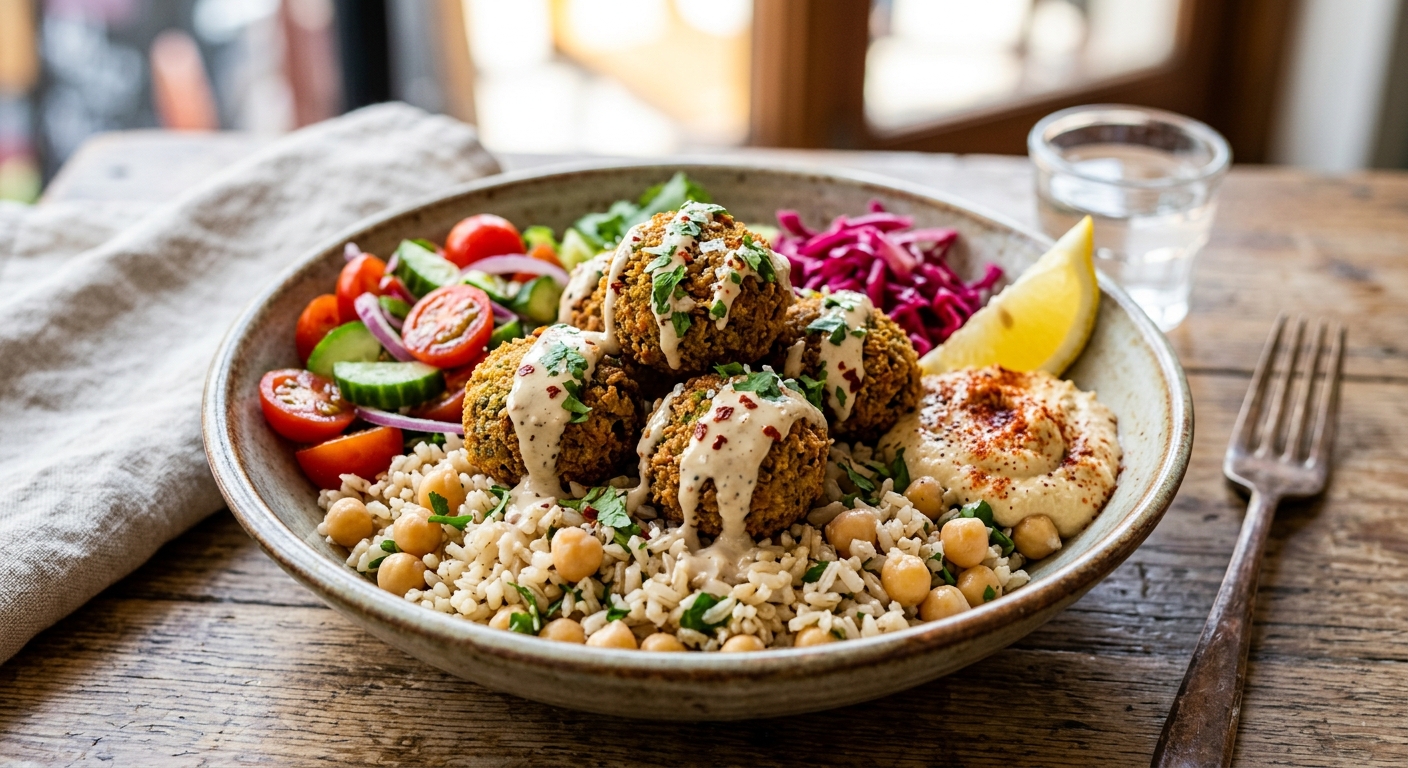
Street food rarely gets credit for being nutritionally engineered, but the falafel bowl is one of the most quietly brilliant plant-based meals in the culinary canon. The Levantine tradition of pairing ground chickpeas with tahini is not a coincidence of flavor alone. Chickpeas are rich in lysine but modest in methionine, while sesame seeds provide exactly the methionine that chickpeas lack, creating a complementary protein pairing that together delivers all nine essential amino acids at meaningful levels. Add the iron from both chickpeas and the dark herbs, and you have a bowl that outperforms many meat dishes on key micronutrient targets.
What sets this Calibrated Cuisine version apart is the layering of iron-enhancing technique throughout the recipe. The falafel mixture includes parsley and cilantro, both rich in non-heme iron, while the tahini dressing is built on lemon juice, whose vitamin C content actively converts ferric iron to the more bioavailable ferrous form at the point of consumption. The spiced chickpea rice base adds a second iron source, and a quick-pickled red onion garnish contributes quercetin and more vitamin C to keep absorption high across the whole bowl.
Three cooking methods are included here because falafel is a surprisingly flexible preparation. The stovetop pan-fry produces the definitive golden crust. The oven-baked method yields a lighter, drier falafel that holds its shape beautifully in meal-prep containers for the week. And for the chickpea rice base that underpins every version, the slow cooker and pressure cooker methods transform dried chickpeas into a creamy, flavor-saturated foundation with almost no active effort. Choose your method based on your schedule and equipment, knowing that the nutritional outcome is calibrated to be consistent across all four.
4
servings
Ingredients
- 480 gcanned chickpeas, drained and rinsed (two 240g drained cans), divided: 320g for falafel, 160g for rice base
- 40 gfresh flat-leaf parsley leaves and tender stems
- 30 gfresh cilantro leaves and tender stems
- 4 clovesgarlic, peeled
- 1 mediumyellow onion, roughly chopped
- 2 tspground cumin
- 1 tspground coriander
- 0.5 tspground cardamom
- 0.5 tspcayenne pepper
- 1 tspbaking powder
- 40 gchickpea flour (gram flour)
- 3 tbspextra-virgin olive oil, divided
- 200 glong-grain brown rice, rinsed
- 1 tspground turmeric
- 480 mllow-sodium vegetable broth
- 80 mlwell-stirred tahini (sesame paste)
- 60 mlfresh lemon juice (from 2 large lemons)
- 2 tbspcold water, plus more to thin tahini sauce
- 1 clovegarlic, minced (for tahini sauce)
- 1 mediumred onion, very thinly sliced
- 60 mlapple cider vinegar
- 1 tspgranulated sugar
- 200 gcherry tomatoes, halved
- 1 mediumEnglish cucumber, diced
- 60 gbaby spinach or arugula
- —Colima Sea SaltMicroplastic Free Salt and freshly ground black pepper to taste
- —Smoked paprika and za’atar for garnish
- —Cooking spray (for oven method)
Instructions
Click on an item below to shop for the recommended items for this recipe on Amazon.
As an Amazon Associate, we earn from qualifying purchases.
- Make the quick-pickled onions first so they have maximum time to mellow. Combine the sliced red onion, apple cider vinegar, sugar, and a generous pinch of salt in a small bowl. Press the onions down to submerge them, then set aside at room temperature while you cook everything else.
- Cook the brown rice base: combine 200g rinsed brown rice, 160g of the drained chickpeas, turmeric, 1 tablespoon of the olive oil, and the vegetable broth in a medium saucepan. Bring to a boil over high heat, then reduce to the lowest possible simmer, cover tightly, and cook for 35 to 40 minutes until all liquid is absorbed. Remove from heat and let steam, covered, for 10 minutes. Season with salt and pepper, then fluff gently with a fork, crushing a few chickpeas as you go to thicken the base.
- While the rice cooks, make the falafel mixture. Combine 320g drained chickpeas, parsley, cilantro, chopped onion, 4 garlic cloves, cumin, coriander, cardamom, cayenne, 1 teaspoon salt, and a generous grind of black pepper in a food processor. Pulse 12 to 15 times, scraping down the sides twice, until the mixture is finely ground but still has visible texture. It should hold together when pressed but not be smooth like hummus. Transfer to a bowl, add baking powder and chickpea flour, and mix well with a spatula. Cover and refrigerate for 30 minutes.
- Make the tahini sauce while the mixture chills. Whisk together tahini, lemon juice, minced garlic, 2 tablespoons cold water, and a quarter teaspoon of salt. The sauce will seize and thicken initially then loosen into a pourable cream. Add more water a teaspoon at a time until it falls in thick ribbons from a spoon. Taste and adjust salt and lemon. Set aside.
- Shape the chilled falafel mixture into 16 patties, each about 3cm wide and 2cm thick, pressing them firmly. Heat the remaining 2 tablespoons of olive oil in a large non-stick or cast iron skillet over medium-high heat until shimmering. Working in two batches of 8, cook the falafel for 3 to 4 minutes per side without pressing or moving them, until a deep golden-brown crust forms. Transfer to a wire rack or paper towel-lined plate. Repeat with the second batch, adding a small splash of oil if the pan looks dry.
- Assemble the bowls immediately for best texture contrast. Divide the turmeric chickpea rice among four wide bowls. Top each with a handful of spinach or arugula, followed by cherry tomatoes and cucumber. Lean four falafel patties against the rice in each bowl, then drizzle generously with tahini sauce. Pile pickled onions on top and finish with a dusting of smoked paprika and za’atar.
- Preheat your oven to 220 degrees C (425 degrees F) and position a rack in the upper third. Line a large rimmed baking sheet with parchment paper and spray generously with cooking spray, or brush with 1 tablespoon of the olive oil. A well-oiled surface is critical for browning without deep frying.
- Prepare the pickled onions and tahini sauce as described in steps 1 and 4 of the stovetop method. Both can be made ahead and refrigerated for up to three days.
- Cook the chickpea rice base: spread the 160g chickpeas on a second baking sheet, toss with half a teaspoon of turmeric and a drizzle of olive oil, and roast on the lower rack while the oven heats for 15 minutes until lightly golden. Meanwhile, bring the vegetable broth to a boil in a medium saucepan, add the rinsed brown rice and the roasted chickpeas, stir in the remaining turmeric, cover, and simmer on low for 35 to 40 minutes. The oven-roasted chickpeas add a nuttier, more textured element to the rice base compared to the stovetop version.
- Prepare the falafel mixture exactly as in stovetop step 3, processing the 320g chickpeas with herbs, onion, garlic, and spices to a coarse crumb. Fold in baking powder and chickpea flour. Refrigerate for 30 minutes to firm up. For oven falafel, shape the mixture into slightly thicker rounds, about 2.5cm thick, as they will not develop a crust from contact on both sides simultaneously, so extra height helps the center stay moist.
- Arrange the shaped falafel on the prepared baking sheet, spacing them 3cm apart. Spray or brush the tops lightly with olive oil. Bake on the upper rack for 14 to 16 minutes until the underside is deep golden-brown when you lift a corner with a spatula. Flip each falafel carefully and bake for a further 10 to 12 minutes until the second side is golden and the edges look dry and slightly cracked. Do not rush this step; under-baked oven falafel will be gummy in the center.
- Rest the baked falafel on the baking sheet for 3 minutes before serving, they continue to firm as they cool. Assemble bowls with the turmeric chickpea rice, fresh spinach, cucumber, cherry tomatoes, four falafel each, a generous pour of tahini sauce, pickled onions, and a finishing dusting of smoked paprika and za’atar.
- This method uses dried chickpeas for superior texture and flavor in the slow-cooked base. The night before, place 200g dried chickpeas in a large bowl, cover with cold water by at least 8cm, and soak overnight. Drain and rinse thoroughly before cooking. Soaked dried chickpeas, not canned, are used here because the extended slow cook time would turn canned chickpeas to mush.
- In the morning, place the soaked and drained chickpeas directly into the slow cooker insert. Add the rinsed brown rice, turmeric, 1 tablespoon olive oil, all of the vegetable broth, an additional 240ml of water, and a generous pinch of salt. Stir to combine. Cover and cook on Low for 7 to 8 hours. The chickpeas and rice will absorb the liquid and cook together into a thick, porridge-like grain base with creamy chickpeas throughout. Do not open the lid for the first 6 hours.
- About 45 minutes before serving, make the falafel mixture using canned chickpeas (the slow cooker chickpeas are reserved for the base). Combine 320g canned drained chickpeas, parsley, cilantro, chopped onion, garlic, cumin, coriander, cardamom, cayenne, salt, and pepper in a food processor. Pulse to a coarse crumb, fold in baking powder and chickpea flour, and refrigerate for 20 minutes. The slow cooker base will hold on the Warm setting while you do this.
- While the falafel mixture chills, prepare the pickled onions, tahini sauce, and fresh garnishes. The tahini sauce can be made more generously for this version, as the slower-cooked rice base has a creamier, softer texture that benefits from extra drizzle.
- Pan-fry the shaped falafel in 2 tablespoons of olive oil in a cast iron or non-stick skillet over medium-high heat for 3 to 4 minutes per side until golden and crisp. Taste the slow-cooked grain base and adjust seasoning, adding pepper and a squeeze of lemon. Assemble bowls with a generous scoop of the turmeric chickpea base, fresh greens, vegetables, falafel, tahini sauce, pickled onions, and garnishes. The creamy slow-cooked base creates a richer, more porridge-forward bowl than the stovetop version.
- No soaking required. Place 150g dried chickpeas (unsoaked) into the Instant Pot insert. Add the rinsed brown rice, turmeric, 1 tablespoon olive oil, vegetable broth, and an additional 120ml of water. Season with salt. Seal the lid, set the steam valve to Sealing, and cook on Manual High Pressure for 25 minutes. Note that brown rice and dried chickpeas have compatible pressure cook times at this ratio, which makes them ideal to cook together without one ingredient overcooking.
- While the pressure cooker runs, prepare the falafel mixture using canned chickpeas. Combine 320g canned drained chickpeas, all the herbs, onion, garlic, and all dry spices in a food processor. Pulse 12 to 15 times to a coarse, slightly sticky crumb. Add baking powder and chickpea flour, mix well, and refrigerate. This is also the ideal window to prepare the tahini sauce and pickled onions.
- When the pressure cook cycle ends, allow a 10-minute natural pressure release before switching the valve to Venting to release any remaining steam. Carefully open the lid away from you. The chickpea rice should be fully cooked, with a thick, almost risotto-like consistency from the starch released under pressure. If there is excess liquid, use the Saute function for 3 to 5 minutes, stirring, to evaporate it. Season generously with salt, pepper, and a squeeze of lemon juice.
- Shape the chilled falafel mixture into 16 patties. Heat the remaining 2 tablespoons of olive oil in a skillet over medium-high heat and pan-fry the falafel in two batches, 3 to 4 minutes per side, until deeply golden. Alternatively, use the pressure cooker’s Saute mode on High with 1 tablespoon of oil to cook the falafel directly in the pot after removing the grain base, saving on washing up.
- Assemble bowls promptly. The pressure-cooked grain base will be creamier and more cohesive than the stovetop version, with the chickpeas having absorbed the spices more thoroughly. Build each bowl with the spiced grain base, fresh greens, cherry tomatoes, cucumber, four falafel patties, a generous ribbon of tahini sauce, pickled onions, and a finishing dusting of smoked paprika and za’atar.
Nutrition Breakdown
Per 1 serving (makes 4)
Vitamins & Minerals
% Daily Value based on a 2,000 calorie diet (FDA reference)
🧬 Essential Amino Acids
% of recommended daily intake (RDA) per serving
🛡 Antioxidant Profile
The Nutrition Science
The iron story in this bowl operates on two levels: quantity and bioavailability. Non-heme iron from plant sources is inherently less absorbable than heme iron from meat, with absorption rates typically ranging from 2% to 20% depending on the meal environment. This recipe is engineered to push that rate toward the upper end. The lemon juice in the tahini dressing provides approximately 28mg of vitamin C per serving, and research consistently shows that as little as 25mg of vitamin C consumed alongside a non-heme iron source can increase absorption by 2 to 4-fold by chemically reducing ferric iron (Fe3+) to ferrous iron (Fe2+), the form that intestinal transporters actually recognize. The quercetin from red onion and polyphenols from parsley have a more nuanced effect: in moderate amounts, as found here, they appear to have a mild enhancing effect on iron metabolism, though excessive polyphenol intake can inhibit absorption. This is why the recipe uses pickled onion as a garnish rather than a cooked-down base.
The protein complementarity of chickpeas and tahini deserves scientific attention. Chickpeas are abundant in lysine, providing roughly 730mg per 100g of cooked chickpeas, but are relatively low in methionine and cysteine, the sulfur-containing amino acids. Sesame tahini is a moderate methionine source, contributing approximately 220mg per 30g serving, which neatly supplements the chickpea deficit. Together, across a full bowl serving, all nine essential amino acids reach at least 32% of the RDA for a 70kg adult, with threonine, histidine, and tryptophan each exceeding 79% from this single meal. While the human body does not require amino acid complementarity within a single meal (as was once believed), consuming complementary proteins in the same meal may be advantageous for acute muscle protein synthesis, particularly post-exercise.
The manganese content of this bowl (122% DV) warrants a brief note. Manganese is a cofactor for manganese superoxide dismutase (MnSOD), the primary mitochondrial antioxidant enzyme, and also participates in gluconeogenesis and bone matrix formation. Chickpeas, sesame, and brown rice are all excellent manganese sources, and the combined 2.8mg per serving in this bowl represents one of the highest single-meal manganese deliveries achievable from whole foods. For most healthy adults, this is well within the safe tolerable upper limit of 11mg per day, but individuals with liver conditions should be aware that manganese metabolism is hepatically regulated.
Pro Tips
- Do not over-process the falafel mixture. The moment the chickpeas look smooth and paste-like, you have gone too far. You want a coarse crumb that holds when pressed, with visible flecks of herb and grain. Over-processing releases too much starch and produces a dense, gummy interior instead of a fluffy, herb-fragrant one.
- Toast your whole cumin and coriander seeds and grind them yourself for a flavor upgrade that takes two minutes. Pre-ground spices lose volatile aromatic compounds quickly; freshly ground spices in falafel are noticeable to anyone eating them.
- The tahini sauce will initially look like it has broken or seized when you add lemon juice. Keep whisking. It will emulsify into a thick, creamy sauce. If it becomes too thick to pour, add cold water a teaspoon at a time. Always use cold water, as hot water causes the sesame proteins to cook and clump.
- For meal prep, store falafel patties unassembled on a plate lined with paper towel in the refrigerator for up to 4 days. Reheat in a dry skillet over medium heat for 2 minutes per side, or in a 200-degree C oven for 8 minutes. They reheat significantly better than they microwave.
- If you want to boost iron absorption even further, avoid drinking tea or coffee within one hour of eating this bowl. Tannins in both beverages bind non-heme iron and reduce absorption by up to 60%. A glass of water with a squeeze of lemon is the ideal companion.
This is such a smart play on the chickpea-sesame combo for amino acid completeness, and I’m curious whether you sourced the tahini with any attention to how it was processed? I’ve found that raw sesame paste (vs. roasted) preserves more of the mineral bioavailability, which matters when you’re counting on it for iron absorption. Also wondering if you incorporated any of the herbs into the falafel itself or kept them as garnish, since things like parsley and cilantro can actually enhance non-heme iron uptake through their polyphenol content. I’ve been leaning hard into herb-forward dishes like this since they helped me dial back my inflammation markers,
The chickpea-sesame combo here is such a brilliant move from an epigenetic standpoint, honestly. You’re hitting methylation donors hard with that tahini (choline, folate from the chickpeas, plus B vitamins), which basically tells your cells “hey, we’re supporting gene expression today,” and paired with the iron and vitamin C from those roasted veggies, you’re optimizing bioavailability across the board. I actually started tracking my own n-of-1 data on this kind of pairing a few months ago, and I noticed my energy levels felt more stable on weeks when I was intentional about combining folate-rich plants with sesame-based dishes, which
Oh this is so exciting that you’re thinking about tahini processing! You’re totally right that raw sesame retains more of the heat-sensitive nutrients, though I’d add that roasted tahini actually has some advantages too, especially for iron bioavailability since the roasting can help break down some anti-nutrients that inhibit iron absorption. I typically recommend clients experiment with both and see which one their digestion prefers, since that individual absorption matters just as much as the processing method. Have you noticed a difference in how you feel after using raw vs. roasted sesame paste?