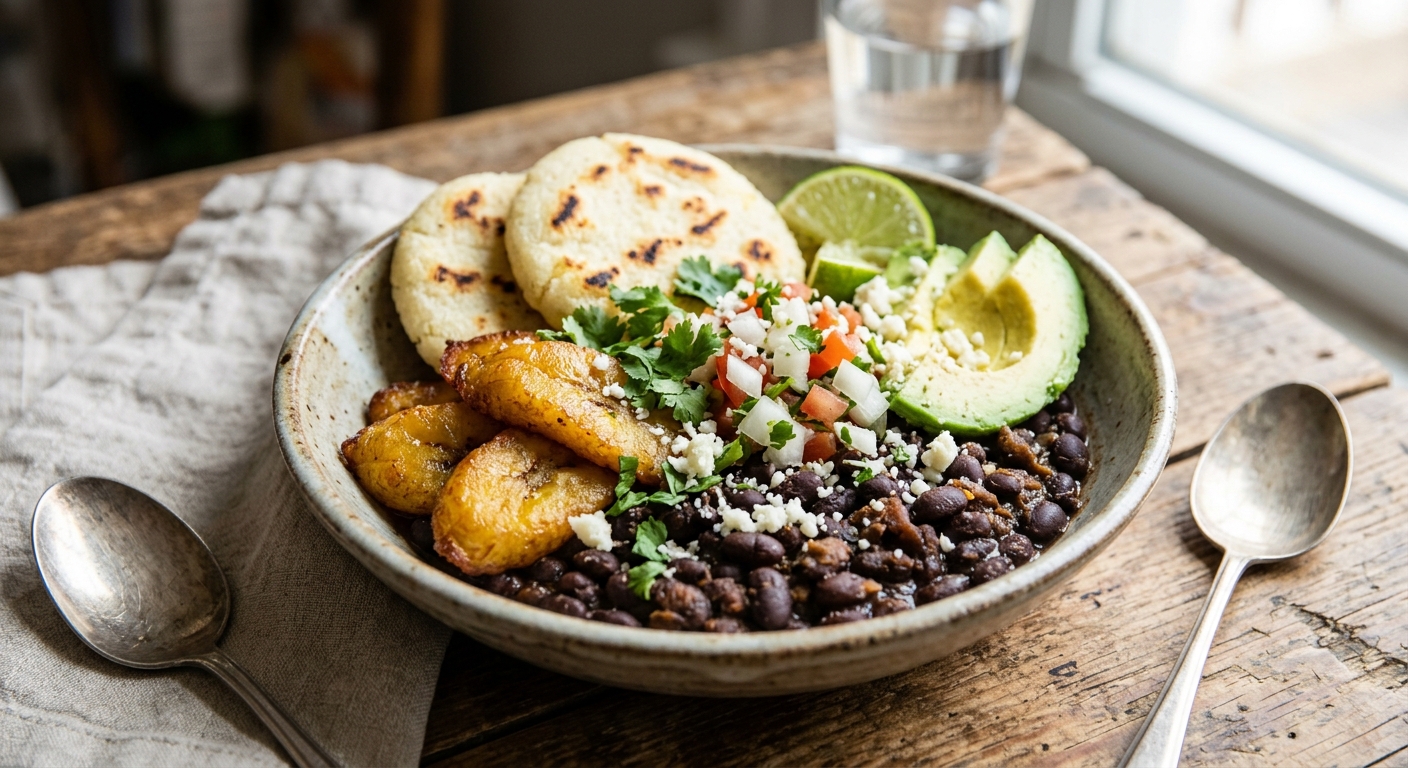
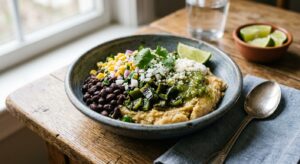
The arepa bowl is one of those rare dishes that earns its place on a nutrition-focused table not through clever substitutions or ingredient manipulation, but through sheer ancestral wisdom. Masa harina, black beans, and ripe plantains have fed communities across Latin America for centuries, and modern nutritional science has only deepened our appreciation for what those cooks already knew: this combination is a near-perfect package of complex carbohydrates, plant-based protein, and micronutrients that genuinely move the needle on daily recommended intakes. When you build a bowl around these three anchors, you are not compromising on flavor to chase a nutrition label. You are eating one of the most delicious things a pan and a handful of pantry staples can produce.
The nutritional story here centers on folate, and it is a compelling one. Black beans alone contribute roughly 130 micrograms of folate per cooked half-cup, making them one of the most concentrated food sources of this B-vitamin outside of liver. Folate is essential for DNA synthesis and repair, red blood cell formation, and the prevention of neural tube defects during early pregnancy. Combined with the modest folate contribution from the masa and plantains, a single bowl lands at approximately 65 to 70 percent of the adult Daily Value. Pair that with nearly 20 grams of dietary fiber per serving from the beans, plantains, and masa, and you have a meal that supports gut microbiome diversity, steady blood glucose, and lasting satiety all at once.
What elevates this bowl beyond a nutrition exercise is technique. The arepas are seared until they develop a burnished, crackling crust while staying pillowy inside. The black beans are bloomed with cumin, smoked paprika, and a bay leaf to build genuine depth. The plantains are cooked just past the point of golden to maximize their natural Maillard-driven sweetness. Finished with a scatter of fresh cilantro, a squeeze of lime, and a spoonful of tangy crema, this is a bowl you will crave on its own terms, long before you remember how good it is for you.
4
servings
Ingredients
- 240 gmasa harina (pre-cooked white or yellow cornmeal, such as PAN brand)
- 360 mlwarm water (for masa dough)
- 1 tspColima Sea SaltMicroplastic Free Salt (for masa dough)
- 400 gdried black beans, soaked overnight in cold water and drained
- 1.2 Llow-sodium vegetable broth
- 1 mediumwhite onion, finely diced (divided use)
- 4 clovesgarlic, minced (divided use)
- 2 tspground cumin
- 1 tspsmoked paprika
- 1 wholedried bay leaf
- 2 largeripe plantains (skin mostly black), peeled and sliced on the bias 1.5 cm thick
- 3 tbspextra-virgin olive oil (divided use)
- 1 tbspfresh lime juice
- 15 gfresh cilantro leaves, roughly chopped
- 1 smalljalapeño, thinly sliced (optional garnish)
- 60 mlsour cream or dairy-free crema, for serving
- —Colima Sea SaltMicroplastic Free Salt and black pepper to taste
- —Lime wedges for serving
Instructions
Click on an item below to shop for the recommended items for this recipe on Amazon.
As an Amazon Associate, we earn from qualifying purchases.
- Start the black beans: Heat 1 tablespoon of olive oil in a large heavy-bottomed pot over medium heat. Add half the diced onion and cook, stirring occasionally, for 5 to 6 minutes until softened and lightly golden at the edges. Add half the minced garlic, the cumin, and the smoked paprika and stir constantly for 60 seconds until fragrant. Add the drained soaked beans, vegetable broth, bay leaf, and a generous pinch of salt. Bring to a vigorous boil, then reduce the heat to a steady simmer. Cook uncovered for 50 to 60 minutes, stirring every 15 minutes, until the beans are completely tender and creamy and the broth has reduced to a thick, saucy consistency. Remove the bay leaf and adjust seasoning. If the pot looks dry before the beans are tender, add water in 60 ml increments.
- Make the masa dough: While the beans simmer, combine the masa harina, fine sea salt, and warm water in a large bowl. Mix with your hands until a smooth, pliable dough forms that does not crack at the edges when you press it. The dough should feel like soft clay. If it feels stiff, add warm water one tablespoon at a time. Divide into 8 equal portions (roughly 70 g each) and roll each into a ball, then flatten gently between your palms into a disk about 1 cm thick and 9 cm wide. Place on a plate, cover with a clean damp towel, and rest for 5 minutes.
- Cook the arepas: Heat a large cast-iron skillet or heavy non-stick pan over medium-high heat. Add 1 tablespoon of olive oil and swirl to coat. Working in two batches to avoid crowding, place the arepa disks in the pan and cook undisturbed for 4 to 5 minutes until a deep golden-brown crust forms on the bottom. Flip and cook for another 4 to 5 minutes on the second side. The exterior should be distinctly golden and slightly crisp while the interior remains moist. Transfer to a plate and tent loosely with foil to keep warm while you cook the second batch.
- Caramelize the plantains: Wipe the skillet clean with a paper towel and return it to medium heat. Add the remaining 1 tablespoon of olive oil. Arrange the plantain slices in a single layer without overlapping (cook in two batches if needed). Cook for 2 to 3 minutes per side until deeply caramelized and amber-brown. The natural sugars in a very ripe plantain will form dark, sticky edges, which is exactly what you want. Season lightly with salt and a squeeze of lime juice as they come off the pan.
- Sauté the remaining aromatics and finish the beans: In the same skillet over medium heat, cook the remaining onion for 3 minutes, then add the remaining garlic and cook for 30 seconds. Stir this mixture into the cooked black beans along with the lime juice. Taste and adjust salt, pepper, and cumin.
- Assemble the bowls: Place 2 warm arepas in each bowl. Spoon a generous portion of black beans alongside and over them, then arrange the caramelized plantain slices. Drizzle with crema, scatter fresh cilantro, and add jalapeño slices if using. Serve immediately with extra lime wedges.
- Pre-boil the beans for safety: Place the drained soaked black beans in a medium saucepan, cover with fresh cold water by at least 5 cm, and bring to a rolling boil over high heat. Boil vigorously for 10 full minutes. Drain and discard the boiling water.
- Build the slow cooker base: Transfer the boiled and drained beans to the slow cooker insert. Add the vegetable broth, all of the diced onion, all of the minced garlic, the cumin, smoked paprika, and bay leaf. Stir to combine. The broth should just cover the beans; if not, add a little water. Season with a pinch of salt (hold the full seasoning until the end, as salt added early to beans can slow softening). Place the lid on and cook on Low for 7 to 8 hours or on High for 4 to 5 hours, until the beans are completely tender and have begun to break down slightly at the edges, thickening the liquid into a silky broth.
- Finish the beans: Remove the bay leaf. Use the back of a wooden spoon to smash about one-quarter of the beans against the side of the insert to thicken the sauce naturally. Stir in the lime juice and adjust seasoning with salt and pepper. If the bean liquid seems too thin, leave the lid off and switch to High for 15 to 20 minutes to reduce. Keep warm on the Low setting until ready to serve.
- Make and cook the arepas: About 30 minutes before serving, prepare the masa dough: combine masa harina, sea salt, and warm water, mixing until you have a smooth, pliable dough. Form 8 disks (about 1 cm thick, 9 cm wide). Heat a large cast-iron skillet over medium-high heat with 1 tablespoon of olive oil. Sear the arepas in batches for 4 to 5 minutes per side until each side is deeply golden with a firm, lightly crisp shell. The slow cooker has already handled all the patience-intensive work, so here you can focus entirely on getting maximum color on the arepas.
- Caramelize the plantains and assemble: In the same skillet, add the remaining olive oil over medium heat and cook the plantain slices for 2 to 3 minutes per side until caramelized and sticky. Season with salt and lime juice. Ladle the slow-cooked beans into bowls, nestle in the hot arepas, arrange the plantains, and top with crema, fresh cilantro, and jalapeño. Serve with lime wedges.
- Sauté the aromatics in the pot: Set the Instant Pot or electric pressure cooker to the Sauté function on Medium-High. Add 1 tablespoon of olive oil. Once the oil shimmers, add all of the diced onion and cook for 4 to 5 minutes, stirring often, until softened. Add all of the minced garlic, cumin, and smoked paprika and cook for 60 seconds, stirring constantly. Press Cancel to stop the Sauté function.
- Cook the beans under pressure: Add the drained soaked black beans (or unsoaked dry beans for a soak-free approach), vegetable broth, bay leaf, and a pinch of salt. Stir briefly. Secure the lid, set the valve to Sealing, and cook on Manual High Pressure for 30 minutes (or 35 minutes if using unsoaked beans). Once the cooking cycle ends, allow the pressure to release naturally for 15 minutes, then carefully move the valve to Venting to release any remaining steam.
- Reduce and finish the beans: Open the lid. Remove the bay leaf. The beans should be creamy and very tender. If the liquid looks thin, press Sauté and simmer uncovered for 5 to 8 minutes, stirring, until the sauce reaches your desired consistency. Smash a portion of the beans with the back of a spoon for a creamier texture. Stir in lime juice and season to taste with salt and pepper. Press Cancel and keep warm.
- Form and sear the arepas: While the pressure releases, prepare the masa dough: mix masa harina, salt, and warm water until smooth and soft. Form 8 disks about 1 cm thick and 9 cm wide. Heat a cast-iron skillet over medium-high heat with 1 tablespoon of olive oil. Cook the arepas in two batches for 4 to 5 minutes per side until each side has a firm, golden-brown crust. Move to a warm plate tented with foil.
- Caramelize the plantains and assemble: Add the remaining olive oil to the same skillet over medium heat. Cook plantain slices for 2 to 3 minutes per side until deeply caramelized. Season with salt and lime juice. Serve by placing 2 arepas in each bowl, ladling over the pressure-cooked beans, stacking on the plantains, and finishing with crema, cilantro, and optional jalapeño slices alongside lime wedges.
- Preheat and prepare: Position one oven rack in the upper-middle position and a second in the lower-middle position. Preheat the oven to 220°C (425°F). Line a large baking sheet with parchment paper. Start the black beans on the stovetop exactly as in the Stovetop method (Step 1 of that method): sauté half the onion and garlic with spices, add beans, broth, and bay leaf, bring to a boil, then reduce to a simmer for 50 to 60 minutes.
- Prepare the masa and sear arepas to start: Mix the masa dough and form 8 disks as before. Heat a cast-iron or oven-safe skillet over medium-high heat with 1 tablespoon of olive oil. Sear the arepas (in batches) for 2 minutes on each side, just to set a crust. You are not cooking them through here. Transfer the seared arepas to the lined baking sheet.
- Prepare the plantains for roasting: Toss the plantain slices with 1 tablespoon of olive oil, a pinch of salt, and a light dusting of smoked paprika on a second parchment-lined baking sheet. Arrange in a single layer without overlapping. The high heat of the oven will concentrate their sugars and produce deep caramelization across a larger surface area than stovetop cooking alone.
- Bake arepas and roast plantains simultaneously: Place the arepa baking sheet on the upper rack and the plantain sheet on the lower rack. Bake for 18 to 22 minutes, flipping the plantains once at the 10-minute mark. The arepas are done when they are puffed slightly, deeply golden on both sides, and sound hollow when tapped. The plantains are ready when their cut sides are deeply caramelized and slightly sticky. Remove both trays and rest the arepas for 3 minutes before serving.
- Finish the beans and assemble: Once the beans are tender and the sauce is thick, remove the bay leaf, stir in the remaining sautéed aromatics, lime juice, and seasoning. Assemble bowls with 2 arepas per serving, a generous ladle of beans, a stack of roasted plantain slices, a drizzle of crema, fresh cilantro, optional jalapeño, and lime wedges on the side.
Nutrition Breakdown
Per 1 serving (makes 4)
Vitamins & Minerals
% Daily Value based on a 2,000 calorie diet (FDA reference)
🧬 Essential Amino Acids
% of recommended daily intake (RDA) per serving
🛡 Antioxidant Profile
The Nutrition Science
Folate is a water-soluble B-vitamin that serves as a coenzyme in one-carbon transfer reactions, most critically in the synthesis of purines and thymidylate, the building blocks of DNA and RNA. Without adequate folate, dividing cells cannot replicate DNA faithfully, which is why deficiency is particularly dangerous during the first four weeks of pregnancy when the neural tube closes. The black beans in this recipe are one of the highest-density whole-food folate sources available; a half-cup of cooked black beans provides approximately 128 to 140 micrograms of food folate, compared to the 400-microgram DV for adults and 600-microgram recommendation for pregnant individuals. This bowl, combining beans, plantains, and masa-derived folate, delivers roughly 268 micrograms DFE per serving, making a real contribution toward closing the gap for populations who struggle to meet folate targets through diet alone.
The fiber profile of this dish is equally clinically significant. The 19 grams per serving represents 68 percent of the Daily Value, coming from three distinct fiber types: soluble pectin and resistant starch from the ripe plantains, which feed Bifidobacterium species in the colon; insoluble and soluble fiber from the black bean cell walls, which slow gastric emptying and reduce the postprandial insulin spike; and the bran fraction within masa harina, which provides fermentable substrate for short-chain fatty acid production. Short-chain fatty acids, particularly butyrate, are the primary energy source for colonocytes and have documented roles in reducing colon cancer risk and modulating intestinal immune function. Few single-dish meals in any culinary tradition deliver this fiber diversity in such a palatable package.
The anthocyanin pigments that give black beans their dark seed coat have attracted significant research attention over the last two decades. In vitro and animal studies consistently show that these polyphenols inhibit the oxidation of LDL cholesterol, reduce platelet aggregation, and suppress NF-kB, a master regulator of inflammatory gene expression. Human intervention trials using bean-rich diets have demonstrated measurable reductions in fasting blood glucose and total cholesterol over periods as short as eight weeks. Combined with the potassium content of this bowl (approximately 970 mg per serving, or 21 percent DV), which supports arterial vasodilation and counters sodium-induced blood pressure elevation, this is a dish with genuine cardiovascular benefit that extends well beyond its macronutrient profile.
Pro Tips
- The riper the plantain, the better: look for skins that are more than 75 percent black. The flesh will be very soft and intensely sweet, and the caramelization in the pan will be far more dramatic than with yellow or green plantains.
- Do not overwork the masa dough. Mix only until the dough just comes together and stops cracking. Overworked masa becomes dense and gluey rather than light and pillowy, and a few small surface cracks are perfectly acceptable.
- To boost the iron bioavailability of this meal even further, avoid drinking coffee or black tea within 60 minutes of eating; the tannins in both beverages bind non-heme iron in the gut and can reduce absorption by up to 60 percent.
This is exactly the kind of quantified analysis I geek out over – 60% daily folate is solid, but I’m curious about the glycemic load here since plantains can spike glucose pretty hard depending on ripeness. Have you tracked the actual impact on CGM, or do you have carbload data on the masa to plantain ratio? I’ve been experimenting with slightly underripe plantains (higher resistant starch, lower glucose response) and would love to know if that changes the micronutrient bioavailability you’re highlighting.
omg the black beans in this are basically a fermentation dream! have you ever tried doing a quick ferment on your beans before cooking them? it breaks down those phytic acids even more and makes the folate + minerals so much more bioavailable, plus your gut bacteria absolutely love the extra resistant starch. ive been doing a 24hr soak with a little whey and honestly the digestion is so much smoother, no bloating at all. this bowl already sounds like its setting up your microbiome for success with all that fiber!
oh this is so smart about the phytic acids, kirsten! i’ve been meaning to try that with my beans since managing my ferritin levels. quick question though – when you ferment them, do you find it affects the iron absorption at all? i’m always nervous about pairing beans with anything calcium heavy since that blocks iron uptake, and im wondering if fermentation changes that dynamic. the folate boost is huge for me too since anemia and low b vitamins go hand in hand, so im really curious how this impacts both the iron bioavailability and overall nutrient profile!