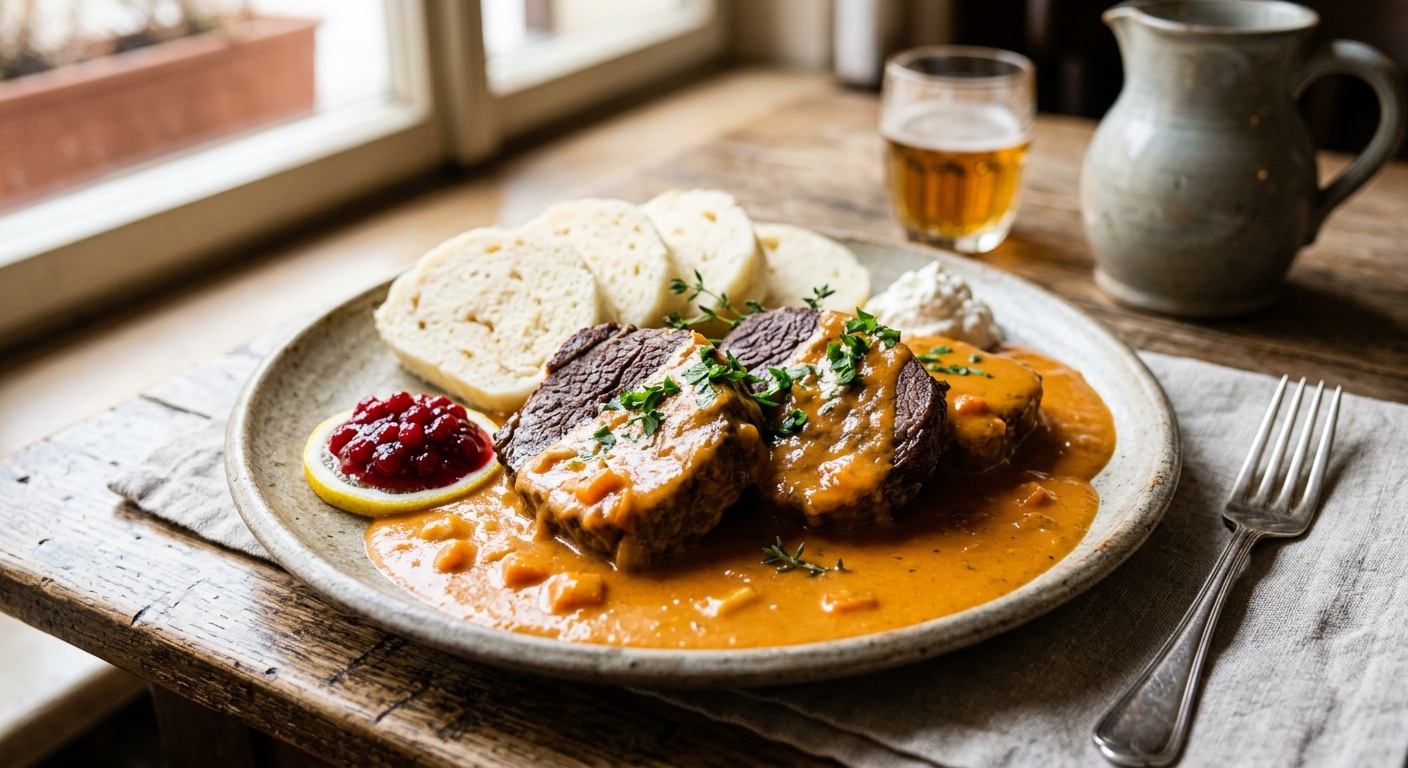
Few dishes in the Central European canon are as deeply nourishing as Czech svickova na smetane, literally ‘sirloin in cream.’ Born from the farmhouse kitchens of Bohemia, this dish was never designed as health food, yet it turns out to be one of the most scientifically compelling meals for musculoskeletal health you can put on a dinner table. Collagen from the beef’s connective tissue, heme iron from the sirloin, glycine and proline from the long braise, vitamin C from the lemon garnish, and a cascade of carotenoids from the carrot, parsnip, and celeriac base: every component earns its place on both culinary and nutritional grounds.
The genius of svickova lies in the braise itself. When beef sirloin is cooked low and slow in an aromatic vegetable mirepoix with bay, allspice, and black pepper, the collagen in the surrounding connective tissue hydrolyses into gelatin, producing a sauce that is literally thickened by bioavailable glycine and hydroxyproline, the exact amino acids your body uses to synthesise new cartilage and strengthen bone matrix. Finishing the sauce with creme fraiche and a splash of lemon juice not only delivers the dish’s signature tangy sweetness but also provides the ascorbic acid that is biochemically required to cross-link collagen fibrils. This is nutritional synergy that pre-dates modern sports medicine by several centuries.
At Calibrated Cuisine we have dialled the recipe to serve four at precisely the quantities needed to deliver meaningful daily value contributions without tipping into excess saturated fat. The root vegetable medley, carrot, parsnip, celeriac, and onion, provides folate, potassium, and a full spectrum of carotenoids, while the beef sirloin brings roughly 36% of your daily iron needs and a complete essential amino acid profile per serving. Whether you choose the stovetop braise, the slow cooker overnight method, the pressure cooker weeknight shortcut, or the oven’s dry radiant heat, you will arrive at a dish that is authentic, technically precise, and calibrated for your long-term health.
4
servings
Ingredients
- 800 gbeef sirloin or topside, sinew left on, cut into 4 thick steaks
- 2 tbspclarified butter (ghee) or Avocado Oil100% Pure Avocado Oil
- 200 gcarrots (approximately 2 medium), peeled and roughly chopped
- 150 gparsnip (approximately 1 large), peeled and roughly chopped
- 200 gceleriac, peeled and cut into 2 cm cubes
- 1 largeyellow onion, roughly chopped
- 3 clovesgarlic, smashed
- 2 tbsptomato paste
- 250 mldry white wine
- 400 mlgood-quality beef stock (low sodium)
- 3 wholebay leaves
- 6 wholeallspice berries
- 8 wholeblack peppercorns
- 4 wholejuniper berries, lightly crushed
- 1 tspcaster sugar
- 150 mlcreme fraiche (full-fat)
- 1 tbspfresh lemon juice, plus wedges to serve
- 1 tspDijon mustard
- 2 tbspunsalted butter, cold, cubed (for finishing)
- —Colima Sea SaltMicroplastic Free Salt and freshly ground black pepper to taste
- —Fresh flat-leaf parsley or chives, finely chopped, to garnish
- —Crusty bread, Czech knedliky bread dumplings, or egg noodles to serve
Instructions
Click on an item below to shop for the recommended items for this recipe on Amazon.
As an Amazon Associate, we earn from qualifying purchases.
- Pat the beef steaks completely dry with paper towels and season generously on all sides with fine sea salt and black pepper. Heat the clarified butter in a wide, heavy Dutch oven (at least 5 litres) over high heat until shimmering and just beginning to smoke. Sear the steaks two at a time, pressing them firmly onto the base, for 3 to 4 minutes per side until a deep mahogany crust forms. Do not move them during searing. Transfer to a plate and set aside.
- Reduce the heat to medium. Add the chopped carrot, parsnip, celeriac, and onion to the same pot without adding extra fat. Cook, stirring occasionally, for 8 to 10 minutes until the vegetables soften and develop golden-brown edges. Add the smashed garlic and cook for a further 1 minute until fragrant. Stir in the tomato paste and cook for 2 minutes, letting it caramelise slightly on the bottom of the pot to deepen colour and flavour.
- Pour in the white wine and use a wooden spoon to scrape up every bit of fond from the base of the pot. Let the wine bubble and reduce by half, about 3 minutes. Add the beef stock, bay leaves, allspice berries, peppercorns, juniper berries, and caster sugar. Stir to combine and bring to a full boil.
- Nestle the seared beef steaks into the pot, submerging them as much as possible in the braising liquid. The liquid should come at least two-thirds of the way up the meat. Reduce the heat to the lowest possible simmer, cover tightly with a lid, and cook for 1 hour 45 minutes to 2 hours, turning the steaks once at the halfway point. The beef is ready when it yields completely to a fork but still holds its shape when lifted.
- Transfer the cooked beef steaks to a warm plate and cover loosely with foil. Remove and discard the bay leaves, allspice berries, peppercorns, and juniper berries. Using an immersion blender (or carefully transferring in batches to a standing blender), puree the vegetable braising liquid until completely smooth. Return the blended sauce to the pot over medium-low heat. Stir in the creme fraiche, lemon juice, and Dijon mustard. Taste and adjust salt, sugar, and lemon. Whisk in the cold butter cubes one at a time until the sauce is glossy and slightly thickened. Reduce gently for 5 minutes if needed. Return the beef to the sauce and warm through for 2 minutes before serving. Garnish with herbs and serve with bread dumplings or noodles.
- The night before or in the morning, pat the beef steaks dry and season well. Heat clarified butter in a large skillet over high heat and sear the steaks in two batches, 3 to 4 minutes per side, until deeply browned. This step cannot be skipped in the slow cooker method because the low cooking temperature will never develop Maillard flavour on its own. Transfer the seared steaks directly into the slow cooker insert.
- Without wiping the skillet, reduce heat to medium and add the chopped carrot, parsnip, celeriac, and onion. Cook for 6 to 7 minutes until lightly softened and tinged golden. Stir in the garlic and tomato paste and cook for 2 minutes more. Deglaze with the white wine, scraping up all the browned bits, and let it reduce by half over 3 minutes. Pour the entire skillet contents over the beef in the slow cooker.
- Pour the beef stock over everything. Add the bay leaves, allspice berries, peppercorns, juniper berries, and caster sugar. The liquid level will appear lower than stovetop because the sealed environment loses very little moisture: this is correct. Place the lid on and cook on Low for 8 hours or on High for 5 hours. Do not lift the lid during cooking, as each peek adds 20 to 30 minutes of recovery time.
- When the beef is fall-tender, carefully lift the steaks out onto a warm plate using a slotted spoon and cover loosely with foil. The braising liquid will be more voluminous than stovetop due to moisture retention. Pour the liquid and vegetables through a fine-mesh strainer into a wide saucepan, discarding the whole spices and bay leaves. Transfer the strained vegetables to a blender with about 100 ml of the braising liquid and blend to a smooth puree. Return the puree and the remaining liquid to the saucepan.
- Set the saucepan over medium heat and bring to a gentle simmer. Stir in the creme fraiche, lemon juice, and Dijon mustard. Because the slow cooker braise produces more liquid, reduce the sauce uncovered for 10 to 15 minutes, stirring occasionally, until it coats the back of a spoon. Whisk in the cold butter cubes for gloss. Taste and adjust seasoning. Slice the beef across the grain and return to the finished sauce. Serve immediately with your choice of accompaniment and a garnish of fresh herbs.
- Set the Instant Pot or stovetop pressure cooker to the Saute function on High (or heat over high heat on the stovetop). Add the clarified butter and, once smoking, sear the seasoned beef steaks in two batches for 3 to 4 minutes per side until a dark crust forms. Because the pressure cooker’s base is smaller than a Dutch oven, be especially careful not to crowd the pan. Transfer seared steaks to a plate.
- Keep the Saute function on medium. Add the carrot, parsnip, celeriac, and onion to the pot and cook for 5 minutes, stirring often as the base is smaller and scorching is more likely. Add garlic and tomato paste and cook for 90 seconds. Pour in the white wine and scrape the base thoroughly: any stuck fond left on the bottom can trigger a burn warning. Reduce the wine by half, about 2 minutes.
- Add the beef stock, bay leaves, allspice, peppercorns, juniper berries, and sugar. Return the beef steaks to the pot, submerging them as much as possible. Cancel the Saute function. Secure the lid and set the pressure valve to Sealing. Cook on High Pressure for 45 minutes.
- Allow the pressure to release naturally for 15 minutes, then carefully move the valve to Venting for a quick release of any remaining pressure. Open the lid and check the beef: it should be very tender and yielding. Transfer the steaks to a warm plate and cover. Remove the whole spices. Use an immersion blender directly in the pressure cooker pot to puree the vegetables and braising liquid until smooth, working carefully around the heating element.
- Set the pot back to Saute on Normal. Stir in the creme fraiche, lemon juice, and Dijon mustard. Simmer the sauce, stirring frequently, for 5 to 8 minutes to concentrate flavour and reduce slightly (the pressure environment retains moisture, so reduction is needed). Whisk in the cold butter cubes off the heat for a glossy finish. Return the beef to the sauce, warm through on the Keep Warm setting for 3 minutes, and serve garnished with fresh herbs.
- Preheat your oven to 160 C (320 F) with a rack positioned in the lower-middle position. Pat the beef steaks dry and season well. Heat the clarified butter in an oven-safe Dutch oven or heavy braising dish over high heat on the stovetop. Sear the steaks in two batches for 3 to 4 minutes per side until a deep, even crust forms. The oven braise rewards patient searing because the lower oven temperature will not compensate for a pale crust. Transfer steaks to a plate.
- Reduce the stovetop heat to medium. Add the carrot, parsnip, celeriac, and onion to the same Dutch oven and cook undisturbed for 4 minutes, then stir and cook for another 4 minutes, allowing the vegetables to caramelise in the beef drippings. Add the garlic and tomato paste, stir well, and cook for 2 minutes. Pour in the white wine, scrape the base clean, and reduce the wine by half.
- Pour in the beef stock and add the bay leaves, allspice, peppercorns, juniper berries, and sugar. Bring the liquid to a boil on the stovetop, then nestle the seared beef steaks into the pot. Cut a circle of parchment paper (cartouche) to fit the interior of the pot and press it directly onto the surface of the liquid and meat: this traps additional moisture at the surface level. Place the tight-fitting lid on top of the parchment.
- Transfer the covered Dutch oven to the preheated oven. Braise at 160 C for 2 hours to 2 hours 30 minutes without opening the lid. At the 2-hour mark, check the beef by inserting a fork: it should slide in with very little resistance. If the meat still has firmness, return it for a further 20 minutes. The sealed, even oven heat yields an exceptionally gelatinous, golden braising liquid.
- Remove the Dutch oven from the oven and let it rest, lid on, for 10 minutes. Transfer the beef steaks to a warm plate. Discard the whole spices and bay leaves. Use an immersion blender to puree the vegetables and braising liquid directly in the Dutch oven until silky smooth. Return the pot to the stovetop over medium-low heat. Stir in the creme fraiche, lemon juice, and Dijon mustard, then reduce gently for 5 minutes. Whisk in the cold butter cubes off the heat until the sauce is glossy and coats a spoon beautifully. Return the beef, warm through, and serve with garnish.
Nutrition Breakdown
Per 1 serving (makes 4)
Vitamins & Minerals
% Daily Value based on a 2,000 calorie diet (FDA reference)
🧬 Essential Amino Acids
% of recommended daily intake (RDA) per serving
🛡 Antioxidant Profile
The Nutrition Science
The bone-and-joint credentials of svickova rest on a cascade of biochemical interactions that begin with collagen hydrolysis. Beef sirloin, especially when the sinew and connective tissue remain intact during a long braise, contains roughly 22 to 25% collagen by dry weight of those connective tissues. At temperatures between 70 C and 90 C sustained over one or more hours, the triple-helical collagen structure denatures irreversibly into gelatin, releasing free glycine (approximately 330mg per gram of collagen) and hydroxyproline, the two amino acids that serve as direct precursors for endogenous collagen synthesis in chondrocytes and osteoblasts. Consuming these pre-formed precursors from dietary collagen has been shown in randomised controlled trials to reduce joint pain scores in athletes and increase collagen density in cartilage biopsies over 24-week supplementation periods. Whole-food braises like svickova deliver these peptides in a food matrix that also includes glycosaminoglycan precursors from the sauce gelatin, making them potentially more bioavailable than isolated hydrolysed collagen powders.
The heme iron content of beef sirloin, approximately 2.2mg per 100g, is absorbed at 15 to 35% efficiency compared to 2 to 8% for non-heme iron from plant sources. This makes a 200g serving of sirloin one of the most efficient dietary iron delivery mechanisms available, particularly relevant for connective tissue health because iron is a required cofactor for lysyl oxidase, the enzyme that cross-links both collagen and elastin into functional fibres. Zinc, present at 7.8mg per serving (71% DV), co-activates matrix metalloproteinases that remodel cartilage after exercise, while selenium at 51% DV supports the glutathione peroxidase antioxidant pathway that protects chondrocytes from hydrogen peroxide generated during joint loading.
The root vegetable mirepoix contributes more than flavour. Carrots deliver approximately 4.8mg of beta-carotene per serving, which the intestinal mucosa cleaves into retinal and retinoic acid, both of which regulate the transcription of collagen type II genes in cartilage. Celeriac and parsnip provide inulin-type fructans that selectively feed Bifidobacterium species in the colon, and emerging research links a diverse gut microbiome to lower systemic inflammation as measured by circulating IL-6 and TNF-alpha, two cytokines that directly degrade articular cartilage in conditions like osteoarthritis. The lemon juice garnish is not merely decorative: its ascorbic acid is a stoichiometrically required substrate for prolyl-4-hydroxylase, the enzyme that hydroxylates proline residues in nascent collagen chains, without which collagen triple helices cannot fold correctly and are degraded intracellularly before secretion.
Pro Tips
- Do not trim the sinew or silverskin from the beef before cooking. It is the structural collagen that, once hydrolysed, thickens the sauce naturally and provides the joint-supportive gelatin peptides central to this recipe’s nutritional mission.
- The sauce must be pureed completely smooth before adding the creme fraiche: adding dairy to a warm but unpureed vegetable braise risks curdling because the pH fluctuates around the starch-rich vegetable solids. A smooth, stable emulsion accepts the cream reliably.
- For the deepest colour and most complex flavour, allow the tomato paste to ‘toast’ in the dry pan for a full 2 minutes before adding any liquid. The Maillard reactions that occur in concentrated tomato solids at this stage add umami depth that distinguishes an authentic svickova from a bland beef stew.
- Leftover svickova sauce freezes exceptionally well and actually improves as the gelatin molecules re-aggregate during freezing and thawing, producing an even silkier texture on reheating. Freeze sauce separately from the beef for best results.
- To maximise vitamin C availability (critical for collagen synthesis), add the lemon juice after the sauce has come off the boil rather than simmering it. Ascorbic acid is highly heat-labile and loses significant potency after 5 minutes above 80 C.


Great question on the root vegetable composition, Anna – I’d be really curious about the exact glycemic load breakdown since root veg density varies wildly. Parsnips hit around 17g net carbs per 100g while carrots are closer to 7g, so the sauce ratio matters a lot for CGM response. I’ve found that celery root actually gives you the joint-support collagen benefits without the carb spike, so if the recipe includes it, that’s a smart move for anyone tracking metabolic markers during recovery.
I love the specificity here, Ben, and you’re absolutely right about celery root being that quiet powerhouse – it’s actually prized in Ayurvedic cooking for supporting joint mobility and circulation without that glycemic load you’re describing. I’d add though that the real magic of a dish like svickova might be less about carb counting and more about the slow braising process itself, which breaks down collagen into gelatin and makes those minerals, including iron, way more bioavailable to our bodies. The root vegetables’ natural sweetness and beta-carotene actually support the absorption of that iron too, so they’re working together nutritionally rather than against each other. Have you noticed if your CGM
This sounds absolutely wonderful, and I’m so curious about the root vegetables in the cream sauce – are parsnips and carrots the base, or does the recipe include anything like celery root? I’ve been rebuilding my joint support after my Hashimoto’s diagnosis, and slow-braised beef with that kind of gelatin-rich cooking has been genuinely transformative for my gut lining. One question though: do you happen to know the iodine content, or is this something that uses minimal added salt? I’m always trying to balance iron absorption with keeping my thyroid support steady, and I’d love to know if this is something I could make regularly without worrying about iodine fluctuations.