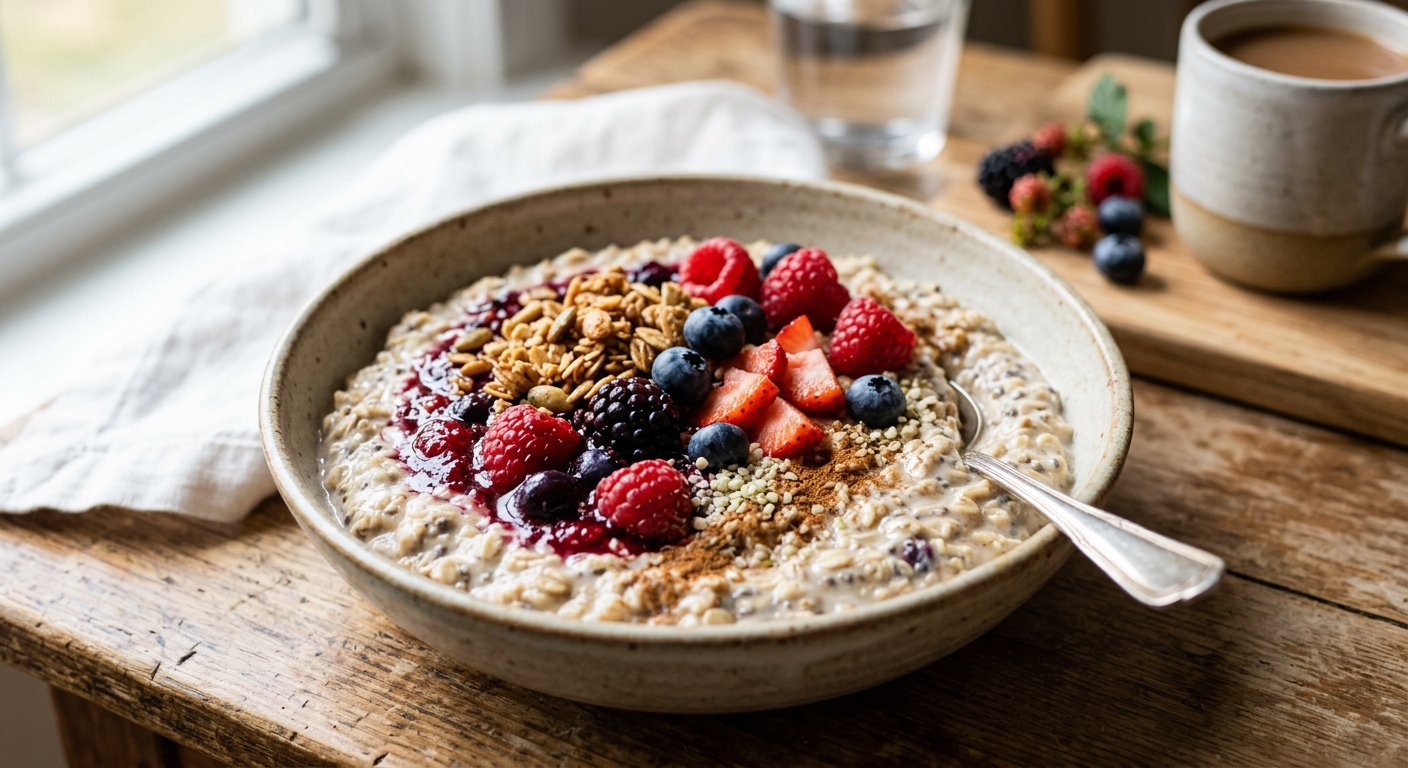
Most overnight oats recipes are pleasant but nutritionally passive, relying on oats alone to carry the metabolic load. This version is different. By adding one tablespoon of psyllium husk powder per serving, you transform a simple breakfast into a clinically meaningful fiber intervention. Psyllium husk is one of the most concentrated sources of soluble fiber on the planet, and when it hydrates overnight alongside rolled oats and chia seeds, it forms a thick, viscous gel that physically slows the rate at which your digestive enzymes can reach carbohydrate molecules. The practical result: a dramatically flatter post-meal blood glucose curve and a satiety signal that lasts well past your morning coffee.
The flavor story here is just as compelling as the science. We lean into warming spices, namely cinnamon and cardamom, that carry their own evidence base for insulin sensitivity. Ripe banana provides natural sweetness and potassium without added sugar, while a base of unsweetened oat milk keeps the dish completely dairy-free. A crown of sliced strawberries, a drizzle of almond butter, and a scatter of pumpkin seeds at serving time adds textural contrast and a second wave of nutrients, pushing the dish past 40% DV for both magnesium and manganese in a single bowl.
Although this recipe has “overnight” in the name, we have developed three hot preparation methods alongside the cold-soak base, because some mornings call for something warm and deeply comforting. The stovetop version cooks in under fifteen minutes and produces a porridge-style bowl. The slow cooker method works on a timer overnight while you sleep, filling your kitchen with cardamom-scented steam by morning. The pressure cooker version is the weekday workhorse, delivering a fully cooked, fiber-rich bowl in under ten minutes of active time. All three methods begin with the same ingredient list and produce the same outstanding nutrition panel.
4
servings
Ingredients
- 320 gold-fashioned rolled oats (not instant)
- 4 tbsppsyllium husk powder
- 4 tbspchia seeds
- 2 tspground cinnamon
- 0.5 tspground cardamom
- 0.25 tspColima Sea SaltMicroplastic Free Salt
- 960 mlunsweetened oat milk
- 240 mlcold water
- 2 largeripe bananas, mashed
- 2 tbsppure maple syrup
- 1 tsppure vanilla extract
- 200 gfresh strawberries, hulled and sliced
- 4 tbspnatural almond butter (no added sugar)
- 4 tbspraw pumpkin seeds (pepitas)
- —Extra oat milk for loosening texture at serving, if desired
Instructions
Click on an item below to shop for the recommended items for this recipe on Amazon.
As an Amazon Associate, we earn from qualifying purchases.
- Combine the rolled oats, cinnamon, cardamom, and salt in a heavy-bottomed medium saucepan. Toast over medium heat for 2 to 3 minutes, stirring constantly, until the oats smell lightly nutty and the spices are fragrant. This dry-toasting step deepens flavor and helps the oats cook more evenly.
- Pour in the oat milk and water all at once and stir immediately to prevent any oat clumps from forming on the hot pan base. Add the mashed banana and maple syrup. Bring the mixture to a gentle simmer over medium heat, stirring every 30 seconds, about 4 to 5 minutes.
- Reduce the heat to medium-low. Sprinkle the psyllium husk powder over the surface of the oats in a thin, even layer and stir vigorously for 30 seconds before it can clump. Add the chia seeds and stir again. The mixture will begin thickening noticeably within 1 to 2 minutes.
- Continue cooking at a gentle simmer, stirring every 60 seconds and scraping the base of the pan, for 6 to 8 more minutes, until the porridge reaches a thick, creamy consistency that falls slowly from the spoon. If it thickens faster than expected, add oat milk in 60 ml increments.
- Remove from heat and stir in the vanilla extract. Let the porridge rest in the pan for 2 minutes, during which it will thicken a little further. Divide into four bowls and immediately top each with one quarter of the sliced strawberries, one tablespoon of almond butter, and one tablespoon of pumpkin seeds. Serve hot.
- Lightly grease the insert of a 4-quart or larger slow cooker with a small amount of coconut oil or cooking spray. This prevents the psyllium-thickened mixture from sticking and makes cleanup dramatically easier.
- Add the steel-cut oats (substituted 1:1 by weight for rolled oats), cinnamon, cardamom, salt, mashed banana, and maple syrup directly to the greased insert. Pour in the oat milk and water and stir everything together well. Do not add the psyllium husk or chia seeds yet as they will over-gel and create a gummy texture during the long cook.
- Place the lid on the slow cooker, set it to Low, and cook for 7 to 8 hours. If your slow cooker runs hot, check at the 6-hour mark. The oats are done when they are fully tender and have absorbed most of the liquid, with a creamy, porridge-like consistency.
- Switch the slow cooker to Warm. Remove the lid and sprinkle the psyllium husk powder evenly over the surface of the cooked oats. Stir vigorously for 60 seconds to distribute the psyllium completely, then immediately add the chia seeds and vanilla extract and stir again. Replace the lid and let the mixture rest on Warm for 10 minutes. The residual heat will activate the psyllium gel and the chia seeds will swell, thickening the porridge to the correct consistency.
- Stir once more before serving. If the porridge is thicker than you prefer after resting, stir in 60 to 120 ml of warm oat milk. Ladle into four bowls and top each with sliced strawberries, one tablespoon of almond butter, and one tablespoon of pumpkin seeds.
- Add the rolled oats, cinnamon, cardamom, salt, mashed banana, and maple syrup to the pressure cooker inner pot. Pour in the oat milk and water. Stir briefly to combine. Do not add psyllium husk or chia seeds before pressurizing, as their gel-forming properties will cause a thick foam that can block the pressure release valve.
- Secure the lid and set the pressure release valve to Sealing. Cook on Manual High Pressure for 5 minutes. While the cooker comes to pressure (about 8 to 10 minutes), use the time to prepare your toppings: slice the strawberries and set out the almond butter and pumpkin seeds.
- Once the 5-minute cook time completes, allow the pressure to release naturally for 5 minutes, then carefully turn the valve to Venting to release any remaining steam. Open the lid away from you. The oats will look slightly loose at this stage, which is intentional.
- Switch the Instant Pot to the Saute function on Low (or Keep Warm if Saute runs too hot on your model). Sprinkle the psyllium husk powder over the oats in a thin layer and stir rapidly and continuously for 90 seconds until fully incorporated with no dry streaks. Add the chia seeds and vanilla extract and stir for another 30 seconds. Turn off the Saute function and let the oats rest uncovered for 3 minutes. The psyllium and chia will thicken the oats to a creamy, spoonable consistency without any further heat.
- Stir once more, taste for sweetness, and add a touch more maple syrup if desired. Divide into four bowls and top with sliced strawberries, almond butter, and pumpkin seeds. Serve immediately while hot.
- Preheat your oven to 180 degrees Celsius (350 degrees Fahrenheit). Lightly grease a 9×13 inch (23×33 cm) ceramic or glass baking dish with coconut oil or cooking spray and set aside.
- In a large mixing bowl, whisk together the oat milk, water, mashed banana, maple syrup, and vanilla extract until smooth. Add the psyllium husk powder and whisk immediately and vigorously for 60 seconds until completely dissolved, because psyllium gels within seconds of contact with liquid. You will notice the liquid thicken slightly to a pourable but viscous consistency.
- Add the rolled oats, chia seeds, cinnamon, cardamom, and salt to the bowl with the liquid mixture. Fold everything together with a spatula until the oats are fully coated. The mixture should be the consistency of a thick batter. Let it rest for 5 minutes so the psyllium and chia can begin absorbing liquid. Stir once more and pour into the prepared baking dish, spreading it into an even layer.
- Arrange the sliced strawberries in a single decorative layer over the top of the oat mixture, pressing them gently into the surface. Transfer to the preheated oven and bake uncovered for 40 to 45 minutes, until the top is golden brown at the edges and the center is set and does not jiggle when you shake the dish gently.
- Remove from the oven and let the baked oatmeal cool in the dish for at least 10 minutes before cutting. This resting period is important: the psyllium gel continues to set as it cools, and cutting too early will cause the pieces to crumble. Cut into 4 equal portions. Plate each portion and finish with one tablespoon of almond butter drizzled over the top and one tablespoon of pumpkin seeds scattered across the surface.
Nutrition Breakdown
Per 1 serving (makes 4)
Vitamins & Minerals
% Daily Value based on a 2,000 calorie diet (FDA reference)
🧬 Essential Amino Acids
% of recommended daily intake (RDA) per serving
🛡 Antioxidant Profile
The Nutrition Science
The central mechanism behind this recipe’s metabolic benefit is the formation of a viscous soluble fiber gel in the gastrointestinal tract. Psyllium husk is approximately 70% soluble fiber, and its primary polysaccharide, arabinoxylan, absorbs water at a ratio of up to 1:40 by weight, creating a thick, stable gel that coats the intestinal lining. This gel acts as a physical diffusion barrier between digestive enzymes and dietary carbohydrates, meaningfully reducing the rate of glucose absorption into the bloodstream. Clinical trials using just 5 to 10 grams of psyllium per day (this recipe provides approximately 7 grams per serving) have demonstrated reductions in postprandial blood glucose area-under-the-curve of 20 to 30 percent in both healthy individuals and those with type 2 diabetes. Importantly, psyllium does not merely delay glucose absorption; it also reduces peak insulin secretion, which has downstream benefits for insulin sensitivity over time.
Oats contribute a second and distinct soluble fiber: beta-glucan, a linear polysaccharide found in the oat cell wall. Beta-glucan’s viscosity-building properties are well established in the scientific literature, and the FDA has recognised that 3 grams of oat beta-glucan per day may reduce the risk of heart disease. One serving of this recipe provides approximately 3.2 grams of beta-glucan from the rolled oats alone. The combination of psyllium and beta-glucan creates a synergistic fiber matrix that is considerably more effective than either fiber source in isolation, because the two polysaccharides form interacting gels with different viscosity profiles, maintaining thickness across a broader range of digestive pH and enzyme concentrations.
Cinnamon adds a third evidence-based metabolic intervention. Its primary bioactive compound, cinnamaldehyde, along with procyanidin polyphenols, has been shown in multiple randomised controlled trials to improve insulin receptor signalling by activating glucose transporter type 4 (GLUT4) translocation to cell membranes, enhancing peripheral glucose uptake. The two teaspoons used in this recipe provide a meaningful but safe daily dose. Chia seeds contribute additional alpha-linolenic acid (ALA omega-3), which supports the anti-inflammatory environment needed for optimal insulin receptor function, as well as additional soluble fiber in the form of mucilage, further reinforcing the gel matrix already established by psyllium and beta-glucan.
Pro Tips
- Always whisk psyllium husk powder into liquid before combining it with dry oats. Psyllium gels within seconds of contacting liquid, and adding it directly to dry oats without pre-mixing causes it to form dense, unmixed lumps that will not dissolve during cooking.
- Banana ripeness matters significantly for both flavor and blood sugar: a banana with brown spots is sweeter and higher in simple sugars (faster glucose) while a just-ripe yellow banana has more resistant starch (slower glucose). Choose based on your metabolic goals, using a speckled banana for flavor or a firmer yellow banana for a lower glycemic load.
- Pumpkin seeds should always be added at serving time, never cooked in. Their zinc and magnesium content is best preserved raw, and their healthy unsaturated fats can oxidise and develop a bitter flavor at sustained cooking temperatures. Store leftover cooked oats without toppings in airtight containers in the refrigerator for up to four days, and add fresh toppings each morning.

Great question, Remy! Soaking does preserve some heat-sensitive enzymes, but here’s the nuance: that enzyme activity matters way less for blood sugar control than the actual fiber gel formation you’re asking about. Both raw soaked and cooked oats will hydrate and create that viscous matrix with psyllium and chia, which is what actually slows glucose absorption. The real difference is that cooked oats gelatinize the starch more completely, making it slightly less accessible to your digestive enzymes initially, which can actually be a *plus* for glucose stability. Raw soaked oats stay more structurally intact, so they digest a bit faster. Either way, you’re
This is such a practical breakdown, Pete. I’ve actually noticed this distinction in my own quarterly labs over the past two years, where my fasting glucose and post-prandial response improved more noticeably when I shifted to cooked oats versus raw soaked, even though I was getting the same total fiber load. My functional medicine doc mentioned that the gelatinization you’re referencing creates a physical barrier that genuinely slows down amylase activity, which tracks with what you’re saying about starch accessibility. The enzyme preservation angle is interesting nutritionally, but yeah, for someone specifically managing blood sugar like I am, the glucose stability win from cooked oats with viscous fiber seems to outweigh the
tbh im curious how much the fiber content changes if you use raw oats soaked overnight vs cooked – like does soaking them raw preserve more enzyme activity while still getting that gel effect from the psyllium and chia? ive been experimenting with sprouted oat groats in mine and theyre way easier to digest, though i wonder if youre losing any of that blood sugar stabilizing viscosity that comes from the beta-glucans breaking down during cooking. have you tested glucose response on both versions?