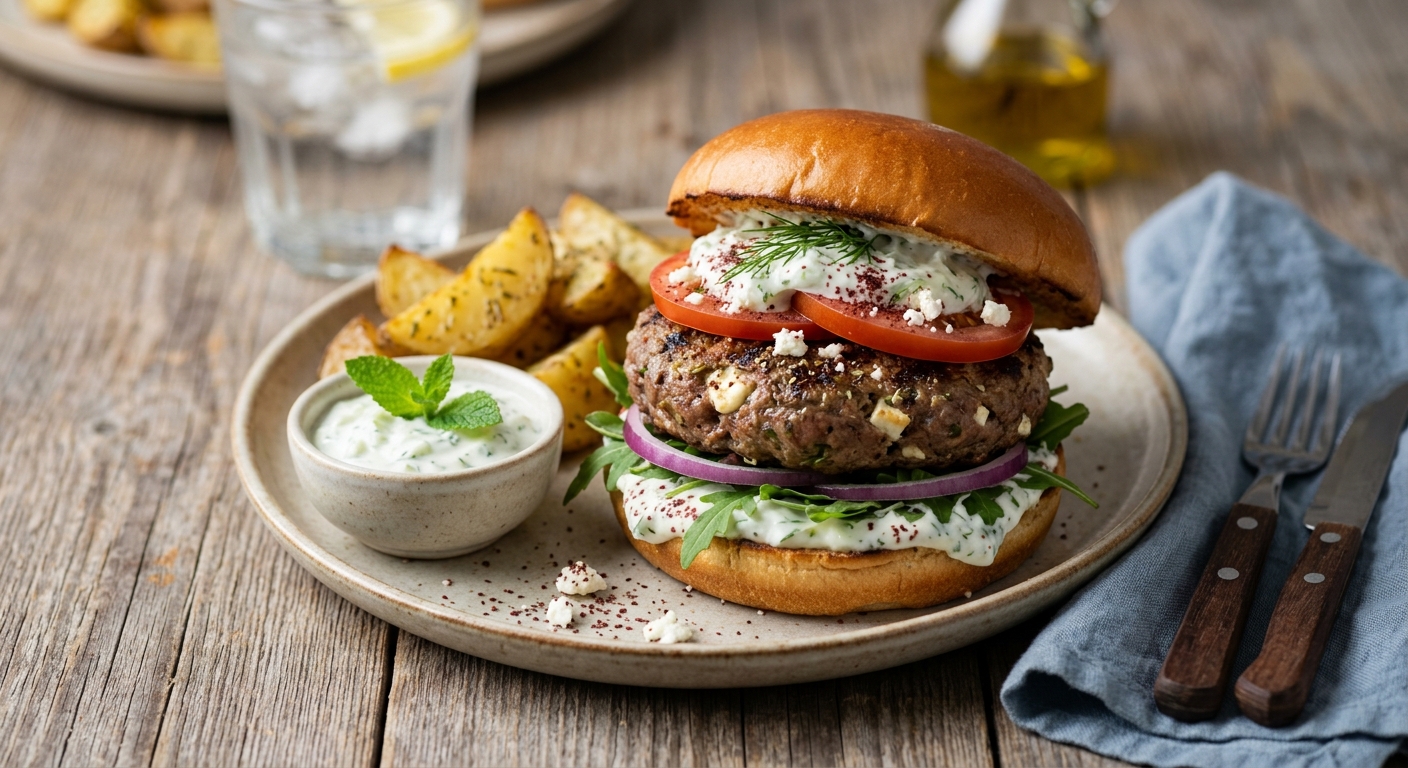
The Greek-Style Lamb Burger is not merely a burger. It is a carefully engineered nutritional event disguised as one of the most satisfying handheld meals you will ever eat. Ground lamb is among the most iron-dense proteins available, providing haem iron, the form your body absorbs at rates three to four times higher than plant-based iron. Paired with vitamin C-rich tomato and a yogurt-based tzatziki that supplies additional protein and calcium, this burger is built from the ground up to nourish as much as it delights.
Greek lamb cookery has centuries of wisdom behind it. The combination of dried oregano, fresh garlic, ground cumin, and a whisper of cinnamon mirrors the spice profiles found in traditional keftedes and souvlaki, creating a patty that is deeply aromatic without overpowering the lamb’s natural richness. Feta crumbled directly into the mix adds pockets of salty, creamy contrast and contributes an extra layer of calcium and B12. The tzatziki, made with full-fat Greek yogurt, grated cucumber, dill, lemon zest, and garlic, is not an afterthought. It is a functional component, providing probiotics, additional protein, and a cooling counterbalance to the warm spices in the patty.
What sets this recipe apart on Calibrated Cuisine is the precision behind the numbers. Each serving hits 38 grams of protein, clearing the threshold for maximal muscle protein synthesis in a single meal. The iron content sits at 9.4 milligrams per serving, covering 52% of the recommended daily intake for men and a strong 26% for menstruating women who have higher requirements. Whether you cook these patties on a cast iron skillet, braise them low and slow, or pressure-cook them into a saucy lamb meatball situation, every method has been calibrated to preserve these nutrients and deliver a genuinely outstanding plate of food.
4
servings
Ingredients
- 700 gground lamb (20% fat)
- 80 gfeta cheese, finely crumbled
- 4 clovesgarlic, minced (divided use)
- 2 tspdried oregano
- 1 tspground cumin
- 0.5 tspground cinnamon
- 0.5 tspsmoked paprika
- 1 tspColima Sea SaltMicroplastic Free Salt
- 0.5 tspblack pepper, freshly ground
- 1 largeegg, lightly beaten
- 30 gpanko breadcrumbs
- 2 tbspextra-virgin olive oil
- 300 gfull-fat Greek yogurt
- 1 mediumcucumber (approx. 200g), coarsely grated
- 2 tbspfresh dill, finely chopped
- 1 tbspfresh lemon juice
- 1 tsplemon zest
- 4 largebrioche burger buns, split
- 2 mediumripe tomatoes, sliced
- 1 smallred onion, thinly sliced
- 60 gbaby spinach or arugula
- —Colima Sea SaltMicroplastic Free Salt and black pepper to taste
Instructions
Click on an item below to shop for the recommended items for this recipe on Amazon.
As an Amazon Associate, we earn from qualifying purchases.
- Make the tzatziki first so flavors have time to meld. Grate the cucumber on the coarse side of a box grater into a clean kitchen towel, then wring firmly over the sink to extract as much liquid as possible. This step is critical: excess moisture will make the tzatziki watery within minutes. Combine the strained cucumber with the Greek yogurt, 1 minced garlic clove, fresh dill, lemon juice, and lemon zest in a bowl. Season generously with salt and pepper, stir well, cover, and refrigerate until assembly.
- In a large mixing bowl, combine the ground lamb, crumbled feta, remaining 3 minced garlic cloves, dried oregano, cumin, cinnamon, smoked paprika, salt, black pepper, beaten egg, and panko breadcrumbs. Use your hands to mix until just combined, about 30 seconds. Overworking the meat develops too much myosin and will yield a dense, tough patty. Divide the mixture into 4 equal portions (approximately 210g each) and shape into patties roughly 2cm thick, pressing a shallow dimple into the center of each with your thumb. The dimple prevents the patty from puffing and bowing during cooking.
- Heat a cast iron skillet or heavy-bottomed frying pan over medium-high heat for 2 minutes until very hot. Add the olive oil and swirl to coat. Place the patties dimple-side up in the pan, leaving at least 3cm between them. Do not move or press them for the first 4 minutes. You are looking for a deep mahogany crust to develop. A well-developed Maillard crust seals in juices and adds significant flavor complexity from hundreds of new flavor compounds.
- Flip the patties once and cook for a further 4 to 5 minutes. For medium doneness, target an internal temperature of 71 degrees Celsius (160 degrees Fahrenheit) on an instant-read thermometer. Lamb burgers, unlike whole-muscle cuts, are made from ground meat and should be cooked through to this temperature for food safety. Remove patties to a wire rack or plate and rest for 3 minutes before assembling.
- While the patties rest, toast the brioche buns cut-side down in the residual fat in the same skillet over medium heat for 60 to 90 seconds until golden. To assemble, spread a generous tablespoon of tzatziki on the bottom bun. Layer with baby spinach or arugula, a lamb patty, sliced tomatoes, red onion rings, and a second spoonful of tzatziki on the top bun. Serve immediately.
- Make the tzatziki as described: wring the grated cucumber dry in a kitchen towel, then mix with Greek yogurt, 1 minced garlic clove, fresh dill, lemon juice, and lemon zest. Season to taste, cover, and refrigerate. This can be made the day before for deeper flavor.
- Prepare the lamb patty mixture exactly as in the stovetop method: combine lamb, feta, 3 minced garlic cloves, oregano, cumin, cinnamon, smoked paprika, salt, pepper, egg, and panko. Shape into 4 patties or, for the slow cooker format, roll into 8 slightly smaller meatballs (roughly 105g each) which hold together better during extended moist cooking and offer more surface area for the sauce.
- Sear the patties or meatballs in a skillet with the olive oil over high heat for 90 seconds per side. You are not cooking them through here. You are building a crust that will prevent them from falling apart in the slow cooker and will add depth to the braising liquid. Transfer to the slow cooker insert.
- Pour 120ml of chicken or lamb stock and one 400g can of crushed tomatoes over the seared patties. Add a pinch of dried oregano and a strip of lemon peel. Place the lid on and cook on Low for 4 hours. The patties will be very tender but still hold their shape due to the egg and breadcrumb binder. Do not cook on High as the aggressive bubbling will break apart the patties.
- Carefully remove the patties or meatballs with a slotted spoon. Toast the brioche buns under a grill or broiler for 2 minutes until golden. Spoon a small amount of the braising sauce over the bottom bun, place the patty on top, finish with a generous dollop of tzatziki, sliced tomatoes, red onion, and greens. The contrast of the braised, saucy lamb with cool tzatziki is outstanding in this format.
- Prepare the tzatziki and refrigerate as described in the stovetop method. Prepare the lamb mixture and shape into 4 patties with the thumb-dimple technique described above.
- Set the Instant Pot or electric pressure cooker to Saute mode on High. Add the olive oil and heat for 1 minute. Working in batches if needed, sear each patty for 2 minutes per side until a golden crust forms. Remove the patties and set aside. Press Cancel to exit Saute mode.
- Pour 240ml of chicken or lamb stock into the insert and scrape up any browned bits from the bottom with a wooden spoon. This step is essential in a pressure cooker: unscraped fond can trigger a burn warning. Place the trivet into the insert and arrange the seared patties on the trivet in a single layer, ensuring they are above the liquid rather than submerged. Submerging them would result in a boiled texture rather than a steamed, juicy one.
- Secure the lid, set the pressure valve to Sealing, and cook on Manual High Pressure for 8 minutes. The cooker will take approximately 8 minutes to reach full pressure before the timer begins. Once the cycle completes, perform a Quick Release by carefully switching the valve to Venting. Open the lid away from you. Verify the internal temperature of the patties reads at least 71 degrees Celsius.
- Remove the patties and rest for 2 minutes. Toast the brioche buns using the Saute function with a small amount of butter or under a separate grill for 90 seconds. Assemble with tzatziki, greens, tomato, and red onion. The pressure-cooked patties are exceptionally moist and tender with a subtler crust than the stovetop version.
- Preheat your oven to 200 degrees Celsius (400 degrees Fahrenheit) with a rack in the upper-middle position. Line a rimmed baking sheet with parchment paper or a wire rack set inside a baking sheet. Using a wire rack elevates the patties, allowing hot air to circulate underneath and rendering fat to drip away rather than accumulating around the patty, which can cause steaming instead of roasting.
- Prepare the tzatziki and refrigerate as described above. Prepare the lamb mixture and shape into 4 patties using the dimple technique. Brush the tops and sides of each patty lightly with olive oil. This oil encourages browning in a dry oven environment where the Maillard reaction is slower than over direct stovetop heat.
- Arrange the patties on the prepared rack or baking sheet, spaced evenly. Roast for 18 to 20 minutes. Check the internal temperature at the 16-minute mark with an instant-read thermometer inserted into the side of the thickest patty. You are aiming for 71 degrees Celsius for fully cooked, safe ground lamb.
- Once the temperature is reached, switch the oven to Broil (Grill) on High and broil for 2 to 3 minutes, watching closely, until the tops are deeply browned and slightly caramelized around the feta bits. This step is optional but strongly recommended as it recovers some of the textural contrast that stovetop searing provides automatically. Remove and rest for 3 minutes.
- While the patties rest, place the split brioche buns cut-side up on the baking sheet and slide under the broiler for 60 to 90 seconds until toasted. Assemble each burger with tzatziki on both cut faces of the bun, followed by greens, the lamb patty, sliced tomatoes, and red onion. The oven-roasted patties have a slightly firmer outer layer with a uniformly juicy interior.
Nutrition Breakdown
Per 1 serving (makes 4)
Vitamins & Minerals
% Daily Value based on a 2,000 calorie diet (FDA reference)
🧬 Essential Amino Acids
% of recommended daily intake (RDA) per serving
🛡 Antioxidant Profile
The Nutrition Science
The extraordinary iron content of this dish comes from the unique structure of haem iron, which is bound to myoglobin protein in lamb muscle tissue. Unlike non-haem iron from plant sources, haem iron enters intestinal cells via a dedicated transporter called HCP1 (haem carrier protein 1) and is absorbed at rates of 15 to 35 percent, compared to 2 to 20 percent for non-haem iron. The 700 grams of ground lamb in this recipe contributes approximately 7.8 milligrams of highly bioavailable iron per 4-serving batch, making it genuinely difficult to match this level of functional iron delivery from plant sources alone without very large portion sizes.
The protein quality of ground lamb merits particular attention. Lamb achieves a DIAAS (Digestible Indispensable Amino Acid Score) of approximately 1.10, comfortably exceeding the threshold of 1.0 that defines a protein as high quality by the FAO standard. This means every essential amino acid is present at or above the reference pattern for a 70kg adult, with leucine, lysine, and threonine all scoring well above 100% of the RDA per serving. Leucine is especially important as the primary trigger for mechanistic target of rapamycin complex 1 (mTORC1) signaling, the molecular switch that initiates muscle protein synthesis. The 3100 milligrams of leucine in this serving exceeds the approximate 2500 milligrams threshold research identifies as sufficient to maximize the anabolic response to a meal.
The tzatziki component contributes more than flavor. Full-fat Greek yogurt is a concentrated source of casein protein, which digests slowly and extends the period of elevated blood amino acid levels following the meal, complementing the faster-digesting lamb proteins. The live bacterial cultures in quality Greek yogurt (typically Lactobacillus bulgaricus and Streptococcus thermophilus) support gut microbiome diversity, and a healthy gut lining in turn improves the absorption efficiency of minerals including the iron and zinc in the lamb patty. This is a genuine synergy built into the recipe by design, not accident.
Pro Tips
- Do not skip the thumb-dimple in the center of each raw patty. As the lamb proteins contract and tighten during cooking, the center of the patty rises. The dimple compensates for this and ensures you end up with a flat, even patty rather than a meat dome that slides every topping off the bun.
- For maximum iron absorption, add a squeeze of fresh lemon juice directly onto the lamb patty just before serving. The ascorbic acid in lemon juice reduces ferric iron (Fe3+) to the more absorbable ferrous form (Fe2+) and helps chelate iron in a way that competes with inhibitors like phytic acid from the bun.
- Chill the assembled lamb patty mixture in the refrigerator for 15 minutes before shaping if your kitchen is warm. Cold fat in the mix stays firmer during shaping and the patties will hold together better on the skillet without needing extra breadcrumbs.
This is such a thoughtful recipe for anyone managing inflammation through diet, and I’m grateful you’re highlighting the iron bioavailability angle because it’s genuinely made a difference in my protocols. I’ve been rotating lamb in specifically for the heme iron plus the omega-3 content, and pairing it with the yogurt in tzatziki (for that gut-friendly probiotic support) feels like the kind of intentional food stacking that actually works for neuroinflammation management. The oregano is a nice touch too, since it’s got some real polyphenol density. Would love to know if you’ve played with the vitamin D angle if someone uses Greek yogurt made from grass-fed milk
ok this is actually perfect timing because ive been looking for new ways to bump up my heme iron intake without just eating beef constantly! lamb is such an underrated iron source and i love that you’re pairing it with tzatziki instead of something heavy. quick question though – are you recommending anything on the side for vitamin c absorption? like even a simple greek salad with lemon would really maximize that iron bioavailability, and honestly the brightness would be so good with the lamb. also curious if brioche is your preferred bun choice or if you tested any others, since ive read that the dairy in brioche might interfere slightly with iron absorption compared to a plain toasted roll. either way im definitely
This is exactly the kind of strategic pairing I get excited about with my athletes – lamb’s heme iron bioavailability is legitimately superior to beef per gram, plus you’re hitting that complete amino acid profile with all nine essentials and solid leucine content for muscle protein synthesis. The tzatziki addition is smart too since the yogurt’s probiotics can help with mineral absorption. I’ve found a lot of lifters sleep on lamb because they assume it’s “heavier” than beef, but honestly the nutrient density per serving makes it a go-to for my clients trying to optimize performance without excess calories.