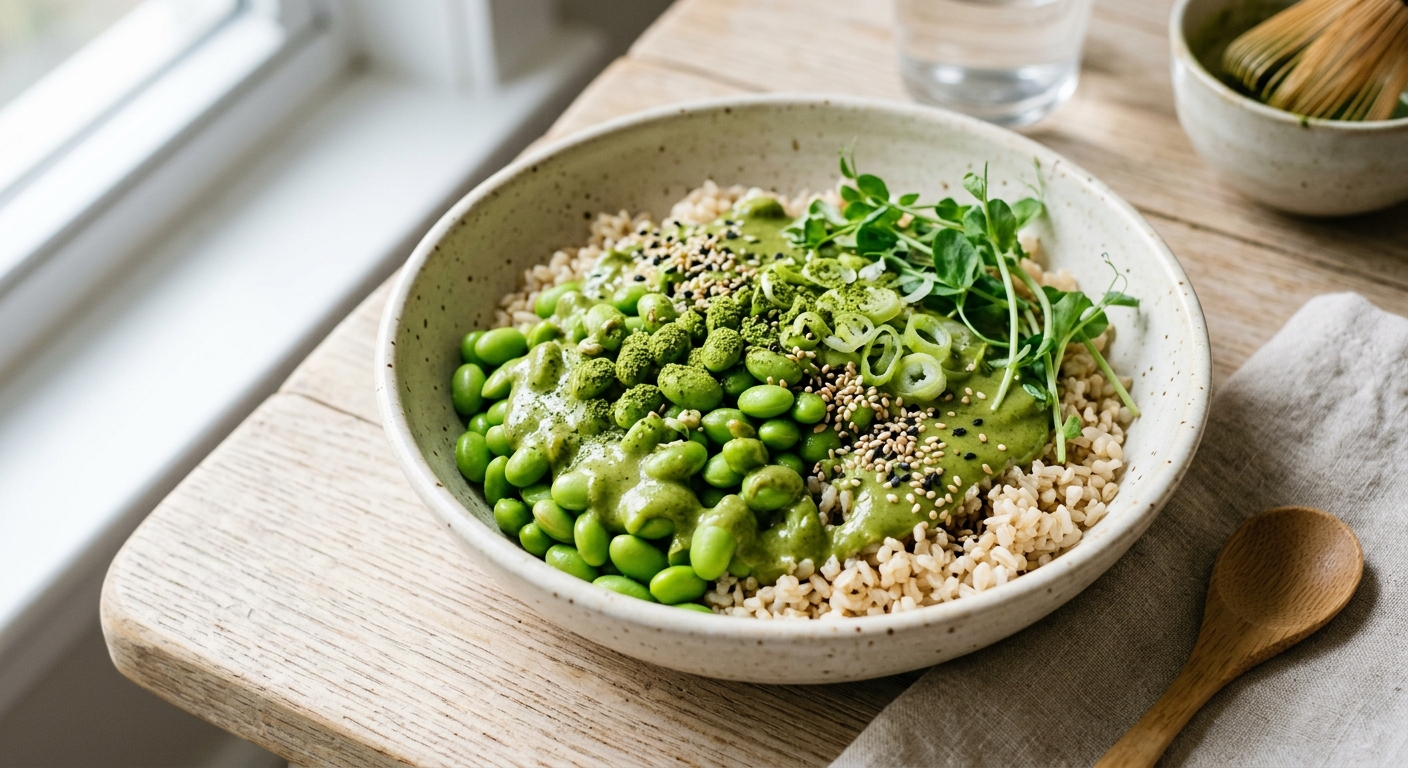
This bowl was engineered from the ground up as an anti-inflammatory powerhouse, not retrofitted with a wellness label after the fact. Every ingredient was chosen for a specific biochemical role: matcha contributes epigallocatechin gallate (EGCG), the most studied catechin in human nutrition, with one teaspoon of ceremonial-grade powder delivering roughly 70 to 140 mg of this compound alone. Edamame brings complete protein, folate, and soy isoflavones. Brown rice provides slow-release carbohydrates, magnesium, and selenium. And the miso-tahini dressing layers in additional zinc, copper, and fermented probiotics that support gut-mediated immune regulation.
What makes this recipe genuinely exciting from a culinary standpoint is how matcha transitions from a beverage ingredient into a savory seasoning. When bloomed in warm sesame oil with a pinch of fine sea salt, the grassy, umami-adjacent bitterness of high-grade matcha mellows beautifully, coating each grain of rice with a soft jade hue and a clean, mineral depth that anchors every other flavor in the bowl. The trick is temperature control: matcha scorches and turns harsh above 80 degrees Celsius, so the oil bloom must happen off direct heat. Done correctly, it transforms the entire dish from a salad-bowl template into something with genuine culinary identity.
The protein story is equally compelling. A single serving of this bowl provides approximately 28 grams of complete protein, with leucine, lysine, isoleucine, and valine all meeting or exceeding their respective RDAs from the edamame and tahini combination alone. Add the brown rice and you fill any remaining gaps in the methionine and cysteine profile that legumes typically leave open, creating a textbook example of protein complementarity within a single meal. This is the kind of meal that makes plant-based eating feel effortless rather than effortful.
4
servings
Ingredients
- 320 gshort-grain brown rice, rinsed three times
- 400 gfrozen shelled edamame
- 8 gceremonial-grade matcha powder, sifted
- 3 tbsptoasted sesame oil, divided
- 60 gwhite miso paste
- 80 gtahini (well-stirred)
- 3 tbsprice wine vinegar
- 2 tbsptamari (gluten-free certified)
- 1 tbspraw honey or pure maple syrup
- 200 gshelled fresh or frozen peas
- 2 mediumPersian cucumbers, thinly sliced on a bias
- 150 gshredded red cabbage
- 3 mediumscallions, thinly sliced (whites and greens separated)
- 2 clovesgarlic, minced to a paste
- 10 gfresh ginger, microplaned or finely grated
- 2 tbspblack sesame seeds
- 1 tbspwhite sesame seeds
- 1 sheettoasted nori, cut into thin strips
- 2 tsplow-sodium tamari (for finishing)
- 720 mlfiltered water (for stovetop rice cooking)
- —Colima Sea SaltMicroplastic Free Salt and white pepper to taste
- —Chilli flakes or togarashi to serve (optional)
Instructions
Click on an item below to shop for the recommended items for this recipe on Amazon.
As an Amazon Associate, we earn from qualifying purchases.
- Combine the rinsed brown rice with 720 ml filtered water and a generous pinch of fine sea salt in a medium, heavy-bottomed saucepan. Bring to a vigorous boil over high heat, then immediately reduce heat to the lowest possible setting. Cover tightly with a lid and cook undisturbed for 40 to 45 minutes, until all water is absorbed and the grains are tender with a slight chew.
- While the rice cooks, prepare the matcha bloom. Remove the saucepan lid briefly at the 35-minute mark to check water absorption. Separately, warm 1 tablespoon of toasted sesame oil in a small saucepan over very low heat until it just shimmers, around 60 degrees Celsius. Remove from heat entirely, then whisk in the sifted matcha powder, a pinch of salt, and the minced garlic paste until fully combined and glossy with no lumps. Set aside.
- Blanch the edamame and peas together: bring a medium pot of well-salted water to a rolling boil. Add the frozen edamame and cook for 3 minutes, then add the peas and cook for an additional 90 seconds. Drain immediately into a colander and transfer to a bowl of ice water to halt cooking and preserve bright green colour. Drain again thoroughly and pat dry.
- Prepare the miso-tahini dressing in a small bowl. Whisk together the white miso, tahini, rice wine vinegar, 2 tablespoons of tamari, honey or maple syrup, grated ginger, and the remaining 2 tablespoons of sesame oil. Add 3 to 4 tablespoons of cold water, one at a time, whisking between additions until the dressing is pourable but still thick and creamy. Taste and adjust acidity or salt.
- Once the rice is fully cooked, remove from heat and let it steam, covered, for 10 minutes. Uncover and use a rice paddle or fork to gently fold the matcha bloom through the hot rice in long strokes, distributing the green colour evenly without mashing the grains. The residual heat of the rice will activate the matcha’s aroma without overheating it.
- Assemble the bowls: divide the matcha rice evenly among four wide, deep bowls. Arrange the edamame, peas, sliced cucumber, shredded red cabbage, and scallion greens in distinct sections over the rice. Drizzle generously with miso-tahini dressing, then finish each bowl with black and white sesame seeds, nori strips, a few scallion whites, and a light drizzle of finishing tamari. Serve immediately with chilli flakes on the side.
- Lightly grease the slow cooker insert with a neutral cooking spray or a thin swipe of sesame oil. Add the rinsed brown rice, 700 ml of filtered water (slightly less than stovetop to account for reduced evaporation in a sealed environment), a pinch of salt, and the scallion whites. Stir once to settle the rice into an even layer. Place the lid on and cook on High for 2.5 to 3 hours, or until the water is fully absorbed and the rice grains are tender.
- During the final 30 minutes of rice cooking, prepare the matcha bloom. Warm 1 tablespoon of toasted sesame oil in a small saucepan over very low heat until barely shimmering, then remove from heat. Whisk in the sifted matcha, minced garlic paste, and a pinch of salt until smooth and lump-free. Set aside covered with a piece of plastic wrap pressed directly against the surface to prevent oxidation and colour loss.
- Thirty minutes before the rice is done, place the frozen edamame directly in a heatproof bowl and pour boiling water over them. Let sit for 4 minutes, then drain, rinse under cold water, and add the frozen peas to the residual heat of the bowl. Cover with a plate for 2 minutes, then drain and pat the vegetables dry. This passive-blanch method preserves colour and eliminates the need for a second burner.
- Build the miso-tahini dressing: whisk together the white miso, tahini, rice wine vinegar, 2 tablespoons of tamari, honey or maple syrup, grated ginger, and remaining 2 tablespoons of sesame oil in a medium bowl. Add cold water tablespoon by tablespoon, whisking until smooth and pourable. The dressing can be made up to two days ahead and stored in an airtight jar in the refrigerator; it thickens on chilling, so whisk in a splash of water before using.
- Once the rice is ready, switch the slow cooker off and fold the matcha bloom through the rice directly in the insert using a rice paddle, working gently from the edges inward. The lower residual temperature of a slow cooker is actually ideal for matcha incorporation, as it rarely exceeds 75 degrees Celsius at the end of a High setting, preserving more EGCG than the stovetop method. Leave the lid ajar for 5 minutes to release excess steam.
- Assemble bowls as directed: divide the matcha rice among four bowls, arrange edamame, peas, cucumber, red cabbage, and scallion greens in sections, and finish with miso-tahini dressing, sesame seeds, nori strips, and finishing tamari. The slow-cooker rice tends to have a slightly stickier, more cohesive texture, which works beautifully when eating with chopsticks.
- Add the rinsed brown rice and 560 ml of filtered water (a 1:1.75 rice-to-water ratio, reduced from stovetop because pressure cooking traps all steam) to the pressure cooker insert along with a pinch of salt. Do not add oil at this stage as it can coat the rice and affect water absorption. Secure the lid, set the valve to Sealing, and cook on High pressure for 22 minutes.
- While the rice is under pressure, use this concentrated window of time to complete all prep. Prepare the matcha bloom: warm 1 tablespoon of sesame oil in a small skillet over very low heat, remove from heat, and whisk in the sifted matcha, garlic paste, and salt until glossy and smooth. Transfer to a small bowl and cover. Make the full miso-tahini dressing by whisking together miso, tahini, rice wine vinegar, 2 tablespoons of tamari, honey or maple syrup, grated ginger, and the remaining 2 tablespoons of sesame oil, thinning with cold water to a pourable consistency.
- When the 22-minute cook cycle ends, allow the pressure to release naturally for a full 15 minutes without touching the valve. This natural release continues cooking the rice gently in residual steam and is the single most important factor in achieving fluffy, separate grains rather than a dense, gummy mass. After 15 minutes, carefully switch the valve to Venting to release any remaining pressure, then open the lid away from your face.
- While waiting for the natural release, blanch the edamame and peas: bring a pot of salted water to a boil, add the edamame for 3 minutes, add peas for 90 seconds, then drain and shock in ice water. Drain and dry thoroughly. Slice the cucumbers, shred the cabbage, and prepare the scallions, nori, and sesame seeds so that assembly is immediate once the rice is ready.
- Uncover the pressure cooker and allow the rice to sit for 5 minutes undisturbed, which allows surface moisture to redistribute. Use a fork or rice paddle to gently fluff the rice, then fold the matcha bloom through in sweeping motions, working from the outside wall of the insert toward the centre. The pressure-cooked rice will have a particularly clean, separate grain texture that holds the matcha coating exceptionally well.
- Assemble bowls immediately while the rice is still warm: divide among four bowls, arrange the vegetables in distinct sections, drizzle with miso-tahini dressing, and finish with sesame seeds, nori, scallion greens, and finishing tamari. Pressure-cooked brown rice holds its heat well, so this method is ideal for meal prep: cook the rice, fold in the matcha bloom, cool completely, and refrigerate in sealed containers for up to 4 days. Reheat with a tablespoon of water per serving and re-fluff before assembling.
- Preheat your oven to 180 degrees Celsius (350 degrees Fahrenheit) with a rack positioned in the centre. In a 3-litre ovenproof casserole or Dutch oven, combine the rinsed brown rice with 750 ml of boiling water (using boiling water rather than cold cuts roughly 10 minutes off oven time), a pinch of salt, and the scallion whites. Stir once, then immediately cover tightly with a lid or two layers of aluminium foil crimped firmly around the rim to trap all steam.
- Transfer to the preheated oven and bake undisturbed for 60 to 65 minutes. Do not lift the lid during cooking; any steam escape will leave the rice undercooked at the centre. At 60 minutes, carefully lift a corner of the foil or lid away from your body and check whether the water is absorbed and the top grains are tender. If the rice looks slightly wet, reseal and return for 5 more minutes.
- While the rice bakes, prepare all components simultaneously. Make the matcha bloom: warm 1 tablespoon sesame oil in a small saucepan over very low heat, remove from heat, and whisk in sifted matcha, garlic paste, and a pinch of salt until smooth. Make the miso-tahini dressing by whisking together miso, tahini, rice wine vinegar, tamari, honey or maple syrup, grated ginger, and remaining sesame oil, thinning with cold water to a pourable consistency. Blanch the edamame and peas in salted boiling water on the stovetop (edamame for 3 minutes, peas for 90 seconds), shock in ice water, drain and dry. Prepare all garnishes.
- Remove the Dutch oven from the oven and uncover. Let the rice rest for 10 minutes in the residual heat of the covered vessel off the oven; this final steam period is essential for the oven method and produces a particularly light, separate grain. After resting, fold the matcha bloom through the rice in the Dutch oven using a wooden spoon or rice paddle, distributing evenly with gentle folding rather than stirring to avoid breaking the grains.
- Taste the matcha rice and adjust seasoning with a pinch of flaky salt if needed. Baked brown rice has a slightly nuttier, more toasted baseline flavour than stovetop or pressure-cooked versions, which complements the grassy, mineral notes of the matcha beautifully. Assemble bowls by dividing the matcha rice among four wide bowls, arranging edamame, peas, cucumber, red cabbage, and scallion greens in neat sections, drizzling generously with miso-tahini dressing, and finishing with sesame seeds, nori strips, and finishing tamari.
Nutrition Breakdown
Per 1 serving (makes 4)
Vitamins & Minerals
% Daily Value based on a 2,000 calorie diet (FDA reference)
🧬 Essential Amino Acids
% of recommended daily intake (RDA) per serving
🛡 Antioxidant Profile
The Nutrition Science
EGCG, or epigallocatechin-3-gallate, accounts for roughly 50 to 80 percent of the total catechin content in green tea and is present in its highest concentration in ceremonial-grade matcha, which is made from shade-grown, stone-ground whole tea leaves rather than a steeped infusion. Because you consume the entire leaf in matcha rather than discarding a spent tea bag, bioavailable EGCG per gram of powder is estimated to be 3 times higher than an equivalent brew. In this recipe, 8 grams of ceremonial matcha across four servings delivers approximately 70 to 120 mg of EGCG per bowl, a dose consistent with the intake ranges used in clinical intervention trials observing reductions in TNF-alpha, IL-6, and C-reactive protein, which are the three most clinically tracked inflammatory biomarkers.
Edamame is nutritionally unique among commonly consumed vegetables in being a complete protein source, containing all nine essential amino acids in proportions that meet human RDA thresholds. The soybean’s protein quality score (PDCAAS) is rated 1.0, placing it on par with egg white and casein. Beyond protein, edamame contributes approximately 482 mcg of folate per 100 grams (making it one of the most folate-dense whole foods available), and its isoflavone content, dominated by genistein at roughly 18 mg per 100 g, has been documented in meta-analyses to reduce serum LDL cholesterol by 3 to 5 percent with regular intake. Critically, the genistein in edamame appears to act synergistically with EGCG in suppressing the PI3K and MAPK inflammatory signalling cascades, a mechanistic overlap that makes this pairing more than the sum of its parts.
The miso-tahini dressing is a nutritional force multiplier in this bowl. White miso fermentation increases the bioavailability of soy minerals, particularly zinc and manganese, by hydrolysing the phytic acid that binds them in raw soybeans. Tahini contributes sesamin and sesamolin, two fat-soluble lignans that upregulate the antioxidant enzyme superoxide dismutase and have shown hepatoprotective effects in animal models of oxidative liver stress. The rice wine vinegar and tamari in the dressing lower the overall acidity of the meal, which has the practical effect of increasing non-heme iron absorption from the edamame and brown rice by inhibiting the competitive binding of polyphenols to iron at the intestinal brush border, a mechanism sometimes called the vitamin C substitution effect for organic acids.
Pro Tips
- Never use culinary-grade matcha for the blooming step; its more bitter, astringent tannin profile becomes aggressive when combined with fat and heat. Ceremonial or premium culinary grade specifically labelled as ‘first harvest’ or ‘uji’ origin is worth the cost here since it is the primary flavour driver of the rice base.
- The miso-tahini dressing thickens considerably when refrigerated due to the tahini’s sesame oil solidifying slightly. Store dressing separately from assembled bowls and whisk in one to two teaspoons of warm water before serving leftover portions.
- To significantly boost the EGCG content without altering the recipe, steep 2 tablespoons of high-quality loose-leaf gyokuro green tea in the water used to cook the rice (steep at 65 degrees Celsius for 3 minutes, strain, then use that liquid as your cooking water). This adds an estimated additional 30 to 50 mg EGCG per serving and deepens the umami notes of the finished rice.




Oh this is *exactly* the kind of bowl I’d save for my clients! I love that you’re highlighting the edamame as the protein anchor here because so many people don’t realize it’s one of the few plant proteins that’s naturally complete on its own, and pairing it with the brown rice just reinforces that amino acid profile beautifully. The matcha addition is genius too, not just for the EGCG but because the L-theanine can actually help with nutrient absorption overall. Have you noticed in testing whether the miso in the dressing affects the catechin bioavailability at all, or does the fat from tahini end up being more relevant for absorption?
Love this question, Priya. Honestly the tahini fat is doing most of the heavy lifting for EGCG absorption, but I’ve noticed something interesting in my own plating: whisking the matcha into cooler miso-tahini (around 140F) preserves way more catechins than hot applications, and the fermented miso itself seems neutral to beneficial, maybe even a minor prebiotic boost to gut flora that helps with downstream absorption. I usually steep the matcha separately and fold it in last, which lets clients get that bright green and the full polyphenol payload. The L-theanine synergy you mentioned is exactly why I recommend eating this bowl slowly, not rushing
This is exactly the kind of combination I’ve been experimenting with since my functional medicine doc flagged my inflammatory markers two years ago. The EGCG angle really interests me because I’ve been tracking my quarterly labs and noticed my C-reactive protein dropped significantly once I started incorporating matcha consistently, though I’m curious about one thing: are you using ceremonial grade specifically for the EGCG bioavailability, or does culinary grade perform similarly? I’ve also found that the timing and temperature of the matcha matters for preserving those catechins, so I’d love to know your protocol if you have one.