
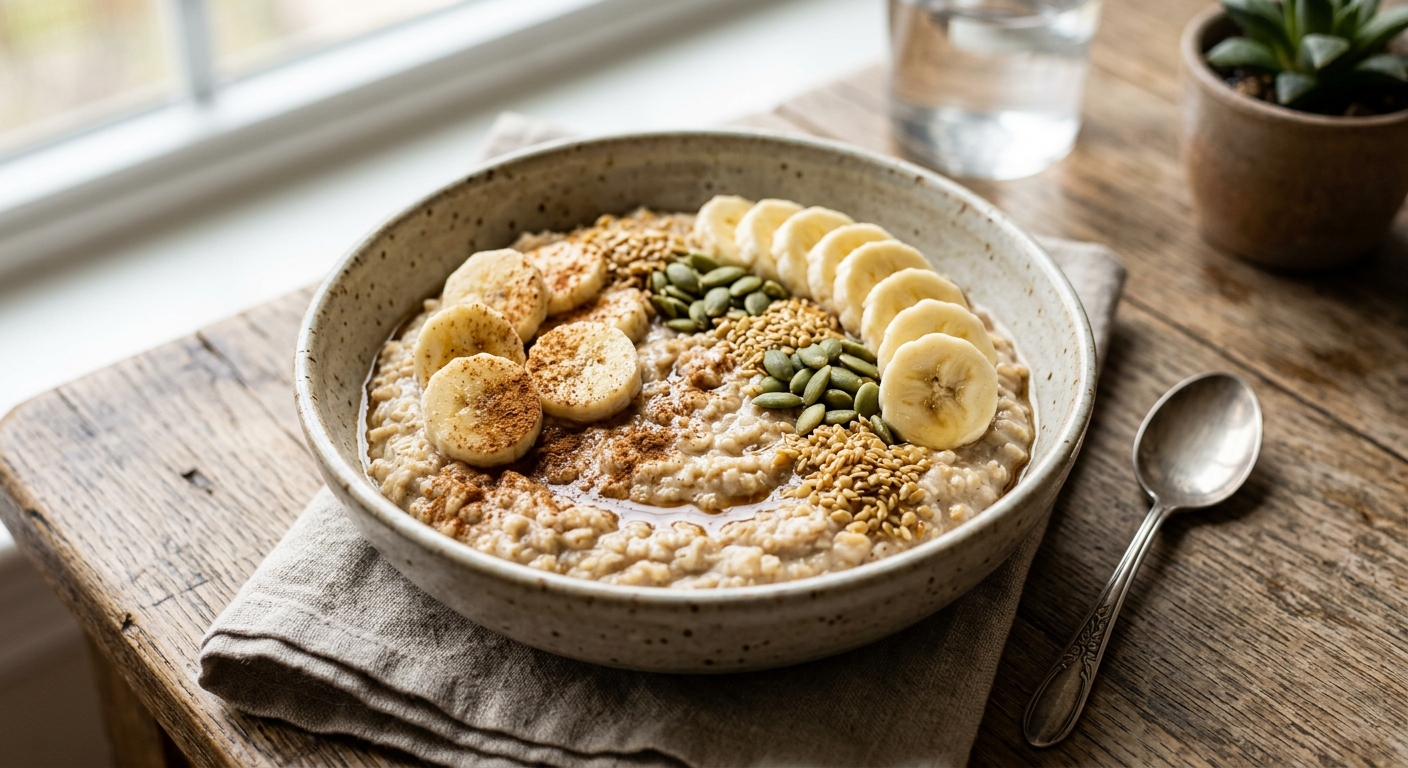
Most people reach for calcium supplements when they think about bone health, but the science of skeletal nutrition runs much deeper. Silicon, an often-overlooked trace mineral abundant in whole oats and bananas, plays a critical role in the early stages of bone formation by stimulating osteoblast activity and cross-linking collagen fibers that give bone its tensile strength. A single serving of this calibrated breakfast delivers approximately 11.7 mg of dietary silicon, placing it among the most silicon-dense meals you can build around everyday ingredients.
This recipe is not simply oats with banana thrown on top. Every component has been chosen for its synergistic contribution to the bone-support matrix. Rolled oats provide the silicon backbone and a slow-release carbohydrate platform. Ripe banana contributes potassium and manganese, two minerals that work together to reduce urinary calcium loss and activate the enzymes responsible for synthesizing proteoglycans in cartilage. Pumpkin seeds add a meaningful hit of magnesium and zinc, while ground flaxseed brings lignans and alpha-linolenic acid to moderate systemic inflammation that would otherwise accelerate bone resorption.
From a culinary standpoint, the challenge with oats is coaxing maximum creaminess without sacrificing the textural contrast that makes a bowl satisfying. Each cooking method below solves this differently: the stovetop version uses a classic low-and-slow stir to build a velvety porridge, the slow cooker develops overnight depth through extended hydration, and the pressure cooker creates an ultra-creamy result in under fifteen minutes. Whichever path you choose, you are sitting down to a breakfast that has been precisely calibrated, not just assembled.
4
servings
Ingredients
- 320 gold-fashioned rolled oats (not instant)
- 2 mediumripe bananas (approx. 240g total), divided
- 1000 mlunsweetened oat milk
- 480 mlfiltered water
- 60 graw pumpkin seeds (pepitas)
- 30 gground golden flaxseed
- 2 tbsppure maple syrup
- 1 tspground cinnamon
- 0.5 tspground ginger
- 0.25 tspground turmeric
- 1 tsppure vanilla extract
- 1 pinchColima Sea SaltMicroplastic Free Salt
- 20 gsesame seeds, lightly toasted
- 15 mlextra-virgin coconut oil
- —Additional banana slices, pumpkin seeds, and a drizzle of maple syrup to serve
Instructions
Click on an item below to shop for the recommended items for this recipe on Amazon.
As an Amazon Associate, we earn from qualifying purchases.
- Toast the pumpkin seeds first: place them in a dry heavy-bottomed saucepan or Dutch oven over medium heat. Stir constantly for 3 to 4 minutes until they begin to pop and turn lightly golden. Transfer to a small bowl and set aside. This step develops nuttiness and slightly increases the bioavailability of zinc.
- In the same pan, combine the oat milk, water, cinnamon, ginger, turmeric, and fine sea salt. Bring to a gentle simmer over medium heat, stirring occasionally to prevent a skin from forming.
- Peel one banana and mash it directly into the simmering liquid using the back of a fork or a silicone spatula, stirring to incorporate. The mashed banana will dissolve into the base and sweeten it naturally while adding potassium and manganese to every spoonful.
- Add the rolled oats and stir well to submerge all the grains. Reduce the heat to low. Cook uncovered, stirring every 2 to 3 minutes, for 15 to 18 minutes until the oats are tender and the porridge has thickened to a creamy, spoonable consistency. If it thickens too quickly, add a splash of warm water or oat milk and stir through.
- Remove from heat and stir in the ground flaxseed, maple syrup, vanilla extract, and coconut oil. The residual heat will bloom the flaxseed without destroying its beneficial omega-3 fatty acids. Let the porridge rest for 2 minutes, during which it will thicken slightly further.
- Slice the second banana. Ladle the porridge into four bowls and top each with banana slices, a quarter of the toasted pumpkin seeds, a sprinkle of toasted sesame seeds, and an optional extra drizzle of maple syrup. Serve immediately.
- Replace the rolled oats in this method with 240g of steel-cut oats. Lightly coat the inside of a 4-quart or larger slow cooker insert with a small amount of coconut oil, using a paper towel to wipe it around the base and up the sides. This prevents the oats from crusting and scorching overnight.
- Peel one banana and mash it thoroughly in a bowl. Combine the mashed banana, oat milk, water, cinnamon, ginger, turmeric, vanilla extract, maple syrup, and sea salt in the slow cooker insert. Stir well to distribute the spices evenly through the liquid.
- Add the steel-cut oats and stir again to fully submerge. Scatter the ground flaxseed over the surface and stir in. Do not add the pumpkin seeds or sesame seeds at this stage as prolonged cooking makes them soft and unpleasant. Place the lid on the slow cooker.
- Cook on Low for 7 to 8 hours. Overnight cooking from 10 pm to 6 am is ideal. Avoid cooking on High, which produces a gluey, unevenly cooked result with oats. Do not lift the lid during cooking as this releases steam and throws off the liquid ratio.
- In the morning, toast the pumpkin seeds in a dry skillet over medium heat for 3 to 4 minutes until they pop and turn golden. Set aside. Stir the slow cooker porridge thoroughly, scraping up any thickened oats from the sides. Stir in the coconut oil. If the porridge is thicker than you prefer, stir in a few tablespoons of warm oat milk until it reaches your desired consistency.
- Slice the second banana. Spoon the porridge into four bowls and top with fresh banana slices, toasted pumpkin seeds, and toasted sesame seeds. Add a drizzle of maple syrup if desired and serve at once.
- Replace the rolled oats in this method with 240g of steel-cut oats. Peel one banana and mash it well. Place the mashed banana into the Instant Pot inner pot along with the oat milk, water, cinnamon, ginger, turmeric, maple syrup, vanilla extract, sea salt, and coconut oil. Stir to combine. Adding the coconut oil now helps suppress foam formation during pressurization.
- Add the steel-cut oats and ground flaxseed. Stir everything together, making sure no oats are sitting dry on the bottom, which can trigger the burn warning on some Instant Pot models. Do not add pumpkin seeds or sesame seeds inside the pressure cooker.
- Secure the lid and set the steam release valve to the Sealing position. Select Pressure Cook (or Manual) on High Pressure and set the timer for 10 minutes. The unit will take approximately 8 to 10 minutes to come to pressure before the countdown begins.
- When the cooking cycle finishes, allow the pressure to release naturally for 10 minutes. Do not perform a quick release immediately, as the oats continue cooking gently in residual steam and the pressure inside is very high at this point. After 10 minutes, carefully switch the valve to Venting to release any remaining pressure, then open the lid away from you.
- While pressure is releasing, toast the pumpkin seeds in a dry skillet over medium heat for 3 to 4 minutes, stirring constantly until they pop and turn golden. Slice the second banana.
- Stir the porridge vigorously from the bottom up, as it will have set into a thick mass. Add a splash of warm oat milk if needed and stir until it loosens to a creamy, cohesive consistency. Ladle into four bowls and finish with banana slices, toasted pumpkin seeds, toasted sesame seeds, and a drizzle of maple syrup.
Nutrition Breakdown
Per 1 serving (makes 4)
Vitamins & Minerals
% Daily Value based on a 2,000 calorie diet (FDA reference)
🧬 Essential Amino Acids
% of recommended daily intake (RDA) per serving
🛡 Antioxidant Profile
The Nutrition Science
Silicon is classified as a bioactive trace element rather than an essential mineral under current dietary reference intake frameworks, yet the mechanistic evidence for its role in bone biology is compelling. Orthosilicic acid, the soluble form absorbed from plant foods like oats and bananas, is a cofactor in the hydroxylation of proline and lysine residues within the collagen helix. This cross-linking step is foundational: without adequate silicon, the collagen scaffold that hydroxyapatite crystals (the mineral component of bone) anchor to is structurally compromised. Epidemiological data from the Framingham Offspring Cohort found a significant positive association between dietary silicon intake and bone mineral density at the femoral neck in men and premenopausal women, with oats consistently identified as the leading dietary contributor.
Manganese, delivered here at 135% DV, is the most under-discussed bone mineral in mainstream nutrition. It is the essential cofactor for two key enzymes: manganese superoxide dismutase (MnSOD), which protects osteoblasts from oxidative damage, and glycosyltransferases, which are required to synthesize the glycosaminoglycan chains of proteoglycans in cartilage matrix. Low manganese status has been documented in patients with osteoporosis and osteoarthritis alike. The combination of oats, pumpkin seeds, and flaxseed in this recipe creates one of the most manganese-concentrated breakfasts achievable through whole food sources alone.
Magnesium often plays second fiddle to calcium in bone health discussions, but approximately 60% of the body’s total magnesium is stored in bone tissue, where it stabilizes the hydroxyapatite crystal lattice and moderates bone turnover rate. Critically, magnesium is also required for the conversion of vitamin D to its active hormonal form, 1,25-dihydroxyvitamin D, meaning that a magnesium-deficient diet effectively neutralizes whatever vitamin D you consume. The 138mg per serving provided here covers a third of the adult RDA, and when paired with the complete day tip above, helps ensure that the vitamin D from sardines is properly activated and directed toward intestinal calcium absorption.
Pro Tips
- For maximum silicon bioavailability, use filtered or low-mineral water. High-calcium hard water can partially bind orthosilicic acid in the gut before absorption, reducing uptake by up to 20%.
- Choose the ripest bananas available. As bananas ripen, resistant starch converts to fructooligosaccharides, which act as prebiotics and further support the gut microbiome environment that optimizes mineral absorption.
- Add the ground flaxseed off the heat or after cooking is complete. Sustained temperatures above 120 degrees Celsius degrade the ALA omega-3 content. Stirring it in at the end preserves both nutritional value and the slightly nutty flavor.
- Do not substitute quick oats or instant oats. Their higher surface area from processing means faster starch breakdown, a significantly higher glycemic index (GI ~83 vs ~55 for rolled oats), and far less beta-glucan integrity, which reduces both the cholesterol-lowering effect and the fiber-mediated mineral absorption benefit.
- Toast sesame seeds in a small dry pan for 2 to 3 minutes just before serving. Toasting ruptures the outer hull and dramatically improves the bioavailability of sesame’s calcium (approximately 88mg per tablespoon) and lignan antioxidants.
This is such a smart angle on bone health that goes beyond just calcium and vitamin D. I’ve been diving into how silicon actually modulates gene expression in osteoblasts, and I’m curious if you considered the methylation support angle here too – the banana’s B6 and folate, plus those seeds as choline sources, all work as methyl donors that could theoretically enhance the epigenetic signaling for bone formation. I’ve been testing a similar bowl most mornings with pumpkin seeds swapped in for the extra zinc and arginine, and I’m tracking some biomarkers to see if the nutrient synergy actually moves the needle on collagen turnover. Have you noticed whether your readers report any
What a wonderful recipe to bring into my next cooking class, especially since so many of my students are asking about bone health beyond just dairy. I’ve been making oatmeal bowls for years, but I have to say, the way you’ve layered in silicon-rich ingredients alongside the magnesium and manganese really transforms this from comfort food into functional medicine. I’m genuinely curious about the osteoblast gene expression angle Eddie mentioned, though I’ll confess the deeper biochemistry still feels a bit new to me, so I’d be grateful for any beginner-friendly resources you’d recommend. I’m already planning to prep a batch of those toasted seeds to have on hand for class next month.
This is a great catch on the gene expression angle, Eddie! I’d love to see the specific studies you’re referencing because the osteoblast data is fascinating, though I’ll admit the methylation pathway connection to dietary silicon still feels like it needs more human evidence to me. That said, the bone matrix mineralization piece is solid, and I think what’s really smart about this bowl is that it’s hitting multiple validated mechanisms at once (silicon for collagen cross-linking, magnesium for hydroxyapatite formation, manganese as a cofactor). The synergy probably matters more than any single nutrient hitting a specific percentage of daily value, which is honestly how real nutrition seems to work in the gut. Have