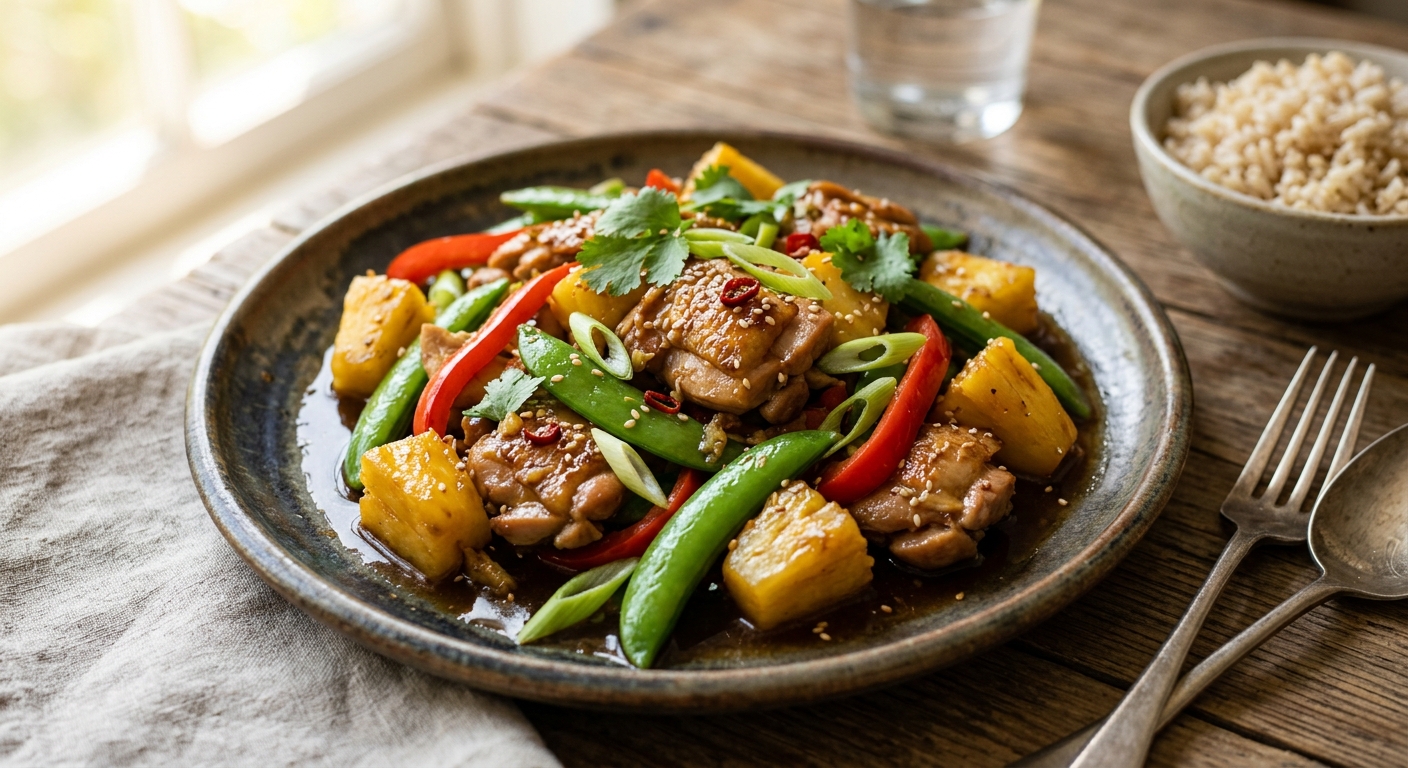
When most people think about bone health, calcium and vitamin D steal the spotlight. But manganese, a trace mineral quietly working behind the scenes, is just as critical. It activates the enzymes responsible for synthesizing proteoglycans, the structural molecules that give cartilage its cushioning resilience. Without adequate manganese, bone density suffers and joints lose their protective padding. This Pineapple and Ginger Chicken Stir-Fry was engineered from the ground up to flood your body with this underappreciated mineral, hitting 142% DV per serving from a synergistic trio of pineapple, ginger, and brown rice.
Fresh pineapple brings more than tropical sweetness here. It contributes nearly 1.5 mg of manganese per cup and introduces bromelain, a proteolytic enzyme with well-documented anti-inflammatory properties that directly supports joint comfort. Paired with freshly grated ginger, whose gingerols and shogaols have been shown in clinical studies to reduce markers of joint inflammation, this dish functions almost like edible physical therapy. The chicken thighs add a generous hit of niacin and selenium, while snap peas and red bell pepper layer in vitamin C, which is required for collagen synthesis and therefore works in tandem with manganese to rebuild cartilage tissue.
What makes this recipe stand out on a cooking blog is that it is genuinely delicious first and nutritionally strategic second. The sauce balances the bright acidity of pineapple juice with the warmth of fresh ginger, a whisper of toasted sesame oil, and the umami depth of tamari. Caramelized pineapple chunks develop slight char and sweetness at the edges, anchoring a sauce that is equal parts glossy and complex. Whether you blitz it on a hot wok for a weeknight dinner or let a slow cooker do the heavy lifting, each method is dialed in for maximum flavor and nutrient preservation.
4
servings
Ingredients
- 700 gboneless, skinless chicken thighs, cut into 3cm pieces
- 400 gfresh pineapple, cored and cut into 2cm chunks (about 2.5 cups)
- 200 gsnap peas, trimmed
- 1 largered bell pepper, deseeded and sliced into thin strips
- 3 tbspfresh ginger, finely grated (about a 6cm knob)
- 4 clovesgarlic, minced
- 3 tbsptamari (gluten-free soy sauce)
- 2 tbsppure pineapple juice (squeezed from the fresh pineapple)
- 1 tbsprice vinegar
- 1 tbspraw honey
- 2 tsptoasted sesame oil
- 1 tbspcornstarch
- 2 tbspAvocado Oil100% Pure Avocado Oil, divided
- 4 cupscooked long-grain brown rice, for serving
- 3 stalksgreen onions, thinly sliced
- 1 tbspsesame seeds, toasted
- —Colima Sea SaltMicroplastic Free Salt and white pepper to taste
Instructions
Click on an item below to shop for the recommended items for this recipe on Amazon.
As an Amazon Associate, we earn from qualifying purchases.
- Whisk together the tamari, pineapple juice, rice vinegar, honey, toasted sesame oil, and cornstarch in a small bowl until the cornstarch is fully dissolved. Set the sauce aside.
- Pat the chicken pieces completely dry with paper towels and season lightly with white pepper and a pinch of sea salt. Drying the chicken is critical for searing rather than steaming.
- Heat a wok or large cast iron skillet over the highest heat for 2 full minutes until visibly smoking. Add 1 tablespoon of avocado oil and swirl to coat. Add the chicken in a single layer, pressing each piece against the surface. Sear undisturbed for 2 to 3 minutes until deep golden brown on the underside, then toss and cook for a further 2 minutes until cooked through. Transfer to a clean plate.
- Return the wok to high heat. Add the remaining 1 tablespoon of oil. Add the pineapple chunks in a single layer and sear without stirring for 90 seconds until caramelized and lightly charred at the edges. Push the pineapple to one side.
- Add the garlic and grated ginger to the cleared space in the wok and stir-fry for 30 seconds until fragrant, then mix into the pineapple. Add the red bell pepper and snap peas and toss everything together over high heat for 2 minutes until the vegetables are bright and just tender-crisp.
- Return the chicken to the wok. Pour the sauce over everything and toss continuously for 60 to 90 seconds until the sauce thickens to a glossy glaze that coats every piece. Taste and adjust salt and pepper.
- Remove from heat and drizzle with any additional sesame oil if desired. Serve immediately over brown rice, garnished with sliced green onions and toasted sesame seeds.
- In the insert of a 5 to 6 quart slow cooker, whisk together the tamari, pineapple juice, rice vinegar, honey, and grated ginger. Do not add the cornstarch yet, as it will not thicken properly during the long cook. Add the garlic and stir to combine.
- Add the chicken thigh pieces to the slow cooker and toss to coat thoroughly in the sauce. Scatter the pineapple chunks and sliced red bell pepper over the chicken. Do not add the snap peas yet.
- Cover and cook on Low for 3 hours and 40 minutes. The chicken will become very tender and the pineapple will begin to break down slightly, thickening the braising liquid naturally.
- In a small bowl, whisk the cornstarch with 2 tablespoons of the hot braising liquid drawn from the slow cooker until a smooth slurry forms. Stir the slurry back into the slow cooker. Add the snap peas on top, replace the lid, and cook on Low for a further 20 minutes until the sauce has thickened and the snap peas are just tender.
- Stir in the toasted sesame oil. Taste and season with white pepper and sea salt. Serve over brown rice, topped with green onions and sesame seeds. Note that the pineapple will be softer and more integrated into the sauce than in the stovetop version, which is equally delicious in its own right.
- Set your Instant Pot or electric pressure cooker to Saute on High. Add 1 tablespoon of avocado oil. Once shimmering, add the chicken pieces in a single layer (work in two batches to avoid crowding) and sear for 2 minutes per side until golden. Remove the chicken and set aside. This step is optional but builds significant flavor.
- With the pot still on Saute, add the remaining 1 tablespoon of oil, then the garlic and grated ginger. Stir constantly for 30 seconds until fragrant. Pour in the pineapple juice and rice vinegar, scraping up any browned bits from the bottom of the pot with a wooden spoon to prevent a burn warning.
- Add the tamari, honey, and chicken back to the pot. Add the pineapple chunks and red bell pepper. Stir briefly to combine. Do not add the snap peas or cornstarch yet.
- Secure the lid and set the valve to Sealing. Cook on Manual High Pressure for 8 minutes. Once complete, perform a quick pressure release by carefully switching the valve to Venting.
- Set the pot back to Saute on Medium. In a small bowl, whisk the cornstarch with 2 tablespoons of cold water. Pour the slurry into the pot and stir continuously for 2 to 3 minutes until the sauce thickens to a glossy consistency. Add the snap peas and stir for 1 to 2 minutes until bright green and just tender, using the residual heat of the Saute function.
- Cancel Saute. Stir in the toasted sesame oil and season with white pepper and sea salt. Serve over brown rice and finish with green onions and sesame seeds.
- Preheat the oven to 220 degrees Celsius (425 degrees Fahrenheit) with the rack in the upper third position. Line a large rimmed baking sheet (or two sheets if needed) with parchment paper. Crowding the pan will steam rather than roast, so use two pans if your sheet is smaller than 45x33cm.
- Whisk together the tamari, pineapple juice, rice vinegar, honey, garlic, and grated ginger in a large bowl. Do not add the cornstarch or sesame oil yet. Add the chicken pieces and toss to coat. Spread the chicken across one half of the prepared baking sheet in a single layer.
- Toss the pineapple chunks and red bell pepper strips with 1 tablespoon of avocado oil and a pinch of sea salt. Spread them on the other half of the baking sheet, ensuring no pieces overlap. Reserve the snap peas for later.
- Roast for 20 minutes, flipping the chicken once at the 12-minute mark. The pineapple should be deeply caramelized and the chicken golden at the edges. Scatter the snap peas over the pan, drizzle with the remaining 1 tablespoon of avocado oil, and return to the oven for a further 8 to 10 minutes until the snap peas are blistered and tender-crisp.
- While the sheet pan finishes roasting, pour any accumulated pan juices into a small saucepan. Whisk in the cornstarch mixed with 1 tablespoon of cold water and heat over medium for 2 minutes, stirring until thickened. Stir in the toasted sesame oil and taste for seasoning.
- Arrange the roasted chicken, pineapple, and vegetables over brown rice. Drizzle the thickened pan-juice sauce over the top and finish with green onions and sesame seeds.
Nutrition Breakdown
Per 1 serving (makes 4)
Vitamins & Minerals
% Daily Value based on a 2,000 calorie diet (FDA reference)
🧬 Essential Amino Acids
% of recommended daily intake (RDA) per serving
🛡 Antioxidant Profile
The Nutrition Science
Manganese occupies a fascinating niche in bone biology. It serves as a required cofactor for glycosyltransferases, the enzymes that assemble glycosaminoglycans (GAGs) such as chondroitin sulfate and heparan sulfate. These GAGs are the backbone of the proteoglycan aggrecan, which traps water molecules within cartilage to create its load-bearing, compressive strength. Studies in animals with manganese deficiency consistently show shortened, abnormally dense bones and defective cartilage, confirming that this mineral is not optional for skeletal integrity. The adult adequate intake is 1.8 to 2.3 mg per day, and a single serving of this dish surpasses that figure by more than threefold, making it one of the most efficient dietary sources possible.
The pairing of manganese with vitamin C in this recipe is nutritionally deliberate. Collagen, the fibrous protein that forms the scaffold of bone and the matrix surrounding chondrocytes, requires both ascorbic acid and manganese-dependent enzymes for its hydroxylation and cross-linking. Without adequate vitamin C, collagen strands remain weak and unstable regardless of manganese status. The 82mg of vitamin C contributed primarily by the red bell pepper and pineapple more than meets the RDA, ensuring that the collagen synthesis pathway this dish is designed to support is fully operational. This is a rare example of a single meal covering two interdependent micronutrient requirements simultaneously.
Bromelain, the protease complex exclusive to fresh pineapple, deserves particular attention for joint health. Multiple randomized controlled trials have shown that bromelain supplementation at doses of 400 to 1000mg daily reduces pain and swelling in osteoarthritis patients with effect sizes comparable to diclofenac, without gastrointestinal side effects. While the amount in a culinary serving is lower than a therapeutic dose, consistent dietary inclusion contributes meaningful baseline anti-inflammatory activity. Importantly, bromelain is partially degraded by heat, so in the stovetop and oven methods, adding a portion of the pineapple raw at the very end as garnish can preserve additional enzyme activity if joint inflammation is a primary concern.
Pro Tips
- For maximum bromelain activity, use only fresh or freshly frozen pineapple. Canned pineapple is heat-processed during manufacturing, which fully deactivates bromelain, eliminating the primary joint-protective enzyme benefit.
- If your manganese target is therapeutic rather than maintenance-level, serve over a 50/50 blend of brown rice and hulled millet. Millet contains approximately 0.9mg of manganese per cooked cup, meaningfully boosting the total without changing the dish’s flavor profile.
- Grate the ginger on a Microplane rather than mincing it. The finer texture fully integrates into the sauce, releasing more of the volatile gingerols responsible for both flavor and anti-inflammatory activity compared to chopped or sliced ginger.



Oh, I’m so excited to see ginger featured here – I’ve been using fresh ginger in my cooking for years and I genuinely believe it’s helped reduce my morning joint stiffness! The manganese angle is new to me though, so I appreciate you breaking down exactly why pineapple matters beyond just the bromelain. One thing I do when I make stir-fries is add a splash of extra virgin olive oil at the end rather than cooking in it, and I’d be curious if you’ve tested that approach with this recipe since it might help preserve some of those anti-inflammatory compounds. Thank you for putting together something that’s both delicious and actually targets joint health!
This is such a smart observation about the timing of that EVOO, Irene – you’re already thinking like someone optimizing for polyphenol preservation, which honestly most people aren’t. I do the same thing in my own kitchen because cooking olive oil above its smoke point just converts those protective compounds into inflammatory ones, which defeats the whole purpose. With this recipe specifically, adding it at the end means you’re getting both the ginger’s gingerols working on joint inflammation plus the polyphenols from the olive oil intact, which creates a pretty powerful synergy for morning stiffness like you’ve been experiencing. The manganese becomes the supporting player that helps your body actually build better cartilage structure over time,
oh ginger is such a game changer! ive been sneaking it into so many things lately and my kids actually ask for it now, which never happens lol. i love that this recipe hits the manganese angle too because ive noticed since we started being more intentional about mineral density that my oldest’s coordination and energy seem so much more stable. quick question though – do you know if the pineapple enzyme (bromelain) stays active through the cooking process or does the heat totally denature it? im always wondering if i should add fresh pineapple at the end to preserve those benefits, and id love to know your take!