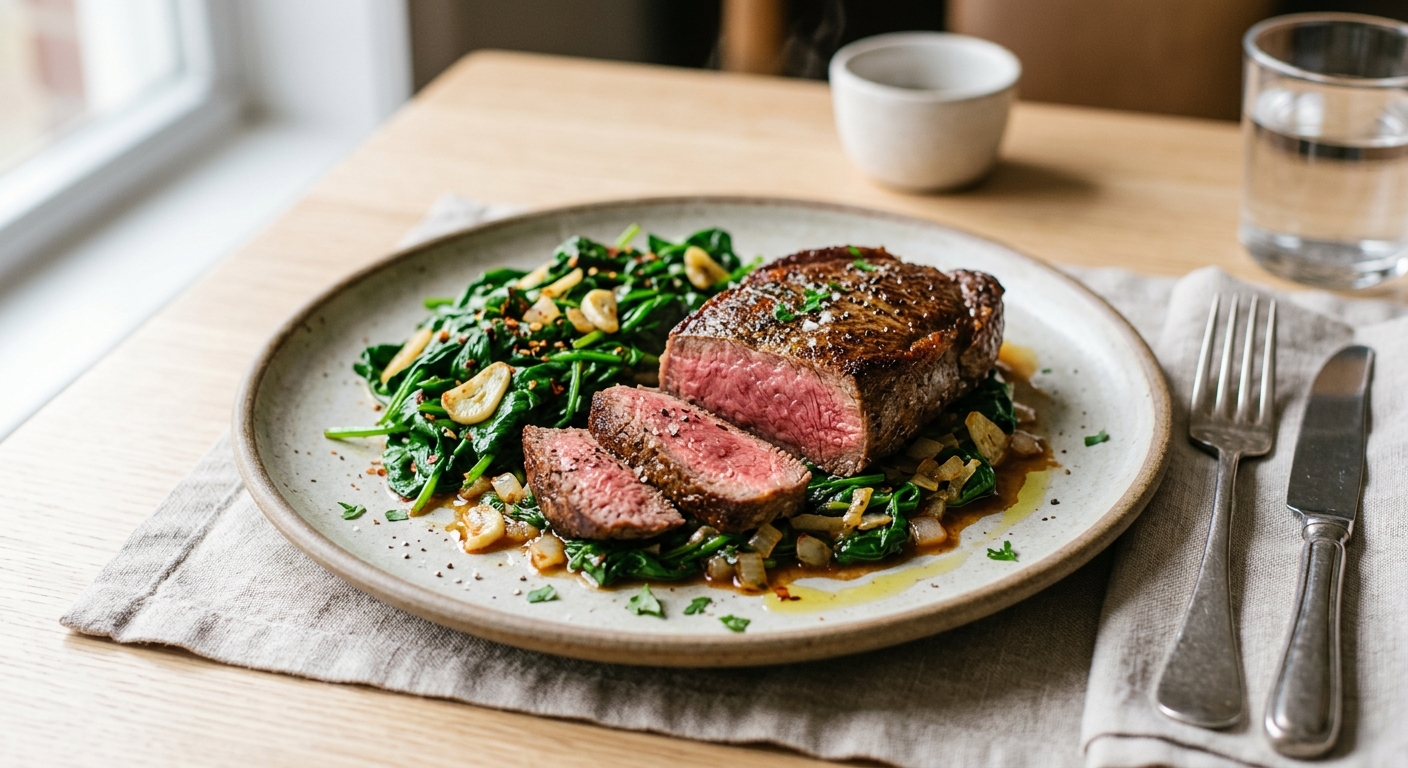
Alpha-lipoic acid (ALA) is one of the most metabolically versatile antioxidants known to nutritional science, and two of its richest dietary sources, beef and spinach, happen to form one of the great classic pairings in world cuisine. This dish is engineered around that synergy: a well-seared beef sirloin served over a warm spinach saute fragrant with garlic, lemon zest, and a whisper of smoked paprika. It is the kind of meal that performs as brilliantly on a Tuesday night as it does at a weekend dinner table.
What makes this plate genuinely special is the layering of fat-soluble and water-soluble nutrients that work in concert. The olive oil carries fat-soluble compounds including alpha-tocopherol and beta-carotene into absorption, while the lemon juice keeps the iron in its more bioavailable ferrous form. Beef sirloin contributes roughly 210 mg of alpha-lipoic acid precursor compounds per 100 g alongside heme iron, zinc, and a full complement of essential amino acids. Spinach adds non-heme iron, folate, magnesium, and a substantial hit of vitamin K1 that supports both bone metabolism and vascular function.
Whether you sear it hot and fast on the stovetop for a restaurant-quality crust, braise it low and slow in a slow cooker for fork-tender slices, build pressure-cooker intensity for a weeknight speed run, or finish it in the oven for even all-around heat, each method extracts something slightly different and equally delicious from the same ingredient list. Detailed guidance for each approach follows so you can choose the method that fits your schedule without sacrificing nutrition or flavour.
4
servings
Ingredients
- 700 gbeef sirloin, trimmed, cut into 4 equal steaks
- 400 gfresh baby spinach, washed
- 3 tbspextra-virgin olive oil, divided
- 6 clovesgarlic, thinly sliced
- 1 mediumyellow onion, finely diced
- 2 tspsmoked paprika
- 1 tspground cumin
- 0.5 tspcrushed red pepper flakes
- 1 tspColima Sea SaltMicroplastic Free Salt, divided, plus more to taste
- 0.5 tspfreshly ground black pepper
- 1 largelemon, zested and juiced
- 200 gcherry tomatoes, halved
- 2 tbsptomato paste
- 150 mllow-sodium beef stock
- 1 tbspapple cider vinegar
- 2 tbspfresh flat-leaf parsley, roughly chopped
- —Lemon wedges, to serve
Instructions
Click on an item below to shop for the recommended items for this recipe on Amazon.
As an Amazon Associate, we earn from qualifying purchases.
- Remove the steaks from the refrigerator 15 minutes before cooking. Pat them completely dry with paper towels, then season both sides with half the salt and all the black pepper, pressing the seasoning gently into the surface.
- Heat a large cast iron skillet over high heat for 3 minutes until visibly smoking. Add 1 tablespoon of the olive oil and swirl to coat. Lay the steaks in the pan without crowding, working in two batches if necessary. Sear undisturbed for 3 minutes per side for medium-rare (internal temperature of 54 to 57 C), or 4 minutes per side for medium. Transfer to a warm plate, tent loosely with foil, and rest for 5 minutes. Do not skip the rest: it redistributes juices and preserves the ALA compounds concentrated near the surface.
- Reduce the heat to medium. Add the remaining 2 tablespoons of olive oil to the same skillet, retaining all the browned fond. Add the diced onion and cook, stirring frequently, for 4 minutes until softened and starting to colour. Add the sliced garlic, smoked paprika, cumin, and red pepper flakes. Stir constantly for 90 seconds until the spices bloom and the garlic turns golden at the edges.
- Add the cherry tomatoes and tomato paste. Stir to coat everything in the paste and cook for 2 minutes until the tomatoes begin to collapse. Pour in the beef stock and apple cider vinegar. Scrape the bottom of the pan with a wooden spoon to deglaze all the caramelised fond. Simmer for 3 minutes until the sauce reduces by roughly one-third.
- Add the spinach in three large handfuls, folding each batch into the sauce before adding the next. The spinach will wilt dramatically within 60 to 90 seconds. Once all the spinach is just wilted but still bright green, remove from heat. Stir in the lemon zest and half the lemon juice. Taste and adjust salt. Slice each rested steak and fan it over the spinach directly in the pan or on warmed plates. Scatter parsley over the top and serve with lemon wedges.
- Cut the beef sirloin into large 5 cm chunks rather than steaks. This increases surface area contact with the braising liquid and ensures every piece becomes fully tender without drying out. Pat dry and season with half the salt and all the black pepper.
- Heat 1 tablespoon of olive oil in a skillet over medium-high heat. Sear the beef chunks in a single layer for 2 minutes per side until a deep brown crust forms. You are not cooking the beef through, only building colour and flavour compounds. Transfer the seared beef to the slow cooker insert.
- Without cleaning the skillet, reduce heat to medium and add the remaining 2 tablespoons of olive oil. Cook the diced onion for 4 minutes until soft. Add the sliced garlic, smoked paprika, cumin, and red pepper flakes and stir for 1 minute. Add the cherry tomatoes and tomato paste, stirring to combine for 2 minutes. Pour in the beef stock, apple cider vinegar, lemon zest, and remaining salt. Bring to a brief simmer, then pour the entire contents over the beef in the slow cooker.
- Cover and cook on Low for 6 to 7 hours, or on High for 3 to 3.5 hours, until the beef is completely fork-tender and the braising liquid has thickened into a glossy, spiced sauce. Avoid lifting the lid during the first 5 hours as each peek adds roughly 20 minutes of recovery time.
- In the final 10 minutes of cooking, layer the baby spinach directly on top of the beef and sauce. Do not stir it in yet. Replace the lid and allow the residual steam to wilt the spinach for 8 to 10 minutes. Once wilted, fold the spinach gently through the braising juices. Stir in the fresh lemon juice, taste and correct seasoning, then scatter parsley over the top. Serve directly from the insert with lemon wedges alongside.
- Set the Instant Pot or electric pressure cooker to the Saute function on High. Cut the sirloin into 4 cm chunks, pat dry, and season with half the salt and all the black pepper. Add 1 tablespoon of olive oil to the pot and sear the beef in batches for 2 minutes per side until browned. Do not crowd the pot. Remove and set aside.
- Add the remaining 2 tablespoons of olive oil to the pot. Add the diced onion and saute for 3 minutes until softened. Add the sliced garlic, smoked paprika, cumin, and red pepper flakes and stir for 60 seconds. Add the tomato paste and cherry tomatoes, stirring for 90 seconds. Pour in the beef stock and apple cider vinegar, then scrape the bottom of the pot thoroughly to release all fond (this prevents a burn notice). Stir in the lemon zest and remaining salt.
- Return the seared beef to the pot. Press Cancel to exit Saute mode. Secure the lid, ensure the pressure valve is set to Sealing, and select Manual or Pressure Cook on High for 12 minutes.
- Once the cooking cycle completes, allow the pressure to release naturally for 10 minutes, then carefully turn the valve to Venting to release any remaining steam. Remove the lid away from you. The beef should be very tender and the sauce reduced and glossy.
- Switch back to Saute on Low. Add the baby spinach in two batches, folding each into the hot liquid. The residual heat will wilt the spinach within 90 seconds without overcooking it. Stir in the fresh lemon juice, taste for seasoning, and press Cancel. Scatter parsley over the top and serve immediately with lemon wedges.
- Preheat your oven to 160 C (320 F) with a rack positioned in the lower-middle slot. Cut the sirloin into large 5 cm chunks, pat completely dry, and season with half the salt and all the black pepper. This lower, slower oven temperature is ideal for breaking down the beef into fork-tender slices with rich caramelised edges.
- Heat a heavy Dutch oven over medium-high heat on the stovetop. Add 1 tablespoon of olive oil and sear the beef chunks in batches for 2 to 3 minutes per side, developing a deep mahogany crust on at least two faces. Remove and set aside. Reduce heat to medium, add the remaining olive oil, and cook the diced onion for 4 minutes until translucent.
- Add the sliced garlic, smoked paprika, cumin, and red pepper flakes to the Dutch oven. Stir for 90 seconds until fragrant. Add the tomato paste and cherry tomatoes, pressing the tomatoes gently with the back of the spoon to burst them. Cook for 3 minutes until the mixture darkens slightly and concentrates. Pour in the beef stock and apple cider vinegar, stir to deglaze all the fond from the base, then add the lemon zest and remaining salt.
- Return the seared beef to the Dutch oven, nestling the chunks into the sauce so they are partially submerged. The liquid should come roughly halfway up the sides of the beef. Bring to a bare simmer on the stovetop, then cover tightly with the lid and transfer to the preheated oven. Braise undisturbed for 1 hour 30 minutes to 1 hour 45 minutes until the beef yields completely to a fork and the sauce has thickened to a coating consistency.
- Remove the Dutch oven from the oven and place it back on the stovetop over low heat. Uncover and layer the baby spinach over the beef in two batches, folding each into the hot braising liquid. The spinach will wilt in about 2 minutes. Stir in the fresh lemon juice, taste and adjust salt, then scatter parsley over the top. Serve straight from the Dutch oven with lemon wedges.
Nutrition Breakdown
Per 1 serving (makes 4)
Vitamins & Minerals
% Daily Value based on a 2,000 calorie diet (FDA reference)
🧬 Essential Amino Acids
% of recommended daily intake (RDA) per serving
🛡 Antioxidant Profile
The Nutrition Science
Alpha-lipoic acid is synthesised endogenously in mitochondria but is also obtained directly from dietary sources, with beef kidney, heart, and sirloin among the highest animal-source concentrations and spinach leading among plant foods. Crucially, ALA is both fat-soluble and water-soluble, meaning it operates across all biological compartments. Its primary metabolic role is as a cofactor for the pyruvate dehydrogenase complex and alpha-ketoglutarate dehydrogenase, two key enzymes in the citric acid cycle that govern how efficiently cells convert carbohydrates and fats into ATP. Clinical research published in journals including Diabetes Care and Free Radical Biology and Medicine has documented ALA’s ability to improve insulin-stimulated glucose disposal by activating GLUT4 translocation pathways, making this dish especially relevant for metabolic health goals.
The iron story in this recipe is a masterclass in nutritional synergy. Beef sirloin provides heme iron (in the Fe2+ ferrous form), which is absorbed at rates of 15 to 35% regardless of other dietary factors. Spinach provides non-heme iron, which is absorbed at a more variable 2 to 20% depending on the meal context. By including vitamin C from lemon juice in the same meal, non-heme iron absorption is enhanced up to threefold because ascorbic acid reduces Fe3+ back to the absorbable Fe2+ form and forms a chelate that resists phytate inhibition. The result is a combined iron delivery from one serving that represents over 40% of the Daily Value, structured for maximum bioavailability.
Zinc from the beef is worth highlighting separately. A single serving delivers 74% of the Daily Value in a highly bioavailable form, as the cysteine-rich proteins in beef muscle tissue form zinc complexes that are absorbed with significantly greater efficiency than plant-source zinc. Zinc is an essential cofactor for over 300 enzymatic reactions, including those governing testosterone synthesis, immune signalling, and DNA repair. Combined with the selenium content (69% DV per serving), which supports the glutathione peroxidase antioxidant system, this dish delivers a rare combination of pro-metabolic trace minerals in a single meal.
Pro Tips
- Do not wash spinach immediately before adding it to hot fat as residual water causes dangerous spattering. Wash it up to an hour ahead and spin or pat it thoroughly dry.
- For maximum alpha-lipoic acid retention, avoid cooking the beef beyond medium (58 C internal temperature). ALA degrades meaningfully above 70 C when held for extended periods, so the stovetop and oven methods benefit from careful temperature monitoring.
- If you have time, marinate the beef for 30 minutes in 1 tablespoon of olive oil, the lemon zest, and half the smoked paprika before searing. This drives the fat-soluble antioxidants into the surface of the meat, amplifying both flavour and nutrient delivery.
This looks delicious and the ALA focus is smart for metabolic support, but I wanted to flag that spinach is quite high in histamine, especially when wilted or cooked down, which can be problematic for anyone with mast cell issues like me. If you’re histamine-sensitive, swapping in lower-histamine greens like fresh zucchini noodles, green beans, or even well-cooked asparagus would give you similar nutrients without the trigger. The seared beef is perfect though, and you could load up extra on that plus add fresh herbs like basil if you tolerate them. Just wanted to mention in case anyone in the MCAS community comes across this recipe!
Lorraine makes a solid point about histamine load, especially relevant for anyone with MCAS or histamine intolerance. That said, the ALA angle here is worth noting: beef provides it endogenously, and the iron bioavailability from heme sources means this plate works hard for metabolic flexibility regardless of spinach choice. For histamine-sensitive folks, raw or lightly steamed leafy greens, or even swapping in arugula, would preserve the nutrient density without the degradation products from prolonged cooking. The beef’s omega-3 content (small but present, especially in grass-fed cuts) still anchors the anti-inflammatory framework here.
Lorraine’s point is important to flag, and I appreciate the nuance on cooking methods. For the broader audience though, the beef-spinach pairing really does deliver on metabolic grounds: you’re getting ALA from the beef itself, plus heme iron that spinach’s oxalates won’t inhibit, and that combination moves the needle on insulin sensitivity in ways I’ve seen clinically. For anyone dealing with histamine sensitivity, simply reducing the cooking time or substituting a quick saute of arugula preserves nearly all the nutrient stacking without the histamine accumulation from breakdown. The grass-fed angle matters here too, since pasture-raised beef carries a better omega-3 to omega