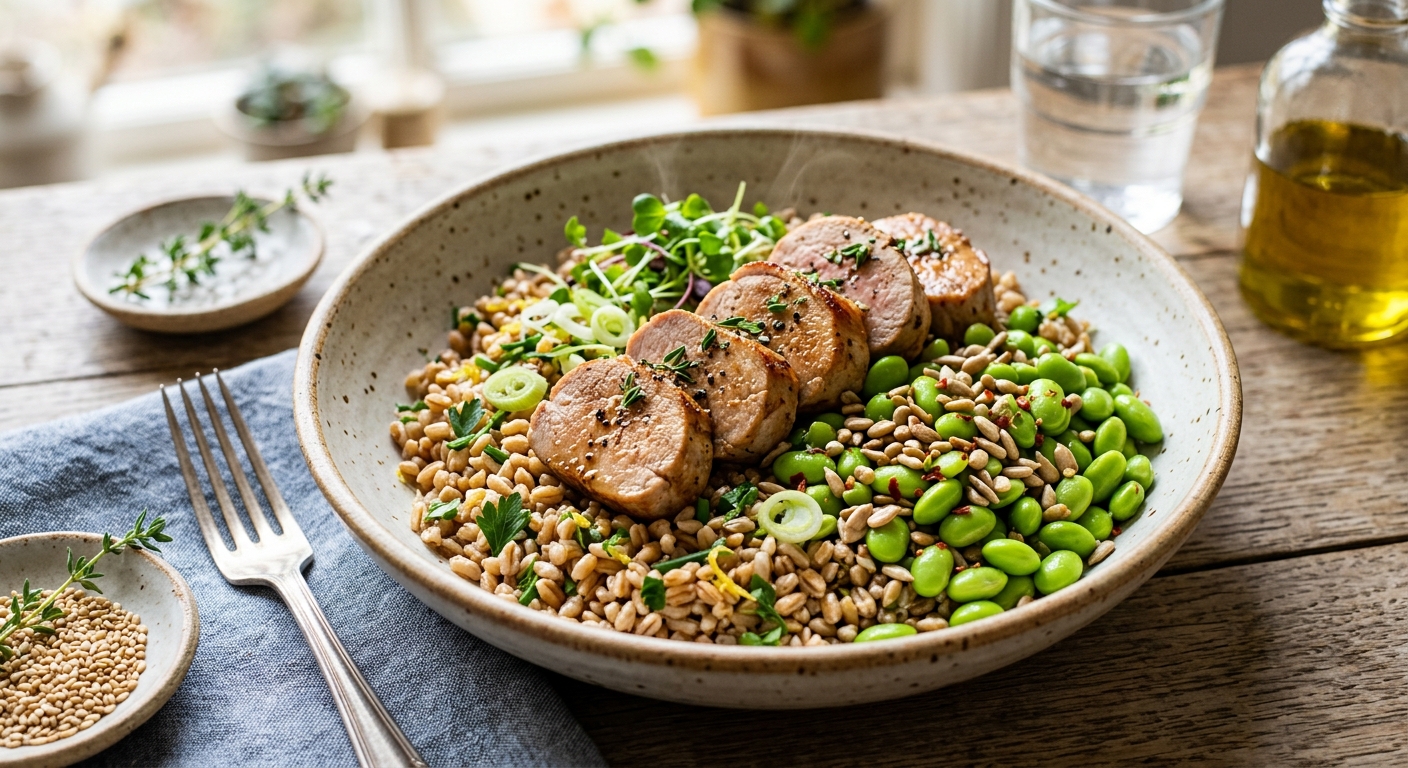
Thiamine, or vitamin B1, is one of nutrition’s unsung heroes. Every carbohydrate you eat must pass through a thiamine-dependent enzymatic gateway before your cells can harvest its energy. Without adequate B1, fatigue, brain fog, and sluggish digestion are common companions. Yet surveys consistently show that a significant portion of adults fall short of the 1.1 to 1.2 mg daily recommended intake. This bowl was engineered to close that gap deliciously.
The two headline ingredients, pork tenderloin and pearled farro, are among the most thiamine-dense foods available in a standard grocery store. A 100g cooked portion of pork loin provides roughly 0.7 mg of thiamine, while a 200g dry serving of farro contributes an additional 0.4 mg from its intact bran layers, along with a remarkable fibre and protein profile that rivals quinoa. Together, with supporting players like edamame, sunflower seeds, and nutritional yeast stirred in at the finish, a single serving of this dish clears 80% of the adult RDI for B1 before you even consider the rest of your day.
Beyond thiamine, this recipe tells a broader nutritional story. Farro is one of the few grains to supply all three macronutrients in meaningful quantities, and its low-to-medium glycemic index makes it ideal for sustained energy release. Pork tenderloin is leaner per gram than skinless chicken breast while delivering more zinc, selenium, and B-vitamins. The dish is finished with a miso-ginger broth and a scatter of fresh herbs, because calibrated nutrition should never taste like a supplement, it should taste like dinner.
4
servings
Ingredients
- 600 gpork tenderloin, silver skin removed, cut into 3cm medallions
- 280 gpearled farro, rinsed
- 150 gshelled edamame, thawed if frozen
- 2 tbspwhite (shiro) miso paste
- 1 tbspnutritional yeast flakes
- 2 tbspextra-virgin olive oil
- 1 tbsptoasted sesame oil
- 30 graw sunflower seeds
- 3 clovesgarlic, finely minced
- 1 tbspfresh ginger, grated on a microplane
- 1 mediumyellow onion, finely diced
- 2 mediumcarrots, peeled and cut into 1cm coins
- 2 stalkscelery, thinly sliced
- 900 mllow-sodium chicken stock
- 200 mlwater
- 1 tbsplow-sodium soy sauce
- 1 tspsmoked paprika
- 0.5 tspground turmeric
- 4 stalksgreen onions, thinly sliced (to serve)
- 15 gfresh flat-leaf parsley, roughly chopped (to serve)
- —Colima Sea SaltMicroplastic Free Salt and freshly cracked black pepper to taste
Instructions
Click on an item below to shop for the recommended items for this recipe on Amazon.
As an Amazon Associate, we earn from qualifying purchases.
- Pat the pork medallions dry with paper towels and season generously on both sides with salt, black pepper, and the smoked paprika. Heat a large Dutch oven or heavy-bottomed pot over medium-high heat until smoking slightly. Add the olive oil, then sear the pork medallions in a single layer for 2 to 3 minutes per side until deeply golden. Work in two batches to avoid crowding the pan. Transfer the seared medallions to a plate and set aside; they will finish cooking in the broth.
- Reduce the heat to medium. Add the diced onion, carrot coins, and celery to the same pot, scraping up the fond with a wooden spoon. Cook, stirring occasionally, for 6 to 7 minutes until the onion is softened and translucent. Add the garlic and ginger, stir constantly for 90 seconds until fragrant, then sprinkle in the turmeric and cook for a further 30 seconds.
- Add the rinsed farro to the pot and stir to coat each grain in the aromatic base, toasting lightly for 2 minutes. Pour in the chicken stock and water, then stir in the soy sauce. Bring to a rolling boil over high heat, then immediately reduce to a steady simmer over medium-low heat. Cover with a lid slightly ajar and cook for 25 minutes, stirring every 8 to 10 minutes to prevent the farro sticking to the base.
- Whisk the miso paste and nutritional yeast into 60ml of warm water until smooth, making a slurry. After 25 minutes, check the farro; it should be tender but still have a slight chew at the centre (al dente). Nestle the seared pork medallions back into the pot, pressing them gently into the grain mixture. Scatter in the edamame. Pour the miso slurry around the edges of the pot and gently stir to incorporate. Cover and cook for a further 6 to 8 minutes until the pork registers 63 degrees C (145 F) on an instant-read thermometer.
- Remove from the heat and drizzle the toasted sesame oil over the surface. Rest, covered, for 3 minutes. Taste for seasoning, adding salt and pepper as needed. Spoon into wide bowls and finish with a generous scatter of green onions, fresh parsley, and the sunflower seeds. Serve immediately.
- In a small bowl, whisk together the miso paste, nutritional yeast, soy sauce, smoked paprika, and turmeric with 60ml of the chicken stock until a smooth paste forms. Set aside. Place the diced onion, carrot coins, celery, minced garlic, and grated ginger into the slow cooker insert and stir to distribute. Scatter the rinsed farro over the vegetables.
- Pour the miso-spice paste over the farro, then add the remaining chicken stock and water. Stir gently from the bottom to ensure nothing is pooling dry beneath the farro. Season lightly with salt and black pepper, noting the miso and stock already contribute significant sodium. Place the lid on and cook on Low for 5 to 5.5 hours, or until the farro is nearly tender but still has a firm core.
- Meanwhile, about 15 minutes before adding the pork, season the medallions on both sides with salt, black pepper, and a light dusting of smoked paprika. For best flavour and texture, sear them in a hot skillet with the olive oil for 2 minutes per side. This step is optional but strongly recommended; the caramelisation adds depth to the broth and helps the medallions hold together rather than shredding.
- After 5 to 5.5 hours, nestle the seared (or raw, if skipping the sear) pork medallions into the farro, pressing them below the surface of the liquid. Scatter the edamame around the medallions. Replace the lid and cook on Low for a further 1 to 1.5 hours, until the pork is cooked through to 63 degrees C (145 F) and the farro is fully tender with a creamy, porridge-like consistency.
- Turn off the slow cooker. Drizzle the toasted sesame oil over the surface and rest for 5 minutes with the lid on. Stir gently, taste for seasoning, and ladle into bowls. Top with green onions, parsley, and sunflower seeds. The farro will have absorbed most of the liquid and developed a luxurious, starchy texture quite different from the stovetop version.
- Set the Instant Pot or electric pressure cooker to Saute on High (or use a stovetop pressure cooker over medium-high heat). Add the olive oil. Season the pork medallions with salt, pepper, and smoked paprika, then sear in batches for 2 minutes per side until golden. Transfer to a plate. Add the diced onion, carrots, and celery to the pot and saute for 4 minutes, scraping up any browned bits. Add the garlic and ginger and cook for 60 seconds until fragrant.
- Sprinkle in the turmeric and stir for 20 seconds. Add the rinsed farro and stir to coat in the aromatics. Press Cancel to stop the Saute function. In a small bowl, whisk the miso paste, nutritional yeast, and soy sauce into 80ml of the chicken stock until smooth, then pour into the pot. Add the remaining stock and water. Stir to deglaze any stubborn fond from the base; this prevents a Burn warning.
- Nestle the seared pork medallions on top of the farro mixture; do not fully submerge them, as they should steam rather than boil. Secure the lid and set the pressure valve to Sealing. Cook at High Pressure for 14 minutes. While the pot comes to pressure and cooks, prepare the toppings: slice the green onions, chop the parsley, and measure out the sunflower seeds.
- When the cook time is complete, perform a controlled Quick Release by moving the valve to Venting in short, 3-second bursts for the first 30 seconds to avoid sputtering, then fully open the valve. Once the float pin drops, carefully open the lid away from you. Check the pork with an instant-read thermometer; it should read 63 to 68 degrees C. If it reads below 63 degrees C, reseal and cook at High Pressure for a further 2 minutes.
- Gently lift the pork medallions onto a cutting board and rest for 3 minutes while you stir the edamame directly into the hot farro; the residual heat will warm the edamame through in 2 minutes without requiring additional cooking. Drizzle the sesame oil into the farro and stir. Taste for seasoning. Slice or leave the pork medallions whole, return them to the bowls over the farro, and finish with green onions, parsley, and sunflower seeds.
- Preheat the oven to 175 degrees C (350 F) with the rack set in the lower-middle position. Place a large Dutch oven over medium-high heat on the stovetop. Add the olive oil and heat until shimmering. Season the pork medallions with salt, pepper, and smoked paprika, then sear for 2 to 3 minutes per side until a deep golden crust forms. Transfer to a plate. Lower the heat to medium, add the onion, carrot, and celery, and cook for 5 to 6 minutes, stirring frequently, until softened. Stir in the garlic and ginger and cook for 90 seconds.
- Add the turmeric and stir for 30 seconds. Pour in the rinsed farro and stir to coat in the aromatics. In a separate bowl, whisk the miso paste, nutritional yeast, and soy sauce together with 80ml of warm stock, then add this slurry along with the remaining stock and water to the Dutch oven. Stir well to incorporate. Bring to a simmer on the stovetop over medium-high heat, then cover tightly with the lid.
- Carefully transfer the covered Dutch oven to the preheated oven. Bake for 30 minutes without opening the lid. The enclosed environment allows the farro to absorb the broth gently and evenly, developing a flavour and texture quite different from constant stirring on the stovetop.
- After 30 minutes, remove the lid and check the farro; it should be about 70% cooked with some liquid remaining. Nestle the seared pork medallions into the farro, pressing them partially below the surface. Scatter the edamame around the pork. Replace the lid and return the Dutch oven to the oven. Bake for a further 20 to 25 minutes until the pork reaches an internal temperature of 63 degrees C (145 F) and the farro has absorbed nearly all the liquid.
- Remove the Dutch oven from the oven and let it rest, lid on, for 5 minutes. Remove the lid and drizzle the sesame oil across the surface. Taste for seasoning. The farro at the edges will have formed a very slightly crisped, nutty crust against the sides of the pot; scrape these into the bowls as you serve, as they carry exceptional flavour. Finish with green onions, parsley, and sunflower seeds.
Nutrition Breakdown
Per 1 serving (makes 4)
Vitamins & Minerals
% Daily Value based on a 2,000 calorie diet (FDA reference)
🧬 Essential Amino Acids
% of recommended daily intake (RDA) per serving
🛡 Antioxidant Profile
The Nutrition Science
Thiamine (vitamin B1) is a water-soluble vitamin that functions as the essential cofactor for three critical enzyme complexes: pyruvate dehydrogenase, alpha-ketoglutarate dehydrogenase, and the branched-chain alpha-keto acid dehydrogenase complex. In practical terms, this means thiamine is the biochemical gatekeeper through which glucose from carbohydrates enters the Krebs cycle for ATP production. Without sufficient B1, carbohydrate-rich meals generate lactate rather than energy, contributing to the fatigue, irritability, and cognitive sluggishness that mild thiamine insufficiency produces long before clinical deficiency (beriberi) appears. Pork is the most concentrated dietary source of thiamine in the standard Western food supply, providing nearly 5 times more B1 per gram than beef or chicken, primarily because pigs store thiamine in high concentrations within their muscle tissue.
Farro (Triticum dicoccum) contributes meaningfully to the thiamine load of this dish through its intact pericarp and aleurone layers, the bran fractions where B-vitamins in whole grains are concentrated. Pearled farro retains more of these fractions than refined wheat, and its intact cellular structure also slows amylase digestion, lowering the postprandial glucose and insulin response relative to white rice or pasta, which is why this dish achieves a medium rather than high glycemic load despite its substantial carbohydrate content. The edamame contributes a small but meaningful additional thiamine increment alongside isoflavones and complete soy protein, while the nutritional yeast stirred in at the end provides a significant, heat-stable source of B1 and B3 that survives gentle incorporation into the finished dish.
The inclusion of selenium-rich pork alongside vitamin E from sunflower seeds is a nutritionally deliberate pairing. These two nutrients are biochemically synergistic: selenium is a structural component of glutathione peroxidase while vitamin E acts as the primary lipid-soluble radical quencher; together they form an interlocking antioxidant network. Thiamine itself is increasingly understood to have direct antioxidant properties beyond its enzymatic roles, with emerging evidence that it reduces advanced glycation end-products (AGEs) and may protect neuronal membranes from lipid peroxidation. Building a dish that simultaneously optimises thiamine intake and supports the antioxidant systems that protect thiamine-dependent tissues is therefore not a coincidence, but a deliberate principle of calibrated nutritional design.
Pro Tips
- Do not overcook the pork: pork tenderloin is safest and juiciest at an internal temperature of 63 degrees C (145 F) followed by a 3-minute rest. Above 70 degrees C, the lean fibres contract sharply and the meat becomes dry and chalky. An instant-read thermometer is the single most impactful tool in this recipe.
- Rinse the farro but do not soak it overnight for this recipe; a quick rinse removes surface starch and prevents excessive thickening of the broth, while skipping the soak preserves the grain’s structural integrity so it holds its texture through the full cooking time without turning mushy.
- Thiamine is heat-sensitive and water-soluble, so avoid boiling the dish aggressively once the pork and miso are added. A gentle simmer or the residual heat of the resting period is sufficient. Adding the miso as a slurry rather than directly to boiling liquid also preserves its beneficial enzymes and limits thiamine losses from the fermented paste.

Love this angle on thiamine, especially since B1 is so crucial for glucose metabolism and energy production. I’m always looking for whole food sources instead of relying on fortified stuff, and pork tenderloin is such a smart choice here. Quick question: what’s the glycemic load on this with the farro? I’ve found that pairing whole grains with protein and fat in the right ratios makes such a difference in how my blood sugar responds, so I’m curious how this performs for you!
This is exactly what I needed to see right now. I’ve been struggling with energy crashes in the afternoons, and my neurologist mentioned that B1 deficiency can actually worsen neuroinflammation, which is obviously a big concern for me with my MS. I love that you’re building the thiamine content around whole food sources like pork and farro instead of just relying on enriched grains, because I’ve noticed my body responds better when I’m getting micronutrients from the actual food matrix. Thank you for putting this together with that kind of precision, it genuinely helps me meal plan around what actually supports my nervous system health.
This is really interesting from a metabolic perspective – I’ve been tracking how B1 status affects my lactate clearance during high intensity intervals, and there’s definitely something there with thiamine’s role in pyruvate metabolism. The farro component caught my eye too, since whole grains have better micronutrient density than refined carbs, though I’m curious about the total carb load per serving and whether you’d recommend this more for recovery days or base building phases? Currently I’m experimenting with timing thiamine-rich meals around my harder efforts to see if it impacts my power output data, so this recipe could be a solid addition to my rotation.