
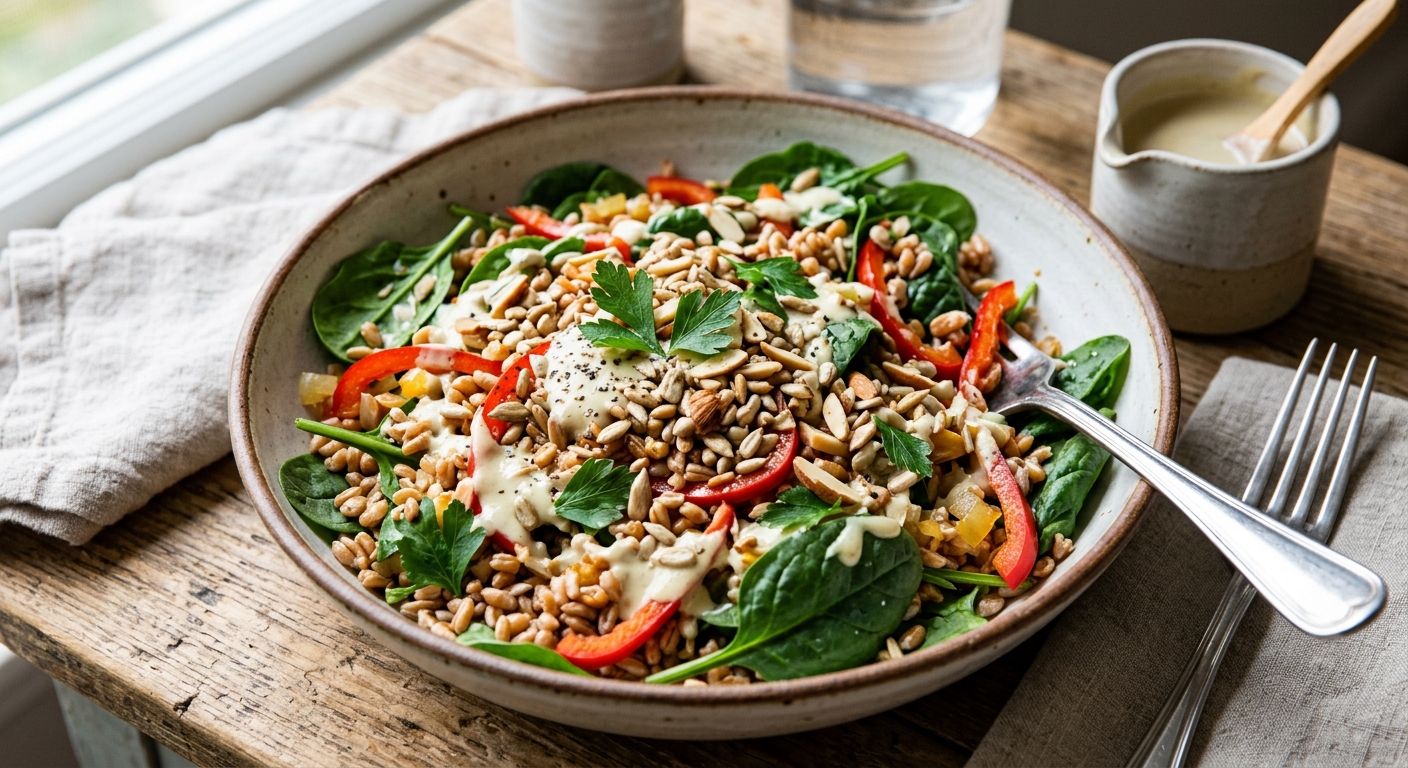
Vitamin E is one of the most underconsumed fat-soluble vitamins in the modern diet, yet its role in immune defense, skin integrity, and cellular protection from oxidative stress is absolutely critical. Most people associate Vitamin E with capsule supplements, but the most bioavailable forms come packaged inside whole foods alongside the healthy fats needed to absorb them. This Sunflower, Almond, and Spinach Plate was engineered from the ground up to change that, concentrating three of the richest natural sources of alpha-tocopherol into a single, deeply satisfying meal.
What makes this dish special beyond its nutritional profile is how beautifully its flavors cohere. Toasted sunflower seeds bring a roasted, nutty depth. Slivered almonds add crunch and a faint sweetness. Baby spinach, gently wilted, provides a silky, mineral backbone. Farro, the ancient emmer wheat, gives the bowl its hearty, chewy center. The lemon-tahini dressing ties everything together with acidity, creaminess, and the welcome bitterness of sesame, while a touch of smoked paprika and garlic transforms the whole plate from wholesome to genuinely craveable.
Every cooking method here, whether stovetop, slow cooker, pressure cooker, or oven, has been designed to develop the dish’s flavor differently. The stovetop builds layers in sequence. The slow cooker melds the farro and vegetables into something almost risotto-like. The pressure cooker delivers speed without sacrificing the nutty texture of whole farro. The oven method roasts the vegetables for deeper caramelization and a slightly more complex flavor profile. Choose your method based on your schedule and your preference, and then finish every version with the same bright dressing and a generous scatter of toasted seeds and nuts for maximum Vitamin E impact.
4
servings
Ingredients
- 280 gwhole farro, rinsed
- 150 graw sunflower seeds (shelled)
- 100 gslivered almonds
- 300 gbaby spinach, washed and dried
- 2 largered bell peppers, thinly sliced
- 1 mediumyellow onion, finely diced
- 4 clovesgarlic, minced
- 3 tbspextra-virgin olive oil
- 720 mllow-sodium vegetable broth
- 60 mltahini (well-stirred)
- 3 tbspfresh lemon juice (about 1.5 lemons)
- 1 tbsplemon zest
- 1 tspsmoked paprika
- 0.5 tspground cumin
- 2 tbspnutritional yeast
- 1 tbspapple cider vinegar
- 2 tbspwarm water (for dressing)
- —Colima Sea SaltMicroplastic Free Salt and black pepper to taste
Instructions
Click on an item below to shop for the recommended items for this recipe on Amazon.
As an Amazon Associate, we earn from qualifying purchases.
- Toast the sunflower seeds and slivered almonds separately in a dry skillet over medium heat, stirring constantly. The sunflower seeds will take 3 to 4 minutes until golden and fragrant. The almonds will take 2 to 3 minutes. Transfer each to a small bowl immediately once toasted, as they continue browning off the heat. Set aside.
- In a medium saucepan, combine the rinsed farro with 720 ml of vegetable broth and a pinch of salt. Bring to a boil over high heat, then reduce to a steady simmer. Cook uncovered for 25 to 30 minutes, stirring occasionally, until the farro is tender but still has a pleasant chew. Drain any excess liquid and set aside.
- While the farro cooks, heat 2 tablespoons of olive oil in a large wide skillet or Dutch oven over medium heat. Add the diced onion with a pinch of salt and cook, stirring occasionally, for 7 to 8 minutes until softened and lightly golden. Add the minced garlic, smoked paprika, and cumin, and stir for 1 minute until fragrant.
- Add the sliced red bell peppers to the skillet and cook over medium-high heat for 5 to 6 minutes, stirring occasionally, until they are soft and beginning to char lightly at the edges. Push the vegetables to the side of the pan.
- Add the cooked farro to the skillet and stir everything together. Drizzle the remaining 1 tablespoon of olive oil around the edge of the pan and let the farro sit undisturbed for 90 seconds to develop a light crust on the bottom, then stir. Add the baby spinach in two batches, folding it into the hot farro mixture until just wilted, about 2 minutes total. Season generously with salt and pepper.
- Whisk together the tahini, lemon juice, lemon zest, apple cider vinegar, nutritional yeast, and 2 tablespoons of warm water until a smooth, pourable dressing forms. Season with salt. Divide the farro and vegetable mixture among four bowls, drizzle generously with the lemon-tahini dressing, and finish each bowl with a liberal scatter of toasted sunflower seeds and slivered almonds.
- Toast the sunflower seeds and slivered almonds separately in a dry skillet over medium heat, stirring constantly, 3 to 4 minutes for seeds and 2 to 3 minutes for almonds, until golden and fragrant. Transfer to separate bowls and set aside. These are added at the very end and never go into the slow cooker.
- In the insert of your slow cooker, combine the rinsed farro, diced onion, minced garlic, sliced red bell peppers, smoked paprika, cumin, 1 teaspoon of salt, and a generous grind of black pepper. Pour the vegetable broth over everything and stir briefly to distribute. Drizzle 2 tablespoons of olive oil across the surface.
- Place the lid on the slow cooker and cook on Low for 4 to 5 hours. At the 4-hour mark, lift the lid and test the farro. It should be tender and creamy with most of the broth absorbed. The peppers will be very soft and melded into the grain, creating a more cohesive, stew-like texture than other methods.
- Once the farro is cooked, scatter the baby spinach directly over the top of the hot mixture, replace the lid, and allow the residual heat to wilt the spinach for 8 to 10 minutes without additional cooking. Then stir the wilted spinach through the farro with the remaining 1 tablespoon of olive oil. Taste and adjust seasoning.
- Whisk together the tahini, lemon juice, lemon zest, apple cider vinegar, nutritional yeast, and 2 tablespoons of warm water into a smooth dressing. Season with salt. Ladle the slow cooker farro mixture into four bowls, drizzle with the lemon-tahini dressing, and top each serving with the reserved toasted sunflower seeds and slivered almonds.
- Set your pressure cooker or Instant Pot to the Saute function on medium-high heat. Add 2 tablespoons of olive oil and, once shimmering, add the diced onion with a pinch of salt. Saute for 4 to 5 minutes until softened and translucent. Add the minced garlic, smoked paprika, and cumin and stir for 30 seconds.
- Add the sliced red bell peppers and cook on Saute for 3 minutes, stirring frequently. Add the rinsed farro and stir to coat every grain in the spiced oil for about 1 minute. This brief toasting step develops a nutty flavor that compensates for the lack of a crust the stovetop method achieves.
- Pour in the vegetable broth and stir once to deglaze any stuck bits from the bottom of the pot. This is important for preventing a burn warning. Secure the lid, set the valve to Sealing, and cook on High Pressure for 18 minutes.
- Once the cycle completes, allow the pressure to release naturally for 10 minutes, then carefully switch the valve to Venting to release any remaining pressure. Open the lid and stir the farro. If any liquid remains, switch back to Saute and cook uncovered, stirring, for 2 to 3 minutes until absorbed.
- Add the baby spinach directly to the hot pot and fold it through the farro mixture using tongs. The residual heat of the pot will wilt the spinach within 2 minutes without returning to heat. Stir in the remaining tablespoon of olive oil and season well. Meanwhile, toast the sunflower seeds and slivered almonds in a dry skillet on the stovetop for 3 to 4 minutes as described above.
- Whisk the tahini, lemon juice, lemon zest, apple cider vinegar, nutritional yeast, and warm water into a smooth dressing. Divide the farro mixture among four bowls, drizzle with dressing, and top with the toasted sunflower seeds and almonds.
- Preheat your oven to 220 degrees Celsius (425 degrees Fahrenheit). Line a large rimmed baking sheet with parchment paper. Scatter the sliced red bell peppers and diced onion across the sheet. Drizzle with 2 tablespoons of olive oil, sprinkle with smoked paprika, cumin, salt, and pepper, and toss thoroughly to coat. Spread in a single layer.
- Roast on the upper-middle rack for 30 to 35 minutes, tossing once at the 20-minute mark, until the peppers are blistered and lightly charred at the edges and the onions are deeply caramelized. Scatter the minced garlic over the vegetables for the final 5 minutes of roasting only, as garlic burns quickly at this temperature.
- While the vegetables roast, cook the farro on the stovetop. Combine the rinsed farro and vegetable broth in a medium saucepan, bring to a boil, reduce to a simmer, and cook uncovered for 25 to 30 minutes until tender but chewy. Drain any excess liquid. In the final minutes of farro cooking, spread the sunflower seeds and slivered almonds on a separate small baking sheet and toast in the same oven for 5 to 6 minutes, watching carefully, until golden.
- Remove the roasted vegetables from the oven and scrape them, along with all their caramelized juices, into the drained farro saucepan. Place the pan over low heat and fold together. Add the baby spinach in two batches and stir over low heat for 1 to 2 minutes until wilted. Stir in the remaining 1 tablespoon of olive oil and the nutritional yeast. Season generously with salt and pepper.
- Whisk together the tahini, lemon juice, lemon zest, apple cider vinegar, and 2 tablespoons of warm water to form the dressing. Season with salt. Spoon the farro and roasted vegetable mixture into four bowls. Drizzle with the lemon-tahini dressing and finish with the oven-toasted sunflower seeds and slivered almonds.
Nutrition Breakdown
Per 1 serving (makes 4)
Vitamins & Minerals
% Daily Value based on a 2,000 calorie diet (FDA reference)
🧬 Essential Amino Acids
% of recommended daily intake (RDA) per serving
🛡 Antioxidant Profile
The Nutrition Science
Vitamin E is a family of eight fat-soluble compounds, but only alpha-tocopherol is recognized by the human body as meeting the dietary requirement. The three primary sources in this dish, sunflower seeds, almonds, and spinach, collectively deliver approximately 14.8 mg per serving, virtually the entire 15 mg daily value established by the Institute of Medicine. Crucially, all three sources arrive alongside dietary fat, the lipid carrier that triggers bile secretion and enables fat-soluble vitamin absorption in the small intestine. The olive oil and tahini in the dressing further amplify this absorption window, making the bioavailability of the Vitamin E in this plate significantly higher than from a supplement taken with a low-fat meal.
The synergy between Vitamin E and Vitamin C in this dish is worth highlighting explicitly. Spinach and red bell peppers supply approximately 82 mg of ascorbic acid per serving. When alpha-tocopherol neutralizes a free radical, it becomes a tocopheroxyl radical, an oxidized and temporarily inactive form. Vitamin C donates an electron to regenerate the tocopheroxyl radical back to active alpha-tocopherol. This electron-cycling partnership means the Vitamin E in this meal works harder and longer than if consumed in isolation, a phenomenon sometimes called the Vitamin C-E antioxidant network. This is precisely why whole food sources consistently outperform isolated supplements in clinical antioxidant trials.
The selenium from sunflower seeds (approximately 38 mcg per serving, 69% DV) adds a third layer to this antioxidant architecture. Selenium is a required cofactor for glutathione peroxidase, the enzyme that reduces lipid hydroperoxides before they can cascade into wider cellular damage. Glutathione peroxidase and Vitamin E are mechanistically complementary: Vitamin E intercepts free radicals before they damage cell membranes, while glutathione peroxidase cleans up the peroxidation products that do form. This dish, by design, activates both systems simultaneously from a single plate.
Pro Tips
- Do not skip toasting the sunflower seeds and almonds. Toasting drives off residual moisture and triggers the Maillard reaction, developing dozens of new flavor compounds and intensifying the nutty character that anchors the entire dish. Untoasted seeds taste flat by comparison.
- The lemon-tahini dressing seizes up quickly when cold. If preparing the dressing in advance, store it undiluted (without the warm water) in the fridge, then whisk in the warm water just before serving to restore its pourable consistency.
- Whole farro contains the bran and germ, which means it retains far more Vitamin E, fiber, and minerals than pearled farro. Check the package label carefully. If the label reads semi-pearled, add about 5 minutes to stovetop and pressure cooker cook times. If it reads pearled, reduce cook times by 10 minutes and accept a slight reduction in nutritional density.
This is such a smart composition, especially the multi-source approach to vitamin E bioavailability – I love that you’re not just hitting the numbers but actually thinking about absorption. I’ve noticed in my practice that patients taking blood thinners often worry about vitamin K in leafy greens, but the real win here is that the fat from tahini and almonds actually helps absorb both the E and K, which can help stabilize their anticoagulant levels instead of causing fluctuations. The lemon component is the chef’s kiss though, because that acid aids mineral absorption too – do you find the brightness of the dressing changes how people perceive the earthiness of the farro?
This really caught my attention because my last quarterly labs showed my inflammation markers were finally trending down, and my functional medicine doc specifically flagged vitamin E as one of the micronutrients we needed to dial in better. I love that you’re layering three different sources here rather than just relying on one, since bioavailability varies so much depending on the food matrix. Quick question though: are you toasting the sunflower seeds and almonds yourself, or does that matter for the vitamin E availability? I’ve been experimenting with different prep methods and want to make sure I’m actually absorbing what I’m eating.
oh this is SO exciting that your inflammation markers are trending down, congrats! i totally get the bioavailability question because i’ve been doing the same deep dive with my kids’ meals. i toast everything myself now and honestly i think it does help with absorption (plus tastes better lol), but the real game changer for me was realizing that raw almonds and sunflower seeds have phytic acid that can actually bind minerals, so i started soaking and sprouting the sunflower seeds before light toasting and my kids genuinely eat more of them now without the weird aftertaste. have you experimented with any sprouting or soaking? i’m curious if thats something your functional medicine doc mentioned