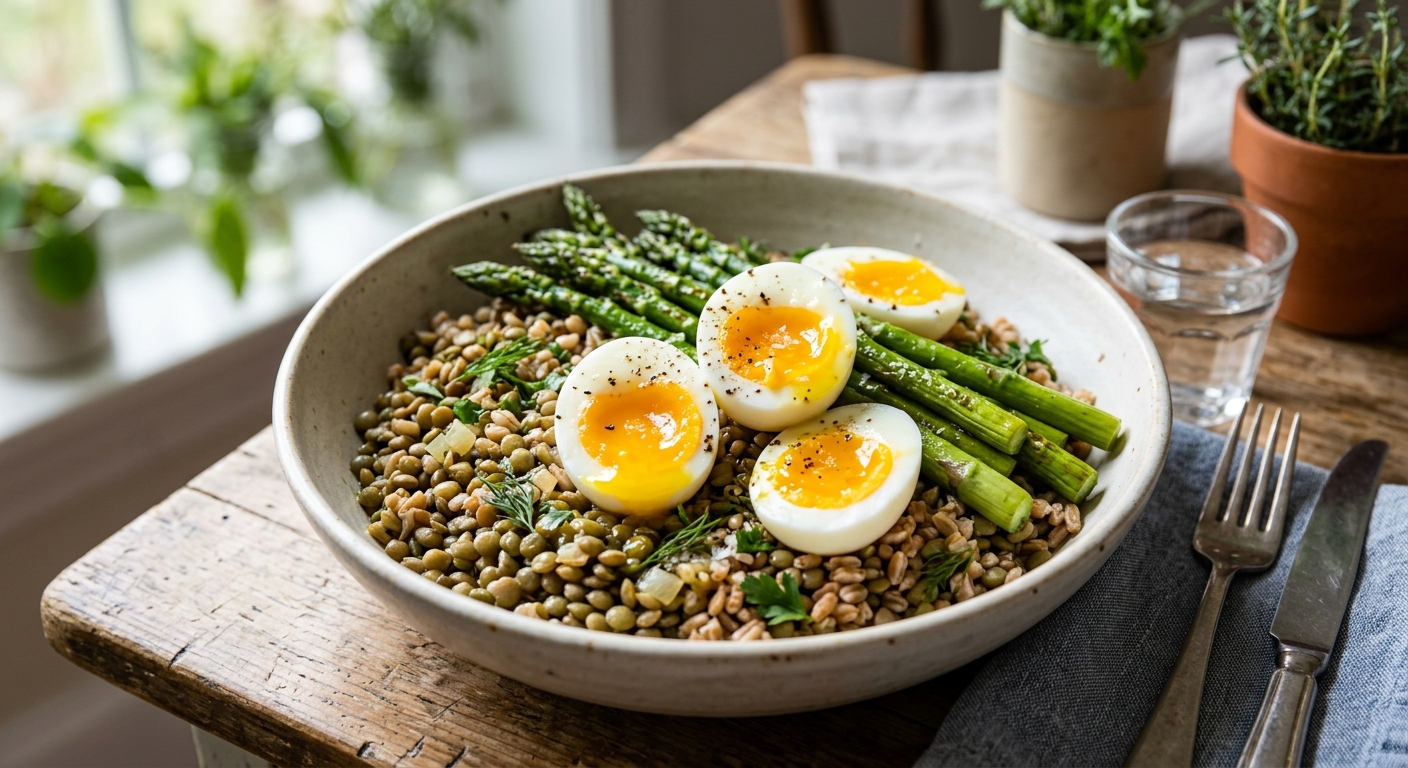
Spring arrives with a nutritional gift wrapped in green: asparagus spears push through the soil loaded with folate, glutathione, and prebiotic inulin, while humble green lentils quietly deliver more folate per cup than almost any other legume on the planet. Bring a perfectly jammy egg into the picture and you have a bowl that does serious biochemical work while tasting like a farmers-market Saturday morning. This is the kind of recipe that makes the phrase “eating your vitamins” feel less like a chore and more like a celebration.
The nutritional architecture here is deliberate. Folate (vitamin B9) is essential for DNA synthesis, red blood cell formation, and neural tube development, yet surveys consistently show it is one of the most under-consumed B vitamins in adults aged 18 to 50. Green lentils contribute roughly 180 mcg of folate per cooked half-cup, asparagus adds another 130 mcg per six spears, and the egg yolk layers in an additional 24 mcg, pushing a single bowl well past the 400 mcg RDA. The addition of lemon juice is not merely culinary: ascorbic acid in lemon actively improves non-heme iron absorption from the lentils by up to threefold, making this pairing a textbook example of food synergy.
The bowl is built around a base of quick-cooking farro, which brings its own portfolio of B vitamins, manganese, and chewy, nutty texture that stands up to the boldness of everything piled on top. A tahini-lemon drizzle ties the whole bowl together with creaminess and a further hit of calcium and zinc. Whether you simmer everything on the stovetop in under an hour, set the lentils low-and-slow in a slow cooker, blast them in a pressure cooker, or roast the asparagus and bake the lentils in the oven, every method is tuned to preserve as much folate as possible while maximising flavour through careful application of heat.
4
servings
Ingredients
- 250 ggreen lentils, rinsed and drained
- 200 gsemi-pearled farro, rinsed
- 480 gfresh asparagus (about 24 medium spears), woody ends snapped off
- 4 largeeggs
- 900 mllow-sodium vegetable broth
- 480 mlwater (for farro)
- 3 tbspextra-virgin olive oil, divided
- 1 mediumyellow onion, finely diced
- 4 clovesgarlic, thinly sliced
- 1 tspground cumin
- 0.5 tspsmoked paprika
- 0.25 tspground turmeric
- 2 tbsptahini
- 3 tbspfresh lemon juice (about 1 large lemon), divided
- 1 tsplemon zest
- 30 gfresh flat-leaf parsley, roughly chopped
- 20 gfresh mint leaves, torn
- 40 gsunflower seeds, lightly toasted
- 1 tsphoney or maple syrup
- —Colima Sea SaltMicroplastic Free Salt and freshly cracked black pepper to taste
- —Pinch of red pepper flakes (optional)
Instructions
Click on an item below to shop for the recommended items for this recipe on Amazon.
As an Amazon Associate, we earn from qualifying purchases.
- Cook the farro: bring 480 ml water and a generous pinch of salt to a boil in a medium saucepan over high heat. Add the rinsed farro, reduce heat to medium-low, cover, and simmer for 25 to 30 minutes until tender with a pleasant chew. Drain any excess water, toss with 1 tbsp lemon juice and a drizzle of olive oil, cover to keep warm, and set aside.
- While the farro cooks, start the lentils: heat 2 tbsp olive oil in a Dutch oven or large saucepan over medium heat. Add the diced onion with a pinch of salt and cook, stirring occasionally, for 6 to 8 minutes until softened and lightly golden. Add the sliced garlic, cumin, smoked paprika, and turmeric, and cook for 90 seconds until fragrant, stirring constantly to prevent the garlic from burning.
- Add the rinsed lentils and vegetable broth to the Dutch oven. Increase heat to bring to a boil, then reduce to a steady simmer. Cook uncovered for 22 to 25 minutes, stirring occasionally, until lentils are tender but holding their shape. Season generously with salt and pepper. If liquid remains, increase heat briefly to reduce it to a glossy, saucy consistency.
- While the lentils finish, cook the asparagus: heat the remaining 1 tbsp olive oil in a large skillet over medium-high heat until shimmering. Add the asparagus spears in a single layer, season with salt and pepper, and cook undisturbed for 2 minutes. Toss and continue cooking for 2 to 3 more minutes until bright green, tender-crisp, and lightly charred in spots. Remove from heat, squeeze 1 tbsp lemon juice over the spears.
- Soft-boil the eggs: bring a small saucepan of water to a rolling boil. Gently lower the eggs in with a spoon, set a timer for exactly 7 minutes, then transfer immediately to an ice bath for 2 minutes. Peel carefully and halve lengthwise.
- Make the tahini drizzle: whisk together tahini, remaining 1 tbsp lemon juice, lemon zest, honey, and 2 to 3 tbsp warm water until smooth and pourable. Season with a pinch of salt.
- Assemble the bowls: divide the warm farro among four bowls. Spoon a generous mound of spiced lentils alongside. Arrange 6 asparagus spears over each bowl and nestle two egg halves cut-side up. Drizzle tahini sauce over everything, then scatter with parsley, mint, toasted sunflower seeds, and a pinch of red pepper flakes if using. Serve immediately.
- In the slow cooker insert, combine the rinsed lentils, diced onion, sliced garlic, cumin, smoked paprika, turmeric, and vegetable broth. Stir everything together, drizzle 1 tbsp olive oil over the top, and season with 0.5 tsp salt and several grinds of black pepper. Place the lid on and cook on Low for 6 to 7 hours, or on High for 3 to 3.5 hours, until the lentils are completely tender and have absorbed most of the broth into a thick, saucy consistency.
- About 35 minutes before serving, cook the farro on the stovetop: bring 480 ml water and a pinch of salt to a boil in a medium saucepan. Add the rinsed farro, reduce to a simmer, cover, and cook for 25 to 30 minutes until tender. Drain, toss with 1 tbsp olive oil and 1 tbsp lemon juice, cover, and keep warm.
- While the farro cooks, roast the asparagus under the broiler for a char that the slow cooker cannot provide: preheat your broiler to high and line a rimmed baking sheet with foil. Toss asparagus spears with 1 tbsp olive oil, salt, and pepper, and spread in a single layer. Broil 10 to 12 cm from the heat for 5 to 6 minutes, turning once halfway, until tender and lightly blistered.
- Soft-boil the eggs: bring a small saucepan of water to a boil, lower in the eggs, and cook for exactly 7 minutes. Transfer to an ice bath for 2 minutes, then peel and halve.
- Stir 1 tbsp lemon juice into the finished lentils in the slow cooker and taste for seasoning, adding more salt if needed. The long, gentle braise will have melded the spices into a deeply savoury base.
- Make the tahini drizzle by whisking together tahini, remaining 2 tbsp lemon juice, lemon zest, honey, and 2 to 3 tbsp warm water until smooth and pourable. Season with salt.
- Build the bowls: spoon farro into each of four bowls, top with a portion of the slow-cooked lentils, lay the broiled asparagus across, and nestle two egg halves in each bowl. Finish with tahini drizzle, fresh parsley, mint, toasted sunflower seeds, and red pepper flakes.
- Select the Sauté function on Normal heat. Add 2 tbsp olive oil and let it heat for 1 minute. Add the diced onion with a pinch of salt and sauté, stirring frequently, for 4 to 5 minutes until softened. Add the garlic, cumin, smoked paprika, and turmeric, and cook for 60 seconds, stirring constantly, until the spices are blooming and fragrant. Press Cancel.
- Add the rinsed lentils and vegetable broth to the pot. Stir to combine, scraping up any browned bits from the bottom of the insert to prevent a burn notice. Secure the lid, set the steam-release valve to Sealing, and select Pressure Cook on High for 10 minutes.
- While the lentils pressure-cook, cook the farro on a separate burner: bring 480 ml water and a pinch of salt to a boil, add the rinsed farro, reduce to a simmer, cover, and cook 25 to 30 minutes until tender. Drain any excess water, toss with 1 tbsp olive oil and 1 tbsp lemon juice, and keep covered.
- Soft-boil the eggs on the same burner while the farro simmers: bring a small saucepan of water to a boil, lower in the eggs, cook 7 minutes, then transfer to an ice bath. Peel and halve when cool enough to handle.
- When the pressure cooker beeps, allow a natural pressure release for 5 minutes, then carefully turn the valve to Venting to release any remaining steam. Open the lid, stir in 1 tbsp lemon juice, and taste for seasoning. If the lentils look soupy, select Sauté and cook uncovered for 2 to 3 minutes, stirring, until thickened.
- Cook the asparagus using the now-free stovetop burner: heat the remaining 1 tbsp olive oil in a skillet over medium-high heat. Sear the asparagus spears for 4 to 5 minutes, tossing occasionally, until tender-crisp and charred in spots. Season with salt, pepper, and a squeeze of lemon.
- Whisk the tahini drizzle: combine tahini, remaining lemon juice, lemon zest, honey, and 2 to 3 tbsp warm water until pourable. Assemble bowls with farro, pressure-cooked lentils, seared asparagus, and egg halves. Finish with tahini drizzle, herbs, sunflower seeds, and chilli flakes.
- Preheat your oven to 190 degrees C (375 degrees F). Place a Dutch oven over medium heat on the stovetop. Add 2 tbsp olive oil and cook the diced onion with a pinch of salt for 6 to 8 minutes, stirring occasionally, until soft and golden at the edges. Add the garlic, cumin, smoked paprika, and turmeric, and stir for 90 seconds until fragrant.
- Add the rinsed lentils and vegetable broth to the Dutch oven. Season with 0.5 tsp salt and several grinds of pepper. Bring to a simmer on the stovetop, then cover tightly with the lid and transfer to the preheated oven. Bake for 40 to 45 minutes, checking once at 30 minutes, until the lentils are tender and have absorbed the broth into a thick, stewlike consistency. Stir in 1 tbsp lemon juice when you remove the pot from the oven.
- While the lentils bake, cook the farro: bring 480 ml water and a pinch of salt to a boil on the stovetop. Add the rinsed farro, reduce to a simmer, cover, and cook 25 to 30 minutes until tender. Drain, toss with 1 tbsp olive oil and 1 tbsp lemon juice, and keep warm.
- Roast the asparagus on a separate oven rack during the last 15 minutes of the lentils’ baking time: toss asparagus with 1 tbsp olive oil, salt, and pepper on a rimmed baking sheet, spreading in a single layer. Roast at the same 190 degrees C for 12 to 15 minutes, turning once, until tender with lightly caramelised tips.
- Soft-boil the eggs on the stovetop: bring a small saucepan of water to a boil, lower in the eggs, cook for 7 minutes, then transfer immediately to an ice bath. Peel once cooled and halve lengthwise.
- Whisk together the tahini drizzle: combine tahini, remaining lemon juice, lemon zest, honey, and 2 to 3 tbsp warm water until smooth and pourable. Taste and season with salt.
- Assemble the bowls with a base of farro, a generous spoonful of oven-braised lentils, the roasted asparagus arranged on top, and two egg halves. Drizzle generously with tahini sauce and finish with parsley, mint, toasted sunflower seeds, and red pepper flakes.
Nutrition Breakdown
Per 1 serving (makes 4)
Vitamins & Minerals
% Daily Value based on a 2,000 calorie diet (FDA reference)
🧬 Essential Amino Acids
% of recommended daily intake (RDA) per serving
🛡 Antioxidant Profile
The Nutrition Science
Folate’s biochemical role centres on the one-carbon transfer cycle, a metabolic pathway that underpins DNA methylation, nucleotide synthesis, and the conversion of homocysteine to methionine. Elevated homocysteine is an independent risk factor for cardiovascular disease, and adequate dietary folate is one of the most effective nutritional strategies for keeping it in check. This bowl delivers roughly 484 mcg DFE of folate per serving, exceeding the 400 mcg RDA for adults and approaching the 600 mcg requirement for pregnant individuals, all from natural food-matrix folate rather than synthetic folic acid.
The distinction between food-matrix folate and synthetic folic acid matters biochemically. Natural folates arrive in the polyglutamate form, which must be cleaved to monoglutamate by intestinal folate conjugase before absorption. Bioavailability ranges from 50% to 80% depending on the food source and gut health. However, food-matrix folate also arrives packaged with co-factors including riboflavin and vitamin B6 that support the same one-carbon cycle, creating a more complete nutritional effect than fortification alone. Cooking at moderate temperatures, as in all four methods above, is deliberately managed: folate is heat-sensitive and water-soluble, which is why the asparagus is cooked briefly, the lentils are never boiled aggressively, and the cooking broth is incorporated into the bowl rather than discarded.
Iron absorption from this plant-based bowl is meaningfully enhanced by the dish’s own vitamin C content. The ascorbic acid in the lemon juice reduces ferric iron (Fe3+) to the more absorbable ferrous form (Fe2+) directly in the gut lumen, and simultaneously chelates iron into a soluble complex that resists precipitation by phytates present in the lentils and farro. Research published in the American Journal of Clinical Nutrition demonstrates that consuming 25 mg of vitamin C alongside a phytate-rich plant meal can increase non-heme iron absorption by 200% to 300%. This bowl provides approximately 22 mg vitamin C per serving, concentrated in the asparagus, lemon juice, and fresh herbs, making the lemon dressing a functional nutritional component rather than merely a flavour choice.
Pro Tips
- Do not overcook the asparagus. Folate is water-soluble and heat-sensitive; studies show that boiling asparagus for more than 5 minutes can destroy up to 50% of its folate content. Stir-frying or roasting for under 15 minutes preserves significantly more, which is why all methods here use high, fast heat for the spears.
- Toast the sunflower seeds in a dry skillet over medium heat for 3 to 4 minutes, shaking constantly, until golden. The Maillard reaction creates nutty, roasted flavour compounds and slightly increases the bioavailability of zinc by reducing surface phytate concentration.
- Lentils do not need soaking, but rinsing them thoroughly under cold water until it runs clear removes surface saponins that can cause bitterness and digestive discomfort. For even better digestibility, soak them in cold water for 2 hours before cooking and reduce simmer time by 5 minutes.

omg this is so up my alley because ive been sprouting green lentils for like two months now and the folate bioavailability is just next level when you do it right, plus the phytic acid reduction means my kids actually absorb whats there instead of it just passing through. ive been pairing them with roasted asparagus too and my son literally asked for seconds the other night which never happens with anything green lol. one question though – are you soaking/sprouting the lentils in this recipe or using them straight cooked, and do you know if the heat from cooking reduces the folate much or does the raw asparagus help compensate?
this sounds amazing and i love that youre sprouting your lentils, sylvia – that phytic acid reduction is so real for mineral absorption! i have to ask though, are you pairing this with anything acidic like that lemon mentioned in the recipe? im always thinking about iron bioavailability alongside folate since theyre both so important, and that citric acid from lemon would really help if theres any non-heme iron from the lentils getting absorbed. my ferritin has been so much better since i started being intentional about these kinds of food pairings, and folate plus optimized iron absorption feels like the ultimate spring combo for us
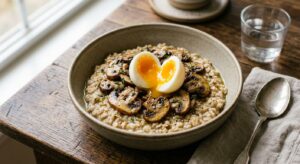
this is such a smart observation about the lemon pairing! tbh the real mvp move here would be throwing some mushrooms into this bowl – hear me out, shiitake or oyster mushrooms have decent folate themselves but more importantly they’re packed with ergothioneine which is this incredible antioxidant that actually protects folate from degradation during cooking and storage, plus they have compounds that support iron absorption in ways that complement that citric acid boost youre talking about. ive been adding sauteed mushrooms to basically every leafy green or legume heavy meal specifically for this reason and my energy levels have been noticeably better, not just from the iron optimization but from the whole synerg