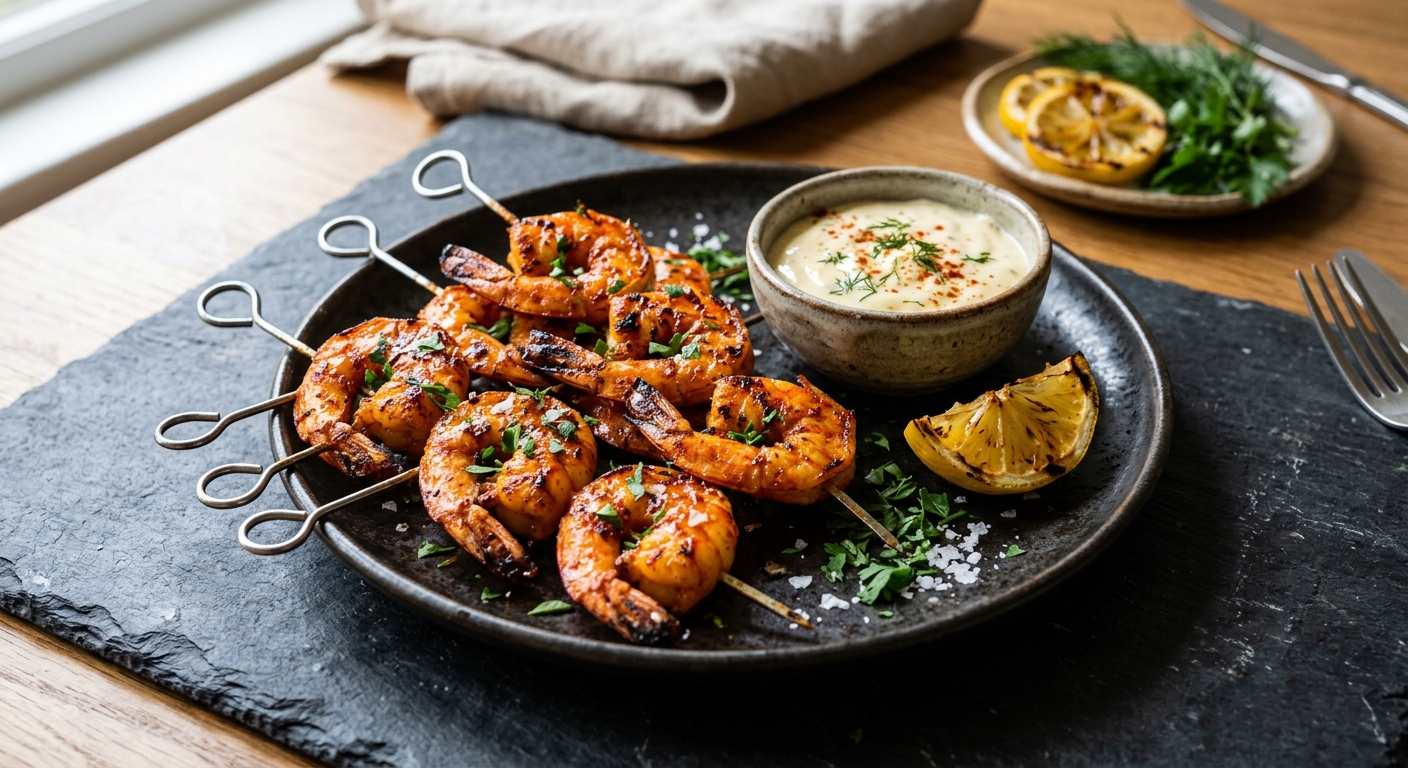
Prawns are one of nature’s most concentrated sources of selenium, a trace mineral that most people chronically under-consume. A single 150g serving of prawns provides more selenium than almost any other whole food, and when you pair them with smoked paprika, which is rich in the carotenoid capsanthin, and a robust olive oil aioli loaded with vitamin E, you create a dish where every component is actively working to support thyroid function, immune defence, and antioxidant enzyme production. This is not a side dish dressed up in health claims. It is a genuinely restaurant-calibre plate that earns its nutritional credentials.
The smoked paprika marinade does double duty here. Beyond lending that distinctive deep, earthy warmth and a gorgeous brick-red colour, paprika is one of the richest dietary sources of capsanthin and zeaxanthin, two carotenoids that protect the retina and quench reactive oxygen species. The olive oil in the marinade acts as a fat carrier that dramatically improves the bioavailability of these fat-soluble compounds, meaning the carotenoids you eat are actually absorbed rather than excreted. Lemon zest contributes a sharp, bright top note while contributing a meaningful dose of vitamin C, which in turn helps with non-haem iron absorption from the aioli’s egg yolks.
Choosing the right cooking method for prawns is critical to preserving their nutritional integrity. Selenium is relatively heat-stable compared to water-soluble vitamins, but overcooked prawns lose moisture rapidly, which concentrates rubbery texture rather than nutrients. Each method in this recipe is calibrated to cook the prawns to exactly the right internal temperature of 63 degrees Celsius, ensuring maximum juiciness, optimal texture, and full flavour development. Whether you go stovetop, oven-roasted, or use a pressure cooker for a crowd-scaled version, the science behind each technique is built into the steps.
4
servings
Ingredients
- 600 graw king prawns, peeled and deveined, tails on
- 3 tbspextra-virgin olive oil, divided
- 2 tspsmoked paprika
- 1 tspsweet paprika
- 4 clovesgarlic, 2 minced for marinade and 2 for aioli
- 1 tspground cumin
- 0.5 tspcayenne pepper
- 1 wholelemon, zest and juice separated
- 2 largeegg yolks, at room temperature
- 150 mlAvocado Oil100% Pure Avocado Oil (for aioli)
- 1 tspDijon mustard
- 2 tbspfresh flat-leaf parsley, finely chopped
- 1 tbspColima Sea SaltMicroplastic Free Salt flakes
- —Colima Sea SaltMicroplastic Free Salt and freshly cracked black pepper to taste
- —8 to 12 metal or pre-soaked wooden skewers
Instructions
Click on an item below to shop for the recommended items for this recipe on Amazon.
As an Amazon Associate, we earn from qualifying purchases.
- Prepare the marinade: in a large mixing bowl, combine 2 tablespoons of extra-virgin olive oil, the smoked paprika, sweet paprika, cumin, cayenne, 2 minced garlic cloves, lemon zest, half the lemon juice, and half a teaspoon of fine sea salt. Whisk until fully combined into a deep red paste.
- Add the peeled, deveined prawns to the bowl and toss thoroughly to coat every surface. Cover with cling film and refrigerate for 15 minutes. Do not over-marinate as the lemon acid will begin to denature the proteins and give a mushy texture beyond 30 minutes.
- While the prawns marinate, make the aioli. Place the 2 room-temperature egg yolks, Dijon mustard, remaining 2 minced garlic cloves, a pinch of salt, and a few drops of lemon juice into a tall jug or the bowl of a small food processor. Whisk or blend briefly to combine. With the motor running or while whisking vigorously, add the 150ml of light olive oil in an extremely slow, thin stream, drop by drop at first, until the emulsion thickens and turns pale yellow. Finish with the remaining lemon juice, adjust seasoning, cover, and refrigerate.
- Thread the marinated prawns onto skewers, using 4 to 5 prawns per skewer and threading through both the tail and body so each prawn lies flat and will cook evenly without spinning.
- Heat your cast iron grill pan over high heat for at least 3 minutes until it is smoking hot. Brush lightly with the remaining tablespoon of olive oil. Lay the skewers in the pan without crowding, working in two batches if necessary. Cook undisturbed for 2 to 3 minutes until strong char marks form and the prawn flesh has turned pink and opaque two thirds of the way up from the pan. Flip once and cook for a further 1 to 2 minutes until just cooked through and the tails are curled.
- Transfer skewers to a warm plate, scatter with smoked sea salt flakes and chopped parsley, and serve immediately alongside the chilled aioli and lemon wedges cut from the remaining lemon half.
- Prepare the marinade exactly as in the stovetop method and marinate the prawns for 15 minutes in the refrigerator. Make the aioli as described in the stovetop method and refrigerate.
- Position one oven rack in the upper third of the oven and one in the centre. Preheat the oven to 220 degrees Celsius (fan 200 degrees Celsius). Line a heavy rimmed baking sheet with foil and place it on the centre rack to preheat for 5 minutes. A preheated baking sheet dramatically reduces the steaming effect and promotes a better sear on the underside of the prawns.
- Thread the marinated prawns onto skewers as described in the stovetop method, 4 to 5 per skewer. Carefully remove the hot baking sheet from the oven and arrange the skewers in a single layer without overlapping. The prawns should sizzle on contact with the hot foil.
- Roast on the centre rack for 6 to 7 minutes until the prawns are pink and almost fully opaque. Move the baking sheet to the upper rack and switch the oven to the grill or broiler setting on high. Grill for 2 to 3 minutes, watching carefully, until the paprika coating blisters and darkens slightly and the edges of the prawns take on a caramelised colour.
- Remove from the oven immediately, as residual heat will continue cooking the prawns for 60 to 90 seconds after removal. Rest on the tray for 1 minute, then scatter with smoked sea salt flakes and parsley. Serve with the chilled aioli, lemon wedges, and a light green salad.
- Make the aioli first, as described in the stovetop method, since it requires no heat and can be refrigerated while you prepare everything else. This also allows the garlic flavour to mellow and develop fully.
- In the slow cooker insert, combine 2 tablespoons of extra-virgin olive oil, the smoked paprika, sweet paprika, cumin, cayenne, all 4 minced garlic cloves, lemon zest, half the lemon juice, 120ml of water, and half a teaspoon of fine sea salt. Stir to combine into a fragrant, rust-coloured poaching liquor. The water prevents the oil-based marinade from scorching against the ceramic insert and creates a gentle steaming environment.
- Set the slow cooker to Low and allow the liquid to warm for 20 minutes with the lid on until you can see gentle wisps of steam and the liquid is fragrant. Do not add the prawns to a cold slow cooker or they will overcook gradually from a cold start and lose their texture entirely.
- Add the raw prawns directly to the warm poaching liquid, spreading them in as even a layer as possible. Replace the lid and cook on Low for 45 to 60 minutes. Check at the 45-minute mark: the prawns should be uniformly pink, fully opaque, and just firm to the touch. If they still appear translucent in the thickest part, replace the lid and check every 10 minutes.
- Using tongs or a slotted spoon, transfer the prawns to a warm serving platter. If desired, thread them onto skewers for presentation after cooking. Spoon a little of the aromatic poaching oil over the top, scatter with smoked sea salt flakes and chopped parsley, and serve immediately with the chilled aioli and lemon wedges.
- Make the aioli as described in the stovetop method and refrigerate. Because this method is so fast, having the aioli ready before you start the cooker is essential.
- Prepare the marinade in a bowl (olive oil, smoked paprika, sweet paprika, cumin, cayenne, all 4 minced garlic cloves, lemon zest, half the lemon juice, and salt) and toss the prawns in it for 10 minutes at room temperature while you set up the cooker. Room-temperature prawns cook far more evenly under pressure than cold ones straight from the fridge.
- Pour 240ml of water into the bottom of the pressure cooker insert. Place the steam rack or trivet inside. Lay the marinated prawns in a single layer on the trivet, or thread them onto short skewers that fit within the diameter of your cooker pot and stack them across the trivet. Drizzle any remaining marinade over the top.
- Secure the lid, set the pressure release valve to Sealing, and select Low Pressure for 1 minute. On an Instant Pot, use the Steam function and set it to 1 minute on low, or use the custom Pressure Cook setting at low pressure for 1 minute.
- As soon as the timer beeps, immediately perform a quick pressure release by carefully switching the valve to Venting. Open the lid away from you to avoid the steam. The prawns should be uniformly pink and opaque. If any remain slightly translucent, replace the lid without pressure for 1 to 2 minutes using residual heat only. Transfer to a warm platter, scatter with smoked sea salt flakes and parsley, and serve with the chilled aioli and lemon wedges.
Nutrition Breakdown
Per 1 serving (makes 4)
Vitamins & Minerals
% Daily Value based on a 2,000 calorie diet (FDA reference)
🧬 Essential Amino Acids
% of recommended daily intake (RDA) per serving
🛡 Antioxidant Profile
The Nutrition Science
Selenium occupies a unique position in human biochemistry: it is the only trace mineral incorporated directly into amino acids, specifically as selenocysteine, which is sometimes called the 21st amino acid. This selenoprotein architecture is the backbone of the glutathione peroxidase enzyme family, the body’s primary intracellular antioxidant defence system. Without adequate selenium, glutathione peroxidase activity drops sharply, leaving cells vulnerable to hydrogen peroxide accumulation and membrane lipid peroxidation. Prawns are one of the richest dietary sources because they bioaccumulate selenium from marine sediments, with concentrations typically ranging from 40 to 60 micrograms per 100g of cooked flesh.
The synergy between selenium and vitamin E in this dish is clinically significant and not accidental. These two nutrients operate as a cooperative antioxidant pair: vitamin E, delivered here through the extra-virgin olive oil in both the marinade and the aioli, intercepts and neutralises lipid peroxyl radicals in cell membranes. When it does so, it becomes oxidised itself and must be regenerated. Selenium-dependent thioredoxin reductase performs exactly this regeneration, recycling spent vitamin E back to its active form. A diet rich in both nutrients therefore provides multiplicative antioxidant protection far exceeding the sum of either nutrient alone.
The smoked paprika also contributes meaningfully to the iodine story in this dish. While the prawns themselves deliver approximately 110 micrograms of iodine per serving, nearly 73% of the daily value, the selenium provided by the same prawns is essential for converting the inactive thyroid hormone thyroxine (T4) into the metabolically active triiodothyronine (T3) via the enzyme iodothyronine deiodinase. This is a selenoprotein. In practical terms, eating iodine-rich foods without adequate selenium is like filling a car with petrol but removing the spark plugs: the fuel is present but conversion to usable energy is impaired. This dish provides both nutrients in clinically relevant quantities simultaneously.
Pro Tips
- Buy prawns with shells on and peel them yourself: shell-on prawns are typically fresher, and the shells can be simmered with water, garlic, and a bay leaf for 20 minutes to make a rich shellfish stock that freezes well for paella or bisque.
- For the most stable aioli, ensure both the egg yolks and the light olive oil are at exactly room temperature before you begin emulsifying. Cold oil added too quickly is the single most common reason aioli breaks.
- If you are using wooden skewers on the stovetop or in the oven, soak them in cold water for at least 30 minutes before threading the prawns, but metal skewers are strongly preferred as they also conduct heat into the centre of the prawns for more even cooking.

This looks so good, and I love the selenium focus! Quick question though – I’m nursing and trying to nail my micronutrient intake, so I’m curious: do you have the DHA/EPA breakdown on these prawns? I’ve been rotating seafood carefully to keep my levels up for my baby’s brain development without overdoing mercury. Also, this aioli is calling my name as a postpartum recovery dish since egg yolks are basically my secret weapon for choline right now, but I’m wondering if you’d consider a note about making sure it’s stored/consumed safely given the raw egg situation? Either way, definitely making this soon!
Oh wow, this is such a smart spotlight on selenium, especially paired with iodine and zinc for thyroid function! I’m actually researching trace mineral bioavailability in my thesis right now, and what’s interesting to me is how the cooking method here (searing/smoking) might affect the selenium retention compared to raw or gently poached preparations. One thing I’m curious about though – I know the garlic in that aioli is getting all the attention for flavor, but did you consider that raw garlic also contains compounds that enhance mineral absorption? I’ve been experimenting with adding microgreens or sprouts on top of seafood dishes lately for that extra sulfur content and magnesium-chlorophyll
Love that you’re highlighting selenium here, honestly don’t see enough attention paid to it in clinical nutrition conversations. Prawns are genuinely underrated for thyroid support and antioxidant defense, especially glutathione peroxidase activity. One note though: that aioli sits in a gray zone for me depending on oil choice and quantity – if it’s mostly mayo and soybean oil, you’re potentially offsetting some of the anti-inflammatory benefit from the selenium and the paprika’s capsanthin. Have you tested versions with avocado oil or even just egg yolk and lemon? I’ve seen patients with metabolic syndrome respond better when we dial back the refined seed oils, and the flavor profile here