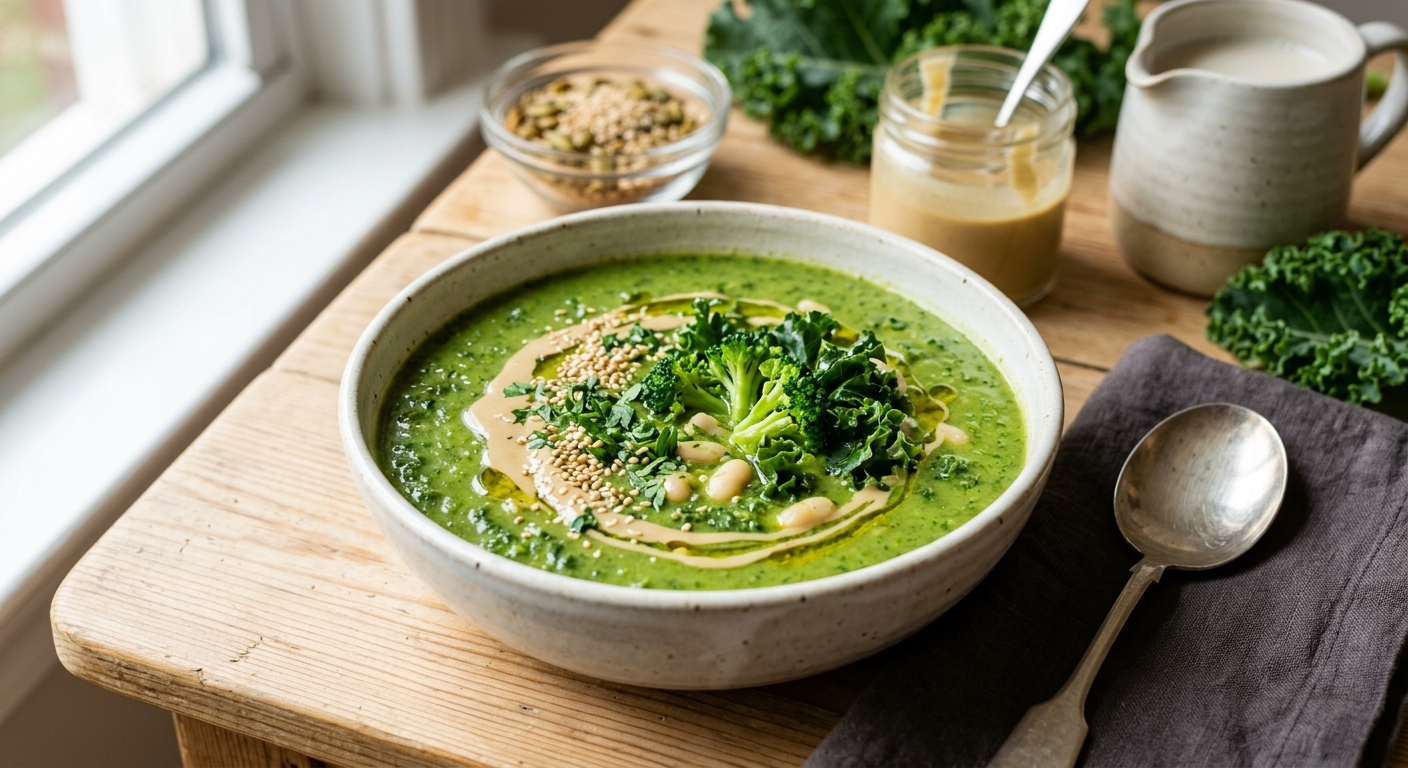
Bone health is not built on dairy alone. In fact, some of the most calcium-dense, bone-supportive ingredients on the planet are leafy greens, legumes, and fortified plant milks, and this Green Goddess Bone Health Blend brings them all together in one silky, deeply satisfying bowl. Inspired by the spirit of a green smoothie but elevated into a warm, restaurant-quality blended soup, this recipe was designed from the nutrient profile up. Every ingredient earns its place by contributing measurably to your skeletal system.
Kale and broccoli bring not only calcium and vitamin K1 (essential for bone mineralisation via osteocalcin activation) but also sulforaphane and lutein, two compounds with emerging evidence for reducing inflammatory bone loss. Fortified oat milk layers in additional calcium and vitamin D, the critical cofactor that determines how much calcium your gut actually absorbs. White beans contribute magnesium and phosphorus, the two minerals that make up the crystalline matrix of hydroxyapatite, the literal building material of bone. Tahini, ground from sesame seeds, adds a further hit of calcium alongside healthy monounsaturated fats that improve the absorption of fat-soluble vitamins D and K.
What makes this recipe especially powerful is the synergy between its nutrients. Vitamin D without adequate magnesium cannot be properly converted to its active hormonal form. Calcium without vitamin K2 analogs risks calcifying soft tissue rather than bone. This soup is calibrated so that each nutrient amplifies the others, making it far more effective than any single supplement. Whether you make it on the stovetop in under 40 minutes, let it develop deep flavour in a slow cooker, blast it to silky perfection in a pressure cooker, or build roasted complexity in the oven, every method delivers a bowl that genuinely tastes as good as it performs.
4
servings
Ingredients
- 300 gcurly kale, tough stems removed, leaves roughly torn
- 300 gbroccoli florets and peeled stems, roughly chopped
- 1 mediumwhite onion, roughly chopped
- 4 clovesgarlic, smashed
- 240 gcanned white cannellini beans, drained and rinsed
- 800 mlcalcium-fortified and vitamin-D-fortified unsweetened oat milk
- 400 mllow-sodium vegetable broth
- 3 tbsptahini (hulled sesame paste)
- 2 tbspextra-virgin olive oil
- 1 tbspfresh lemon juice
- 1 tspground nutmeg
- 1 tspColima Sea SaltMicroplastic Free Salt, plus more to taste
- 0.5 tspwhite pepper
- 2 tbspnutritional yeast (optional, for B12 and umami depth)
- —Toasted pumpkin seeds and a drizzle of olive oil, to serve
- —Pinch of smoked paprika, to serve
Instructions
Click on an item below to shop for the recommended items for this recipe on Amazon.
As an Amazon Associate, we earn from qualifying purchases.
- Heat the olive oil in a large Dutch oven or heavy-bottomed pot over medium heat. Add the chopped onion and cook, stirring occasionally, for 6 to 8 minutes until softened and translucent but not browned. Add the smashed garlic and cook for a further 90 seconds until fragrant, scraping the bottom of the pot as you stir.
- Add the broccoli florets and stems to the pot along with the vegetable broth. Increase the heat to medium-high and bring to a gentle boil. Reduce to a steady simmer and cook uncovered for 8 minutes, until the broccoli stems are just tender when pierced with a knife tip.
- Add the kale leaves in three or four batches, pressing each batch down into the liquid and allowing it to wilt before adding the next. Once all the kale is incorporated and vivid green (about 4 minutes), add the drained cannellini beans, fortified oat milk, nutmeg, white pepper, and salt. Stir well and bring back to a bare simmer for 3 minutes. Do not boil vigorously once the oat milk is added, as this can cause it to separate.
- Remove the pot from the heat and allow it to cool for 5 minutes. Add the tahini, lemon juice, and nutritional yeast (if using). Using an immersion blender, blend directly in the pot for 2 to 3 minutes, starting on low and moving to high, until completely smooth and velvety. Alternatively, transfer in batches to a countertop blender, filling no more than halfway each time, and hold the lid down firmly with a folded kitchen towel.
- Taste and adjust seasoning with additional salt, lemon juice, or a pinch more nutmeg. If the soup is thicker than you prefer, stir in additional warm broth or oat milk, 50ml at a time, until you reach a pourable, bisque-like consistency. Reheat gently over low heat if needed. Ladle into warmed bowls and finish each serving with toasted pumpkin seeds, a drizzle of olive oil, and a pinch of smoked paprika.
- If time allows, heat the olive oil in a small skillet over medium heat and saute the onion for 6 minutes until softened. Add the garlic and cook for 1 minute. Transfer directly to the slow cooker insert. If skipping this step, simply add the raw onion, garlic, and olive oil to the insert.
- Add the broccoli florets and stems, cannellini beans, vegetable broth, nutmeg, salt, and white pepper to the slow cooker. Stir everything together. Do not add the oat milk or kale at this stage. The kale and oat milk are added later to preserve colour, nutrition, and texture.
- Set the slow cooker to Low for 6 hours or High for 3 hours. Place the lid on and leave undisturbed. The broccoli and beans will become completely tender and will absorb the aromatics deeply during this long, gentle cook.
- Approximately 30 minutes before serving, remove the lid and add the kale leaves, pressing them into the liquid. Replace the lid and cook on High for 25 to 30 minutes until the kale is fully tender but still a bright green. Then pour in the fortified oat milk, tahini, lemon juice, and nutritional yeast. Stir well. Replace the lid and cook on High for a further 10 minutes until heated through, stirring once halfway.
- Turn off the slow cooker. Using an immersion blender, blend the soup directly in the insert until completely smooth, about 2 to 3 minutes. Take care, as the insert will be very hot. Alternatively, ladle in batches into a countertop blender. Adjust seasoning, add more warm oat milk if you want a thinner consistency, and serve in warmed bowls with pumpkin seeds, a drizzle of olive oil, and smoked paprika.
- Select the Saute function on your pressure cooker or Instant Pot and set to Normal heat. Add the olive oil and heat until shimmering. Add the onion and cook, stirring frequently, for 5 minutes until softened. Add the garlic and cook for 1 minute. Press Cancel to end the Saute cycle.
- Add the broccoli, kale, cannellini beans, vegetable broth, nutmeg, salt, and white pepper to the pot. Pour in only 200ml of the fortified oat milk (holding back the remaining 600ml for after pressure cooking, to prevent scorching and separation under pressure). Stir everything together and ensure nothing is stuck to the bottom of the pot, as food residue on the base can trigger a Burn warning.
- Secure the lid and set the pressure release valve to Sealing. Select Manual or Pressure Cook on High Pressure for 8 minutes. The pot will take approximately 8 to 10 minutes to come up to pressure before the timer begins.
- Once the cook time is complete, allow a Natural Pressure Release for 5 minutes, then carefully turn the valve to Venting for a Quick Release of any remaining pressure. Open the lid away from you. The vegetables will be completely collapsed and tender.
- Add the remaining 600ml of fortified oat milk, the tahini, lemon juice, and nutritional yeast. Using an immersion blender, blend directly in the pot on high for 2 to 3 minutes until the soup is perfectly smooth and creamy. If you prefer a thinner texture, press the Saute function briefly and stir in additional warm oat milk. Adjust seasoning, then serve immediately in warmed bowls with pumpkin seeds, olive oil drizzle, and smoked paprika.
- Preheat your oven to 220C (200C fan, 425F). Line two large rimmed baking sheets with parchment paper. Toss the broccoli florets and stems with 1 tablespoon of olive oil, a pinch of salt, and the white pepper. Spread in a single layer on one baking sheet. On the second sheet, spread the onion quarters and smashed garlic cloves and toss with the remaining tablespoon of olive oil and a pinch of salt. Roast both trays in the oven simultaneously for 20 to 22 minutes, until the broccoli edges are deeply charred and the onion and garlic are golden and caramelised. Remove from the oven and set aside.
- While the vegetables roast, bring the vegetable broth to a gentle simmer in a large pot on the stovetop over medium heat. Add the kale leaves in batches, pressing each batch into the broth. Cover and simmer for 6 to 8 minutes until the kale is completely tender. Remove from heat.
- Transfer all roasted vegetables (broccoli, onion, and garlic, scraping up any caramelised bits from the parchment) into the pot with the braised kale. Add the cannellini beans, fortified oat milk, tahini, lemon juice, nutritional yeast, nutmeg, and salt. Stir well to combine. Allow to cool for 3 minutes.
- Using an immersion blender, blend the soup directly in the pot on high for 3 minutes until silky smooth, taking care to blitz the roasted skins of the garlic completely into the base. The roasted caramel notes will distribute throughout the soup, giving it a nutty, complex flavour distinct from the other methods. For the smoothest result, pass the blended soup through a fine-mesh sieve, pressing the solids through with the back of a ladle.
- Return the blended soup to a clean pot and warm gently over low heat, stirring, for 3 to 5 minutes until steaming. Do not boil. Taste and adjust seasoning with additional salt, lemon juice, or nutmeg. Serve immediately in warmed bowls, topped with toasted pumpkin seeds, a finishing drizzle of extra-virgin olive oil, and a pinch of smoked paprika for colour contrast against the vibrant green.
Nutrition Breakdown
Per 1 serving (makes 4)
Vitamins & Minerals
% Daily Value based on a 2,000 calorie diet (FDA reference)
🧬 Essential Amino Acids
% of recommended daily intake (RDA) per serving
🛡 Antioxidant Profile
The Nutrition Science
Bone is not the static, inert structure it appears to be. It is a living tissue in constant remodelling, with osteoclast cells continuously resorbing old bone matrix and osteoblast cells depositing new mineral crystal. This cycle requires a coordinated supply of at least a dozen nutrients, and deficiency in any single one creates a weak link in the chain. The most well-known is calcium, and this soup delivers over 520mg per serving, more than half the adult daily requirement, drawn from a combination of fortified oat milk, kale, broccoli, cannellini beans, and tahini. Critically, the bioavailability of calcium from kale (around 50 to 60%) is actually higher than from cow’s milk (around 32%), because kale contains very low levels of oxalate, the compound that inhibits calcium absorption in higher-oxalate greens like spinach.
Calcium absorption itself is gated by vitamin D, and this is where many plant-based diets fall short. Fortified oat milk is a reliable source, providing roughly 1.2mcg per 100ml, and this recipe uses 800ml across four servings to ensure each bowl delivers a meaningful 3.5mcg of vitamin D. But vitamin D’s role is only half the story. For calcium to be directed into bone rather than deposited in arterial walls, vitamin K is required. Vitamin K1 (phylloquinone), delivered in abundance by kale at over 350% DV per serving, activates osteocalcin, the protein that anchors calcium ions into the hydroxyapatite lattice of bone. Magnesium, contributed by white beans and pumpkin seed garnish, is equally essential: it is a required cofactor for the enzyme that converts vitamin D into its active hormonal form, calcitriol, and it also regulates calcium transport at the cellular level.
The inclusion of broccoli is deliberate beyond its calcium content. Broccoli is the richest whole-food source of sulforaphane, an isothiocyanate formed when myrosinase enzyme contacts glucoraphanin during chopping or blending. Sulforaphane has been shown in cell studies and animal models to inhibit RANKL, the signalling molecule that stimulates osteoclast activity, effectively putting the brakes on bone breakdown. The slow and gentle cooking temperatures used in the stovetop and slow cooker methods help preserve a greater proportion of sulforaphane compared to high-heat boiling, making technique a genuine nutritional variable here, not just a culinary one.
Pro Tips
- For maximum sulforaphane formation, chop the broccoli at least 10 minutes before it contacts heat. This gives the myrosinase enzyme time to act on glucoraphanin before heat denatures it, increasing the active compound yield by up to 2.5 times.
- Do not substitute regular oat milk for the fortified version. Standard oat milk contains minimal calcium and virtually no vitamin D. The fortification is the nutritional backbone of this recipe. Check the label to confirm at least 120mg calcium and 1mcg vitamin D per 100ml.
- The pumpkin seed garnish is not purely decorative. A 15g serving adds approximately 40mg of magnesium and a further 2mg of zinc, a mineral required for the synthesis of bone matrix proteins. Toasting them in a dry pan for 3 minutes before serving deepens their flavour and makes them more aromatic.

Oh Chris, what a thoughtful question about the blanching! I’ve been teaching cooking for nearly forty years and have definitely seen how proper blanching technique changes everything, especially with greens. I’m so glad you brought up the oxalate angle because that’s exactly the kind of science-backed detail I’m planning to highlight in my next class when we make this soup. A gentle blanch, just until the greens turn that vibrant bright color (maybe 2-3 minutes for kale), really does preserve more nutrients while reducing antinutrient compounds, and the tahini’s calcium bioavailability gets a real boost from that. The author’s combination here feels like it finally honors what we knew intuit
Love the tahini anchor here, it’s doing real work both nutritionally and for mouthfeel. Quick question though: what’s your blanching protocol for the kale and broccoli before blending? I find a hard boil can leach oxalates (which actually helps calcium bioavailability) but if you’re going too long you’re nuking the vitamin K and folate. I’ve been experimenting with 90 second blanch plus ice bath, then blending at lower speeds to preserve structure and keep it from breaking down into that chalky texture some calcium-fortified soups get.
This is such a smart build for managing insulin spikes too, which I’ve found matters so much for PCOS management. The white beans plus tahini combo creates that blood sugar stability I’m always hunting for, and honestly the calcium from the fortified oat milk plus the bioavailable calcium from tahini is something I wish more PCOS recipes emphasized since we can have higher bone loss risk. Have you experimented with adding spearmint to this at all, or does it compete with the green goddess flavors you’ve got going?