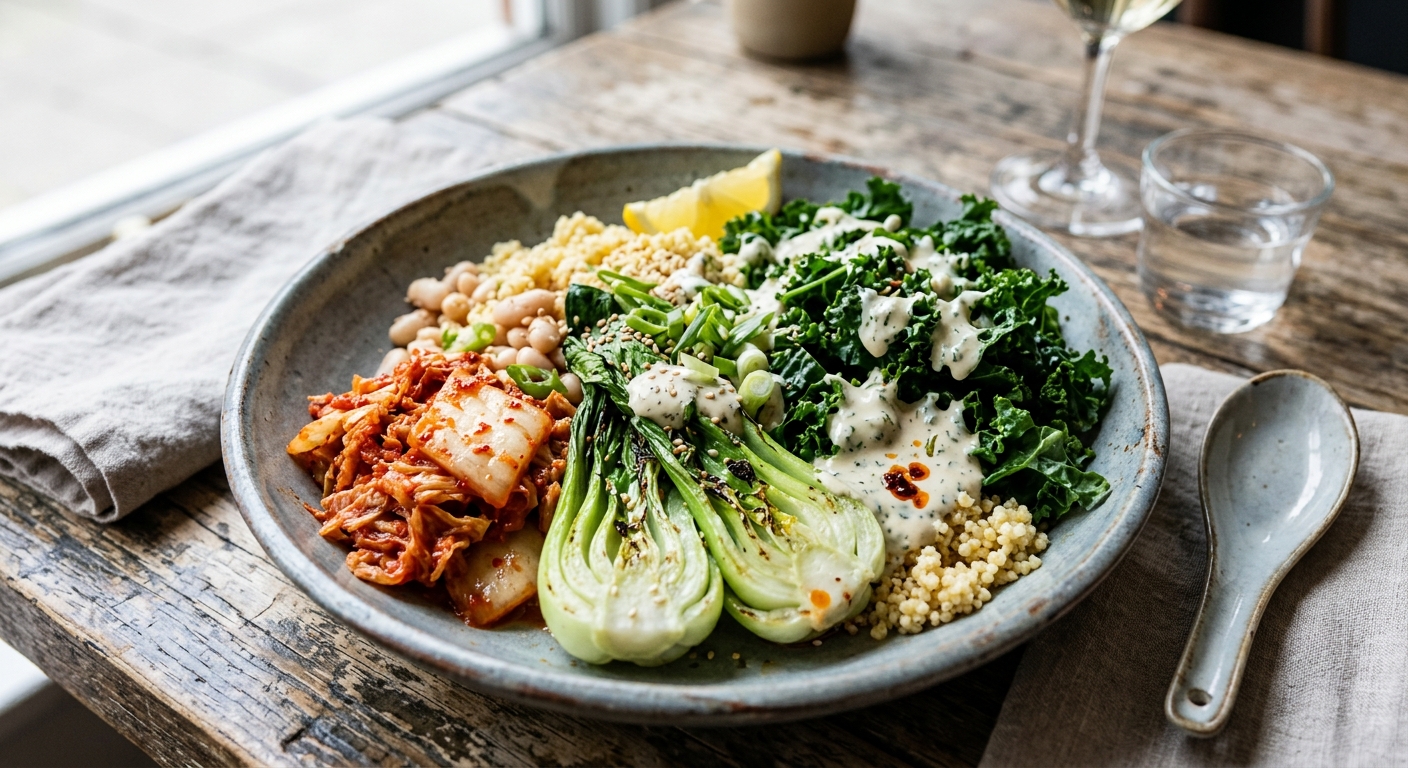
This is not a recipe that asks you to choose between eating well and eating wisely. The Fermented Foods Plate brings together three of the most scientifically validated ingredients for skeletal health, kefir, kimchi, and calcium-rich greens, into a genuinely craveable bowl that tastes as vibrant as it performs nutritionally. The creamy, tangy kefir dressing coats tender braised bok choy and napa cabbage kimchi, while a base of warm millet and white beans provides a scaffold of plant calcium and complete amino acids that rival a serving of dairy.
What makes this plate exceptional from a bone health perspective is the concept of calcium synergy: calcium absorption is not simply a function of how much calcium you consume, but of which cofactors accompany it. Kefir contributes not only calcium but also vitamin K2 (as menaquinone MK-7 produced by its bacterial cultures), which activates osteocalcin to direct calcium into bone matrix rather than arterial walls. The fermented kimchi supplies vitamin K1 alongside bioavailable magnesium and phosphorus, while the gentle acidity from lacto-fermentation actually enhances mineral solubility in the digestive tract.
Each cooking method here, whether you braise the vegetables on the stovetop for maximum caramelization, let the slow cooker meld flavors into a deeply savory base, or use the pressure cooker for a weeknight-fast assembly, produces a distinct but equally delicious result. The kefir dressing is always prepared fresh and drizzled just before serving, preserving its live cultures and ensuring every bowlful delivers active Lactobacillus strains alongside its impressive mineral payload.
4
servings
Ingredients
- 300 gmillet, rinsed
- 720 mllow-sodium vegetable broth
- 400 gcanned white beans (cannellini), drained and rinsed
- 350 gnapa cabbage kimchi, store-bought or homemade, roughly chopped
- 400 gbaby bok choy, halved lengthwise
- 200 glacinato kale, stems removed, leaves torn
- 240 mlplain whole-milk kefir
- 2 tbspwhite miso paste
- 1 tbsptoasted sesame oil
- 2 tbsprice vinegar
- 2 tspraw honey
- 3 clovesgarlic, minced
- 15 gfresh ginger, peeled and finely grated
- 2 tbspAvocado Oil100% Pure Avocado Oil (avocado or sunflower)
- 2 tbsplow-sodium soy sauce
- 1 tspgochugaru (Korean red pepper flakes), optional
- 30 gtoasted sesame seeds
- 4 stalksscallions, thinly sliced
- —Colima Sea SaltMicroplastic Free Salt and white pepper to taste
Instructions
Click on an item below to shop for the recommended items for this recipe on Amazon.
As an Amazon Associate, we earn from qualifying purchases.
- Toast the rinsed millet in a dry medium saucepan over medium heat, stirring constantly, for 3 to 4 minutes until the grains are golden and fragrant. Add the vegetable broth and a pinch of salt, bring to a boil, then reduce heat to low, cover, and cook for 18 minutes. Remove from heat and let steam, covered, for 5 minutes. Fluff with a fork and fold in the drained white beans. Cover to keep warm.
- While the millet cooks, make the kefir dressing: whisk together the kefir, white miso paste, rice vinegar, honey, half the minced garlic, and half the grated ginger in a small bowl until the miso is fully dissolved and the dressing is smooth. Season with white pepper. Set aside at room temperature (do not heat).
- Heat the neutral oil in a large cast-iron or stainless-steel skillet over medium-high heat until shimmering. Place the bok choy halves cut-side down in a single layer and sear undisturbed for 3 minutes until deeply golden. Flip, add the remaining garlic and ginger to the pan, and cook for 1 minute more until fragrant. Deglaze with the soy sauce and 2 tablespoons of water, tossing to coat. Transfer bok choy to a plate.
- In the same skillet over medium heat, add the torn kale and cook, tossing with tongs, for 2 to 3 minutes until just wilted and bright green. Season with salt. Push the kale to one side of the pan, then add the chopped kimchi and gochugaru (if using) and stir-fry for 2 to 3 minutes until the kimchi is warmed through and slightly caramelized at the edges. Drizzle the toasted sesame oil over the vegetables and toss everything together briefly.
- Divide the millet and white bean base among four bowls. Arrange the seared bok choy, wilted kale, and kimchi over each bowl. Drizzle generously with the kefir dressing, then top with toasted sesame seeds and sliced scallions. Serve immediately so the kefir dressing remains cool and its live cultures are preserved.
- Combine the drained white beans, chopped kimchi, minced garlic, grated ginger, soy sauce, gochugaru (if using), and vegetable broth in the slow cooker insert. Stir to combine. Place the halved bok choy on top of the bean and kimchi mixture in a single layer, cut-side up, so it gently steams as the braise develops. Cover and cook on Low for 4 hours. The beans will absorb the kimchi brine and become silky, and the bok choy will become very tender.
- About 25 minutes before serving, prepare the millet on the stovetop: toast the rinsed millet in a dry saucepan over medium heat for 3 to 4 minutes, then add 600 ml of water and a pinch of salt. Bring to a boil, reduce to low, cover, and cook for 18 minutes. Remove from heat, steam covered for 5 minutes, then fluff with a fork.
- While the millet rests, make the kefir dressing: whisk together the kefir, white miso paste, rice vinegar, honey, toasted sesame oil, and white pepper in a bowl until smooth and cohesive. Taste and adjust acidity with extra rice vinegar if needed. Keep the dressing at room temperature until plating.
- In the final 5 minutes of slow cooker time, stir the torn kale directly into the hot slow cooker insert, pressing it into the liquid. Replace the lid and allow the residual heat to wilt the kale for 4 to 5 minutes. The kale will turn bright and tender without becoming mushy.
- Spoon the millet into four wide bowls. Ladle the slow-cooked kimchi, bean, and bok choy braise generously over the millet, including some of the deeply flavored braising liquid. Drizzle the kefir dressing over the top, then scatter toasted sesame seeds and scallions over each bowl. Serve at once.
- Add the rinsed millet, drained white beans, minced garlic, grated ginger, soy sauce, gochugaru (if using), and 600 ml of vegetable broth to the pressure cooker or Instant Pot insert. Stir to combine, making sure the millet is fully submerged. Do not add the kimchi or greens at this stage, as their acidity and delicate texture require finishing outside the pressure environment.
- Seal the lid and set the valve to Sealing. Cook on Manual High Pressure for 10 minutes. Allow a natural pressure release for 5 minutes, then carefully perform a quick release to vent any remaining steam. Open the lid and stir the millet and bean mixture with a fork to fluff and combine. The mixture should be thick and cohesive. Season with salt and white pepper.
- While pressure releases, prepare the kefir dressing: whisk the kefir, white miso paste, rice vinegar, honey, and toasted sesame oil together vigorously in a bowl until the miso is completely dissolved. Adjust seasoning and set aside.
- Switch the Instant Pot to Saute mode (or transfer the millet base to a bowl and use a separate skillet over high heat). Add the neutral oil and, once shimmering, add the bok choy halves cut-side down. Sear for 2 minutes until golden, then add the torn kale and toss for 1 to 2 minutes until wilted. Finally, add the chopped kimchi and stir-fry for 1 minute, just enough to warm it through without cooking away its probiotic cultures or fresh fermented flavor.
- Spoon the pressure-cooked millet and bean base into four bowls. Top with the sauteed bok choy, kale, and warmed kimchi. Drizzle the kefir dressing over each bowl, then finish with toasted sesame seeds and sliced scallions. Serve immediately for the best texture contrast between the creamy base and the lightly seared greens.
- Preheat the oven to 220C (425F) with two oven racks positioned in the upper and lower thirds. Line two large rimmed baking sheets with parchment paper. Toss the halved bok choy and torn kale separately with 1 tablespoon each of neutral oil, a pinch of salt, and the soy sauce. Spread the bok choy cut-side down on one baking sheet in a single uncrowded layer. On the second baking sheet, spread the kale, then scatter the chopped kimchi and white beans over it. Drizzle the sesame oil over the kimchi and bean sheet and toss lightly.
- Roast both sheets simultaneously: the bok choy sheet on the upper rack for 18 to 20 minutes until the cut faces are deeply golden and the outer leaves are crisped at the edges; the kimchi and bean sheet on the lower rack for 15 to 18 minutes, stirring once at the halfway point, until the kimchi is caramelized and the beans have developed a lightly crisp exterior. The high dry heat concentrates the fermented flavor of the kimchi into something rich and jammy.
- While the vegetables roast, cook the millet using the absorption method on the stovetop: combine the rinsed millet, 600 ml of vegetable broth, minced garlic, grated ginger, and a pinch of salt in a medium saucepan. Bring to a boil, cover, and reduce to a low simmer for 18 minutes. Remove from heat, steam for 5 minutes covered, then fluff with a fork.
- Prepare the kefir dressing while everything finishes: whisk the kefir, white miso paste, rice vinegar, honey, and white pepper in a small bowl until silky and uniform. Taste and add a small pinch of salt if needed. The dressing should be pourable but substantial enough to cling to the vegetables.
- Build each bowl with a generous base of garlic millet, followed by the roasted bok choy arranged cut-side up, then the caramelized kimchi and crispy bean mixture spooned over the top. Pour the kefir dressing in a wide spiral over the assembled bowl. Garnish with toasted sesame seeds and scallions. Serve warm, with extra kimchi on the side if desired.
Nutrition Breakdown
Per 1 serving (makes 4)
Vitamins & Minerals
% Daily Value based on a 2,000 calorie diet (FDA reference)
🧬 Essential Amino Acids
% of recommended daily intake (RDA) per serving
🛡 Antioxidant Profile
The Nutrition Science
The phrase ‘calcium synergy’ describes a phenomenon that bone researchers have documented for decades: calcium consumed without its cofactors, specifically vitamins D, K2, and magnesium, is poorly incorporated into bone mineral hydroxyapatite and may instead accumulate in soft tissue. Kefir is uniquely positioned among dairy products because its Lactobacillus and Leuconostoc cultures produce menaquinone MK-7 (vitamin K2) during fermentation. MK-7 is the most bioavailable form of K2 and is required to carboxylate osteocalcin, the bone matrix protein that anchors calcium ions into the hydroxyapatite crystal lattice. A 2019 meta-analysis in Osteoporosis International found that MK-7 supplementation at doses equivalent to those found in fermented dairy significantly increased carboxylated osteocalcin and bone mineral density in postmenopausal women.
Kimchi contributes to bone health through several parallel mechanisms. Its fermentation process converts inorganic minerals bound to plant cell walls into more bioavailable ionic forms, particularly magnesium and phosphorus, two minerals that constitute approximately 30% of bone mineral by weight. The lactic acid produced by Lactobacillus kimchii and related strains during fermentation lowers local intestinal pH, which increases calcium solubility and transporter-mediated uptake in the duodenum. Additionally, kimchi supplies substantial vitamin K1 from the napa cabbage base, and the human gut microbiome can partially convert K1 to K2, extending the skeletal benefit further.
The inclusion of lacinato kale as the third pillar of this plate is deliberate and not merely decorative. Per 100g cooked, kale provides approximately 150mg of calcium in a form that, contrary to early nutritional assumptions, is highly bioavailable, with a fractional absorption rate of around 49% compared to 31% for cow’s milk calcium. Kale’s oxalate content is low relative to other leafy greens such as spinach, meaning its calcium is not significantly sequestered before absorption. The kaempferol and quercetin flavonoids in kale have been shown in in vitro and animal studies to inhibit RANKL-mediated osteoclastogenesis, suggesting a direct role in reducing pathological bone resorption beyond simple mineral provision.
Pro Tips
- Never heat the kefir dressing above room temperature. Temperatures above 40C (104F) will kill the live Lactobacillus cultures that provide the probiotic benefit. Dress the bowls after all hot components have been plated.
- For maximum vitamin K2 content, choose a kefir that is made with a full multi-strain starter culture including Lactococcus lactis and Leuconostoc cremoris, rather than a single-strain product. These are typically labelled as traditionally fermented or heirloom culture kefir.
- If you make homemade kimchi, allow it to ferment for at least 5 days at room temperature before refrigerating. Longer fermentation increases the concentration of lactic acid bacteria and amplifies the mineral bioavailability-enhancing effect described in the nutritional science section.
this is such a thoughtful combo – i love that youre thinking about the synergy piece because calcium alone doesnt do much without K2 and the gut health to actually absorb it. my question though is about the fermentation timeline on the kimchi, especially if anyone reading is dealing with histamine sensitivity or mold concerns (i know its a smaller subset but they exist lol). are you using a specific fermentation length that keeps the beneficial bacteria while minimizing histamine buildup? ive found that shorter ferments work better for my family but i’m curious what youve seen with the bone mineral absorption data – does fermentation length matter for that part or is it more about the K2 foods youre pa
Oh Liza, YES to this question – I’ve been tracking this exact thing in my own elimination diet for months now! I found that my gut actually responds SO much better to shorter ferments (like 3-5 days max for kimchi) compared to the traditional 2+ week versions, especially since I have histamine sensitivity on top of my IBS – the longer ferment just triggers bloating and inflammation markers in my tracking. From what I’ve noticed with my own calcium absorption (I check via food diary + how my joints feel), the K2 from the kimchi fermentation seems to matter more than fermentation length itself, but honestly the shorter ferment keeps my digestion calm enough to actually benefit from
I’m really glad Liza brought this up because fermentation timeline is genuinely where a lot of people get tripped up! The thing is, you don’t need a super long ferment to get meaningful bacterial populations (even 24-48 hours can yield viable CFUs), but the *type* of ferment matters more for K2 production specifically, since certain Bacillus species are your K2 champions and they love a slower, cooler ferment. I’ve always found that a 5-7 day kefir at room temp gives you solid probiotics *and* better K2 levels, whereas kimchi can go shorter and still deliver on the enzyme front. Did you notice a