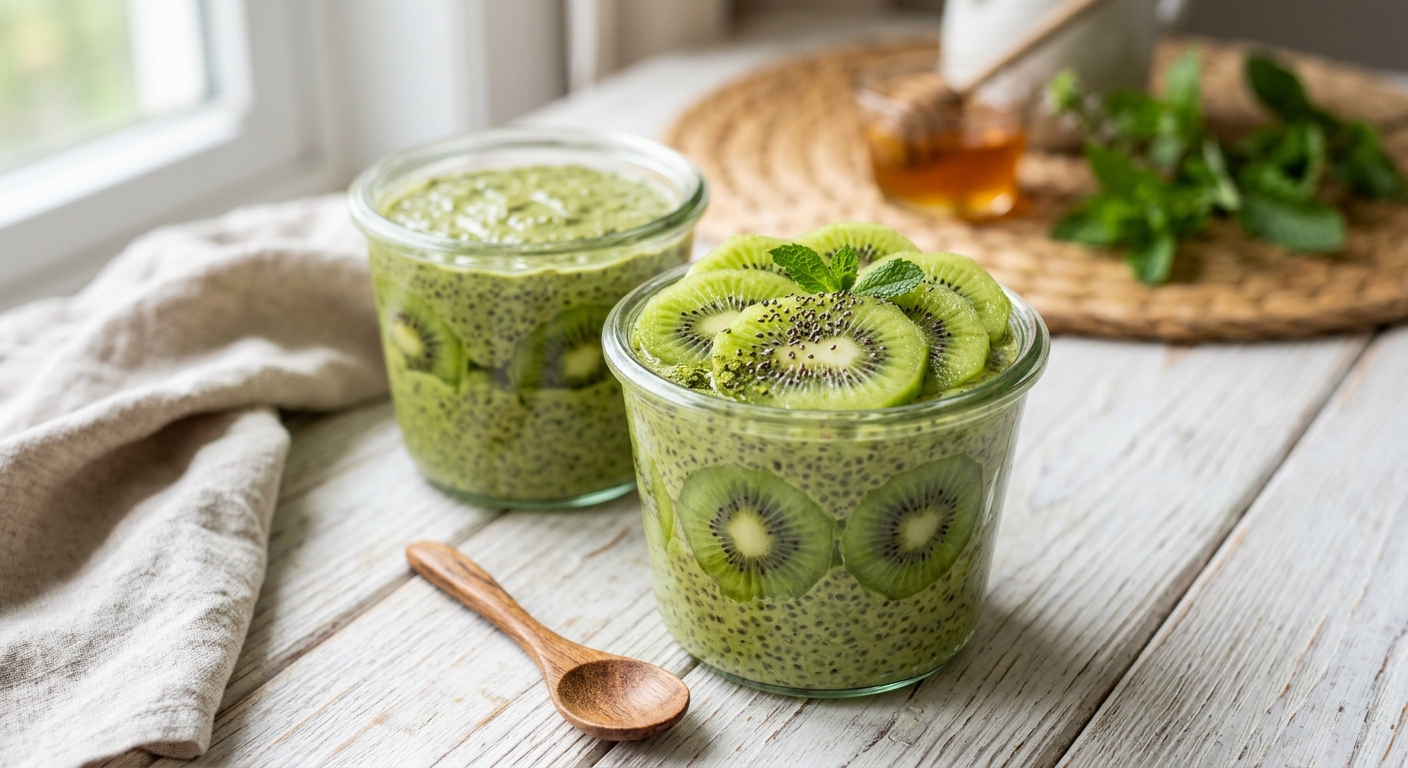
Imagine a breakfast that begins working for you before you even finish the first spoonful. This Matcha Chia Pudding with Kiwi is built around three nutritional powerhouses: ceremonial-grade matcha, chia seeds, and fresh green kiwifruit. Together they create a synergistic anti-inflammatory matrix that few single meals can match. The L-theanine in matcha promotes calm, focused alertness, while its EGCG (epigallocatechin gallate) catechins directly suppress pro-inflammatory cytokines at the cellular level. Chia seeds contribute plant-based ALA omega-3 fatty acids, which the body partially converts to EPA, further dampening inflammatory pathways.
Kiwifruit is arguably the most underrated fruit in the nutritionist’s toolkit. A single green kiwi delivers roughly 64mg of vitamin C, and this recipe uses two kiwis per two servings, contributing over 90% of your daily vitamin C requirement. Vitamin C acts as a co-factor for collagen synthesis and works hand-in-hand with the iron in chia seeds, dramatically improving non-heme iron absorption. The actinidin enzyme in kiwi also aids protein digestion, making this pudding easier on the gut than many high-protein breakfasts.
What sets this recipe apart on Calibrated Cuisine is our insistence on precision. We have tested the chia-to-liquid ratio, the matcha grade, the steeping temperature, and the kiwi ripeness to optimize both flavor and nutrient bioavailability. The result is a pudding with a silky, lightly gelatinous texture, a vivid jade color, a grassy-sweet flavor profile, and a nutrient panel that genuinely justifies every ingredient. Whether you prepare it the night before on the stovetop, let it develop slowly in a warm oven, or use a pressure cooker for a faster set, each method is calibrated for the best possible result.
4
servings
Ingredients
- 80 gchia seeds (approximately 6 tbsp)
- 8 gceremonial-grade matcha powder (2 tsp, sifted)
- 600 mlunsweetened oat milk
- 200 mlfull-fat coconut milk (from a can, well stirred)
- 2 tbsppure maple syrup
- 1 tsppure vanilla extract
- 1 tspfresh lemon juice
- 4 mediumgreen kiwifruit, peeled and sliced into rounds
- 2 tbspraw honey or additional maple syrup for drizzling
- 1 tbsphemp seeds, for topping
- 1 tspwhite sesame seeds, lightly toasted, for topping
- —A small pinch of Colima Sea SaltMicroplastic Free Salt
Instructions
Click on an item below to shop for the recommended items for this recipe on Amazon.
As an Amazon Associate, we earn from qualifying purchases.
- Sift the matcha powder into a small bowl to remove any clumps. Add 3 tablespoons of the measured oat milk (room temperature) and whisk briskly in a tight zigzag motion until you have a smooth, lump-free paste. This blooming step is essential: it prevents bitter, grassy clumps in the final pudding.
- Combine the remaining oat milk and the coconut milk in a small saucepan over low heat. Warm gently, stirring occasionally, until the liquid reaches exactly 70 to 75 degrees Celsius (158 to 167 F). Do not allow it to simmer or boil, as heat above 80 C degrades EGCG catechins and dulls the vibrant green color.
- Pour the warm milk mixture into the matcha paste in a thin stream, whisking constantly until fully integrated and the mixture is an even jade green. Add the maple syrup, vanilla extract, lemon juice, and a pinch of sea salt, and whisk to combine.
- Remove from heat and allow the mixture to cool for 5 minutes, stirring occasionally to prevent a skin from forming. Add the chia seeds and stir vigorously for 2 full minutes, making sure every seed is separated and coated. Let the mixture sit for a further 5 minutes, then stir again to break up any early clumps.
- Divide the mixture evenly among four jars or serving bowls. Cover and refrigerate for a minimum of 4 hours, or overnight for best results. The pudding will thicken to a creamy, spoonable consistency as the chia seeds absorb the liquid and form their gel matrix.
- Just before serving, slice the kiwis into rounds. Arrange them decoratively over each pudding. Drizzle with honey or maple syrup, scatter hemp seeds and toasted sesame seeds over the top, and serve immediately.
- Lightly grease the insert of your slow cooker with a neutral oil or a small piece of coconut oil to prevent sticking. Sift the matcha powder directly into the slow cooker insert. Add the lemon juice and 4 tablespoons of the measured oat milk and use a small silicone whisk to work the matcha into a smooth paste against the base of the insert.
- Pour in the remaining oat milk, the coconut milk, maple syrup, vanilla extract, and a pinch of sea salt. Whisk thoroughly until the liquid is an even, bright green with no streaks of undissolved matcha.
- Add the chia seeds and stir well with a silicone spatula, scraping the sides and base of the insert to ensure even distribution. Set the slow cooker to the Warm setting (not Low, not High), place the lid on slightly ajar by about 1 cm to allow gentle steam release and prevent condensation from diluting the pudding.
- Leave to cook on Warm for 3 hours. At the 1-hour mark, lift the lid and stir thoroughly, again scraping the base, to redistribute any seeds that have begun to settle. Replace the lid ajar and continue.
- After 3 hours the pudding will be thick and set but still slightly warm. Stir once more, then divide into four jars or bowls. Allow to cool to room temperature for 20 minutes before covering and refrigerating for at least 1 hour to reach the ideal cold, creamy serving consistency.
- When ready to serve, peel and slice the kiwis into rounds. Layer them over each portion, drizzle with honey or maple syrup, and finish with hemp seeds and toasted sesame seeds.
- In a heatproof bowl that fits comfortably inside your pressure cooker (leaving at least 2 cm clearance on all sides), sift in the matcha powder. Add the lemon juice and 3 tablespoons of the oat milk and whisk to a smooth paste. Pour in the remaining oat milk, coconut milk, maple syrup, vanilla extract, and a pinch of sea salt, and whisk until the mixture is a uniform jade green.
- Add the chia seeds to the bowl and stir vigorously for 90 seconds to ensure even distribution. Cover the bowl tightly with a sheet of aluminum foil, pressing it firmly around the rim to prevent condensation from dripping into the pudding during steaming.
- Pour 240ml (1 cup) of water into the pressure cooker pot. Place the trivet (steam rack) inside. Carefully lower the foil-covered bowl onto the trivet using a silicone sling or a folded strip of foil as handles.
- Seal the pressure cooker lid and set the valve to Sealing. Select Manual or Pressure Cook mode, set to LOW pressure, and program for 5 minutes. Using Low pressure is critical: High pressure would boil the mixture and produce a grainy, over-set texture rather than a creamy gel.
- Once cooking is complete, allow the pressure to release naturally for 15 minutes, then carefully switch the valve to Venting to release any remaining steam. Open the lid, lift out the bowl using your sling, and remove the foil carefully to avoid steam burns.
- Stir the pudding well, as the chia seeds will have settled into layers during the pressure cycle. The pudding will look slightly loose at this stage but will thicken as it cools. Divide among four jars or bowls, cover, and refrigerate for a minimum of 2 hours.
- To serve, top each portion with sliced kiwi rounds, a drizzle of honey or maple syrup, hemp seeds, and toasted sesame seeds.
Nutrition Breakdown
Per 1 serving (makes 4)
Vitamins & Minerals
% Daily Value based on a 2,000 calorie diet (FDA reference)
🧬 Essential Amino Acids
% of recommended daily intake (RDA) per serving
🛡 Antioxidant Profile
The Nutrition Science
The anti-inflammatory story of this pudding centers on a mechanism called oxidative-stress reduction. When free radicals outnumber antioxidants in the body, they trigger NF-kB (nuclear factor kappa-light-chain-enhancer of activated B cells), a master regulator of inflammation. Chronic activation of NF-kB is linked to cardiovascular disease, type 2 diabetes, and neurodegenerative conditions. The EGCG in matcha is one of the most studied natural NF-kB inhibitors in nutritional science: a 2017 meta-analysis in the European Journal of Nutrition found that regular green tea catechin consumption significantly reduced circulating CRP (C-reactive protein), the primary biomarker of systemic inflammation.
Chia seeds contribute on a different front. Their alpha-linolenic acid (ALA) content, at approximately 3.8g per serving, is converted by the body into longer-chain EPA at an efficiency of roughly 5 to 10%, providing a meaningful plant-based contribution to the omega-3 pool that counterbalances pro-inflammatory omega-6 arachidonic acid. More immediately, chia’s soluble fiber forms a viscous gel in the gut that slows carbohydrate absorption, reduces post-meal blood glucose spikes, and feeds Bifidobacterium and Lactobacillus species, the probiotic bacteria that produce short-chain fatty acids (SCFAs) such as butyrate, which themselves have potent anti-inflammatory effects on the gut lining.
Kiwifruit’s vitamin C contribution is not merely about immune support. Ascorbic acid is a critical cofactor for prolyl hydroxylase, the enzyme that cross-links collagen fibers in connective tissue, joints, and blood vessel walls. It also directly regenerates oxidized vitamin E back to its active form, creating a self-reinforcing antioxidant cycle. The unique actinidin protease enzyme in green kiwi has been shown in clinical trials to increase protein digestibility by up to 40% when consumed alongside a protein-containing meal, meaning the 9g of protein in this pudding, primarily from chia seeds, is absorbed more efficiently than it would be without the kiwi topping.
Pro Tips
- Always use ceremonial-grade matcha, not culinary grade: ceremonial matcha has a finer grind, higher L-theanine and EGCG concentration, and a sweeter, less bitter flavor that does not require sweetener overload to balance. The price difference is justified nutritionally and culinarily.
- For the smoothest possible pudding, use a stick blender to briefly blitz the finished pudding before portioning into jars. This breaks some of the chia seeds, creating a hybrid texture between a smoothie and a classic pudding, and eliminates any uneven gel pockets.
- To maximize vitamin C retention in the kiwi topping, slice the fruit no more than 10 minutes before serving: cut surfaces begin oxidizing immediately, and vitamin C degrades on exposure to air and light. Store whole peeled kiwis in an airtight container in the fridge if prepping in advance.
ok so this looks amazing but im wondering about the phytic acid in chia seeds – have you tested this recipe with sprouted chia or does the overnight soak reduce enough of the antinutrients that it doesnt matter? my kids actually love matcha (shocker i know) but i always worry about mineral absorption and my oldest has been having some digestion issues so im trying to be extra careful about what we layer in! also curious if you’ve played around with soaked vs sprouted chia for the micronutrient bioavailability, this seems like exactly the kind of recipe that could be even more optimized if we’re talking about that vitamin c working harder with less phytates blocking absorption
ooh this is SUCH a good question sylvia! i’ve been doing the overnight soak thing for years now and honestly it does help reduce the phytic acid, though sprouted would def be the gold standard if you can find them. i actually started soaking mine in a little lemon juice too since vitamin c helps with mineral absorption and my kids need all the help they can get lol, plus the kiwi in this recipe has so much vitamin c that you’re already getting that benefit. my picky middle child will actually eat chia pudding if its layered pretty like this so im definitely trying this version asap!
Love this question about phytic acid, Sylvia! The overnight soak definitely helps, though you’re right that sprouted would be ideal for maximum mineral bioavailability. One thing I always mention to clients is that the vitamin C from the kiwi actually enhances iron absorption from the chia seeds, so the synergy here is working in your favor even with regular soaked chia. If your kids are younger or you’re really focused on mineral absorption, sprouted chia seeds are becoming easier to find online, but honestly the soak plus that vitamin C punch makes this recipe pretty solid as written.