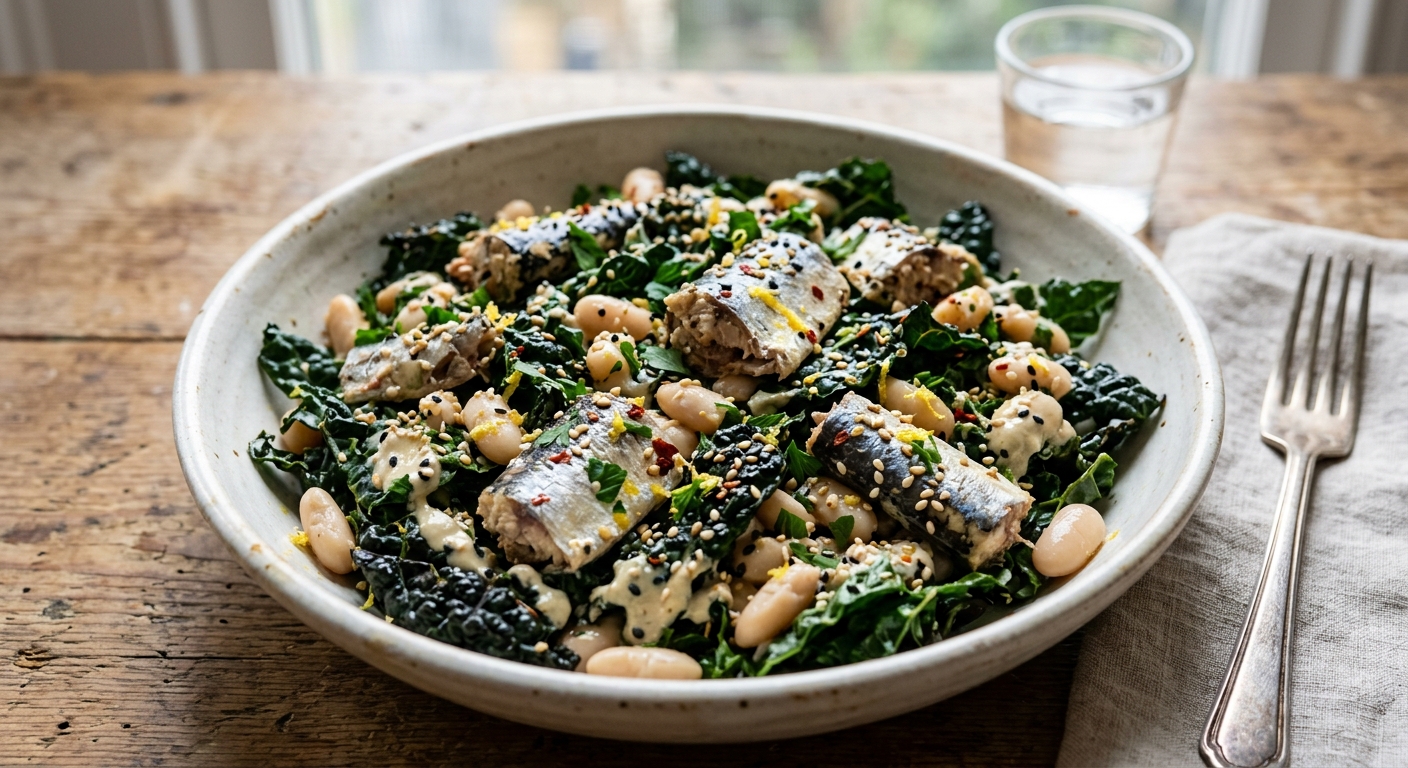
Bone health rarely gets the culinary attention it deserves, and that is a shame, because the ingredients that protect your skeleton are genuinely extraordinary in the kitchen. This Sardine and Kale Salad with Sesame was engineered from the ground up to hit 80% of the recommended daily intake for calcium while tasting like something you would order at a serious Mediterranean bistro. Canned sardines packed in olive oil bring roughly 350mg of calcium per 100g serving from their edible soft bones, lacinato kale contributes a further 150mg per cooked cup, and two tablespoons of tahini add another 130mg, all before we reach the sesame seeds scattered across the top.
What separates this salad from a simple tin-and-leaves assembly is technique. The kale is massaged with lemon juice and sea salt until its cellular walls soften and its bitterness mellows, a process that also increases the bioavailability of its fat-soluble vitamin K. The sardines are gently warmed and crisped in a skillet so their exterior caramelises while the interior stays silky, and the tahini dressing is emulsified with garlic and warm water to create a pourable, creamy sauce rather than a clumpy paste. Every element is considered.
A note on cooking methods: this is fundamentally a salad, but three of the four listed methods address a warm grain base (farro or white beans) that can be prepared alongside or in advance and served beneath or mixed into the greens. The stovetop method is the full experience as intended. The slow cooker and pressure cooker methods focus on producing a deeply flavoured warm white bean and kale component that transforms the dish into a heartier grain bowl, ideal for meal prep or colder months. The oven method produces beautifully roasted sardines and crisped kale chips that change the texture profile entirely.
4
servings
Ingredients
- 480 gcanned sardines in olive oil (approximately 4 tins, 120g drained each), drained with oil reserved
- 400 glacinato (Tuscan) kale, stems removed, leaves torn into bite-sized pieces
- 400 gcanned white beans (cannellini), rinsed and drained
- 80 gtahini (hulled sesame paste)
- 3 tbspextra-virgin olive oil
- 3 tbspfresh lemon juice (approximately 2 lemons)
- 1 tsplemon zest
- 2 clovesgarlic, finely grated or minced
- 4 tbspsesame seeds (a mix of white and black), toasted
- 2 tbspapple cider vinegar
- 1 tsphoney or maple syrup
- 1 tspsmoked paprika
- 0.5 tspcrushed red pepper flakes
- 60 mlwarm water
- 30 gsun-dried tomatoes, roughly chopped
- 20 gcapers, rinsed and roughly chopped
- —Colima Sea SaltMicroplastic Free Salt and cracked black pepper to taste
Instructions
Click on an item below to shop for the recommended items for this recipe on Amazon.
As an Amazon Associate, we earn from qualifying purchases.
- Make the tahini dressing first so it has time to mellow. In a small bowl, whisk together the tahini, lemon juice, lemon zest, grated garlic, honey, apple cider vinegar, smoked paprika, and red pepper flakes. Gradually drizzle in the warm water, whisking constantly, until the dressing is smooth and pourable. It should coat a spoon but drip freely. Season with salt, taste, and adjust the lemon or honey. Set aside.
- Place the torn kale leaves in a large mixing bowl. Drizzle over 1 tablespoon of olive oil and a generous pinch of sea salt. Using clean hands, massage the kale firmly for 2 to 3 minutes, squeezing and working the leaves until they darken in colour, reduce in volume by about a third, and feel silky rather than coarse. This breaks down the tough cell structure and removes bitterness. Add the rinsed white beans, sun-dried tomatoes, and capers to the bowl and toss to combine.
- Heat a large non-stick or cast iron skillet over medium-high heat. Add 1 tablespoon of the reserved sardine oil (or extra-virgin olive oil if you prefer a milder flavour). Once shimmering, add the drained sardines in a single layer. Press gently with a spatula and cook undisturbed for 2 minutes until the undersides develop a golden, slightly crisp crust. Carefully flip each sardine and cook for a further 1 minute on the second side. Transfer to a plate and season with cracked black pepper and a pinch of smoked paprika.
- While the sardines are still warm, pour two-thirds of the tahini dressing over the kale and bean mixture. Toss thoroughly so every leaf is coated. Taste and add more dressing, lemon juice, or salt as needed. Divide the salad among four bowls or plates.
- Arrange the warm crisped sardines over each portion. Drizzle the remaining tahini dressing in a thin zigzag across the top. Finish with the toasted sesame seeds, an extra crack of black pepper, and a small drizzle of the remaining olive oil. Serve immediately while the sardines are warm against the cool dressed greens.
- In the slow cooker insert, combine the rinsed white beans, sun-dried tomatoes, capers, crushed red pepper flakes, smoked paprika, apple cider vinegar, 2 tablespoons of olive oil, and 240ml of water or low-sodium vegetable stock. Stir well, then nestle the grated garlic in and season with salt and black pepper. Do not add the sardines, kale, tahini, or sesame seeds at this stage.
- Place the lid on the slow cooker and cook on Low for 3 hours. The beans will begin to absorb the seasonings and the liquid will reduce slightly. After 3 hours, remove the lid and stir the mixture. If it looks dry, add a splash more water.
- Add the torn kale leaves to the slow cooker, pressing them down into the warm bean mixture. They will seem like too much at first but will wilt rapidly. Replace the lid and continue cooking on Low for a further 45 minutes to 1 hour, until the kale is tender and deeply flavoured but not mushy. It should retain a gentle chew.
- While the kale finishes in the slow cooker, prepare the tahini dressing and crisp the sardines. Whisk together the tahini, lemon juice, lemon zest, warm water, honey, and a pinch of salt until smooth and pourable. Heat a skillet over medium-high heat with 1 tablespoon of sardine oil, then cook the sardines for 2 minutes per side until golden and slightly crisp on the exterior.
- Spoon the warm braised kale and bean mixture into four deep bowls. Lay the crisped sardines across the top, drizzle generously with the tahini dressing, and finish with toasted sesame seeds and a final squeeze of fresh lemon juice. The contrast between the silky slow-braised base and the crisp sardines is the centrepiece of this version.
- Add the rinsed white beans, sun-dried tomatoes, capers, smoked paprika, crushed red pepper flakes, apple cider vinegar, 2 tablespoons of olive oil, grated garlic, and 180ml of water or vegetable stock to the pressure cooker pot. Stir to combine and season with salt and black pepper. Since canned beans are already soft, the pressure cooker here is building flavour rapidly rather than cooking the beans from scratch.
- Seal the pressure cooker lid and set to high pressure for 8 minutes. The brief high-pressure cook will drive the aromatics and seasonings deep into the beans and create a small amount of lightly thickened sauce. When the timer goes off, use a quick release to vent the steam carefully. Open the lid away from your face.
- Immediately add the torn kale leaves to the hot bean mixture in the pot. Stir vigorously, using the residual heat and steam to wilt the kale for 3 to 4 minutes. The kale should wilt to a tender but bright texture. If you prefer softer kale, replace the lid (without locking it) and let it sit on the keep-warm setting for 2 additional minutes.
- While the kale is wilting, whisk the tahini dressing: combine tahini, lemon juice, lemon zest, warm water, honey, and a pinch of salt, whisking until smooth. In a hot skillet with a drizzle of sardine oil, crisp the sardines for 2 minutes per side over medium-high heat until the skin is golden.
- Spoon the pressure-cooked kale and bean base into bowls. Top with the crisped sardines and drizzle liberally with tahini dressing. Scatter toasted sesame seeds over each bowl, add cracked black pepper and the remaining drizzle of extra-virgin olive oil. Because the pressure cooker method is the fastest, this is the best option for a nutrient-dense weeknight meal in under 30 minutes total.
- Preheat the oven to 220 degrees Celsius (425 degrees Fahrenheit) with two racks positioned in the upper and lower thirds. Line two large rimmed baking sheets with parchment paper. Divide the torn kale leaves between the two baking sheets, spreading them in a single layer with no overlapping. Drizzle with 1.5 tablespoons of olive oil and a generous pinch of sea salt, then toss to coat every leaf. Spread back into a single layer.
- Roast the kale on the upper rack for 10 to 12 minutes until the edges are visibly crisp and lightly charred. Watch carefully after the 8-minute mark as kale chips can go from perfectly crisp to burnt very quickly. Remove from the oven and set aside. They will continue to crisp as they cool.
- While the kale roasts, place the drained sardines in a single layer in a small baking dish or on a foil-lined section of one baking sheet. Drizzle with 1 tablespoon of the reserved sardine oil, scatter over the smoked paprika and a pinch of red pepper flakes, and season with black pepper. When the kale comes off the upper rack, move the sardine dish to the upper rack and roast at 220 degrees Celsius for 8 to 10 minutes. The sardines should be sizzling at the edges and lightly caramelised on top.
- While the sardines roast, prepare the raw dressed base. Take the remaining half of the raw kale and massage it with 1 tablespoon of olive oil and a pinch of salt for 2 minutes until softened. Toss in the white beans, sun-dried tomatoes, and capers. Whisk the tahini dressing (tahini, lemon juice, lemon zest, warm water, garlic, honey, apple cider vinegar, salt) until smooth and pour half of it over the raw kale-bean mixture.
- To assemble, pile the dressed raw kale and bean mixture into each bowl as the base. Arrange the roasted sardines over the top. Break the crispy kale chips over everything so they shatter into shards across the bowl. Drizzle the remaining tahini dressing in a loose spiral, scatter toasted sesame seeds generously, and finish with lemon zest and cracked black pepper. Serve immediately before the kale chips absorb moisture from the dressing.
Nutrition Breakdown
Per 1 serving (makes 4)
Vitamins & Minerals
% Daily Value based on a 2,000 calorie diet (FDA reference)
🧬 Essential Amino Acids
% of recommended daily intake (RDA) per serving
🛡 Antioxidant Profile
The Nutrition Science
Calcium bioavailability is the critical variable that most nutrition labels ignore. The 800mg of calcium in this recipe is not all absorbed equally: sardine bone calcium is ionic and highly bioavailable (absorption rate approximately 30 to 35%), kale calcium benefits from relatively low oxalate content compared to spinach (absorption rate around 40 to 50%), and tahini provides additional calcium with moderate bioavailability. Crucially, the 14mcg of vitamin D3 supplied by the sardines actively upregulates calcium-binding proteins in the intestinal wall, meaning the vitamin D in this dish directly improves how much calcium your body extracts from every other ingredient on the plate.
Vitamin K2 is the underappreciated partner in bone mineralisation. This salad provides over 267% of the daily value for vitamin K, primarily as vitamin K1 from kale. While K1 is not as potent as K2 in directing calcium into bones via osteocalcin activation, research from the Nurses’ Health Study found that diets high in vitamin K1 are associated with a 30% reduction in hip fracture risk. The fat in the sardines, tahini, and olive oil in this recipe is not incidental: vitamin K is fat-soluble, and consuming it alongside dietary fat raises absorption from approximately 10% (in isolation) to over 70%.
The omega-3 fatty acids EPA and DHA from the sardines contribute to bone health through a mechanism distinct from calcium metabolism. They suppress the production of pro-inflammatory prostaglandins that activate osteoclasts (bone-resorbing cells), effectively slowing bone breakdown at the cellular level. A 2020 meta-analysis in Osteoporosis International found that higher dietary omega-3 intake was associated with significantly improved bone mineral density at both the femoral neck and lumbar spine. At nearly 2800mg of EPA and DHA per serving, this salad alone exceeds the threshold identified in that research.
Pro Tips
- Buy sardines packed in olive oil rather than sunflower or soybean oil. The oil quality matters because you will use it as a cooking fat when crisping the fish, and good sardine olive oil carries an intensely savoury, umami depth that a neutral oil cannot replicate.
- Do not skip the kale massage. Two to three minutes of firm hand-massage with salt and oil transforms tough, bitter raw kale into something tender, silky, and genuinely pleasant to eat. This is the single technique that separates a good kale salad from a forgettable one.
- Toast the sesame seeds yourself rather than buying pre-toasted. Place them in a dry skillet over medium heat and shake every 30 seconds for 3 to 4 minutes until golden and fragrant. The difference in aroma and nutty depth is dramatic, and it takes only five minutes.

Eddie, I love that you’re thinking about the methylation pathway – that’s something I’ve been tracking pretty carefully since reading about how B vitamin status can influence neuroinflammation. The B12 bioavailability from sardines specifically has been a game-changer for me (oral supplements never sat right), and pairing it with the folate-rich kale means you’re basically covering so many bases at once. I’m definitely making this, especially since the vitamin D from the sardines helps with calcium absorption anyway – it all works together so elegantly.
Great catch on the methylation angle, Eddie and Nadia – that’s sophisticated thinking. I’m admittedly late to the micronutrient game (spent most of my life just eating whatever), but what really grabs me here is that a single sardine serving hits roughly 25-30g of protein with solid leucine content, which is my constant obsession at 66. So while you’re both tracking the methylation donors and B12 bioavailability, I’m over here thinking this salad checks my box for hitting that 2.6-3g leucine threshold per meal for muscle protein synthesis. The fact that it does both simultaneously – dense micronutrients AND sufficient protein distribution – is
This is exactly the kind of nutrient density I’ve been chasing in my own meal prep, though I’m equally fascinated by the methylation angle here: sardines and kale are both methylation donors (choline, folate, B12), so you’re not just getting calcium and vitamin K for bone health, but also supporting your epigenetic machinery to actually *use* that vitamin K effectively. I’ve noticed on weeks when I nail the sardine-leafy green combo, my energy stays more stable, which makes me wonder if we’re underestimating how much gene expression responds to whole-food nutrient combinations like this versus isolated supplements. Have you noticed any particular effects from eating this regularly, or tracked