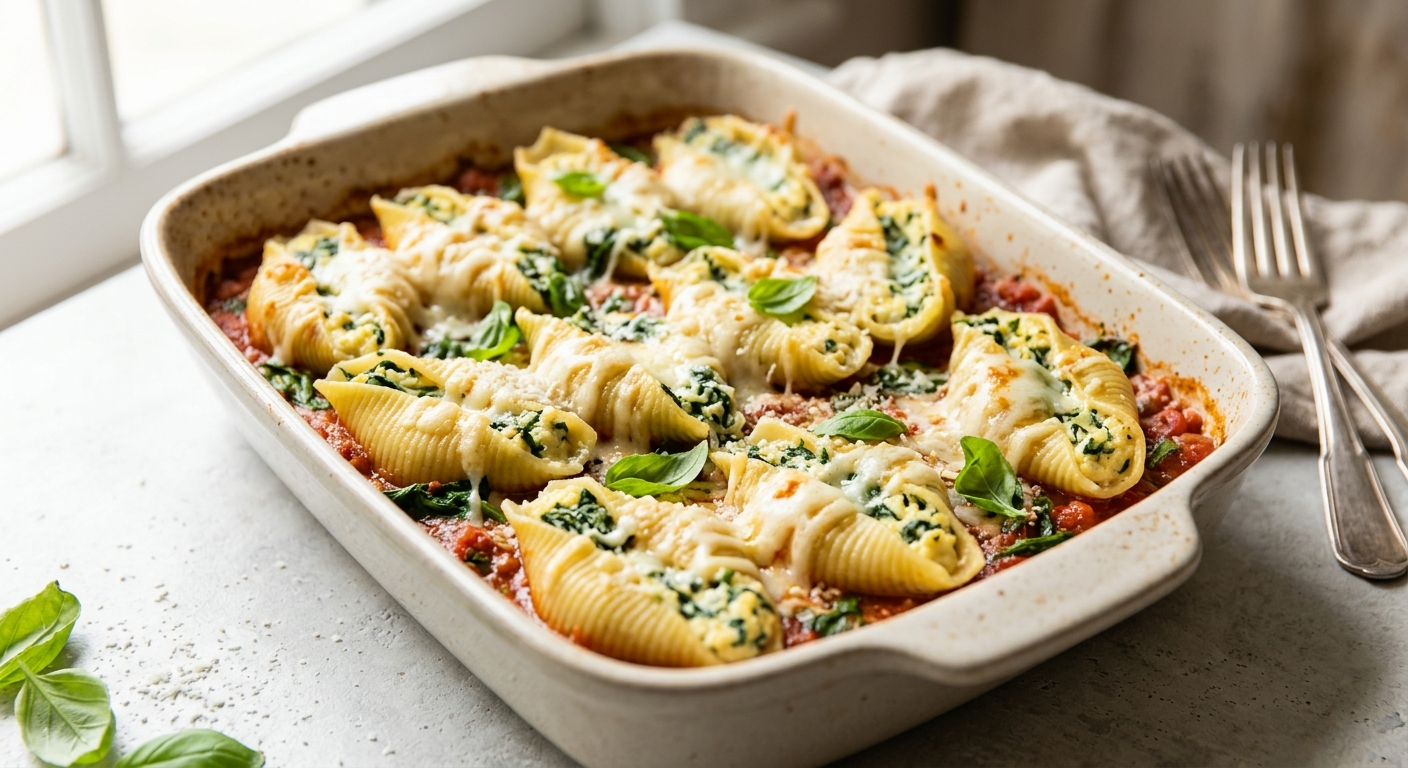
Stuffed shells have always occupied a special place in the Italian-American kitchen, but this version earns its spot at the table on nutritional grounds just as much as culinary ones. Each shell is filled with a generous mixture of whole-milk ricotta, wilted baby spinach, Parmigiano-Reggiano, and a whisper of nutmeg, then nestled into a bright San Marzano marinara and finished with bubbling mozzarella. The result is the kind of dish that feels indulgent while quietly delivering a therapeutic dose of bone-critical nutrients.
The pairing of ricotta and spinach is not accidental from a nutritional standpoint. Ricotta is one of the most bioavailable dietary sources of calcium, providing roughly 207mg per half-cup, while spinach brings a powerful hit of vitamin K1, the cofactor that activates osteocalcin, the protein that anchors calcium into bone matrix. Together, they form a nutritional partnership that researchers increasingly recognize as more effective for bone mineral density than calcium supplementation alone. The fat from the ricotta and olive oil also aids absorption of spinach’s fat-soluble vitamins A and K.
Beyond bone health, this dish punches well above its weight for a weeknight pasta. The spinach contributes meaningful folate, iron, and lutein, the mozzarella adds a second wave of calcium and complete protein, and the tomato sauce supplies lycopene, a carotenoid antioxidant whose bioavailability actually increases with heat and fat. Whether you build it on the stovetop and finish it under the broiler, let it deepen slowly in the slow cooker, or pressure-cook it into a fast weeknight reality, every method is calibrated to protect both the texture of the pasta and the integrity of the nutrients inside.
4
servings
Ingredients
- 20 wholejumbo pasta shells (conchiglie rigate, approx. 200g dry)
- 500 gwhole-milk ricotta cheese
- 300 gfresh baby spinach
- 200 glow-moisture mozzarella, shredded
- 60 gParmigiano-Reggiano, finely grated
- 2 largeeggs, lightly beaten
- 3 clovesgarlic, minced
- 2 tbspextra-virgin olive oil
- 700 gSan Marzano crushed tomatoes (one 700g tin)
- 1 tspdried oregano
- 0.5 tspcrushed red pepper flakes
- 0.25 tspfreshly grated nutmeg
- 1 tspgranulated sugar (to balance tomato acidity)
- —Colima Sea SaltMicroplastic Free Salt and freshly ground black pepper to taste
- —Fresh basil leaves to finish
Instructions
Click on an item below to shop for the recommended items for this recipe on Amazon.
As an Amazon Associate, we earn from qualifying purchases.
- Bring a large pot of heavily salted water to a rolling boil. Add the jumbo shells and cook for exactly 8 minutes, 3 to 4 minutes less than the package direction, so they are pliable but still firm. Drain, rinse briefly under cold water to stop cooking, and spread on a lightly oiled baking sheet in a single layer. Set aside.
- While the pasta cooks, heat a large ovenproof skillet or braising pan over medium heat. Add the olive oil and, once shimmering, add the minced garlic. Cook for 60 seconds until fragrant but not browned. Add the baby spinach in large handfuls, tossing with tongs and allowing each addition to wilt before adding the next, about 3 to 4 minutes total. Season with a pinch of salt and pepper. Transfer the spinach to a colander and press firmly with the back of a spoon to remove as much liquid as possible. Roughly chop and let cool for 5 minutes.
- In the same skillet (no need to wipe it), combine the crushed tomatoes, oregano, red pepper flakes, sugar, and a generous pinch of salt. Simmer over medium-low heat for 8 to 10 minutes, stirring occasionally, until slightly thickened and the raw tomato smell has mellowed. Remove from heat and set aside.
- In a large mixing bowl, combine the drained ricotta, chopped sauteed spinach, half of the shredded mozzarella (100g), all of the Parmigiano-Reggiano, the beaten eggs, nutmeg, and a generous amount of salt and pepper. Stir until fully combined and uniform. Transfer the filling to a piping bag or a zip-lock bag with one corner snipped off for easier filling.
- Position an oven rack 15cm from the broiler element and preheat the broiler to high. Spread half the marinara sauce across the bottom of the ovenproof skillet. Working quickly, pipe or spoon the ricotta filling generously into each parboiled shell and arrange them in a single layer, open side up, over the sauce. Spoon the remaining marinara over and around the shells, then scatter the remaining 100g mozzarella evenly across the top.
- Place the skillet under the broiler for 6 to 8 minutes, watching closely, until the mozzarella is deeply golden and bubbling in spots and the sauce around the edges is beginning to caramelize. Remove from the broiler, rest for 3 minutes, then finish with fresh basil and an extra dusting of Parmigiano-Reggiano before serving directly from the pan.
- Prepare the spinach filling first. Heat the olive oil in a skillet over medium heat, add the garlic, and cook for 60 seconds. Add all the baby spinach and toss until fully wilted, about 4 minutes. Drain well in a colander, pressing out excess liquid, then roughly chop and cool. Combine with the ricotta, half the mozzarella (100g), all of the Parmigiano-Reggiano, beaten eggs, nutmeg, salt, and pepper. Stir thoroughly.
- Whisk together the crushed tomatoes, oregano, red pepper flakes, sugar, a good pinch of salt, and 120ml of water in a bowl. The extra water is necessary because the dry shells will absorb significant liquid during the long cook. Ladle roughly one third of this sauce into the bottom of the slow cooker insert and spread to cover.
- Fill each raw, dry jumbo shell generously with the ricotta-spinach mixture using a small spoon or piping bag. Arrange the filled shells in the slow cooker in a single snug layer, open side facing up, directly over the sauce. If a second layer is necessary, add a ladle of sauce between the layers before adding the second layer of shells.
- Pour the remaining sauce evenly over all the shells, making sure each one has sauce touching it. Scatter the remaining 100g of mozzarella over the top. Place a double layer of paper towels under the lid before closing. This absorbs condensation and prevents the sauce from becoming watery, preserving a rich, concentrated flavor.
- Cook on Low for 3 hours without lifting the lid. At the 3-hour mark, check that the shells are fully tender by piercing one with a paring knife. The cheese should be melted and set and the sauce should be thick and clinging. If the shells need more time, continue cooking for up to 30 minutes more. Serve directly from the insert, garnished with torn fresh basil and extra Parmigiano-Reggiano.
- Prepare the spinach filling using the saute function on your Instant Pot. Select Saute on Medium heat, add the olive oil, and cook the garlic for 60 seconds. Add the baby spinach in batches and stir until fully wilted. Press Cancel. Drain and chop the spinach as described, then combine it in a bowl with the ricotta, half the mozzarella, all the Parmigiano-Reggiano, eggs, nutmeg, salt, and pepper. Set the filling aside.
- Parboil the jumbo shells for 6 minutes in a separate pot of boiling salted water on the stovetop (they need partial cooking before pressure finishing). Drain and cool on an oiled baking sheet.
- Pour 300ml of water into the bottom of the Instant Pot insert. Stir together the crushed tomatoes, oregano, red pepper flakes, sugar, and a pinch of salt in a bowl. Spread roughly half the tomato sauce into a 20cm (8-inch) round oven-safe baking dish or a foil pan that fits inside your Instant Pot above the trivet.
- Fill each parboiled shell generously with the ricotta filling and arrange them, open side up, in the sauced baking dish. Spoon remaining marinara over the tops, then scatter the remaining 100g mozzarella over everything. Cover the baking dish tightly with aluminium foil. Lower the trivet into the Instant Pot, then carefully lower the covered baking dish onto the trivet using a foil sling (two long strips of foil folded lengthwise work well as handles).
- Seal the lid, set the valve to Sealing, and cook on Manual High Pressure for 5 minutes. Allow a natural pressure release for 10 minutes, then carefully switch to quick release to vent any remaining steam. Lift the baking dish out using the foil sling, remove the foil cover, and optionally place the dish under a hot broiler for 3 to 4 minutes to brown the mozzarella. Finish with fresh basil and serve immediately.
- Preheat your oven to 190C (375F) with a rack positioned in the center. Bring a large pot of heavily salted water to a boil. Cook the jumbo shells for 8 minutes (well short of al dente), drain, rinse with cold water, and spread on a lightly oiled baking sheet. This par-cook is important: the shells finish cooking in the oven while absorbing the sauce.
- While the pasta cooks, heat the olive oil in a skillet over medium heat. Cook the garlic for 60 seconds, then add the baby spinach and wilt completely, about 4 minutes. Drain thoroughly, pressing hard to remove all moisture, then roughly chop. In a large bowl, combine the spinach with the ricotta, half the mozzarella (100g), all of the Parmigiano-Reggiano, the beaten eggs, nutmeg, salt, and generous black pepper. Mix until smooth and homogenous.
- Build the marinara directly in a 23 x 33cm (9 x 13-inch) baking dish. Pour in the crushed tomatoes, sprinkle in the oregano, red pepper flakes, sugar, a pinch of salt, and stir together right in the dish. This saves washing an extra pan and the sauce spreads perfectly as a base.
- Fill each parboiled shell generously with the ricotta-spinach filling, using a piping bag, zip-lock bag, or a small spoon. Arrange the filled shells in a single layer, open side down, over the marinara in the baking dish. Pressing them opening-down helps the filling stay inside during baking and allows the tops to brown beautifully. Spoon a few tablespoons of extra marinara over the top of each shell, then scatter the remaining 100g mozzarella and an extra handful of Parmigiano-Reggiano across the entire dish.
- Cover the baking dish tightly with aluminium foil (tent it slightly so it does not stick to the cheese) and bake for 20 minutes. Remove the foil and continue baking for a further 15 minutes until the mozzarella is golden and bubbling, the sauce is caramelizing at the edges of the dish, and the shells feel tender when tested with a paring knife. Rest the dish uncovered for 5 minutes before serving, finished with torn fresh basil.
Nutrition Breakdown
Per 1 serving (makes 4)
Vitamins & Minerals
% Daily Value based on a 2,000 calorie diet (FDA reference)
🧬 Essential Amino Acids
% of recommended daily intake (RDA) per serving
🛡 Antioxidant Profile
The Nutrition Science
The synergy between calcium and vitamin K2 in bone metabolism is one of the most compelling stories in nutritional science, and this dish delivers both in therapeutic quantities. Ricotta and mozzarella together contribute over 700mg of highly bioavailable calcium per serving. Unlike calcium in plant foods such as kale or almonds, dairy calcium is not significantly bound by oxalates, giving it an absorption rate of approximately 32%, compared to around 5% for spinach calcium. But calcium delivery alone is insufficient: without activated osteocalcin, a protein that requires vitamin K as its obligate cofactor, calcium circulates in the bloodstream and may deposit in arterial walls rather than bone tissue. The 290mcg of vitamin K1 per serving, drawn almost entirely from the spinach, is more than double the adequate intake recommendation of 120mcg and provides more than enough substrate for hepatic carboxylation of osteocalcin.
Spinach’s reputation as a calcium source is complicated by its high oxalate content, which binds calcium within the leaf itself into an insoluble compound the gut cannot absorb. However, this does not diminish spinach’s role as a vitamin K1 source, since K1 is not affected by oxalate binding. Wilting the spinach, as this recipe requires, reduces its volume dramatically, allowing a 300g portion of raw spinach to concentrate into the filling. This concentration of volume also concentrates the lutein, zeaxanthin, folate, and iron, all of which remain largely stable through brief heat exposure. The olive oil used in sauteing the spinach is not merely aromatic: dietary fat is required for the absorption of all fat-soluble vitamins (A, D, E, and K), making it a functional ingredient rather than just a flavoring.
The tomato component of this dish deserves its own nutritional footnote. Raw tomatoes contain lycopene in a form bound within the cell matrix that is poorly absorbed. Cooking tomatoes in oil, as this recipe’s marinara does, breaks down cell walls and isomerizes lycopene into more bioavailable geometric forms, while the lipid matrix from olive oil facilitates its absorption in the small intestine. Studies from the Journal of Nutrition have shown that tomato sauce cooked with oil delivers up to 2.5 times more bioavailable lycopene than raw tomato. Lycopene has been associated in observational studies with reduced risk of hip fracture and improved bone mineral density, adding yet another layer of functional nutrition to this dish.
Pro Tips
- Press your wilted spinach extremely hard in the colander, then wrap it in a clean kitchen towel and wring it out again. Excess moisture is the primary cause of watery filling and soggy shells, regardless of which cooking method you use.
- For the most even filling, transfer your ricotta mixture to a large piping bag fitted with a wide round tip. Insert the tip fully into each shell and fill from the back to the front, which prevents air pockets and ensures every shell is evenly loaded.
- If you are scaling this recipe up for a crowd, the baked oven version assembles up to 24 hours in advance. Cover the unbaked dish tightly with cling film and refrigerate. Add 10 minutes to the covered baking time to account for the chilled start temperature.

This is such a smart pairing, especially the calcium plus vitamin K combo for bone mineralization. I’ve noticed with patients on warfarin that the consistency matters more than avoidance here, so this kind of recipe actually helps them maintain stable INR when eaten regularly rather than sporadically. The one pan aspect is chef’s kiss for weeknight compliance, since people are way more likely to stick with nutrition advice that doesn’t require five dishes. Curious if you tested this with fresh versus frozen spinach for the nutrient density, since I’ve seen the oxalate content vary?
Love this calcium-K combo approach, and Veronika’s point about consistency is spot on. One sourcing note though: conventional spinach is routinely on the Dirty Dozen for pesticide residue, so if anyone’s making this regularly (especially for bone health where nutrient density matters), I’d really recommend organic here. The ricotta and mozzarella are usually lower-risk dairy products, but worth checking if they’re from grass-fed sources since that can shift the nutrient profile slightly. I’ve found clients actually stick with recipes like this long-term when they’ve sourced the spinach well from the start.
This is such a thoughtful recipe for thyroid health too, since spinach delivers selenium and zinc when cooked properly. Just a heads up for anyone managing thyroid issues like me, raw spinach contains more goitrogens than cooked, so simmering it in the marinara sauce actually reduces any potential interference with iodine absorption, which is a nice bonus here. If you’re sourcing organic spinach as Klara mentioned, you’re getting those nutrients without extra pesticide load, and that matters for overall thyroid support. Love how this recipe hits multiple nutrient needs at once.