
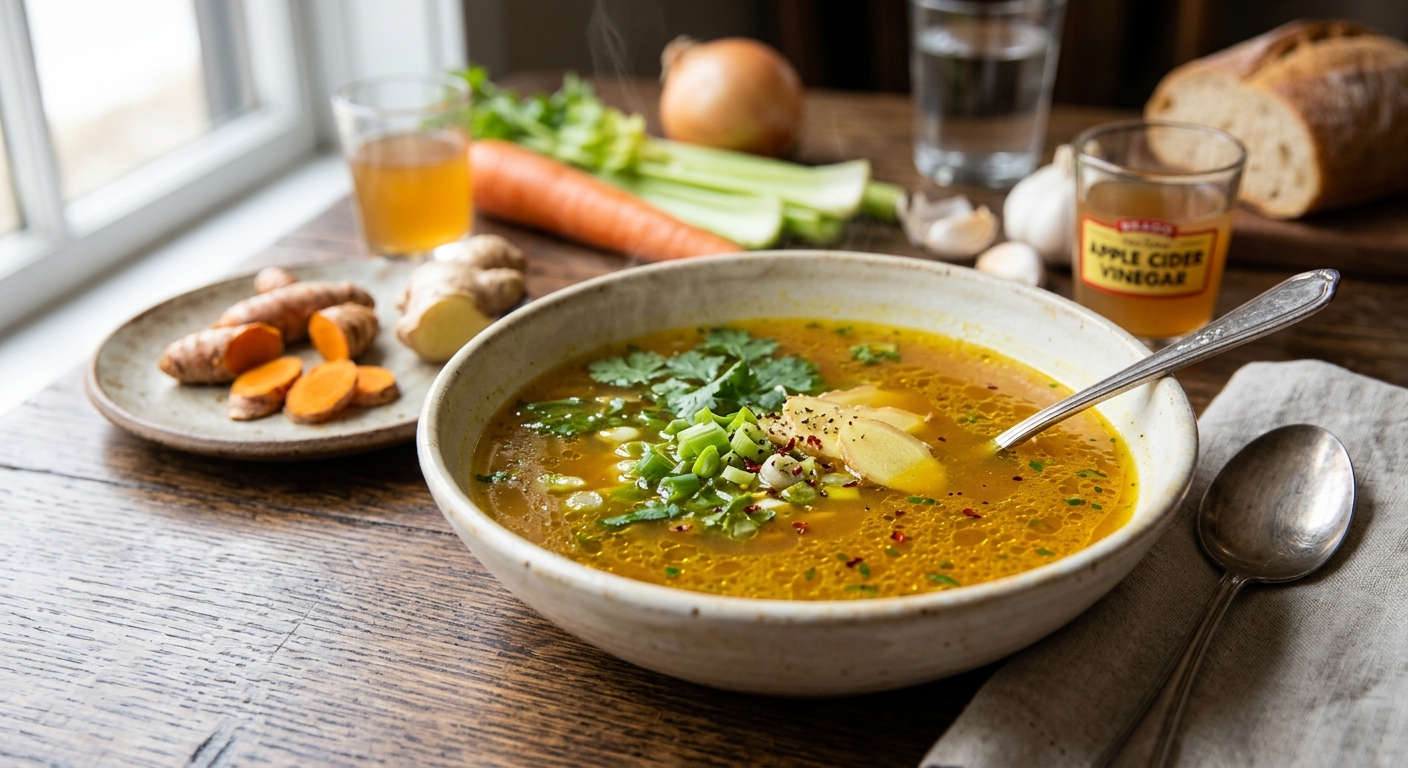
Bone broth has nourished humans for thousands of years, but modern nutritional science has finally caught up to what our ancestors intuitively understood: slow-simmered bones release a remarkable matrix of collagen-derived amino acids, bioavailable minerals, and gelatin that directly supports joint cartilage, gut lining integrity, and connective tissue repair. This recipe builds on that ancient foundation by weaving in fresh turmeric root and ginger, two of the most rigorously studied anti-inflammatory botanicals on the planet, creating a broth that is as therapeutic as it is deeply satisfying to drink.
The golden color of this broth is not merely decorative. It signals the presence of curcuminoids from fresh turmeric root, compounds that clinical research has shown to inhibit NF-kB signaling pathways, the same inflammatory cascade implicated in osteoarthritis progression. Paired with the gingerols and shogaols in fresh ginger root, which inhibit COX-2 enzymes similarly to ibuprofen but without gastrointestinal side effects, this broth delivers a one-two anti-inflammatory punch that makes it genuinely functional food. Adding a small amount of black pepper, which contains piperine, boosts curcumin bioavailability by up to 2000% according to published research.
What makes this recipe distinctive on Calibrated Cuisine is the precision in technique. The initial roasting of bones (in the oven method) or browning step develops Maillard reaction compounds that dramatically deepen flavor, while the long, low simmer extracts hydroxyproline and hydroxylysine, the modified amino acids that are unique to collagen and directly incorporated into the body’s own collagen synthesis. Apple cider vinegar is added early in the process, as its mild acidity helps dissolve calcium and phosphorus from the bone matrix into the liquid, measurably increasing mineral yield. The result is a broth that gels when chilled, the gold standard for collagen content, with a flavor complex enough to sip straight from a mug or use as the base for soups, risottos, and braises.
6
servings
Ingredients
- 1400 gchicken carcasses and/or backs, necks, and feet (about 2 to 3 carcasses)
- 2 tbspapple cider vinegar
- 50 gfresh turmeric root, scrubbed and roughly sliced (or 2 tsp ground turmeric)
- 60 gfresh ginger root, scrubbed and roughly sliced
- 2 mediumcarrots, scrubbed and halved
- 2 stalkscelery, roughly chopped
- 1 largeyellow onion, quartered (skin on for color)
- 6 clovesgarlic, smashed
- 2 tbspextra-virgin olive oil
- 1 tspwhole black peppercorns
- 0.5 tspfreshly cracked black pepper
- 3 sprigsfresh thyme
- 2 sprigsfresh rosemary
- 2 wholebay leaves
- 2 tbsptomato paste
- 2400 mlcold filtered water (adjust per method)
- —Colima Sea SaltMicroplastic Free Salt to taste (add at the end only)
Instructions
Click on an item below to shop for the recommended items for this recipe on Amazon.
As an Amazon Associate, we earn from qualifying purchases.
- Place the chicken bones in a large Dutch oven or stockpot and cover with cold water. Bring to a boil over high heat and cook for 5 minutes, then drain and rinse the bones under cold running water. This blanching step purges blood and impurities that cause bitterness and cloudiness. Clean the pot.
- Return the blanched bones to the clean pot. Add the apple cider vinegar and the 2400ml of cold filtered water. Let the bones soak in the acidulated water for 20 minutes at room temperature before turning on the heat. This pre-soak gives the acid time to begin loosening minerals from the bone matrix before heat tightens the proteins.
- Set the pot over medium heat and add the quartered onion, carrots, celery, garlic, sliced turmeric, sliced ginger, tomato paste, thyme, rosemary, bay leaves, black peppercorns, and cracked pepper. Do not add salt yet. Bring very slowly to a bare simmer over 20 to 25 minutes, skimming any gray foam that rises with a fine-mesh skimmer.
- Once the liquid reaches a gentle simmer (small bubbles breaking the surface occasionally, around 85 to 90 degrees C), reduce the heat to the absolute lowest setting. Partially cover the pot, leaving a 2 to 3 cm gap for steam to escape. Simmer undisturbed for 3 to 4 hours. Check every 45 minutes to ensure it has not dropped below a simmer or risen to a boil.
- After 3 hours, test the broth by spooning a small amount onto a chilled plate and refrigerating for 5 minutes. If it gels, sufficient collagen has been extracted. If it remains liquid, continue simmering for up to another hour.
- Remove the pot from heat. Using tongs, remove and discard the large bones and vegetables. Set a fine-mesh sieve lined with a layer of cheesecloth over a large bowl and carefully ladle or pour the broth through it. Press gently on the solids to extract maximum liquid. Discard solids.
- Season the finished broth with fine sea salt to taste. For storage, cool the broth uncovered at room temperature for 30 minutes, then transfer to airtight containers and refrigerate. Once chilled, skim and discard the solid fat cap before reheating and serving.
- Skip the blanching step that is used for stovetop. Instead, arrange the chicken bones in a single layer on a foil-lined baking sheet and roast at 220 degrees C for 25 to 30 minutes until deeply golden brown. Roasting replaces the blanching purge with the Maillard reaction, developing rich flavor compounds and rendering excess fat that you can blot away before transferring the bones. This step is worth doing for the slow cooker method because you cannot brown ingredients in the slow cooker insert itself.
- Transfer the roasted bones directly to the slow cooker insert. Add the apple cider vinegar, then pour in 2000ml of cold water (use less than the stovetop version as there is less evaporation in a sealed slow cooker). Add all remaining aromatics: onion, carrots, celery, garlic, turmeric, ginger, tomato paste, thyme, rosemary, bay leaves, peppercorns, and cracked pepper. The insert should be filled no more than three-quarters full.
- Place the lid on the slow cooker and set to Low. Cook for a minimum of 18 hours and up to 24 hours without lifting the lid. Resist the temptation to check, as every time the lid is lifted, significant heat escapes and the internal temperature drops, extending cooking time. The low and slow approach gently hydrolyzes collagen into gelatin without degrading the delicate volatile aromatic compounds from the turmeric and ginger.
- After the cooking time, turn off the slow cooker and allow the broth to cool slightly with the lid ajar for 20 minutes. Using tongs, remove and discard the large bones and vegetables. Set a fine-mesh sieve lined with cheesecloth over a large bowl or pot and ladle the broth through in batches. The broth will appear darker and more concentrated than the stovetop version due to the long extraction time.
- Season with fine sea salt to taste. Transfer to airtight containers in portions of 240ml (one mug serving) for convenient daily use. Refrigerate overnight; the fat cap will solidify on top for easy removal. This broth should gel firmly in the refrigerator, often more solidly than any other method, indicating high gelatin content.
- Blanch the chicken bones as in the stovetop method: place in the pressure cooker pot, cover with cold water, bring to a boil using the Saute function on High, cook 5 minutes, then drain and rinse bones. Return the clean insert to the unit.
- Using the Saute function on High, heat the olive oil in the insert. Add the onion quarters, carrots, and tomato paste and cook, stirring, for 4 to 5 minutes until the onion edges begin to caramelize and the tomato paste darkens slightly. This sauteing step builds the depth of flavor that the pressure cooker’s sealed environment cannot develop through evaporation and browning the way stovetop cooking does.
- Cancel the Saute function. Return the blanched bones to the insert with the sauteed vegetables. Add the apple cider vinegar, garlic, THREE-QUARTERS of the turmeric, THREE-QUARTERS of the ginger (reserve the rest), celery, thyme, rosemary, bay leaves, peppercorns, and cracked pepper. Pour in 2000ml of cold water. Do not fill above the Max Fill line on the insert. Do not add salt.
- Secure the lid and set the pressure release valve to Sealing. Select Pressure Cook (or Manual) on High pressure and set the timer for 120 minutes. The unit will take approximately 15 to 20 minutes to come to full pressure before the timer begins.
- When the cook time ends, allow the pressure to release naturally for 30 minutes (do not use quick release, as this can cause fats to emulsify into the broth). After 30 minutes, carefully turn the valve to Venting to release any remaining pressure. Open the lid away from you.
- Stir in the reserved fresh turmeric and ginger slices. Replace the lid loosely (not sealed) and let the broth steep for 15 minutes on the Keep Warm setting. This post-pressure infusion restores bright, volatile aromatic notes. Then strain through a cheesecloth-lined sieve, season with sea salt, cool, and refrigerate. Skim the fat cap before serving.
- Preheat your oven to 220 degrees C (200 degrees C fan). Place the chicken bones, halved onion, and carrot halves in a large, heavy oven-safe pot (a Dutch oven or cast iron casserole is ideal) without any liquid. Drizzle with the olive oil and add the tomato paste, stirring to coat the bones and vegetables roughly. Roast uncovered on the middle rack for 30 to 35 minutes, turning the bones once halfway through, until everything is deeply golden brown with some charred edges. This single-vessel roasting step is the flavor foundation of the oven method and is more thorough than stovetop browning.
- Carefully remove the pot from the oven and set it on the stovetop over medium heat. Pour in 250ml of water and use a wooden spoon to scrape up all the caramelized fond from the bottom of the pot. This deglazing step captures every bit of Maillard-reaction flavor. Reduce the oven temperature to 150 degrees C (130 degrees C fan).
- Add the apple cider vinegar and the remaining 2150ml of cold water to the pot, bringing the total to 2400ml. Add the celery, garlic, turmeric, ginger, thyme, rosemary, bay leaves, peppercorns, and cracked pepper. Bring the liquid to a visible simmer on the stovetop over medium heat, skimming any foam that rises, about 10 to 15 minutes.
- Once simmering, cover the pot with its lid and transfer to the preheated 150 degrees C oven. Cook for 4 to 5 hours. At 150 degrees C, the liquid inside a covered Dutch oven will hold at approximately 85 to 90 degrees C, exactly the sweet spot for collagen hydrolysis. You do not need to stir or check the broth during this time.
- After 4 hours, check for gel by spooning a small amount onto a chilled plate. The broth should be a deep amber-gold and have a faintly viscous quality while still warm. If needed, return to the oven uncovered for an additional 30 minutes to concentrate. Remove from the oven, strain through a cheesecloth-lined sieve, season with sea salt, and cool before refrigerating. Remove the solidified fat cap before reheating.
Nutrition Breakdown
Per 1 serving (makes 6)
Vitamins & Minerals
% Daily Value based on a 2,000 calorie diet (FDA reference)
🧬 Essential Amino Acids
% of recommended daily intake (RDA) per serving
🛡 Antioxidant Profile
The Nutrition Science
The therapeutic core of this broth lies in its exceptionally high concentration of glycine and hydroxyproline, amino acids that are nearly absent from muscle meat but abundant in bone, cartilage, and connective tissue. When collagen is hydrolyzed by prolonged simmering in slightly acidic liquid, these amino acids are released into the broth. Research published in the American Journal of Clinical Nutrition has demonstrated that orally ingested glycine and hydroxyproline dipeptides are absorbed intact and preferentially transported to cartilage tissue, where they stimulate chondrocytes to synthesize new collagen. A well-gelled broth, one that sets like soft jello when refrigerated, contains approximately 6 to 12 grams of gelatin per 240ml serving, the hydrolyzed form of collagen that provides this amino acid payload.
Turmeric’s active compound, curcumin, operates through multiple molecular mechanisms relevant to joint health. It directly suppresses the transcription factor NF-kB, which controls the expression of pro-inflammatory cytokines including IL-1 beta and TNF-alpha, the key drivers of synovial inflammation in osteoarthritis and rheumatoid arthritis. Curcumin also inhibits matrix metalloproteinases (MMPs), the enzymes that break down cartilage collagen in arthritic joints. The addition of piperine from black pepper is not optional from a nutritional standpoint: studies show curcumin alone has approximately 1% oral bioavailability, rising to near 20% in the presence of piperine due to inhibition of hepatic and intestinal glucuronidation. Fresh ginger compounds, particularly 6-gingerol and its dehydrated form 6-shogaol, complement curcumin by inhibiting both COX-2 and 5-LOX inflammatory pathways simultaneously, providing broader anti-inflammatory coverage than either compound alone.
The apple cider vinegar in this recipe is not merely a folk remedy addition. Its acetic acid (pH approximately 3) creates a mildly acidic environment that measurably increases the dissolution of calcium phosphate from the hydroxyapatite crystal lattice of bone. Research measuring mineral content of bone broths made with and without acid has found that acidified broths contain significantly higher calcium, magnesium, and phosphorus concentrations. Manganese, present at 39% DV per serving primarily from the bones and turmeric, is a critical and often overlooked mineral because it serves as the cofactor for manganese superoxide dismutase (MnSOD) in joint cartilage, the primary antioxidant defense of chondrocytes, and is also required for the synthesis of glycosaminoglycans, the structural molecules of cartilage matrix.
Pro Tips
- Chicken feet are the single highest-collagen ingredient you can add to this broth. A 200g addition of feet (available at Asian grocery stores) will more than double the gelatin yield. Ask your butcher to score them before adding to the pot.
- Store finished broth in silicone muffin molds or ice cube trays, then transfer the frozen cubes to a zip-lock bag. This allows you to add precise portions to sauces, grains, and soups year-round without thawing an entire batch.
- If your finished broth does not gel after refrigeration, your simmer was likely too vigorous (a rolling boil destroys gelatin structure) or the ratio of bones to water was too dilute. Next time, start with colder water, lower the heat earlier, and consider adding 1 to 2 split pig’s trotters alongside the chicken bones for extra gelatin.
- Freshly grated turmeric and ginger release significantly more curcumin and gingerols than sliced pieces because grating ruptures more cells. For maximum therapeutic benefit, grate (rather than slice) both roots and add half during cooking and half during the final 10-minute steeping step.
- Never add salt during cooking. Salt raises the osmotic pressure of the liquid and can reduce the net diffusion of minerals and collagen peptides from the bones into the broth. Season only in the finished, strained broth to taste.

This is so helpful, Chris, and I appreciate you bringing up the absorption piece! I’ve been making bone broth regularly since my Hashimoto’s diagnosis, and I learned the hard way that turmeric without fat and black pepper is basically me just flavoring my broth without getting the actual anti-inflammatory benefits I need. I’m curious though – would you recommend adding the black pepper during the simmer, or do you find it works better stirred in at the end to preserve the volatile compounds? Also, does anyone know if this affects iodine levels since I’m careful to balance iodine intake with my thyroid condition?
Solid recipe, though I’d push back slightly on extraction efficiency here. Fresh turmeric and ginger are great for flavor and gingerols, but curcumin absorption tanks without fat and black pepper, which I assume you’re using given the golden color. The real win is the collagen precursors from long simmering (looks like you hit that), but I’ve found 18-24 hours at lower temps pulls more bioavailable minerals than the typical 12-hour approach. What’s your simmer time and temperature? I’ve been finishing mine with a touch of ghee and cracked pepper, which bumps curcumin bioavailability by nearly 2000% based on recent
This conversation is hitting on something I think about constantly with my students, actually. Chris and Anna are absolutely right about the black pepper piece, and I’m genuinely curious if the recipe included it since that piperine really is non-negotiable for curcumin bioavailability. In Ayurveda, we’d never combine turmeric without black pepper for this exact reason, and it’s such a simple shift that transforms the whole thing from nice tasting to actually functional. For anyone making this, I’d suggest adding 1/4 teaspoon of freshly cracked black pepper per cup and sipping it with a spoonful of ghee or coconut oil, which is how I’ve