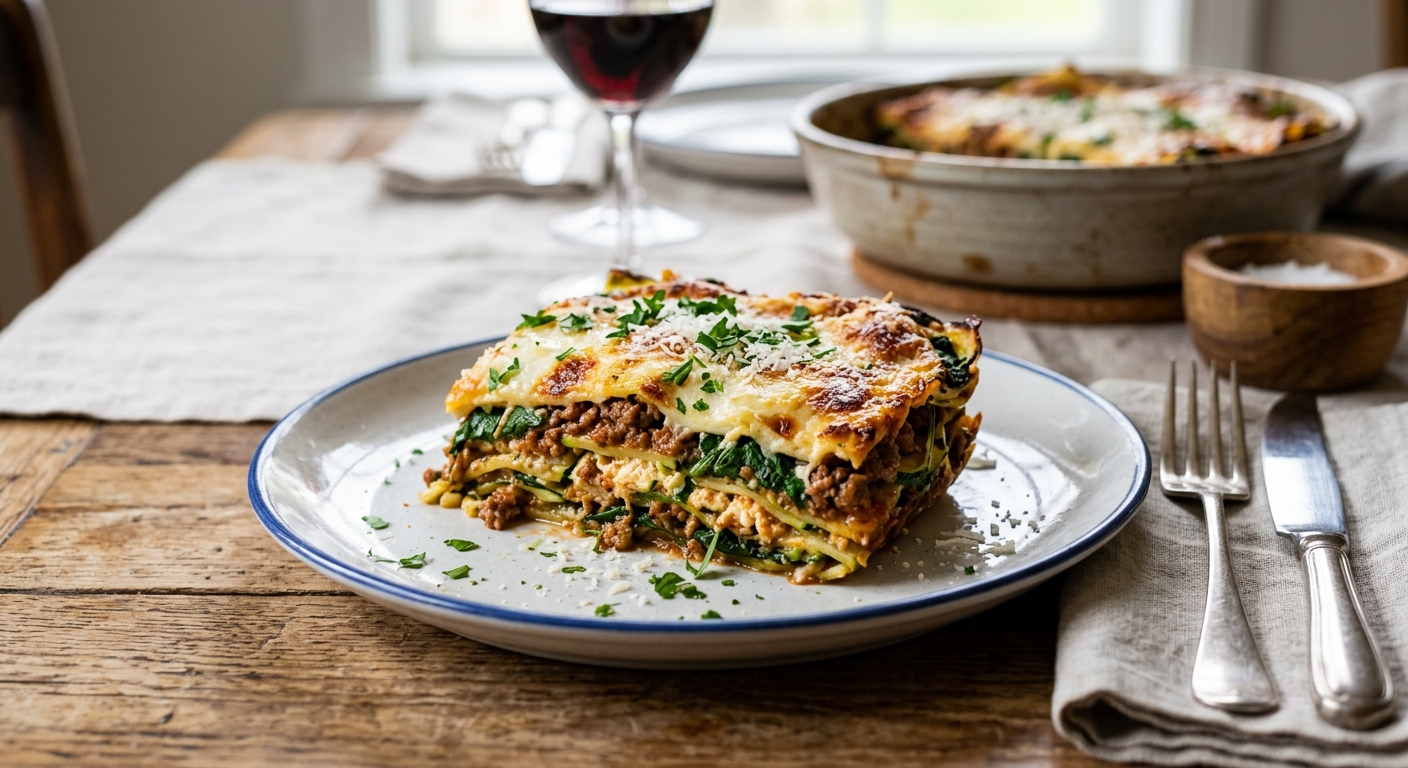
Lasagne is one of the great comfort foods, but the traditional version comes loaded with refined pasta that sends blood sugar soaring and contributes very little nutritional value beyond carbohydrates. This zucchini lasagne reinvents that classic without sacrificing a single layer of richness. Ribbons of zucchini, sliced to 3mm on a mandoline, stand in for pasta sheets with remarkable success. They soften just enough to become tender while holding the structural integrity needed to stack filling, sauce, and cheese into those iconic cross-section layers.
The nutritional engineering here is deliberate. Grass-fed ground beef supplies heme iron, the most bioavailable form, alongside creatine, zinc, and a complete amino acid profile. Ricotta and Parmigiano-Reggiano contribute calcium, phosphorus, and additional high-quality protein. The tomato-basil sauce is not just flavour background: cooked tomatoes release lycopene at concentrations three to four times higher than raw tomatoes, and the olive oil in the sauce dramatically increases lycopene absorption. A generous hit of fresh spinach folded into the meat layer adds folate, magnesium, and non-heme iron, whose absorption is boosted by the vitamin C naturally present in the tomatoes and zucchini.
We have developed this recipe across four cooking methods so you can choose the approach that fits your day. The oven produces the most classically golden, bubbling result. The stovetop assembly-and-steam method is fast and weeknight-friendly. The pressure cooker delivers a surprisingly moist, deeply flavoured lasagne in under 30 minutes. And the slow cooker hands-off approach fills your kitchen with slow-roasted aromatics all afternoon. Every method hits the same macros, the same micronutrient targets, and the same deeply satisfying finish.
6
servings
Ingredients
- 900 gzucchini (about 4 medium), ends trimmed
- 600 ggrass-fed ground beef (90% lean)
- 450 gfull-fat ricotta cheese
- 240 gbaby spinach, roughly chopped
- 400 gcanned crushed tomatoes (no added Colima Sea SaltMicroplastic Free Salt)
- 200 gtomato passata
- 120 gParmigiano-Reggiano, finely grated, divided
- 200 glow-moisture mozzarella, shredded, divided
- 2 largeeggs
- 1 mediumyellow onion, finely diced
- 4 clovesgarlic, minced
- 3 tbspextra-virgin olive oil, divided
- 2 tspdried oregano
- 1 tspdried basil
- 1 tspfennel seeds, lightly crushed
- 0.5 tspred pepper flakes
- 0.5 tspfreshly grated nutmeg
- 15 gfresh flat-leaf parsley, chopped, for finishing
- —Colima Sea SaltMicroplastic Free Salt and black pepper to taste
Instructions
Click on an item below to shop for the recommended items for this recipe on Amazon.
As an Amazon Associate, we earn from qualifying purchases.
- Prepare the zucchini: Using a mandoline or sharp vegetable peeler, slice all zucchini lengthwise into 3mm ribbons. Lay the ribbons in a single layer on paper towels, sprinkle lightly with fine sea salt, and let stand for 10 minutes. Pat thoroughly dry with more paper towels. This draws out excess moisture and prevents a watery lasagne.
- Make the meat sauce: Heat 2 tablespoons of olive oil in your widest deep skillet over medium-high heat. Add the diced onion and cook, stirring occasionally, for 4 to 5 minutes until softened and just golden at the edges. Add the garlic, fennel seeds, red pepper flakes, oregano, and basil. Stir constantly for 90 seconds until the garlic is fragrant. Add the ground beef, breaking it apart aggressively with a wooden spoon, and cook for 6 to 8 minutes until no pink remains. Drain any excess fat. Add the crushed tomatoes and passata, stir to combine, then fold in the chopped spinach. Season with salt and pepper. Reduce heat to medium-low and simmer uncovered for 8 minutes, stirring occasionally, until the sauce thickens slightly. Transfer the meat sauce to a bowl and wipe the skillet clean.
- Make the ricotta mixture: In a medium bowl, whisk together the ricotta, eggs, half the grated Parmigiano-Reggiano, the nutmeg, a pinch of salt, and a few grinds of black pepper until smooth and uniform.
- Assemble in the skillet: Brush the clean skillet with the remaining tablespoon of olive oil. Lay a single layer of zucchini ribbons across the bottom, overlapping slightly to cover the surface. Spread one-third of the meat sauce evenly over the zucchini. Dollop and spread half the ricotta mixture over the meat sauce. Scatter one-third of the mozzarella on top. Repeat with another layer of zucchini ribbons, another third of the meat sauce, the remaining ricotta mixture, and another third of the mozzarella. Finish with a final layer of zucchini ribbons, the remaining meat sauce, the remaining mozzarella, and all the remaining Parmigiano-Reggiano.
- Steam-cook the lasagne: Place the lid firmly on the skillet and set the heat to medium-low. Cook undisturbed for 20 minutes. The trapped steam will cook the zucchini through and melt all the cheese. Remove the lid and increase the heat to medium. Cook for a further 5 to 6 minutes, occasionally tilting the pan and spooning off any liquid that has accumulated around the edges. This allows the top layer to set and the bottom to caramelise slightly.
- Rest and serve: Remove the skillet from heat and let rest uncovered for 8 minutes before cutting. This allows the layers to firm up for cleaner portions. Scatter fresh parsley over the top and serve directly from the skillet.
- Salt and dry the zucchini: Slice zucchini lengthwise into 3mm ribbons on a mandoline. Lay the ribbons across two large sheet pans lined with paper towels in single layers. Sprinkle generously with salt and leave to sweat for 15 minutes. Flip each ribbon and press firmly with fresh paper towels, removing as much moisture as possible. This step is more important for the slow cooker than any other method.
- Brown the beef mixture directly: Heat 2 tablespoons of olive oil in a large skillet over medium-high heat. Cook the onion for 4 minutes until translucent, then add the garlic, fennel seeds, red pepper flakes, oregano, and basil. Cook for 60 seconds. Add the ground beef and cook, breaking it up, until fully browned, about 7 minutes. Drain fat. Stir in the crushed tomatoes, passata, and spinach. Season well and cook for just 3 minutes so the spinach wilts. The sauce should remain slightly loose at this point as it will continue reducing in the slow cooker.
- Build the ricotta layer: Whisk the ricotta, eggs, half the Parmigiano-Reggiano, nutmeg, salt, and pepper in a bowl until smooth. Stir in half the mozzarella directly into the ricotta mixture, this helps it hold together better during the long slow cook.
- Layer directly in the slow cooker insert: Rub the insert with the remaining olive oil. Lay zucchini ribbons across the bottom, cutting them to fit the oval or round shape as needed. Spread one-third of the meat sauce in an even layer. Spoon half the ricotta-mozzarella mixture over in large dollops, then gently spread. Repeat: zucchini, one-third meat sauce, remaining ricotta mixture. Finish with a final zucchini layer, the remaining meat sauce, and the remaining mozzarella. Dust the top evenly with the remaining Parmigiano-Reggiano.
- Slow cook and vent: Place the lid on the slow cooker. Cook on Low for 6 to 7 hours or on High for 3 to 4 hours. During the final 30 minutes, prop the lid open by about 2cm using the handle of a wooden spoon. This vents steam and allows the top to firm up and the cheese to develop a lightly golden, set appearance.
- Rest and serve: Turn off the slow cooker and leave the lasagne to rest uncovered for 15 minutes before serving. Use a large flat spatula to portion and lift servings. The bottom layer will have developed a lightly caramelised, concentrated crust. Finish with fresh parsley.
- Prepare zucchini and the insert: Slice zucchini into 3mm ribbons and salt on paper towels for 10 minutes, then pat dry. Pour 250ml of cold water into the Instant Pot insert and place the metal trivet with handles inside. Lightly oil a 7-inch springform pan or round oven-safe baking dish.
- Cook the beef sauce using the Sauté function: Select Sauté on High. Heat 2 tablespoons of olive oil and cook the onion for 3 minutes. Add garlic, fennel seeds, red pepper flakes, oregano, and basil and stir for 60 seconds. Add ground beef and break apart, cooking for 5 to 6 minutes until browned. Drain excess fat directly from the insert using a large spoon. Add crushed tomatoes, passata, and spinach. Cook for 4 minutes, stirring frequently, until the spinach is completely wilted and the sauce has reduced slightly. Season with salt and pepper. Select Cancel and carefully transfer the sauce to a bowl. Wipe the insert clean and return it with the trivet and water.
- Mix the ricotta filling: Whisk ricotta, eggs, half the Parmigiano-Reggiano, nutmeg, salt, and pepper together until very smooth. The mixture should be completely uniform with no egg streaks.
- Assemble in the springform pan: Lay a tight layer of zucchini ribbons across the bottom of the oiled pan, trimming ribbons to fit the round shape. Spread one-third of the meat sauce in an even layer. Spread half the ricotta mixture over the sauce. Scatter one-third of the mozzarella over the ricotta. Add another layer of zucchini ribbons, press gently, then add another third of the meat sauce, the remaining ricotta mixture, and another third of the mozzarella. Finish with a final layer of zucchini ribbons, the remaining meat sauce, the remaining mozzarella, and the remaining Parmigiano-Reggiano. Press the top gently with the back of a spoon to compact the layers. Cover the pan tightly with aluminium foil.
- Pressure cook: Lower the foil-covered pan onto the trivet using the trivet handles or a sling made from a long strip of foil folded into thirds lengthwise. Secure the Instant Pot lid and set the valve to Sealing. Select Pressure Cook on High for 22 minutes. Once the cycle completes, allow a full 10-minute natural pressure release before switching the valve to Venting to release any remaining pressure.
- Crisp the top and rest: Carefully lift the pan from the insert using the sling. Remove the foil. The top will be set but pale. For best results, slide the pan under a preheated grill (broiler) on high for 3 to 4 minutes until the cheese is golden and bubbling. Allow to rest for 10 minutes before releasing the springform ring and slicing. Finish with fresh parsley.
- Preheat and prepare the zucchini: Preheat your oven to 200°C (180°C fan / 400°F). Slice zucchini into 3mm ribbons on a mandoline. Spread in a single layer across two large parchment-lined sheet pans, brush lightly with 1 tablespoon of olive oil, and season with salt. Roast in the preheated oven for 12 to 15 minutes until the ribbons are pliable, lightly golden at the edges, and have released most of their moisture. Remove and set aside on paper towels. This pre-roasting step is unique to the oven method and produces far superior texture by eliminating moisture before assembly.
- Build the meat sauce on the stovetop: While the zucchini roasts, heat the remaining olive oil in a large skillet over medium-high heat. Cook the onion for 4 to 5 minutes until golden. Add garlic, fennel seeds, red pepper flakes, oregano, and basil and cook for 90 seconds. Add the ground beef, breaking it apart, and cook until fully browned, about 7 minutes. Drain excess fat. Stir in crushed tomatoes, passata, and spinach. Simmer for 10 minutes, stirring occasionally, until the sauce is thick and fragrant. Season generously with salt and pepper. A thicker sauce is ideal here as the pre-roasted zucchini will contribute minimal additional moisture.
- Make the ricotta filling: Whisk together the ricotta, eggs, half the Parmigiano-Reggiano, nutmeg, salt, and pepper in a bowl until completely smooth. The eggs are crucial for setting the ricotta during baking so that it slices cleanly.
- Assemble the baking dish: Spread a thin layer of the meat sauce across the bottom of the baking dish to prevent sticking. Lay the pre-roasted zucchini ribbons in a single overlapping layer. Spread one-third of the remaining meat sauce over the zucchini. Dollop and gently spread half the ricotta mixture evenly across the sauce. Scatter one-third of the mozzarella in an even layer. Repeat: zucchini, meat sauce, remaining ricotta, another third of the mozzarella. Finish with a final layer of zucchini, the remaining meat sauce spread all the way to the edges, and the remaining mozzarella. Dust the entire top generously with the remaining Parmigiano-Reggiano.
- Bake covered then uncovered: Cover the dish tightly with aluminium foil and bake for 25 minutes. Remove the foil and continue baking for a further 15 to 20 minutes until the cheese is deeply golden and bubbling vigorously around the edges and the internal temperature reaches at least 74°C (165°F). If the cheese browns before the full time is up, loosely re-tent with foil.
- Rest before cutting: This step is non-negotiable for the oven method. Remove the lasagne from the oven and let it rest uncovered on a wire rack for a minimum of 15 minutes. The internal structure will firm from molten to sliceable during this time. Cut into 6 even portions using a sharp knife, wiping the blade between cuts for clean edges. Scatter fresh parsley over the top and serve.
Nutrition Breakdown
Per 1 serving (makes 6)
Vitamins & Minerals
% Daily Value based on a 2,000 calorie diet (FDA reference)
🧬 Essential Amino Acids
% of recommended daily intake (RDA) per serving
🛡 Antioxidant Profile
The Nutrition Science
The synergistic relationship between the ingredients in this lasagne is not accidental. Grass-fed beef supplies heme iron, which is absorbed at rates of 15 to 35% regardless of other dietary factors. The spinach contributes non-heme iron, which is normally absorbed at only 2 to 10%, but the vitamin C from the tomatoes and zucchini chemically reduces ferric iron (Fe3+) to ferrous iron (Fe2+) in the gut lumen, pushing non-heme absorption rates up to 25 to 35%. The result is a combined iron delivery that comfortably exceeds 40% of the daily value per serving.
The lipid-soluble antioxidant lycopene, concentrated in the cooked crushed tomatoes and passata, behaves very differently from water-soluble antioxidants. It requires dietary fat for micellarisation in the small intestine before it can be absorbed. The olive oil in the sauce provides exactly this carrier. Research published in the American Journal of Clinical Nutrition demonstrates that lycopene bioavailability from cooked, processed tomato products consumed with olive oil is three to four times higher than from raw tomatoes consumed alone. At over 12mg of lycopene per serving, this dish ranks among the most lycopene-dense non-supplement sources available.
From a metabolic standpoint, replacing pasta sheets with zucchini reduces the net carbohydrate content from approximately 55g to 12g per serving and drops the estimated glycemic load from the high range to just 8, placing it firmly in the low category. With 38g of complete protein per serving and all nine essential amino acids present above 75% of their individual RDAs, this dish supports muscle protein synthesis, satiety, and thermogenesis. The high protein content also triggers a sustained glucagon-like peptide-1 (GLP-1) response, contributing to the prolonged fullness that characterises high-protein, low-carbohydrate meals.
Pro Tips
- The single most important technique in this recipe is aggressively removing moisture from the zucchini before layering. Salting for 10 to 15 minutes and pressing firmly with paper towels removes up to 30% of the zucchini’s water weight, which is the difference between a clean-slicing lasagne and a watery pool of separated cheese and meat.
- For the richest flavour in the meat sauce, resist the urge to stir the ground beef constantly. Let it sit undisturbed in the pan for 90 seconds at a time to develop a proper Maillard crust on the meat pieces. This browning is the primary source of deep, savoury complexity in the finished dish.
- The lasagne slices most cleanly when fully chilled overnight and then reheated by the slice. If you are meal-prepping, assemble, bake using the oven method, cool completely, cover, and refrigerate. Reheat individual portions in a skillet over medium-low heat with a lid on for 5 to 6 minutes or in a 180°C oven for 12 minutes. The cold rest causes the proteins and cheese to set into a perfectly structured slice.

This is exactly the kind of nutrient density breakdown I track against my CGM data. I’m curious about the iron bioavailability though, specifically how the vitamin C from the tomato sauce affects absorption of the non-heme iron, since a 2019 study in the Journal of Agriculture and Food Chemistry showed citric acid can increase non-heme iron absorption by up to 4x. Did you run this against any micronutrient tracking software to verify the 42% daily value claim, or is that based on standard USDA databases? I’m also wondering if you have glucose impact data from your CGM since I noticed most zucchini-based pastas still spike me slightly, though the
This is exactly the kind of recipe I’ve been looking for – the iron and B12 combination is huge for me since my MS protocol focuses on methylation support and reducing neuroinflammation. I’m curious about the grass-fed beef sourcing, does it make a meaningful difference in the micronutrient profile compared to conventional? Also, did you consider adding a fermented element like cultured ricotta or a touch of kombucha to the sauce for additional gut support? That blood sugar stabilization piece is something I’ve noticed really impacts my fatigue levels the next day. Thanks so much for breaking down the exact micronutrient hits per serving, it makes meal planning feel less like guesswork and more like
oh totally get the methylation angle, and yeah the grass-fed beef is definitely worth it here – higher omega-3s and conjugated linoleic acid which honestly matters for the neuroinflammation piece you’re going for. the fermented ricotta idea is *chef’s kiss* though i gotta say the real sleep hack i found with this recipe was that the magnesium in the zucchini plus the tryptophan from the ricotta actually helped me dial in my pre-bed version of it. my sleep tracker showed like a 23% improvement in sleep latency when i had this for dinner versus when i skipped the iron-rich beef, so theres definitely something to the blood sugar