Beef heart is one of the most underutilized cuts in the modern kitchen, yet it has been a cornerstone of nutrient-dense traditional diets across South America, Europe, and Asia for centuries. Unlike fatty organ meats that can feel heavy, the heart is essentially a very hard-working muscle, meaning it is lean, dense, and remarkably rich in mitochondrial-supporting compounds, most notably Coenzyme Q10 (CoQ10). A single 150g serving of beef heart provides an estimated 30 to 45mg of CoQ10, a concentration that dwarfs supplements and makes it one of the most bioavailable sources of this critical enzyme on the planet.
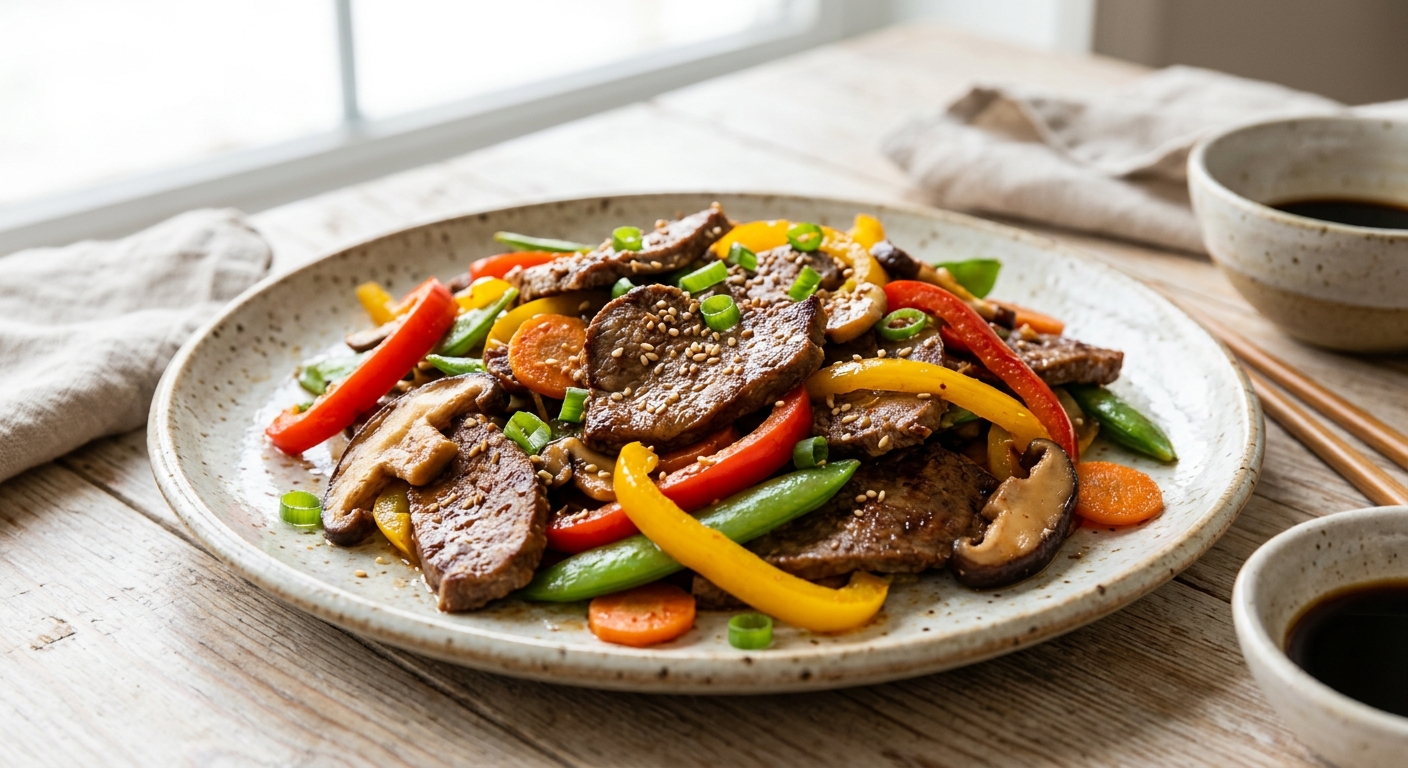
This stir-fry frames beef heart in the most approachable way possible: thin-sliced, marinated, and cooked hot and fast with vibrant bell peppers, broccoli, snap peas, and shiitake mushrooms. The result is a deeply savory, slightly smoky dish with tender meat and crisp-edged vegetables. The marinade, built on tamari, sesame oil, ginger, and garlic, helps tenderize the muscle fibers while layering in umami complexity that makes this dish genuinely craveable rather than medicinal.
Beyond CoQ10, beef heart is a nutritional tour de force. It delivers over 300% of the Daily Value for vitamin B12, more than 50% DV for zinc, and nearly 40% DV for iron per serving, all in a lean package with only 8g of fat. Paired with the antioxidant-rich vegetables in this recipe, you are simultaneously fueling the electron transport chain and protecting the mitochondria that rely on it. This is metabolic nutrition at its most delicious.
4
servings
Ingredients
- 600 gbeef heart, trimmed of fat and sinew, sliced 5mm thin against the grain
- 2 tbsptamari (gluten-free soy sauce)
- 1 tbsptoasted sesame oil
- 1 tbsprice vinegar
- 1 tbsparrowroot starch (or cornstarch)
- 2 tspfresh ginger, finely grated
- 3 clovesgarlic, minced
- 1 tspsmoked paprika
- 200 gbroccoli, cut into small florets
- 150 gred bell pepper, thinly sliced
- 150 gyellow bell pepper, thinly sliced
- 120 gsugar snap peas, strings removed
- 100 gshiitake mushrooms, stems removed, caps sliced
- 1 mediumred onion, halved and thinly sliced
- 2 tbspAvocado Oil100% Pure Avocado Oil (or other high-smoke-point oil)
- 3 tbsplow-sodium beef broth or water
- 1 tbspoyster sauce (ensure gluten-free if needed)
- 1 tspcoconut sugar or brown sugar
- 2 stalksscallions, sliced on the bias, for garnish
- 1 tsptoasted sesame seeds, for garnish
- —Colima Sea SaltMicroplastic Free Salt and black pepper to taste
Instructions
Click on an item below to shop for the recommended items for this recipe on Amazon.
As an Amazon Associate, we earn from qualifying purchases.
- Combine the tamari, sesame oil, rice vinegar, arrowroot starch, grated ginger, minced garlic, and smoked paprika in a medium bowl. Add the sliced beef heart and toss to coat evenly. Marinate at room temperature for 20 minutes while you prepare the vegetables.
- Mix the stir-fry sauce by stirring together the beef broth, oyster sauce, and coconut sugar in a small bowl. Set aside.
- Heat your wok or largest heavy skillet over the highest heat your stove allows for 2 full minutes until smoking. Add 1 tablespoon of avocado oil, swirling to coat. Working in two batches to avoid crowding, add half the marinated beef heart slices in a single layer. Sear without stirring for 90 seconds, then toss and cook for another 60 seconds until lightly charred at the edges and just cooked through. Transfer to a clean plate and repeat with the second batch. The heart should be slightly pink inside; overcooking will toughen it significantly.
- Reduce heat to medium-high. Add the remaining tablespoon of avocado oil to the wok. Add the red onion and shiitake mushrooms and stir-fry for 2 minutes until the onion is translucent and the mushrooms are golden at the edges.
- Add the broccoli florets and both colors of bell pepper. Stir-fry vigorously for 2 to 3 minutes until the broccoli is bright green and just tender with a slight bite. Add the snap peas and toss for 1 minute more.
- Pour the prepared sauce over the vegetables and toss everything together. Return all the seared beef heart to the wok, toss to combine, and cook for 30 to 45 seconds until the sauce thickens and glazes everything. Taste and adjust seasoning with salt and black pepper.
- Transfer to a warm serving platter. Garnish with sliced scallions and toasted sesame seeds. Serve immediately over steamed jasmine rice or cauliflower rice for a lower-carb option.
- Prepare the marinade as directed, but omit the arrowroot starch. Coat the beef heart slices (cut 8 to 10mm thick for this method) in the marinade and refrigerate for at least 20 minutes, or up to overnight for deeper flavor.
- Whisk together the sauce ingredients: tamari, beef broth, oyster sauce, coconut sugar, and sesame oil. Add the ginger, garlic, smoked paprika, and a pinch of black pepper. This combined liquid will serve as the braising medium.
- Place the red onion slices in an even layer on the bottom of the slow cooker insert. Lay the marinated beef heart slices on top, then pour the sauce over everything. Cover and cook on Low for 3 to 3.5 hours until the heart is tender when pierced with a fork but not falling apart.
- Add the shiitake mushrooms and broccoli florets to the slow cooker, gently pressing them into the liquid. Re-cover and continue cooking on Low for 45 minutes to 1 hour until the broccoli is tender.
- Add the bell pepper strips and snap peas during the final 20 minutes of cooking, placing them on top rather than submerging them, so they retain color and a gentle bite.
- Mix 1 tablespoon arrowroot starch with 2 tablespoons cold water to form a slurry. Remove the lid, increase the slow cooker to High, and stir in the slurry. Cook uncovered for 10 to 15 minutes, stirring once, until the sauce thickens to a glossy consistency.
- Garnish with scallions and sesame seeds before serving. Because the slow cooker method produces more liquid, this version pairs beautifully with steamed brown rice or soba noodles to absorb the extra sauce.
- Combine the full marinade including the arrowroot starch, ginger, garlic, sesame oil, tamari, rice vinegar, and smoked paprika. Coat the beef heart slices (cut 6 to 8mm thick) and marinate for 20 minutes.
- Select the Saute function on your Instant Pot and set it to High. Once the display reads HOT, add 1 tablespoon of avocado oil. Sear the marinated beef heart in two batches for 60 to 90 seconds per side until browned. Transfer to a plate. This step develops fond and adds significant flavor depth that pressure cooking alone cannot achieve.
- Add the red onion to the pot and saute for 1 minute, scraping up any browned bits from the bottom with a wooden spoon. This deglazing step is critical to preventing a burn warning. Pour in the beef broth, oyster sauce, and coconut sugar and stir to combine.
- Return the seared beef heart to the pot. Secure the lid and set the steam release valve to Sealing. Select Pressure Cook (Manual) on High for 8 minutes. Once cooking is complete, perform a quick release by carefully turning the valve to Venting.
- Remove the beef heart with tongs and set aside. Select Saute on High again. Add the shiitake mushrooms and broccoli and cook, stirring frequently, for 3 minutes. Add the bell peppers and snap peas and cook for 2 minutes more until everything is just tender and the sauce has reduced and thickened from the residual arrowroot.
- Return the heart to the pot, toss everything together for 30 seconds to coat in the sauce, and turn off the Saute function. Taste and adjust seasoning with salt and pepper.
- Serve immediately, garnished with scallions and sesame seeds. The pressure cooker method yields the most tender heart slices and is ideal for those who find the stovetop version slightly chewy.
- Preheat your oven to 230C (450F) with convection if available, or 240C (465F) conventional. Place two large rimmed baking sheets (each at least 45x30cm) in the oven while it preheats. Hot baking sheets are the key to caramelization rather than steaming.
- Prepare the marinade and coat the beef heart slices as directed, marinating for 20 minutes. While the heart marinates, toss the broccoli, bell peppers, red onion, and shiitake mushrooms separately with 1 tablespoon avocado oil and a pinch of salt.
- Carefully remove the preheated baking sheets from the oven using thick oven mitts. Working quickly, spread the marinated beef heart slices on one sheet in a single layer, leaving space between each piece. Spread the prepared vegetables (except snap peas) on the second sheet.
- Return both sheets to the oven. Roast the vegetables for 12 minutes, then add the snap peas to the vegetable sheet, toss gently, and continue roasting for another 8 minutes. The beef heart sheet cooks for a total of 10 to 12 minutes, flipping each slice at the halfway point. The heart is done when it has browned edges and reads 63C (145F) internally. Do not overcook.
- While the sheets are in the oven, combine the sauce ingredients (beef broth, oyster sauce, sesame oil, coconut sugar, and 1 teaspoon arrowroot starch) in a small saucepan over medium heat. Stir for 2 to 3 minutes until the sauce thickens to a light glaze consistency.
- Remove both sheets from the oven. Transfer all the roasted heart and vegetables to a large warm bowl. Pour the hot sauce over everything and toss to coat, ensuring every piece is glazed.
- Plate immediately and garnish with scallions and sesame seeds. The sheet pan method gives this dish the deepest caramelized flavor of all four methods and pairs especially well with steamed farro or quinoa.
Nutrition Breakdown
Per 1 serving (makes 4)
Vitamins & Minerals
% Daily Value based on a 2,000 calorie diet (FDA reference)
🧬 Essential Amino Acids
% of recommended daily intake (RDA) per serving
🛡 Antioxidant Profile
The Nutrition Science
Coenzyme Q10 is a fat-soluble quinone that sits at the heart of oxidative phosphorylation, the process by which your mitochondria convert nutrients into ATP. It shuttles electrons between Complex I and Complex III of the electron transport chain, and without adequate CoQ10, this process becomes inefficient, producing less energy and more damaging free radicals as a byproduct. While the body synthesizes CoQ10 endogenously, production declines with age starting around the mid-30s, and statin medications further suppress the mevalonate pathway that CoQ10 biosynthesis shares with cholesterol. Dietary CoQ10 from sources like beef heart provides the ubiquinol (reduced, active) form, which has superior bioavailability compared to the ubiquinone form found in most supplements.
The synergy between CoQ10 and the other nutrients in this dish is not incidental. Vitamin B2 (riboflavin) is a structural component of FADH2, which donates electrons to CoQ10 at Complex II. Iron is the central atom of the heme groups in the cytochromes (Complex III and IV) that accept electrons from CoQ10. Copper is essential for the function of cytochrome c oxidase (Complex IV), the final enzyme in the chain. In other words, nearly every key nutrient in this recipe plays a direct mechanistic role in the mitochondrial energy pathway that CoQ10 supports. This is whole-food synergy backed by biochemistry, not marketing language.
The vegetables in this stir-fry address the oxidative stress that comes with high metabolic output. Sulforaphane from broccoli activates the Nrf2 transcription factor, which switches on the genes for superoxide dismutase, catalase, and glutathione peroxidase, essentially boosting your body’s internal antioxidant defenses for 24 to 72 hours after a single serving. Meanwhile, the vitamin C from the bell peppers (one red bell pepper alone provides over 150% DV) regenerates oxidized vitamin E within cell membranes, creating a self-renewing antioxidant network that directly protects the mitochondrial membranes where CoQ10 does its work.
Pro Tips
- Ask your butcher to pre-trim the beef heart, but if doing it yourself, use kitchen scissors to remove the tough white connective tissue and any visible fat from the exterior. The inner chamber walls are already clean muscle and should be sliced directly.
- For the stovetop method, do not skip the batch-cooking step. Crowding the wok drops the surface temperature below the Maillard threshold (around 150C), and the meat will steam rather than sear, losing both texture and the caramelized flavor compounds that make this dish so satisfying.
- CoQ10 is fat-soluble, meaning it is absorbed significantly better when consumed with dietary fat. The avocado oil and sesame oil in this recipe are not just flavor components; they are absorption enhancers for the CoQ10 you are eating. Do not reduce the oil.
- Beef heart freezes exceptionally well. Buy a whole heart (typically 1.5 to 2kg), trim and slice the entire thing, and freeze in 150g portions. You will have four to five servings ready to thaw for a weeknight meal with minimal prep.
- If you are new to beef heart, marinating overnight in the refrigerator dramatically mellows any mineral or gamey notes. The rice vinegar in the marinade denatures surface proteins slightly, which also speeds up tenderization.
Love this combo! I’m curious how many different plant foods are making it into the veggie mix here, because pairing that CoQ10 powerhouse with maximum plant diversity could really amplify the whole mitochondrial support situation. Charlotte’s onto something with the absorption piece, but I’m wondering if there’s opportunity to sneak in even more variety, like maybe adding some brassicas for their sulfur compounds or some colorful roots for their unique polyphenol profiles alongside those greens. My last beef heart stir-fry landed me at 12 different plants and honestly it felt like I unlocked a whole new energy level, so I’m always hunting for that next plant to add!
Oh wow, beef heart for CoQ10 is such a smart move, especially for mitochondrial function! I’m curious though, are you pairing it with specific vegetables that enhance CoQ10 absorption? I’ve been researching whether adding magnesium-rich greens like spinach or chlorophyll-dense vegetables helps with nutrient bioavailability, since my thesis work shows that chlorophyll’s magnesium core might support better cellular energy utilization alongside CoQ10. Have you noticed any particular veggie combinations that seem to maximize the metabolic benefits?
oh man this is right up my alley, beef heart is absolute gold and that coq10 content is insane for cellular energy. ive been doing organ meats for like two years now and the difference in how i feel is night and day, especially energy wise. charlotte makes a great point about the greens too, though id also ask what the net carb count is on those veggies in the stir fry since thats where people sometimes slip up without realizing it. are you using any sauce that might sneak in hidden sugars? coq10 is fantastic but keeping blood sugar stable is what really cranks up metabolic function in my experience.