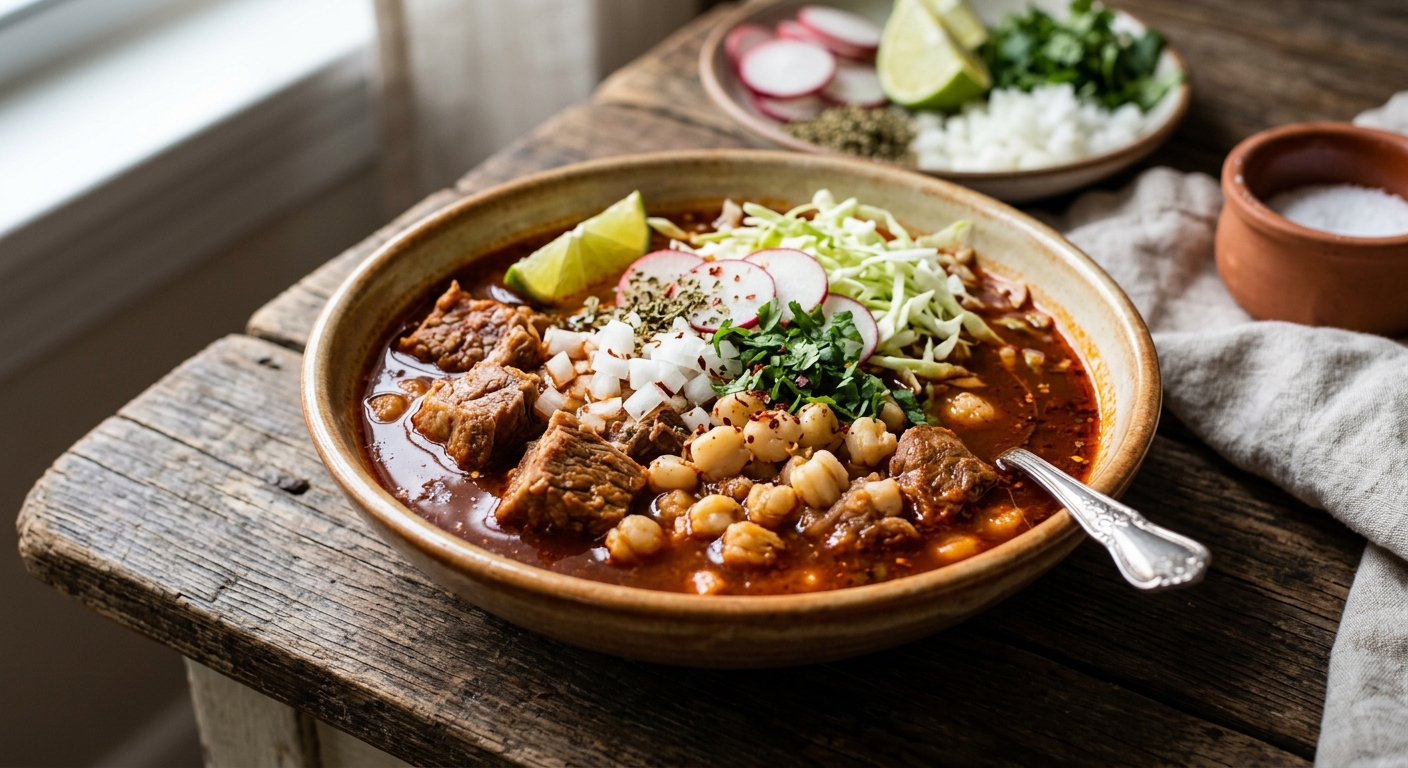
Pozole rojo is one of Mexico’s most celebrated ceremonial dishes, a soul-warming stew built from three foundational pillars: tender braised pork, chewy nixtamalized hominy corn, and a complex dried-chile broth that burns a deep, beautiful red. Long before modern nutrition science existed, indigenous Mesoamerican cooks had already engineered a meal of extraordinary nutritional completeness. The combination of pork and hominy is no accident. The nixtamalization process used to make hominy unlocks bound niacin in corn, while the pork shoulder contributes heme iron, the most bioavailable form of dietary iron available from food.
What sets this recipe apart from a simple comfort stew is the layering of three dried chiles: ancho, guajillo, and pasilla. Each brings its own flavor signature and its own antioxidant payload. Ancho chiles are among the richest dietary sources of capsanthin and beta-carotene, while guajillo chiles contribute measurable vitamin C that actively boosts the non-heme iron absorption from the hominy and chile solids. This is nutritional synergy that cooks have intuited for generations and that scientists can now quantify. A single generous serving of this pozole provides approximately 42% of the daily value for iron, 35% for zinc, and substantial folate, selenium, and B12 from the pork.
Across all three cooking methods below, the technique diverges meaningfully. The stovetop method allows you to build the deepest flavor through active maillard browning and careful layering of the broth. The slow cooker version leverages low, gentle heat to coax the pork into fall-apart tenderness while preserving the volatile aromatic compounds in the chiles. The pressure cooker method compresses hours of simmering into under an hour without sacrificing the silky, collagen-rich body of the broth. Choose your method based on your schedule, and know that each delivers a bowl of pozole rojo that is genuinely excellent.
6
servings
Ingredients
- 900 gbone-in pork shoulder, cut into 5cm chunks (bone reserved)
- 800 gcanned hominy (maiz pozolero), drained and rinsed
- 4 wholedried ancho chiles, stems and seeds removed
- 4 wholedried guajillo chiles, stems and seeds removed
- 2 wholedried pasilla chiles, stems and seeds removed
- 1 wholewhite onion, halved (one half quartered for broth, one half finely diced for serving)
- 8 clovesgarlic, peeled (6 for broth, 2 minced for chile sauce)
- 2 tspdried Mexican oregano
- 1 tspground cumin
- 0.5 tspground cinnamon
- 2 wholebay leaves
- 4 wholeblack peppercorns
- 1.5 literslow-sodium chicken or pork stock
- 2 tbspAvocado Oil100% Pure Avocado Oil (such as avocado or vegetable oil)
- 2 tbspapple cider vinegar
- —Colima Sea SaltMicroplastic Free Salt and black pepper to taste
- —Toppings: thinly sliced cabbage, sliced radishes, dried oregano, tostadas, lime wedges, sliced avocado, fresh cilantro
Instructions
Click on an item below to shop for the recommended items for this recipe on Amazon.
As an Amazon Associate, we earn from qualifying purchases.
- Build the pork broth first. Place the pork shoulder chunks, reserved bone, the quartered half-onion, 6 garlic cloves, bay leaves, and black peppercorns in a large Dutch oven. Cover with the stock and 500ml cold water. Bring to a boil over high heat, then skim the grey foam that rises to the surface for the first 5 to 8 minutes. This is critical for a clean, clear broth. Reduce heat to a steady low simmer, partially cover, and cook for 1 hour 30 minutes until the pork is nearly tender.
- While the pork simmers, toast the dried chiles. Heat a dry cast iron or heavy skillet over medium heat. Working in batches, press each chile flat against the hot surface with a spatula for 20 to 30 seconds per side until fragrant and slightly darkened. Do not let them burn or the broth will turn bitter. Transfer toasted chiles immediately to a bowl and cover with 600ml of boiling water. Soak for 20 minutes until fully softened.
- Blend the chile sauce. Drain the soaked chiles, reserving 200ml of the soaking liquid. Transfer chiles to a blender with the 2 minced garlic cloves, dried oregano, cumin, cinnamon, and apple cider vinegar. Blend on high for 90 seconds until completely smooth. Add reserved soaking liquid as needed to achieve a thick but pourable consistency. For the smoothest sauce, pass it through a fine-mesh strainer, pressing solids with a spoon.
- Fry the chile sauce to bloom its flavor. Heat 2 tablespoons of oil in a separate medium saucepan over medium-high heat until shimmering. Pour the strained chile sauce into the hot oil all at once. It will spatter vigorously, so stand back. Fry the sauce, stirring constantly, for 5 to 6 minutes until it darkens by two shades, thickens, and smells roasted rather than raw. This step is non-negotiable for authentic pozole rojo depth.
- Once the pork is nearly tender, remove the chunks with a slotted spoon and shred them coarsely, discarding the bone and any excess fat. Discard the bay leaves, peppercorns, and onion from the broth. Return the shredded pork to the Dutch oven. Add the rinsed hominy and the fried chile sauce. Stir well to combine. Season generously with fine sea salt.
- Bring the pot back to a gentle boil over medium heat, then reduce to a low simmer. Cook uncovered for 25 to 30 minutes, stirring occasionally, until the hominy has absorbed some of the chile broth and swelled slightly, and the broth has a cohesive, full-bodied flavor. Taste and adjust salt. Ladle into deep bowls and let each person garnish with cabbage, radishes, lime, avocado, cilantro, and tostadas.
- Toast and soak the chiles the night before, or at least 30 minutes before assembling. Toast each dried chile in a dry skillet over medium heat for 20 to 30 seconds per side until fragrant. Soak in 600ml boiling water for 20 minutes. Drain, reserving 150ml soaking liquid. Blend with 2 minced garlic cloves, oregano, cumin, cinnamon, and apple cider vinegar until very smooth, using reserved liquid to loosen. Strain through a fine-mesh sieve. Heat 2 tablespoons of oil in a skillet over medium-high heat and fry the chile paste, stirring constantly, for 5 to 6 minutes until darkened and fragrant. Let cool, then refrigerate overnight if preparing ahead.
- In the morning, season the raw pork shoulder chunks generously on all sides with salt and pepper. For best results, sear them in a hot oiled skillet over high heat for 2 to 3 minutes per side until deeply browned before adding to the slow cooker insert. This step is optional but adds substantial Maillard flavor that slow, gentle heat cannot generate on its own.
- Place the seared pork pieces and the reserved bone into the slow cooker insert. Add the quartered onion half, 6 whole peeled garlic cloves, bay leaves, and black peppercorns. Pour in the stock. Spoon in the entire fried chile sauce and stir gently to distribute it through the liquid. Place the lid on the slow cooker. Cook on Low for 7 to 8 hours, or on High for 4 to 5 hours, until the pork is completely tender and falling from the bone.
- When the cook time is complete, carefully remove the pork pieces and the bone using tongs. Discard the bone, bay leaves, peppercorns, and onion. Shred the pork coarsely with two forks, removing any large pockets of fat. Use a large spoon or a fat separator to skim excess rendered fat from the surface of the broth in the slow cooker insert.
- Return the shredded pork to the slow cooker. Add the drained and rinsed hominy. Stir to combine, replace the lid, and cook on High for a further 30 to 45 minutes until the hominy is heated through and has absorbed the flavors of the broth. Taste carefully and adjust salt. Serve directly from the slow cooker insert into deep bowls with all desired toppings.
- Set the Instant Pot or electric pressure cooker to Saute mode on High. Add the oil and let it heat for 2 minutes. Working in two batches to avoid crowding, brown the pork shoulder chunks on two sides, about 3 minutes per side, until a deep mahogany crust forms. Transfer browned pork to a plate. Add the quartered onion half directly to the pot and let it char slightly, about 2 minutes per side. This brief charring adds smoky sweetness to the broth without any additional time.
- While the pork browns, quickly toast the dried chiles in a dry skillet on the stovetop for 20 to 30 seconds per side. Soak in 500ml of boiling water for 15 minutes. Drain, reserving 100ml soaking liquid. Blend chiles with 2 minced garlic cloves, oregano, cumin, cinnamon, and apple cider vinegar until smooth. In the same dry skillet, heat 1 tablespoon of oil over medium-high heat and fry the blended chile sauce for 4 to 5 minutes until thickened and fragrant.
- Return all browned pork and any resting juices to the Instant Pot insert. Add the remaining 6 whole garlic cloves, bay leaves, peppercorns, fried chile sauce, and enough stock to reach the two-thirds fill line (approximately 1 to 1.2 liters). Stir briefly to combine. Secure the lid and set the pressure valve to Sealing. Select Pressure Cook on High Pressure and set the timer for 45 minutes.
- When the cook time finishes, allow the pressure to release naturally for 15 minutes, then carefully turn the valve to Venting to release any remaining steam. Open the lid away from you. Remove the pork pieces and bone. Discard the bone, bay leaves, peppercorns, and onion. Shred the pork with two forks. Skim visible fat from the broth surface with a spoon.
- Switch the Instant Pot back to Saute mode on Normal. Return the shredded pork to the pot and add the drained rinsed hominy. Stir to combine and simmer uncovered for 10 to 12 minutes until the hominy is heated through and the broth has tightened slightly. The higher heat of Saute mode helps re-concentrate the broth after pressure cooking. Taste, adjust salt, and serve immediately with all desired garnishes.
- Preheat your oven to 160C (325F) with the rack positioned in the lower third. Heat a large, oven-safe Dutch oven over high heat on the stovetop. Add the oil and, working in two batches, sear the pork shoulder chunks on two sides until deeply browned, about 3 minutes per side. Remove and set aside. Reduce heat to medium, add the quartered onion half cut-side down, and let it char without moving for 3 to 4 minutes. This caramelization layers a subtle sweetness into the broth.
- Toast and soak your chiles while the pork sears. Press each chile flat in the hot Dutch oven for 20 seconds per side before adding the pork, or use a separate dry skillet. Soak toasted chiles in 600ml boiling water for 20 minutes. Drain, reserving 150ml soaking liquid. Blend chiles with 2 minced garlic cloves, oregano, cumin, cinnamon, and apple cider vinegar until smooth. In a separate skillet, heat 1 tablespoon oil over medium-high heat and fry the chile paste, stirring constantly, for 5 minutes until thickened and deeply colored.
- Return the seared pork and any resting juices to the Dutch oven. Add the 6 whole garlic cloves, bay leaves, peppercorns, and the fried chile sauce. Pour in the full 1.5 liters of stock. The liquid should come at least two-thirds up the sides of the pork. Bring to a vigorous simmer on the stovetop, then cover the Dutch oven tightly with its lid. Transfer to the preheated oven.
- Braise in the oven for 2 hours 30 minutes to 2 hours 45 minutes, checking once at the 2-hour mark. The pork should be completely yielding when prodded with a fork and beginning to fall apart on its own. The sealed Dutch oven environment ensures the pork braises in its own steam and the stock simultaneously, creating an exceptionally silky, collagen-rich broth. Remove from the oven and allow to rest, lid on, for 10 minutes.
- Remove the pork pieces and bone from the Dutch oven. Place the pot on the stovetop over medium heat. Discard the bone, bay leaves, peppercorns, and onion. Shred the pork coarsely with two forks. Skim surface fat from the broth. Add the shredded pork and the drained rinsed hominy back to the Dutch oven. Simmer on the stovetop over medium heat for 20 to 25 minutes, uncovered, until the hominy has absorbed the broth flavors and swelled. Adjust salt, then serve.
Nutrition Breakdown
Per 1 serving (makes 6)
Vitamins & Minerals
% Daily Value based on a 2,000 calorie diet (FDA reference)
🧬 Essential Amino Acids
% of recommended daily intake (RDA) per serving
🛡 Antioxidant Profile
The Nutrition Science
The extraordinary iron density of pozole rojo comes from two complementary sources working in concert. Pork shoulder is one of the richest sources of heme iron, the form bound inside myoglobin and hemoglobin, which is absorbed at rates of 15 to 35% regardless of other dietary factors. The hominy and dried chile solids contribute non-heme iron, normally absorbed at a modest 2 to 8%, but the vitamin C naturally present in the guajillo and pasilla chiles reduces ferric iron (Fe3+) to ferrous iron (Fe2+) directly in the gut lumen, boosting non-heme absorption by up to threefold. This iron-enhancing mechanism is why serving pozole with a squeeze of fresh lime, which adds another 7 to 10mg of vitamin C per half lime, is not merely a flavor tradition but a nutritional one.
Nixtamalization, the alkaline lime-soaking process used to create hominy from dried corn, is one of the most consequential food preparation technologies in human history. Raw corn contains niacin (vitamin B3) in a bound form called niacytin, which the human digestive system cannot absorb. The calcium hydroxide used in nixtamalization hydrolyzes these bonds, releasing free niacin and dramatically improving the bioavailability of lysine and tryptophan. This is precisely why populations that adopted corn without adopting nixtamalization historically developed pellagra, the niacin-deficiency disease, while Mesoamerican populations eating nixtamalized corn for millennia did not. Each serving of this pozole delivers approximately 70% of the daily value for niacin, a figure that would be dramatically lower with unnixamalized corn.
The zinc content of this dish (approximately 64% DV per serving) deserves particular attention. Zinc from red meat has a bioavailability of roughly 25%, considerably higher than plant-based zinc sources, because pork does not contain the phytic acid that chelates zinc in legumes and grains and reduces its absorption. Zinc is required as a catalytic cofactor for over 300 human enzymes, including the superoxide dismutase antioxidant enzymes, DNA polymerase, and the insulin-processing enzyme carboxypeptidase. For individuals following a diet otherwise low in red meat, a bowl of pozole rojo is one of the most efficient single-meal vehicles for meeting zinc requirements available in traditional world cuisine.
Pro Tips
- Never skip frying the blended chile sauce in hot oil before adding it to the broth. This step, called ‘freir el mole’ in Mexican cooking, eliminates the raw, harsh edge of dried chiles and develops hundreds of Maillard flavor compounds that define authentic pozole rojo.
- Buy bone-in pork shoulder rather than boneless. The collagen and bone marrow released during long cooking add body, gelatin, and additional minerals (notably phosphorus and calcium) to the broth that boneless shoulder simply cannot replicate.
- Soak your dried chiles in boiling water for exactly 15 to 20 minutes. Under-soaking leaves them tough and incompletely flavored; over-soaking for more than 30 minutes can make the blended sauce slightly bitter as tannins leach from the seeds and skin.




omg this is so exciting because ive been wanting to make pozole but didnt realize the iron content was that significant! quick question though – are you using traditionally nixtamalized hominy or store-bought? im wondering if the nixtamalization process affects the bioavailability of that iron, and whether adding something like lime juice or a splash of vinegar at the end would help with absorption. my kids actually rejected pozole the first time i made it because the texture wasnt quite right, but i have a hunch if i pair it with some sprouted black beans on the side for that extra enzyme activation it might help them absorb more of those minerals and theyll actually enjoy it more!
omg yesss the nixtamalization question is so good! i’ve been tracking this too because the calcium in the traditional process actually worried me at first – but honestly the iron from the pork shoulder is what really carries this dish, especially if you’re using the darker chiles like guajillos or anchos which pack serious heme iron support. the store-bought hominy works totally fine nutritionally but i always add fresh lime juice and cilantro at the end because that vitamin c boost helps with the non-heme iron absorption from the chiles and hominy itself, makes a real difference in how your body actually uses it. have you tested your ferritin since eating more iron-rich meals like
Francesca nailed it on the vitamin C angle, that’s exactly what I tell my athletes who are working on iron status. The lime juice isn’t just flavor, it’s literally improving your DIAAS by helping with non-heme iron bioavailability, especially crucial since hominy’s iron comes with phytates that can inhibit absorption. I’d add that pork shoulder also brings that heme iron which doesn’t have those absorption barriers, so the combo of slow-braised pork plus guajillos plus citrus is actually a really smart mineral strategy in one bowl. Have you noticed any difference in your energy levels or recovery since you started tracking it this way?