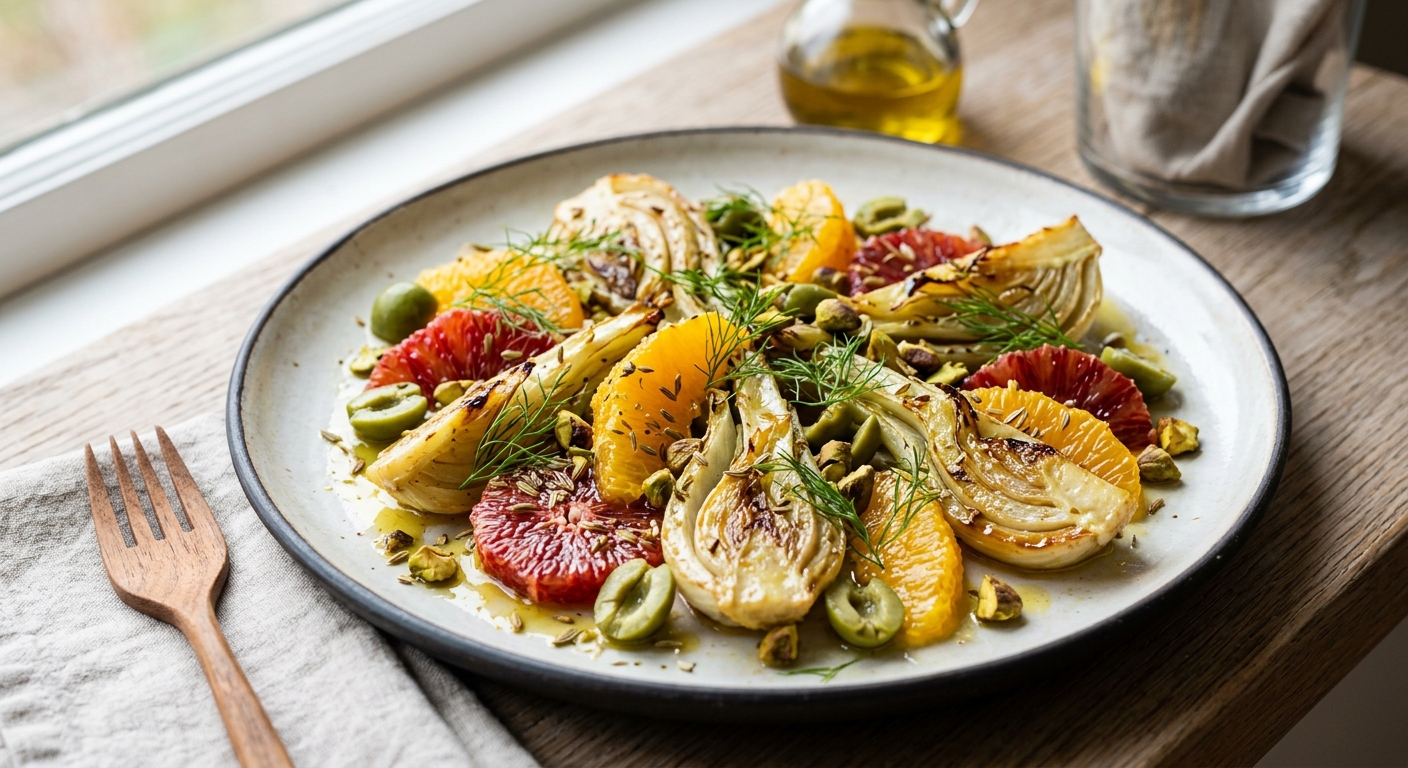
There is a moment in late winter when citrus is at its peak and the fennel at the market smells faintly of anise and cool earth, and that is precisely when this salad was born. Roasting fennel transforms it from a crisp, slightly sharp bulb into something silky, golden, and deeply sweet, with caramelized edges that carry a complexity no raw preparation can match. Layered over blood or navel oranges and scattered with plump green olives, toasted pistachios, and a shower of fresh tarragon, this is a salad that earns a permanent place in your rotation, not just because it tastes extraordinary but because of what it does for your body.
From an anti-inflammatory standpoint, this recipe is unusually well-engineered. Fennel contributes anethole, a phenylpropanoid compound shown in multiple studies to inhibit the NF-kB inflammatory signaling pathway. Oranges supply over 70 mg of vitamin C per serving along with hesperidin, a flavanone glycoside with clinically documented anti-inflammatory and vascular-protective activity. Extra-virgin olive oil ties everything together and brings its own arsenal: oleocanthal, whose ibuprofen-like COX inhibiting action has been demonstrated in peer-reviewed research, and oleic acid, which reduces pro-inflammatory eicosanoid production. Together these ingredients form a synergistic anti-inflammatory matrix, not a collection of isolated superfoods.
Despite carrying serious nutritional credentials, this dish requires no special equipment, no obscure pantry items, and no advanced technique. The oven does the heavy lifting while you prepare the citrus, and the whole salad comes together in under an hour. We have also developed slow cooker and pressure cooker versions for days when you want that same deep, yielding softness in the fennel but prefer a hands-off approach, and each method produces a genuinely distinct texture and flavor profile worth exploring in its own right.
4
servings
Ingredients
- 2 largefennel bulbs (approximately 700g total), stalks trimmed, fronds reserved, bulbs cut into 1.5cm wedges through the root
- 3 mediumnavel or blood oranges (approximately 480g total): 2 segmented (supremed), 1 juiced
- 100 gCastelvetrano olives, pitted and torn in half
- 40 gshelled roasted pistachios, roughly chopped
- 4 tbspextra-virgin olive oil, divided
- 1 tbspraw honey or maple syrup
- 1 tbspapple cider vinegar
- 2 tspfennel seeds, lightly crushed in a mortar
- 1 tspground turmeric
- 0.5 tspred chilli flakes (optional, for additional anti-inflammatory capsaicin)
- 60 gbaby arugula (rocket), washed and dried
- 15 gfresh tarragon leaves, roughly torn
- 20 gParmesan or Pecorino Romano, shaved with a vegetable peeler (optional, omit for vegan)
- —Colima Sea SaltMicroplastic Free Salt and freshly cracked black pepper to taste
Instructions
Click on an item below to shop for the recommended items for this recipe on Amazon.
As an Amazon Associate, we earn from qualifying purchases.
- Preheat your oven to 220C (425F) with a rack positioned in the upper third. Line a large rimmed baking sheet (or use two smaller sheets) with parchment paper. Crowding is the enemy of caramelization, so prioritize a single layer.
- In a large bowl, combine the fennel wedges with 2 tablespoons of olive oil, the crushed fennel seeds, ground turmeric, a generous pinch of sea salt, and several cracks of black pepper. Toss firmly so every cut surface is coated. Drizzle over 1 teaspoon of the honey and toss once more. The natural sugars will amplify browning through the Maillard reaction.
- Arrange the fennel wedges cut-side down on the prepared baking sheet in a single layer, leaving at least 2cm between each piece. Transfer to the preheated oven and roast for 18 minutes without disturbing them. This uninterrupted contact with the hot pan builds the caramelized crust.
- After 18 minutes, flip each wedge carefully using a thin spatula. Return to the oven for a further 10 to 14 minutes until the fennel is deeply golden on both sides, tender when pierced with a knife tip, and the edges show slight char. Remove and allow to cool on the pan for 5 minutes.
- While the fennel roasts, prepare the dressing by whisking together the fresh orange juice, apple cider vinegar, remaining 2 tablespoons of olive oil, remaining 2 teaspoons of honey, chilli flakes if using, a pinch of salt, and black pepper in a small bowl until emulsified. Taste and adjust seasoning.
- Supreme the two remaining oranges by cutting off the top and bottom, standing each on a cut end, and slicing away the peel and white pith in downward strokes following the curve of the fruit. Then cut along each membrane to release clean segments over a bowl to catch the juices. Add those extra juices to your dressing.
- To assemble, spread the arugula across a wide serving platter. Arrange the warm roasted fennel wedges over the top, then tuck the orange segments and torn olives among the fennel. Spoon the dressing evenly over the entire salad. Scatter the chopped pistachios and torn tarragon leaves over the top, add shaved Parmesan if using, and finish with the reserved fennel fronds for a visual flourish. Serve immediately while the fennel is still warm.
- Prepare the orange dressing first so it is ready to use: whisk together the juice of one orange, apple cider vinegar, 2 tablespoons of olive oil, remaining honey, chilli flakes if using, salt, and pepper until emulsified. Set aside. Supreme the remaining two oranges into segments as described, reserving any extra juice to add to the dressing.
- Place a large (30cm) cast iron skillet or heavy stainless steel pan over medium-high heat. Add 2 tablespoons of olive oil and heat until it shimmers and a small piece of fennel placed in the pan sizzles immediately. Do not use a nonstick pan here as the high heat needed for caramelization will damage the coating.
- Add the fennel wedges in a single layer, cut-side down. Do not move them. Season the top faces generously with salt, pepper, the crushed fennel seeds, and turmeric. Cook undisturbed for 7 to 9 minutes until the bottom faces are deep golden brown. Use a thin spatula to peek at the underside at the 7-minute mark.
- Flip each wedge to the second cut face. Drizzle the honey over the fennel. Cook for another 6 to 8 minutes. The honey will bubble and darken, glazing the cut surface beautifully. If the pan looks dry at any point, add a small splash (2 tablespoons) of water to prevent burning and help steam the interior of the thicker wedges to tenderness.
- Reduce heat to medium-low, flip the wedges onto their rounded outer side, and cover the pan with a lid for 4 to 5 minutes. This final steaming step ensures the fennel is fully tender in the center without burning the exterior. Remove the lid and allow any remaining moisture to evaporate for 1 minute. Transfer fennel to a platter, let rest for 3 minutes, then assemble the salad following the same final assembly step as the oven method: arugula base, warm fennel, orange segments, olives, dressing, pistachios, tarragon, and cheese if desired.
- In the slow cooker insert, whisk together the juice of all three oranges (reserving 1 tablespoon for the final dressing), apple cider vinegar, 2 tablespoons of olive oil, all of the honey, crushed fennel seeds, turmeric, chilli flakes if using, 1 teaspoon of salt, and generous black pepper. This braising liquid will infuse the fennel with brightness and heat over the long cook.
- Add the fennel wedges to the insert and toss gently to coat every surface with the braising liquid. Arrange them in as even a layer as possible. Because the slow cooker generates steam, the fennel will release its own liquid and braise rather than roast. Scatter the olives directly into the braising liquid as well as they will absorb flavor and soften slightly.
- Cover and cook on High for 3 to 4 hours or Low for 6 to 7 hours, until the fennel is completely tender when pierced with a knife and the braising liquid has reduced and thickened into a glossy, citrus-scented sauce. Do not lift the lid during cooking as this releases heat and extends cooking time significantly.
- Once the fennel is done, use a slotted spoon to transfer the wedges and olives to a platter. Increase the slow cooker to High (if not already there), leave the lid off, and allow the remaining braising liquid to reduce for 10 to 15 minutes into a concentrated dressing. Stir in the remaining 2 tablespoons of olive oil and the reserved 1 tablespoon of fresh orange juice to finish the sauce.
- Because the slow cooker method does not produce caramelization, optionally place the cooked fennel on a baking sheet and broil (grill) for 3 to 4 minutes at high heat to add some color and a light char. This step is optional but recommended for a more complex finish. Assemble the salad on a bed of arugula, spoon the reduced braising sauce over as the dressing, top with fresh orange segments, chopped pistachios, tarragon, cheese if desired, and reserved fennel fronds.
- Select the Saute function on your Instant Pot (or heat your stovetop pressure cooker over medium-high heat). Add 2 tablespoons of olive oil. Once shimmering, add the fennel wedges in batches, cut-side down, and sear for 2 to 3 minutes per side until lightly golden. Work in two batches rather than crowding the pot. This searing step is critical because pressure cooking alone produces no browning. Transfer seared fennel to a plate.
- Add to the pot the juice of one orange, apple cider vinegar, 2 tablespoons of water, honey, crushed fennel seeds, and turmeric, scraping up any browned bits from the bottom with a wooden spoon. This deglazing step also prevents the burn warning on the Instant Pot by ensuring no dry fond remains.
- Return all the fennel wedges to the pot in an even layer. Secure the lid, set the pressure release valve to Sealing, and cook on High Pressure for 4 minutes. The fennel will become fully tender under pressure in a fraction of the time of other methods. While pressure builds, supreme your two oranges into segments and set aside.
- Once the cook time ends, perform a Quick Release by carefully moving the valve to Venting. Open the lid away from you. The fennel should be fork-tender. Transfer the fennel to a plate. Select Saute again and reduce the cooking liquid in the pot for 3 to 4 minutes until syrupy. Stir in the remaining 2 tablespoons of olive oil, chilli flakes if using, and the juice from the reserved orange supreming. Season to taste.
- Assemble immediately: spread arugula on a platter, arrange the pressure-cooked fennel and scattered olives on top, tuck in orange segments, and spoon the reduced sauce generously over everything. Top with chopped pistachios, torn tarragon, shaved cheese if desired, and fennel fronds. Because the pressure cooker method produces the most delicate fennel texture, handle the wedges gently during plating to keep them intact.
Nutrition Breakdown
Per 1 serving (makes 4)
Vitamins & Minerals
% Daily Value based on a 2,000 calorie diet (FDA reference)
🧬 Essential Amino Acids
% of recommended daily intake (RDA) per serving
🛡 Antioxidant Profile
The Nutrition Science
The anti-inflammatory effect of this salad is not the result of any single ingredient but of synergistic bioactive compounds that operate across multiple inflammatory pathways simultaneously. Anethole, the main phenylpropanoid in fennel, has been shown in cell and animal studies to suppress NF-kB, the master transcription factor that controls the expression of inflammatory genes including TNF-alpha, IL-6, and COX-2. Meanwhile, the hesperidin and narirutin flavanones in oranges work downstream, inhibiting the arachidonic acid cascade that generates prostaglandins and leukotrienes. Extra-virgin olive oil’s oleocanthal then delivers a third layer of inhibition by directly binding to and blocking both COX-1 and COX-2 enzyme active sites, the same mechanism used by non-steroidal anti-inflammatory drugs. This convergence on multiple targets simultaneously is precisely what makes dietary anti-inflammatory strategies more sustainable and less likely to produce the side effects associated with pharmaceutical intervention.
The vitamin C content in this dish, approximately 70 mg per serving, deserves particular attention. Beyond its classical role as a free radical scavenger, vitamin C participates in the enzymatic regeneration of alpha-tocopherol (vitamin E) in cell membranes, meaning the monounsaturated fats in the olive oil and pistachios are actively protected from lipid peroxidation by the vitamin C arriving from the oranges in the same dish. This fat-soluble and water-soluble antioxidant cooperation is a powerful example of food synergy that cannot be replicated by supplementing each compound in isolation. The fat in this recipe also substantially increases the bioavailability of fat-soluble carotenoids like beta-carotene from the arugula and orange peel, with research suggesting up to a threefold increase in absorption when carotenoids are consumed alongside dietary fat.
Turmeric adds curcumin to the equation, but its role here is modest given the small quantity used. What curcumin does at a culinary dose is prime the AMPK metabolic sensing pathway, which in turn downregulates mTOR signaling, a driver of inflammatory gene expression. The fennel seeds contribute rosmarinic acid and additional flavonoids that synergize with curcumin’s activity. Arugula and tarragon round out the polyphenol profile with glucosinolates and flavonols respectively, making this one of the most phytochemically dense salads achievable from readily available supermarket ingredients.
Pro Tips
- Do not skip resting the roasted fennel for 5 minutes before plating. Residual heat continues cooking and the sugars set into a lacquer-like glaze that will smear if you plate too early.
- For the richest anti-inflammatory benefit, use a robust, peppery extra-virgin olive oil (look for Coratina, Koroneiki, or Picual varietals on the label). These cultivars are highest in oleocanthal and oleacein.
- Blood oranges, in season from December through March, dramatically increase the visual impact and contribute additional anthocyanins (the pigments responsible for the red color) that provide their own antioxidant and anti-inflammatory activity beyond what navel oranges deliver.
- If making the slow cooker or pressure cooker version ahead of time, store the braised fennel and reduced liquid separately from the arugula, oranges, herbs, and pistachios. Assemble no more than 15 minutes before serving to prevent the greens from wilting in the warm dressing.
- Crushing the fennel seeds lightly rather than grinding them to a powder releases their volatile oils gradually during cooking, resulting in a more nuanced, layered anise flavor rather than an overwhelming hit at the start.
Good catch, Melanie. Roasting fennel at standard temps (400-425F) actually preserves most of the C since you’re hitting it hard and fast rather than slow-cooking it to death. The real win here though is the caramelization unlocks more bioavailable polyphenols in the bulb itself, which synergizes with the raw orange’s ascorbic acid. For post-race specifically, I’d squeeze fresh lemon over the whole thing right before eating to protect any heat loss and boost absorption via the citric acid pairing, plus the immediate vitamin C hit your body’s asking for.
Love this question, Melanie, because it shows you’re thinking like a real nutritionist about your recovery nutrition. The heat does reduce some vitamin C, but here’s what gets me excited about this particular preparation: roasting fennel actually increases the availability of its quercetin and other flavonoids, which work synergistically with that remaining C to reduce exercise-induced inflammation way more effectively than raw fennel would. I’ve seen athletes get better results pairing roasted cruciferous and allium veggies with citrus post-workout than with raw salads, so you might be onto something with how your body is responding to the caramelization factor.
ok this is calling my name bc vitamin c is huge for collagen repair after long runs and i’ve been experimenting with post-race anti-inflammatory meals. my question though – how does the roasting affect the vit c content? i know heat can degrade it but that caramelization sounds incredible and im wondering if the flavor payoff is worth any nutrient loss, or if theres a sweet spot temp/time wise that preserves most of it? also dying to know if this holds up as a next-day recovery lunch or if its better fresh, bc i could totally see this being part of my race week prep rotation.